
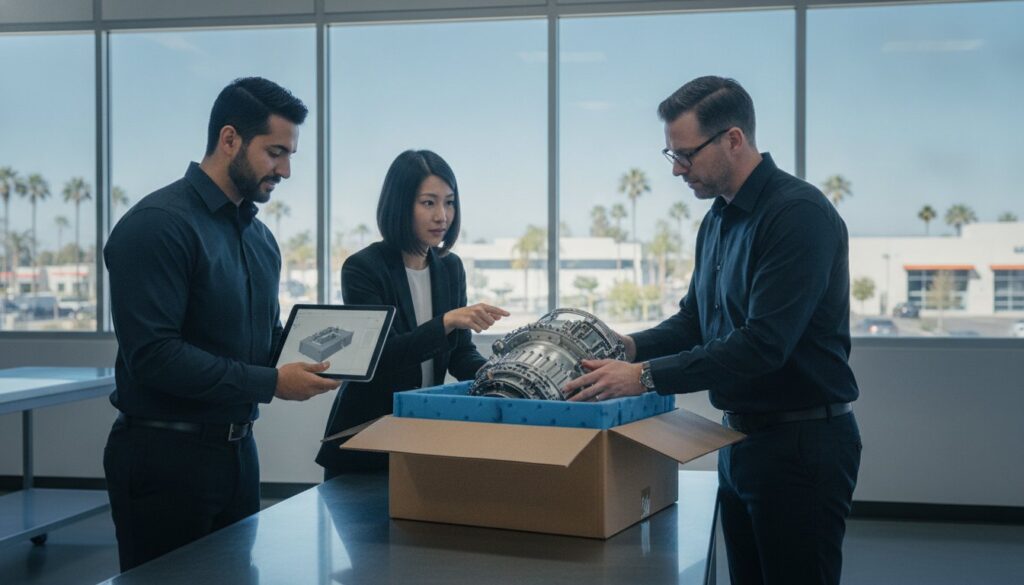
In 2026, industrial packaging in Southern California is no longer just a procurement line item; it is a critical pillar of your manufacturing profitability. You already know that every minute spent managing shipping damage or navigating warehouse clutter from excess corrugated inventory is a direct hit to your bottom line. Long lead times from non-local suppliers only compound these inefficiencies, leaving your production schedule vulnerable to avoidable delays.
This guide explains how implementing custom packaging solutions in Orange County through engineered inserts and integrated supply chain services can eliminate transit losses and optimize your floor space. We will examine how local vendor-managed inventory programs and compliance with new California recycling laws, such as SB 54 and SB 343, provide a competitive edge for aerospace and medical device manufacturers. You will discover how to move beyond basic commodity purchasing toward a strategy that prioritizes zero-damage shipping and reduced labor costs through professional kitting and assembly.
Key Takeaways
- Learn why scaling manufacturing profitably requires moving from standard containers to custom packaging solutions in Orange County that prioritize asset protection.
- Understand the technical applications of single, double, and triple-wall corrugated materials to match packaging strength with specific product weight and fragility.
- Discover how Vendor Managed Inventory (VMI) programs eliminate warehouse clutter and ensure just-in-time delivery for high-volume Southern California production runs.
- Identify how local kitting and assembly services reduce labor costs and streamline the preparation of complex medical and aerospace shipping kits.
Scaling Manufacturing with Custom Packaging in Orange County
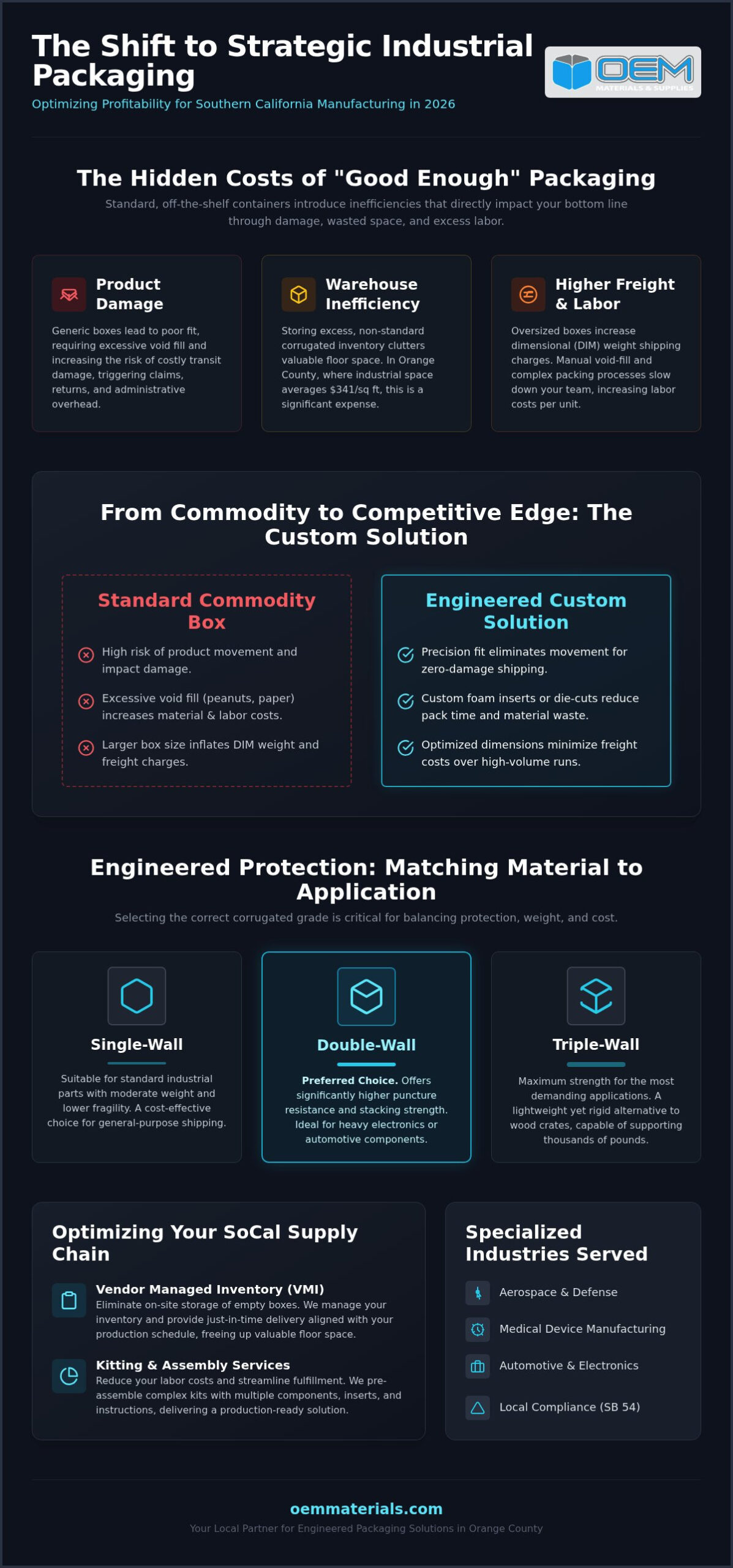
Industrial production in Southern California has reached a point where logistics efficiency determines market survival. With industrial vacancy rates in Orange County hovering around 5.1% in early 2026, every square foot of your facility must be dedicated to production rather than storing empty boxes. Standard shipping containers often fail because they are designed for general commodities, not the high-precision components manufactured in Irvine or Anaheim. These off-the-shelf options lead to excessive void fill, increased dimensional (DIM) weight, and a higher risk of transit damage. By utilizing custom packaging solutions in Orange County, manufacturers can protect sensitive assets while simultaneously optimizing their operational footprint.
The 2026 landscape demands a shift from commodity buying to strategic engineering. Adhering to strict packaging and labeling standards is essential for compliance, especially as California regulations like SB 54 and SB 343 redefine material requirements. A local partner provides the technical oversight needed to balance material durability with these evolving environmental mandates. This proximity ensures that your packaging evolves alongside your product design, preventing the delays associated with non-local suppliers who don’t understand the specific logistical pressures of the SoCal corridors.
The Economic Impact of Proper Industrial Packaging
The true cost of a shipping container isn’t the price per unit; it’s the total cost of the delivery cycle. Shipping damage doesn’t just result in a lost part. It triggers salvage labor, administrative overhead for claims, and potential hits to your contract standing. Engineered packaging reduces these hidden expenses by ensuring a precise fit for every component. Custom dimensions also play a vital role in freight cost control. Since carriers charge based on the space a package occupies, reducing a box size by even an inch can lead to substantial savings over high-volume production runs. Additionally, custom inserts and kitting services improve labor throughput. When a packing station operator has a perfectly fitted foam insert, assembly time drops, allowing your team to move more product through the dock each shift.
Orange County as a Manufacturing Hub
The industrial corridors stretching through Irvine, Anaheim, and Costa Mesa form the backbone of California’s high-tech economy. These areas host dense clusters of aerospace, medical device, and automotive electronics firms that require specialized protection. Proximity to your supplier is a primary defense against supply chain volatility. When your packaging partner is local, you can implement just-in-time delivery models that align with your daily production schedule. This is particularly critical in a market where industrial real estate averages $341 per square foot. You can’t afford to use your expensive floor space as a warehouse for packaging materials. Local custom packaging solutions in Orange County allow for rapid prototyping and immediate adjustments, ensuring that your medical or aerospace components are always shielded by the most current engineering standards.
Engineered Protection: Beyond the Standard Corrugated Box
Engineered packaging is the application of material science to mitigate the specific risks of the transit environment. It moves beyond simply containing a product to actively shielding it from vibration, compression, and impact. For manufacturers seeking custom packaging solutions in Orange County, this process begins with a fragility assessment to determine the G-force tolerance of the component. Once the technical requirements are established, we select the appropriate corrugated grade to ensure structural integrity during stacking and handling.
Corrugated materials are categorized by their wall construction. Single-wall board is suitable for standard industrial parts with moderate weight. Double-wall corrugated offers significantly higher puncture resistance and stacking strength, making it the preferred choice for heavy electronics or automotive components. For the most demanding applications, triple-wall corrugated provides a lightweight yet incredibly rigid alternative to timber, often capable of supporting thousands of pounds of downward pressure. Integrating these materials with die-cut inserts ensures repeatable assembly on your production line, eliminating the variability and waste associated with manual void-fill methods.
Custom Foam Packaging and Inserts
Selecting the right foam requires an understanding of density and Indentation Load Deflection (ILD). Polyethylene (PE) foam is a closed-cell material known for its durability and moisture resistance. It’s ideal for cushioning heavy or sharp-edged parts that would otherwise crush softer materials. In contrast, Polyurethane (PU) is an open-cell foam that provides a gentler cushion for lightweight, highly sensitive items. For engineers, the ILD rating is critical; it measures the firmness of the foam and determines how much weight the material can support before it bottoms out. In the electronics sector, antistatic foam is a requirement to prevent electrostatic discharge from damaging sensitive circuit boards during shipment. If you’re unsure which material fits your specific part geometry, requesting a packaging review can help identify the most cost-effective protection level.
Heavy-Duty Crating and Pallet Solutions
When a product’s weight or dimensions exceed the limits of corrugated board, custom wood crates become the primary solution. These are engineered to handle high-value machinery and oversized industrial equipment. For companies exporting goods through the Port of Los Angeles or San Diego, all wood packaging must meet ISPM 15 standards to prevent the spread of timber pests. This involves certified heat treatment and official stamping to clear international customs. In cleanroom environments, such as those found in medical device manufacturing, heavy-duty plastic pallets are often preferred over wood. They are non-porous, easy to sanitize, and don’t produce the dust or splinters that can contaminate a sterile field. While industrial goods often follow different paths than consumer items, manufacturers in the health sector must also remain aware of relevant FDA packaging regulations when their components interact with sensitive materials.
Industry-Specific Packaging Requirements in Southern California
Orange County’s manufacturing sector is defined by its extreme specialization. General-purpose packaging often fails to meet the stringent technical requirements of the Irvine medical device hub or the aerospace corridor in Huntington Beach. When sourcing custom packaging solutions in Orange County, a one-size-fits-all approach increases the risk of regulatory non-compliance and mechanical failure. Our focus is on translating your engineering blueprints into functional protection that survives the rigors of the Southern California logistics network. This requires a deep understanding of how different industries interact with the regional supply chain.
Medical Device and Life Science Packaging
Precision is the baseline for medical device logistics. Manufacturers in the Irvine corridor require sterile packaging kits that integrate multiple components into a single, organized unit. This requires expert kitting and assembly services where each part is secured in a custom-cut foam insert to prevent any surface abrasion or movement. These kits are often designed for just-in-time delivery to surgical centers, meaning the packaging must be as efficient to open as it was to pack. Beyond physical protection, these systems must support rigorous tracking and regulatory compliance throughout the supply chain. For biological materials, we integrate temperature-controlled solutions that maintain thermal stability during regional distribution between San Diego and Los Angeles.
Aerospace and Defense Logistics
Aerospace logistics involve high-value, low-volume components that require extreme protection. Turbine parts and precision avionics cannot tolerate even microscopic surface scratches or alignment shifts. We design custom cushioning systems that exceed standard industrial requirements, often utilizing multi-density foam layers to absorb high-frequency vibrations during transport. Defense contractors also require MIL-SPEC packaging compliance, ensuring that every wood crate and corrugated box meets specific government durability standards. For oversized machinery, engineered wood crates provide the structural foundation needed for safe transport. Our rapid prototyping capabilities allow aerospace engineers to test these designs against actual part dimensions before committing to high-volume production.
The semiconductor and electronics sectors in the OC tech corridor face unique challenges with electrostatic discharge. The focus here is on the integrated packaging system. This includes the use of custom corrugated boxes treated with conductive coatings and precise internal partitioning to maximize density without sacrificing protection. Automotive component manufacturers also rely on these systems for regional distribution. High-volume durability is essential for protecting heavy metal parts during frequent loading and unloading cycles across the Inland Empire and Orange County. By utilizing edge protectors and high-performance stretch film, we ensure that even the heaviest automotive loads remain stable and secure throughout the journey.
Optimizing Supply Chains: VMI and Kitting Services in OC
Operational efficiency in 2026 relies on minimizing the footprint of non-production materials. For manufacturers in Southern California, where industrial building prices average $341 per square foot, using valuable floor space to store stacks of empty corrugated boxes is a strategic error. Vendor Managed Inventory (VMI) solves this by shifting the responsibility of stock maintenance from your procurement team to your supplier. By utilizing custom packaging solutions in Orange County that include a VMI component, you ensure that shipping supplies are available exactly when needed without over-committing your warehouse capacity.
This model integrates directly with your production flow or ERP system. Instead of placing manual orders and tracking lead times, your partner monitors your usage and replenishes stock based on pre-set thresholds. This “Just-in-Time” delivery approach is essential for maintaining high-volume production in a market with a 5.1% industrial vacancy rate. It allows you to dedicate your facility to revenue-generating manufacturing while we manage the logistics of your protective materials.
The Benefits of Packaging Kitting
Kitting transforms packaging from a collection of individual parts into a single, production-ready unit. A complete packaging kit typically includes the outer corrugated box, custom foam inserts, edge protectors, and any necessary cushioning materials, all delivered as a single SKU. This approach significantly reduces the number of touchpoints in your packing process. Your assembly line workers no longer need to hunt for disparate components across multiple pallets. Instead, they receive a pre-assembled kit that is ready for the product. This streamlined workflow improves throughput and reduces internal labor costs, as the time spent on secondary assembly is virtually eliminated. Local manufacturers who switch to integrated kitting often find they can reallocate labor to more technical assembly tasks.
Implementing a VMI Program
A successful VMI program begins with a technical audit of your annual usage and production cycles. We establish min/max inventory levels for every item, from custom foam inserts to heavy-duty stretch film. Automated replenishment ensures you never face a stock-out of critical supplies, which is a common risk when relying on non-local vendors with long transit times. The financial structure of VMI also provides a significant cash flow benefit. You typically pay for packaging as you use it, rather than tying up capital in months of idle inventory. This partnership model turns your packaging supplier into a logistical extension of your own team. To see how these services can streamline your specific operation, contact us for a supply chain review and inventory assessment.
Selecting an Industrial Packaging Partner in Orange County
Industrial procurement is a balance of technical precision and logistical reliability. When evaluating a manufacturer for custom packaging solutions in Orange County, you must look for a partner capable of acting as an extension of your engineering team. Price is always a factor, but the true value lies in a supplier’s ability to reduce your total cost of ownership through better design and inventory management. A strategic partner should offer a local presence in Southern California, ensuring that lead times remain short and communication stays direct. This proximity is your best defense against the volatility of the global supply chain.
Scalability is another non-negotiable criterion. Your supplier must have the capacity to support you from the initial R&D phase through high-volume production. This requires a facility equipped for both rapid prototyping and large-scale corrugated runs. OEM Materials & Supplies serves as a strategic choice for SoCal OEMs because we bridge the gap between technical design and industrial-scale manufacturing. We understand that a delay in packaging is a delay in your shipping schedule. Our local logistics network is specifically optimized for the speed of the Orange County tech and aerospace corridors.
The Design and Prototyping Process
Effective protection begins with a technical design phase. We translate your product’s CAD drawings into precise packaging blueprints, selecting materials like polyethylene foam or double-wall corrugated board based on your part’s fragility. Once the design is finalized, we produce physical samples for your team to inspect. This stage is critical for verifying the fit of custom inserts and ensuring repeatable assembly on your line. You don’t want to discover a fitment issue when the first thousand units are sitting on the dock.
Testing is a core component of this process. We look at how your assets respond to drop impacts and high-frequency vibrations. These protocols allow us to refine the packaging, often finding opportunities to reduce material volume without compromising safety. This refinement doesn’t just protect the product; it lowers your shipping costs by optimizing the box dimensions for carrier requirements. Every inch removed from a custom box can lead to significant savings in dimensional weight charges over a long production run.
Next Steps for Your Packaging Strategy
Transitioning from generic, off-the-shelf containers to custom-engineered solutions is a proven way to stabilize your supply chain. The first step is a comprehensive packaging audit. This review examines your current damage rates, material waste, and labor touchpoints to identify where custom corrugated or kitting services can provide the most impact. Results depend on specific variables like your product’s weight and your primary shipping methods, so a tailored approach is essential.
To facilitate an accurate recommendation, please be prepared to provide data points such as product dimensions, weight, fragility ratings, and annual usage. This information allows us to engineer a solution that meets your specific technical and budgetary goals. To start this process, Contact OEM Materials for a Custom Quote and schedule a review of your current shipping requirements. Our team will help you move toward a more efficient, zero-damage logistics model.
Future-Proofing Your Southern California Logistics
Industrial packaging in 2026 is a technical discipline that directly impacts your profit margins. Shifting from standard containers to engineered protection prevents transit damage and lowers dimensional weight. For manufacturers in the aerospace and medical device sectors, these efficiencies are essential for maintaining rigorous quality standards while adhering to California’s evolving regulatory landscape. Adopting a strategic approach to your shipping materials ensures that your logistics remain a competitive advantage rather than a recurring cost center.
OEM Materials & Supplies has served Southern California manufacturers for decades, providing the technical expertise required for high-spec applications. Our full VMI and kitting capabilities ensure your supply chain remains resilient and your warehouse space is used for production rather than storage. We are ready to help you implement a logistics strategy that prioritizes speed and precision across your entire distribution network.
To identify specific savings in your current workflow, Request a Custom Packaging Audit for Your OC Facility. Please provide your product dimensions, weight, fragility requirements, and annual usage so our engineers can recommend the most effective custom packaging solutions in Orange County for your operation. We look forward to building a reliable partnership with your team.
Frequently Asked Questions
What is the typical lead time for custom corrugated boxes in Orange County?
Lead times for custom corrugated boxes depend on the order volume and design complexity. Local manufacturing allows for faster turnaround compared to out-of-state vendors, as transit times within Southern California are minimal. Most standard industrial runs are scheduled to align with your production cycles, ensuring that packaging is available when your manufacturing team needs it. For urgent requirements, our proximity to the Irvine and Anaheim corridors enables a more responsive delivery schedule than non-local suppliers.
How do I determine which foam density is right for my product?
Foam density is determined by the weight, geometry, and fragility of your specific component. Heavier parts with sharp edges typically require high-density Polyethylene (PE) foam for structural support and puncture resistance. Fragile, lightweight items often perform better with lower-density Polyurethane (PU) foam, which provides a softer cushion. We evaluate the Indentation Load Deflection (ILD) to ensure the material provides sufficient protection without bottoming out during the vibrations of transit.
Can you help with ISPM 15 certification for international shipping?
We provide wood crates and pallets that meet ISPM 15 heat treatment standards for international export. This certification is mandatory for all wood packaging moving through the Port of Los Angeles or the Port of Long Beach to prevent the spread of timber pests. Every crate is stamped with the official mark to ensure it clears international customs. This process prevents the quarantine delays or fines that can occur with non-certified wood packaging.
What are the minimum order quantities for custom die-cut foam inserts?
Minimum order quantities for custom die-cut foam inserts vary based on the material type and the complexity of the required tooling. We support both short-run prototyping for R&D and high-volume production for established manufacturing lines. Because we focus on industrial custom packaging solutions in Orange County, we scale our production capabilities to match your specific annual usage and delivery requirements rather than forcing a one-size-fits-all volume.
How does Vendor Managed Inventory (VMI) reduce my warehouse costs?
Vendor Managed Inventory (VMI) reduces warehouse costs by shifting stock storage and management responsibilities to our facility. With Orange County industrial real estate averaging $341 per square foot in early 2026, you can reallocate your floor space for revenue-generating manufacturing instead of packaging storage. We monitor your inventory levels and provide just-in-time replenishment. This ensures you only pay for materials as they are consumed, improving your cash flow and operational efficiency.
Do you offer antistatic packaging for electronic components?
We offer a full range of antistatic packaging, including pink Polyethylene foam and conductive corrugated materials. These solutions are engineered to dissipate electrostatic discharge that can damage sensitive semiconductors and circuit boards during handling. For the OC tech sector, we integrate these materials into custom kits to provide both physical protection and electrical shielding. This dual-layer protection is essential for maintaining the integrity of high-value electronic components throughout the supply chain.
Can you provide assembly and kitting services at your facility?
We provide integrated assembly and kitting services to streamline your production line operations and reduce internal labor costs. Our team can pre-assemble complex packaging kits, including boxes, custom foam inserts, and edge protectors, delivering them as a single SKU to your dock. This reduces the number of touchpoints in your facility. Your workers no longer need to source disparate components, allowing them to focus on the technical assembly of your products.
What is the difference between single-wall and double-wall corrugated cardboard?
Single-wall corrugated consists of one layer of fluted medium between two flat liners, which is suitable for standard industrial shipping. Double-wall corrugated adds a second layer of fluting and an additional liner, significantly increasing stacking strength and puncture resistance. Double-wall is the preferred choice for heavy components or high-value assets that require superior structural integrity. It provides the necessary durability for palletized stacking in high-volume distribution environments.