

A single electrostatic discharge, far too small for a human to feel, can silently compromise a high-value circuit board long before it ever reaches your customer. For procurement managers and engineers across Southern California, managing these invisible risks is a constant struggle against latent component failure and rising return rates. You understand that the cost of improper protection isn’t just the price of a replacement part; it’s the long-term damage to your brand’s reputation for reliability. Choosing the right anti-static packaging for electronics requires more than just picking a pink bag from a catalog. It demands a technical understanding of how different materials interact with sensitive components throughout the entire supply chain.
This guide provides a clear framework for selecting the correct ESD protection levels to eliminate product damage in your logistics cycle. We will examine the functional differences between dissipative, conductive, and shielding materials to help you establish a standardized packaging protocol for various sensitivity levels. By the end of this article, you’ll have the knowledge needed to coordinate with local suppliers for just-in-time delivery while ensuring every shipment from Orange County to San Diego arrives fully functional and defect-free.
Key Takeaways
- Identify the critical differences between catastrophic and latent failures to prevent hidden defects in your supply chain.
- Learn how to differentiate between dissipative and shielding materials when selecting the most effective anti-static packaging for electronics.
- Apply specific packaging protocols for sensitive components, including the use of Faraday cage effects for printed circuit boards and integrated circuits.
- Construct a robust protection stack using anti-static foam and specialized corrugated boxes to mitigate both physical shock and electrostatic discharge.
- Streamline your procurement process by leveraging local Southern California supply chains and Vendor-Managed Inventory programs to reduce lead times.
Understanding Electrostatic Discharge in Industrial Logistics
Electrostatic Discharge (ESD) is the rapid, spontaneous transfer of electrostatic charge between two bodies at different potentials. In an industrial logistics environment, this usually occurs when a sensitive electronic component comes into contact with or is in close proximity to a charged surface. Semiconductors are particularly vulnerable because their internal circuits are microscopic. A discharge that a human cannot even feel can easily melt internal silicon pathways or punch holes through thin gate oxides.
Standard packaging materials often exacerbate this problem through triboelectric charging. When two materials rub together and then separate, electrons are transferred, leaving one surface with a positive charge and the other with a negative charge. Standard poly bags and traditional foam packaging are notorious for generating thousands of volts of static during transit. Even the friction between a circuit board and standard corrugated boxes can generate enough charge to cause damage. Without specialized anti-static packaging for electronics, your supply chain becomes an environment where every vibration or shift in a shipping container creates a potential discharge event.
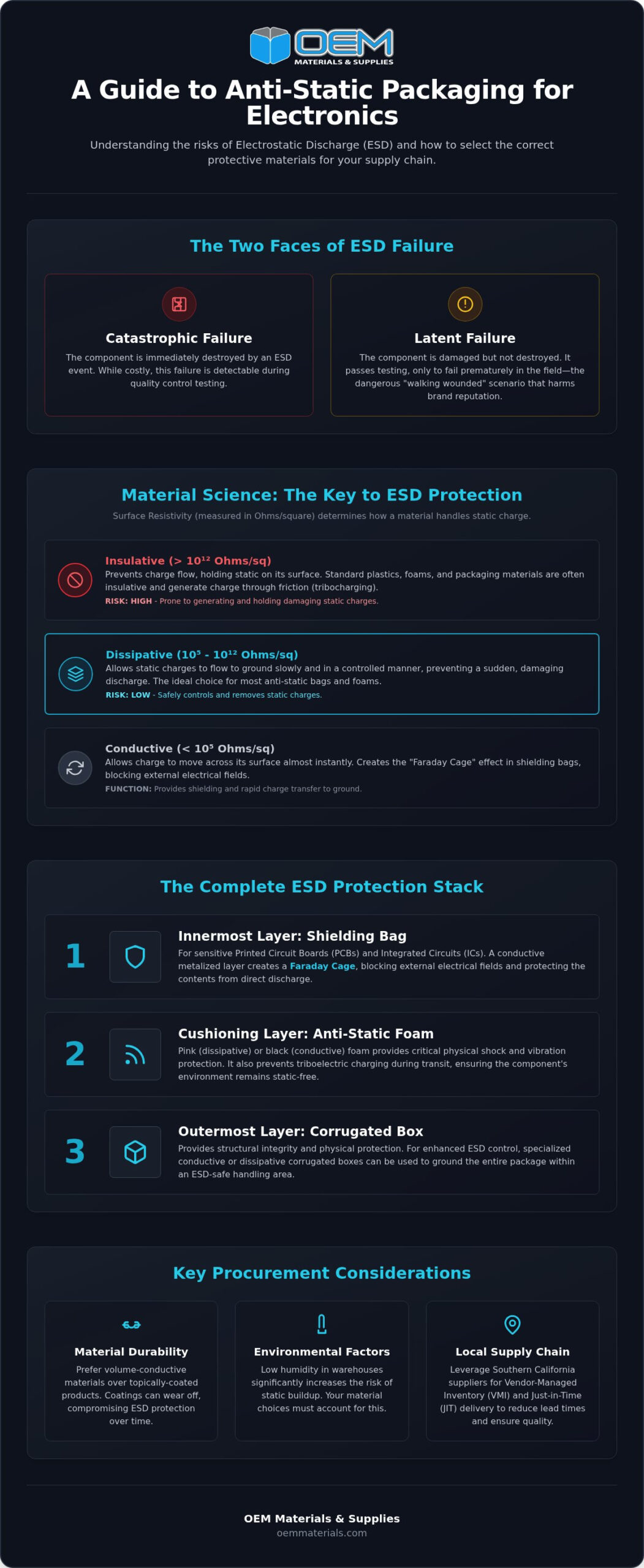
The technical challenge lies in the distinction between failure types. A catastrophic failure occurs when the component is destroyed immediately. While frustrating, it’s detectable during initial testing. Latent failure is far more dangerous. In these cases, the ESD event weakens the component but does not kill it. The device passes quality control and is shipped to the end user, only to fail prematurely in the field. This “walking wounded” scenario leads to unpredictable warranty costs and damages your brand’s reliability record.
The Cost of Improper ESD Protection
The financial impact of ESD damage extends far beyond the cost of a single printed circuit board. For manufacturers in the aerospace and medical sectors, especially those operating in Orange County and San Diego where reliability is non-negotiable, a single failure can trigger extensive root-cause analysis and regulatory reporting. Hidden costs include the labor required for rework, the loss of throughput on assembly lines, and the logistical expense of managing high volumes of returns. Implementing a standardized protocol for anti-static packaging for electronics is a preventative measure that protects your bottom line and your technical authority.
Surface Resistivity: The Metric of Protection
To select the right materials, procurement teams must understand surface resistivity, which is measured in Ohms per square. This metric determines how quickly a material allows a charge to move across its surface. Materials are generally categorized into three zones. Conductive materials have the lowest resistance and move charges almost instantly. Dissipative materials allow charges to flow more slowly and in a controlled manner, preventing the sudden spark of a discharge. Insulative materials, like standard plastic, have high resistance and tend to hold onto static charges. Understanding how anti-static bags work involves balancing these properties to create a safe environment. It’s also vital to account for environmental factors; low humidity in warehouse environments can significantly increase the risk of static buildup, making the choice of material even more critical.
Comparing Anti-Static Materials: Dissipative vs. Shielding
Selecting the correct anti-static packaging for electronics depends entirely on the Electrostatic Discharge Sensitive (ESDS) rating of your components. Procurement teams often confuse dissipative materials with shielding materials, which can lead to costly over-specification or, more dangerously, inadequate protection. To ensure compliance with current industry ESD standards, you must match the material’s resistivity to the environment where the part will be handled, stored, and shipped.
Durability is another critical factor in your material choice. Many lower-cost anti-static products use a topical coating that can wear off during handling or lose effectiveness over time. In contrast, volume-conductive materials incorporate protective properties directly into the polymer matrix, offering a longer shelf life and more reliable performance in high-friction shipping environments. If you’re unsure which grade your specific assembly requires, you can consult with our technical team for a material analysis based on your product dimensions and sensitivity levels.
Pink Polyethylene (Dissipative) Packaging
Pink poly is the most common form of dissipative packaging. It’s treated with a chemical antistatic agent that prevents the bag itself from generating a charge through friction, also known as triboelectric charging. However, you must understand that pink poly doesn’t provide a Faraday cage. It won’t block external electrostatic fields from reaching the component inside. This material is best suited for non-sensitive components or for use as a secondary layer within a controlled ESD Protected Area (EPA). Because the antistatic chemicals can migrate or dissipate, these bags have a finite shelf life, typically around 12 months depending on storage conditions.
Static Shielding and Moisture Barrier Bags
For sensitive semiconductors and microprocessors, static shielding bags are the industrial standard. These bags utilize a multi-layer construction, typically featuring a metalized polyester layer sandwiched between dissipative polyethylene. This creates a Faraday cage effect, which redirects electrostatic charges around the exterior of the bag rather than through the contents. For components that are also sensitive to humidity, moisture barrier bags add an aluminum foil layer to provide a low Moisture Vapor Transmission Rate (MVTR). When shipping sensitive electronics through varying climates, such as from a warehouse in the Inland Empire to a coastal facility in San Diego, combining these bags with custom foam packaging, humidity indicator cards, and desiccant packs ensures total environmental integrity.
Selecting Anti-Static Packaging for Specific Electronic Components
Every electronic component possesses a unique threshold for damage, known as its voltage sensitivity. While a high-voltage power supply might withstand a minor discharge, a modern microprocessor can be rendered useless by a spark as small as 100 volts. Choosing the correct anti-static packaging for electronics requires a granular approach that accounts for both electrical sensitivity and physical fragility. A generic solution often fails because it ignores the specific geometry and material composition of the component being protected.
Printed Circuit Boards (PCBs) present a dual challenge: they are highly sensitive to static and prone to physical damage from sharp solder joints or heavy heat sinks. For these items, static shielding bubble bags are the preferred choice. These bags provide the necessary Faraday cage protection while the air-filled cells prevent physical impact and abrasion. For integrated circuits and microprocessors, the focus shifts to lead integrity. These components are often housed in conductive tubes or JEDEC trays, but they still require an outer layer of shielding to prevent induction from external fields during transit. Unlike household substitutes like paper, which can generate dust and offer zero shielding, professional-grade materials ensure a clean, controlled environment for semiconductor surfaces.
Storage media, such as hard drives and solid-state drives, require a high-performance integrated stack. These units are vulnerable to physical shock that can misalign internal components and ESD that can corrupt data sectors. High-performance anti-static packaging for electronics in this category usually involves a combination of shielding bags and high-density anti-static foam. This combination dampens vibration while maintaining a constant electrical potential around the drive. For low-voltage sensors used in medical or aerospace applications, the margin for error is even smaller; even a minor latent defect can lead to catastrophic system failure in the field.
Custom Corrugated Solutions for Electronics
Standard shipping containers often lack the internal properties needed for sensitive electronics. By utilizing custom corrugated boxes, manufacturers can integrate anti-static liners directly into the high-strength board. These liners, often made from carbon-impregnated or dissipative coatings, eliminate the risk of the box itself becoming a source of static. Precision die-cut packaging designs further enhance protection by securing components in place, preventing the friction-induced charging that occurs when items shift during long-haul shipping between facilities in the Inland Empire and Los Angeles County.
Labeling and Identification Standards
Protection is only effective if the handler knows the package contains sensitive material. Proper identification using labels and printing supplies is a requirement for industrial compliance. This includes the use of the ESD susceptibility symbol, as defined by MIL-STD-129, which alerts warehouse personnel to follow grounded handling procedures. Additionally, many aerospace and medical device manufacturers in San Diego and Orange County utilize tamper-evident seals. These seals provide a clear visual indicator if a package has been opened, ensuring that the chain of custody and the ESD-safe environment remain intact until the product reaches its final assembly point.
The Integrated Protection Stack: Foam and Stretch Film
While shielding bags provide the primary electrical barrier, they do little to mitigate the mechanical stresses of transit. A comprehensive anti-static packaging for electronics strategy requires an integrated stack that combines electrical grounding with physical cushioning. This multi-layered approach ensures that components remain stationary and protected from the vibration-induced friction that often generates static in standard containers. Treating the packaging as a system rather than a collection of individual parts significantly reduces the risk of both physical impact and electrostatic discharge.
The assembly of an industrial electronics shipping container follows a methodical sequence. It begins with a high-strength corrugated box, often treated with an anti-static coating. The component, already sealed in its primary shielding bag, is nested within custom-engineered foam packaging. This foam must be precisely die-cut to eliminate air gaps that allow for movement. Finally, the box is secured with anti-static tape and identified with the appropriate ESD labels to ensure grounded handling procedures at every stop from Los Angeles County to San Diego.
Engineered Anti-Static Foam Inserts
Not all foam is suitable for a high-performance anti-static packaging for electronics stack. Pink anti-static polyethylene foam is the industrial standard for non-critical cushioning because its chemical additives prevent the foam itself from generating a charge. For highly sensitive aerospace components or medical sensors, black conductive foam provides a more robust solution by actively draining charges away from the component. For manufacturers in Orange County, choosing the right density is critical to balancing protection with material costs. Custom foam inserts provide the structural rigidity needed to prevent internal components from shifting during long-haul freight.
Pallet-Level ESD Security
Protection must extend to the pallet level, especially when moving large volumes between manufacturing stages or regional warehouses. Standard stretch film can generate massive static charges during high-speed machine wrapping. This charge can discharge through the primary packaging and damage internal components. ESD-rated stretch film uses dissipative additives to prevent this build-up. Additionally, using plastic pallets instead of wood reduces the risk of particulate contamination in cleanroom and electronics environments.
To maintain load integrity, edge protectors should be applied under the stretch film. This prevents the wrap from crushing the corners of the corrugated boxes while ensuring the entire load remains a single, stable unit during transport through Inland Empire logistics hubs. To get a technical assessment of your current packing stack, request a custom packaging prototype from our engineering team.
Optimizing Procurement for Southern California Manufacturers
For electronics manufacturers in Southern California, the primary procurement hurdle isn’t just technical specification; it’s the logistical challenge of storage and lead times. Anti-static packaging for electronics is inherently bulky. When you factor in large corrugated containers and custom foam inserts, the inventory can quickly consume valuable floor space in high-rent districts like Irvine, Carlsbad, or the Inland Empire. Effective procurement requires a strategy that balances technical compliance with lean manufacturing principles to keep production lines moving without overextending warehouse capacity.
Relying on local supply chains in Orange County and San Diego significantly reduces the risks associated with long-distance shipping delays. A local partner can provide Just-In-Time (JIT) delivery, ensuring that your packaging arrives exactly when your production schedule demands it. This approach minimizes your on-site footprint and frees up capital that would otherwise be tied up in stagnant inventory. Regional proximity also allows for faster prototyping for new product launches. Your engineering team can test and refine ESD-safe designs in days rather than weeks.
Streamlining the Supply Chain
Consolidating your suppliers for corrugated, foam, and ESD supplies is a proven method for reducing administrative overhead and material costs. By implementing Packaging VMI Services, you shift the burden of inventory management to your supplier. Under a Vendor-Managed Inventory program, your partner monitors your stock levels and automatically replenishes supplies based on your actual usage. This prevents the line shutdowns that occur when a simple shortage of shielding bags or custom inserts halts an entire assembly process. It transforms your packaging from a commodity purchase into a synchronized component of your manufacturing workflow.
Requesting an Industrial Packaging Consultation
Moving from a stock solution to a custom-engineered protection stack requires a detailed technical audit. To provide an accurate recommendation and quote, our team needs specific data points regarding your components. This includes:
- Exact product dimensions and weight
- Voltage sensitivity (ESDS) ratings
- Annual usage and typical batch sizes
- Shipping method and final destination
Leveraging expert Custom Packaging Design services ensures your shipments meet the rigorous compliance standards of the aerospace and medical device sectors. Our engineers focus on optimizing the material thickness and footprint to reduce shipping costs while maintaining zero-defect protection. If you’re ready to eliminate ESD-related damage and standardize your packaging protocol, contact us to schedule a consultation at your facility. OEM Materials & Supplies provides on-site support throughout Los Angeles, Orange, Riverside, and San Diego Counties to help you engineer a more reliable electronics supply chain.
Securing Your Electronics Supply Chain
Effective ESD protection is a technical requirement, not a logistical afterthought. By matching material resistivity to component sensitivity and integrating a multi-layered stack of shielding and custom foam, you eliminate the risk of latent failure. Standardizing your anti-static packaging for electronics ensures every shipment remains compliant with rigorous industrial standards. This methodical approach protects your brand reputation and reduces the high costs associated with field returns.
OEM Materials & Supplies has served aerospace and medical OEMs since our inception. We maintain local Southern California delivery hubs to support JIT requirements across Orange County and San Diego. Our engineers are ready to assist with custom prototyping for your most complex electronic assemblies. To receive a technical assessment and accurate pricing, please provide your product dimensions, weight, and annual usage. We look forward to helping you optimize your protective packaging protocols.
Request a Custom ESD Packaging Quote
Frequently Asked Questions
What is the difference between anti-static and static shielding bags?
Static shielding bags protect against external electrostatic fields, whereas anti-static bags only prevent the generation of static from the bag itself. Shielding bags use a metalized layer to create a Faraday cage, making them essential for sensitive components like PCBs. Anti-static dissipative bags are usually pink and are best for non-sensitive items or secondary packaging within a controlled ESD-safe area.
Can I reuse anti-static packaging for multiple shipments?
Reusing anti-static packaging for electronics is generally not recommended for industrial applications. The metalized layers in shielding bags can develop microscopic cracks or creases during handling, which compromises the Faraday cage. Dissipative treatments on pink poly also wear off over time. For aerospace and medical OEMs, using new packaging for every shipment is the only way to guarantee technical compliance and reliability.
How do I know if my electronics require moisture barrier bags (MBB)?
You should use moisture barrier bags if your components have a Moisture Sensitivity Level (MSL) rating of 2 or higher. These ratings are typically found on the manufacturer’s data sheet. MBBs prevent moisture from being absorbed into the component’s substrate, which can cause internal damage during high-temperature soldering. Always include a desiccant pack and a humidity indicator card to ensure the internal environment remains dry during transit.
Does pink anti-static foam provide a Faraday cage effect?
Pink anti-static foam does not provide a Faraday cage effect. It is a dissipative material designed to prevent the generation of static charges through friction or movement. While it is excellent for cushioning, it cannot block external electrostatic fields from reaching your components. For complete protection, you must place the foam-cushioned item inside a static shielding bag or a conductive corrugated box to redirect external charges.
What is the shelf life of dissipative packaging materials?
The typical shelf life for dissipative packaging is approximately 12 months from the date of manufacture. These materials rely on chemical antistatic agents that migrate to the surface to function. Over time, these chemicals dissipate or rub off, reducing the material’s effectiveness. It’s best to rotate your inventory regularly and perform surface resistance testing on any materials that have been in storage for over a year.
Why is standard bubble wrap dangerous for electronic components?
Standard bubble wrap is a dangerous insulator that generates and holds high levels of static charge through triboelectric charging. When a component rubs against standard plastic bubbles, it can create a discharge of several thousand volts. This is often enough to cause immediate catastrophic failure or latent defects. Always use pink anti-static bubble or shielding bubble bags to provide both physical cushioning and electrical safety.
Are anti-static stretch films necessary for all palletized electronics?
Anti-static stretch film is necessary when primary packaging lacks a Faraday cage or when palletizing high volumes of sensitive components. The friction of standard film during high-speed machine wrapping generates massive static buildup. This charge can discharge through secondary packaging, damaging the electronics inside. Using ESD-rated film ensures that the entire pallet load remains at a neutral potential during transit and handling in your warehouse.
How does humidity affect the performance of ESD packaging?
Performance of dissipative materials often decreases as humidity levels drop. Many anti-static agents require a certain level of atmospheric moisture to create a conductive path on the material’s surface. In dry climates, such as the Inland Empire during summer, static generation increases significantly. In these conditions, relying on moisture-independent shielding materials is the most reliable way to maintain consistent ESD protection throughout your regional supply chain.