
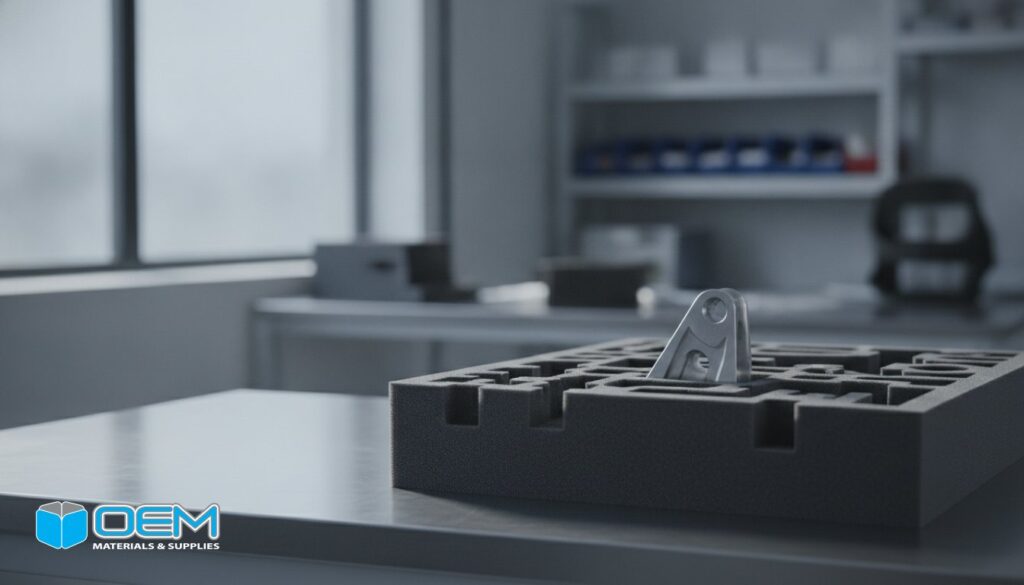
A product that arrives damaged is more than just a lost sale; it is a failure of the entire supply chain that erodes customer trust and inflates operational overhead. For manufacturers across Los Angeles and Orange County, the cost of transit damage is often compounded by excessive labor requirements and inconsistent lead times from secondary suppliers. Precision-engineered die-cut foam inserts provide a functional remedy to these logistical challenges by ensuring every component is secured within a custom-fit cavity designed for its specific geometry.
This guide explains how to engineer custom die-cut foam inserts to eliminate product damage and streamline assembly for industrial manufacturing. You likely understand that off-the-shelf cushioning rarely provides the protection required for sensitive electronics, medical devices, or aerospace components. We will explore how professional engineering support and inventory management strategies like just-in-time delivery can stabilize your supply chain; this approach reduces returns and optimizes warehouse throughput by providing a reliable, repeatable packaging solution for your most critical assets.
Key Takeaways
- Selecting the correct material, such as Polyethylene or Polyurethane foam, is critical for balancing protection levels with the weight and fragility of your product.
- Precision-engineered die-cut foam inserts reduce assembly line labor costs by replacing manual wrapping with repeatable, custom-fit cavities.
- CAD design and prototyping allow for the creation of precise packaging specifications that eliminate product damage before full-scale manufacturing begins.
- A local Southern California supplier can manage inventory through just-in-time delivery to eliminate stock shortages and optimize warehouse space.
Understanding Die-Cut Foam Inserts for Protective Packaging
Protective packaging is often the final hurdle in an industrial supply chain. While many operations rely on generic cushioning materials, high-value sectors like aerospace and medical device manufacturing require a more rigorous approach. Die cutting is a fabrication process that uses specialized tooling to punch precise shapes from foam sheets, creating custom cavities that match a product’s exact geometry. These precision-engineered components are known as die-cut foam inserts, and they serve as a structural barrier against the physical rigors of transit.
Industrial manufacturers often choose between die-cutting and CNC waterjet cutting based on production volume. Waterjet cutting is effective for rapid prototyping or low-volume runs because it requires no physical tooling. However, for high-volume industrial production, die-cutting is the standard. It offers superior speed and repeatability, ensuring that the ten-thousandth insert is identical to the first. This level of consistency is mandatory for automated assembly lines where even a millimeter of deviation can cause a packing delay.
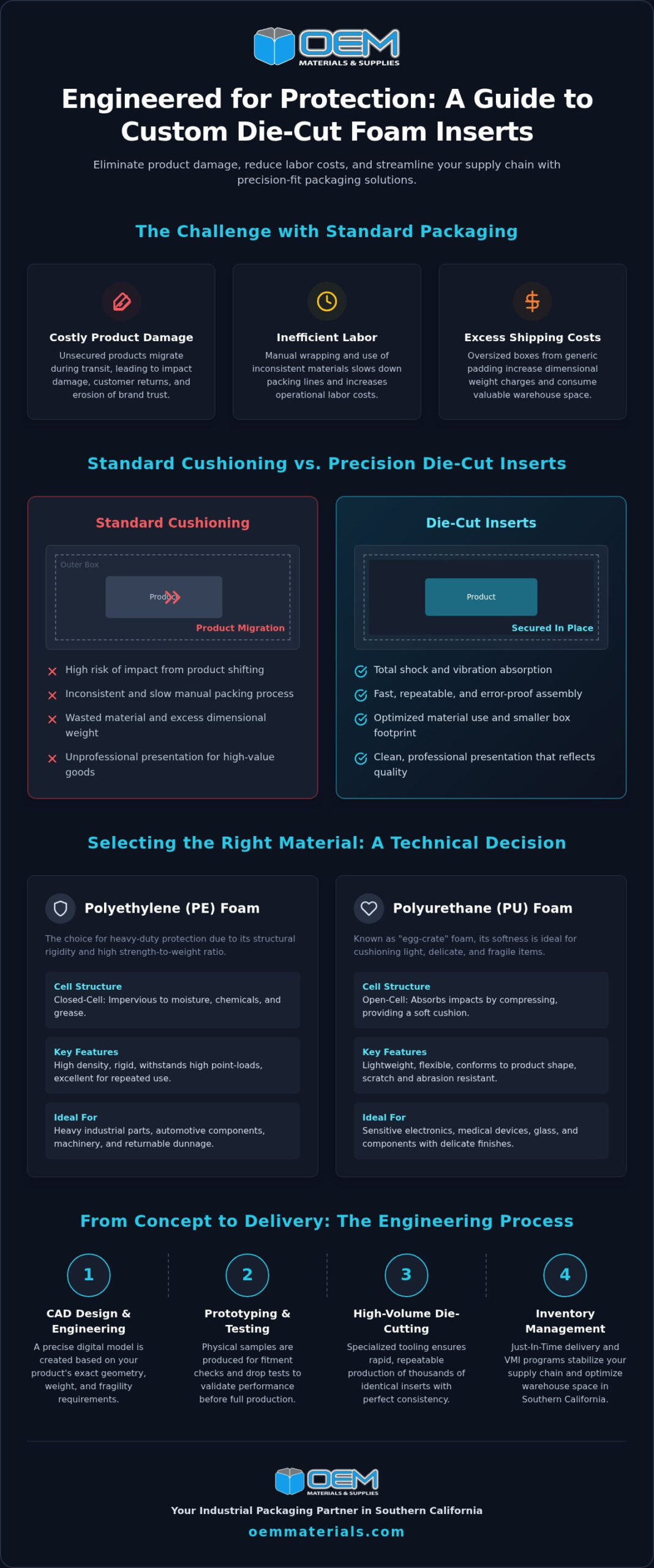
Loose-fill materials or generic foam sheets frequently fail to protect sensitive electronic or medical components. The primary reason is product migration. When a heavy or delicate item is placed in a box with loose cushioning, it can shift toward the edges during handling. Once the item makes contact with the outer corrugated wall, the risk of impact damage increases exponentially. Custom cavities eliminate this movement by locking the product into a fixed position, distributing G-force loads evenly across the foam surface.
Why Custom Inserts Outperform Standard Cushioning
Precision fitment is the most effective way to reduce vibration and shock impact during shipping. When an insert is designed through professional custom packaging design, it accounts for the specific fragility levels of the component. This targeted protection reduces material waste because you aren’t filling a box with excessive, unneeded padding. For aerospace and medical sectors, these inserts also provide a professional presentation that reflects the quality of the high-value parts inside. A clean, organized kit tells the end user that the manufacturer prioritizes precision at every stage of the process.
The Impact on Shipping Efficiency and Damage Rates
Custom die-cut foam inserts lower the total cost of ownership by significantly reducing return rates and the administrative burden of processing damage claims. Standardized cavities allow warehouse staff to pack items in seconds rather than minutes, which directly increases daily throughput. Furthermore, an engineered solution often allows for a smaller outer box. By reducing the overall footprint of the package, manufacturers can lower their dimensional weight shipping costs, which is a critical factor for companies distributing products across Southern California and beyond from hubs in Los Angeles and Orange County.
For more information on material options, you can view our full range of foam packaging solutions.
Selecting the Right Material: PE vs. PU Foam for Die-Cutting
Selecting the substrate for your die-cut foam inserts is a technical decision based on the product’s fragility, weight, and the environment it will face during transit. Foam is an engineered material, not a commodity. Choosing the wrong density or cell structure can lead to product failure or unnecessary packaging costs. Packaging engineers evaluate foam density, measured in pounds per cubic foot (pcf), to determine how much energy the material can absorb. Higher density foams protect heavy items by preventing them from bottoming out during a drop, while lower density foams provide softer deceleration for lighter, more sensitive components.
Polyethylene Foam for High-Durability Requirements
Polyethylene (PE) is a closed-cell foam known for its high strength-to-weight ratio and structural rigidity. Because the cells are sealed, PE foam is naturally resistant to moisture, chemicals, and grease, which are common in industrial manufacturing environments. It’s the preferred material for custom foam packaging in the automotive and heavy machinery sectors. PE foam can withstand high point-loads from heavy parts with sharp edges that would otherwise tear softer materials. It maintains its shape over repeated impacts, making it excellent for returnable shipping containers or long-term storage.
Polyurethane Foam for Delicate Surface Protection
Polyurethane (PU) is an open-cell foam characterized by its soft, flexible texture and superior cushioning for lightweight items. Its primary advantage is energy dissipation for fragile components that require a gentle touch. Engineers often specify PU for electronics and optics where scratch prevention is the priority. For sensitive circuit boards and microchips, anti-static (ESD) foam variants are used to prevent electrostatic discharge during handling and shipping. If your project involves high-sensitivity components, you can consult with a packaging engineer to determine the exact density required for your G-force protection specifications.
For specialized sectors like medical device manufacturing, Cross-Linked Polyethylene (XLPE) offers a premium solution. XLPE has a much finer cell structure than standard PE and features extremely low outgassing properties. It’s non-abrasive and can withstand the sterilization processes required in medical and cleanroom environments. This material ensures that no particulate matter or chemical residue contaminates the product, meeting the rigorous standards often required by aerospace and healthcare firms operating in Orange County and Los Angeles County.
The Economic Value of Custom Die-Cutting in Industrial Supply Chains
Industrial procurement is shifting toward total cost of ownership (TCO) models. While generic cushioning may have a lower unit price, it often conceals costs related to labor, shipping volume, and damage claims. Precision die-cut foam inserts provide a quantifiable return on investment by optimizing the three pillars of supply chain cost: labor, space, and transit. For manufacturers in high-stakes sectors like medical devices or aerospace, the economic logic of custom engineering far outweighs the perceived savings of commodity materials. This principle of optimizing efficiency through specialized support is also why companies in the health and food sectors partner with Simplepack Ltd for professional contract packing services.
Manual packing is a common bottleneck in the manufacturing line. In many facilities, workers spend excessive time measuring, cutting, or multiple-wrapping items in generic foam sheets or bubble wrap. This inconsistency leads to varied protection levels and high labor costs. Pre-assembled packaging kits, where the foam is already seated within corrugated boxes, transform a complex packing task into a repeatable three-second operation. This shift significantly improves operational efficiency by increasing daily throughput without adding headcount. Kitting also simplifies inventory tracking; you manage one SKU for the complete assembly rather than separate inventories for boxes, foam inserts, and tape.
Inventory Management and Vendor Managed Inventory (VMI)
Warehouse space is expensive, especially in high-demand hubs like Los Angeles and Orange County. Storing months of bulky packaging material consumes square footage that should be dedicated to finished goods or production equipment. Utilizing VMI programs allows manufacturers to shift the burden of inventory management to the supplier. We maintain the stock and provide just-in-time delivery to facilities in Riverside, San Diego, and the Inland Empire. This ensures that your production floor stays lean and focused on manufacturing rather than material handling.
This local supply chain model ensures that custom die-cut foam inserts are available exactly when production spikes occur. It eliminates the risk of stockouts that can halt an entire manufacturing line. By sourcing from a Southern California partner, you reduce the lead times and shipping costs associated with out-of-state vendors. The long-term ROI becomes clear when you calculate the reduction in dimensional weight shipping charges and the near-total elimination of transit-related returns. The result is a leaner operation that responds faster to market demands while maintaining a smaller, more efficient warehouse footprint.
Engineering Your Custom Foam Solution: Specifications and Design
Engineering a protective solution begins with a rigorous data collection phase. We analyze the physical properties of the component, focusing on weight distribution, outer dimensions, and specific fragility levels. Fragility is often measured in G-force ratings; knowing the maximum impact a product can survive without internal failure allows us to select the appropriate foam density. Without these metrics, a package is either over-engineered, wasting money, or under-engineered, risking damage. Our engineers use this data to create a digital blueprint that balances material performance with spatial efficiency.
Critical Data for an Accurate Foam Quote
Providing annual usage data is vital for accurate pricing because it determines the most cost-effective manufacturing method and material yield for your project. High-precision aerospace components often require tighter tolerances to ensure parts do not experience friction or rattle during high-vibration transit. We also evaluate whether the application requires permanent adhesive-backed inserts or removable cavities that allow for easy part extraction on the assembly line. Identifying these requirements early ensures the quote reflects the true operational needs of your facility in Los Angeles or Orange County.
The Prototyping Phase: From Design to Production
The transition from a CAD drawing to a physical component occurs during the prototyping phase. Rapid prototyping allows for real-world testing before committing to full-scale production runs of die-cut foam inserts. This stage is critical for verifying the interaction between the foam and the outer corrugated box or wood crate. We perform drop tests to observe how the material absorbs energy and whether the product remains centered within the cavity. If initial results show excessive shock transfer, we adjust the foam density or thickness to compensate. This iterative approach ensures the final design meets rigorous industry standards for protection.
Utilizing professional custom packaging design services eliminates the guesswork from the engineering process. Once the prototype is approved, we finalize the die-cut pattern for high-volume production. This pattern is optimized for maximum material yield, which reduces waste and lowers the unit cost for large-scale manufacturing runs. If you are ready to move from concept to a physical sample, request a custom foam prototype today. Providing your product dimensions and weight will allow our team to generate a precise recommendation for your specific application.
Sourcing Custom Foam Inserts in Southern California
For manufacturers operating in the industrial corridors of Southern California, the proximity of a packaging partner is a strategic asset. Sourcing die-cut foam inserts from a local supplier eliminates the logistical inefficiencies of long-distance freight. Because foam is a low-density, high-volume material, shipping it from out-of-state vendors often results in paying to ship air. By partnering with a supplier located near major hubs in Orange County and Los Angeles County, businesses can drastically reduce transit costs and lead times while maintaining a leaner inventory profile.
Local Support for San Diego and Los Angeles Manufacturers
Proximity allows for a level of agility that distant vendors cannot match. We serve manufacturing centers across the Inland Empire and San Diego County, providing on-site consultations to troubleshoot complex packaging challenges. This hands-on approach is particularly valuable for aerospace and medical device firms where the interaction between the product and the foam cavity must be perfect. While we support nationwide shipping from our local facilities, the core benefit for SoCal businesses is the ability to implement just-in-time delivery schedules that keep production lines moving without overwhelming warehouse floor space.
Why OEM Materials & Supplies is the Preferred Choice
Our expertise spans the most demanding sectors in the region, including automotive, electronics, and specialized manufacturing. We don’t just provide foam; we offer integrated solutions that combine die-cut foam inserts with custom corrugated boxes to create a complete, ready-to-ship unit. This holistic view of the packaging process ensures that every component is optimized for both protection and cost-efficiency. Our history of managing high-volume production programs for local industry leaders demonstrates our commitment to reliability and functional excellence.
Starting a new project requires clear data. To receive an accurate recommendation, provide our engineering team with the outer dimensions, weight, and annual usage of your product. This information allows us to design a solution that meets your specific protection requirements while staying within your budgetary constraints. Whether you need a rapid prototype for a new medical device or a high-volume run for an aerospace contract, we provide the technical support and local presence needed to stabilize your supply chain and protect your bottom line.
Optimizing Your Industrial Supply Chain Through Engineered Protection
Precision-engineered die-cut foam inserts are strategic tools that go beyond simple cushioning. By aligning material density with the specific G-force requirements of your product, you eliminate transit damage and the high costs of returns. Implementing these solutions also streamlines the assembly line, replacing manual packing with efficient, pre-kitted units that maximize throughput. This approach ensures that your logistics strategy is as precise as the products you manufacture.
OEM Materials & Supplies has served Southern California manufacturers for decades, providing the technical expertise required for aerospace, medical, and electronics applications. From expert engineering and design support to comprehensive kitting and VMI services, we function as a local partner committed to your operational efficiency. To ensure your next production run is protected, contact OEM Materials & Supplies for a custom foam insert quote and prototype. Providing specific product dimensions and annual usage data will allow our team to develop a recommendation tailored to your needs. We look forward to helping you stabilize your supply chain.
Frequently Asked Questions
What is the minimum order quantity for custom die-cut foam inserts?
Minimum order quantities vary based on the specific material selected and the complexity of the required tooling. While we support rapid prototyping and low-volume initial runs during the design phase, high-volume production typically offers the best protection-to-cost ratio for industrial clients. Most manufacturing projects find the greatest economic value when ordering in quantities that optimize material yield from standard foam sheets and reduce the per-unit impact of setup costs.
How do I determine which foam density is right for my product?
Foam density selection is determined by a technical analysis of your product’s weight, dimensions, and fragility rating. We evaluate how much energy the material must absorb to prevent damage during a specific drop height. Heavier items generally require high-density polyethylene to prevent bottoming out, while lighter, sensitive components benefit from the softer deceleration provided by lower-density polyurethane foam. This engineering-first approach ensures your product remains secured within the packaging.
Can you provide anti-static foam for electronic components?
We provide specialized anti-static (ESD) foam variants specifically designed to protect sensitive circuit boards and microchips from electrostatic discharge. These materials are essential for electronics manufacturers in Orange County who must meet rigorous handling standards. ESD foam is typically available in both open-cell polyurethane and closed-cell polyethylene, ensuring that your electronic components remain safe from both physical impact and electrical damage during transit. This dual protection is critical for high-value hardware.
How long does the design and prototyping process typically take?
The timeline for design and prototyping depends on the complexity of the component and the availability of CAD data. Once we receive your product specifications, an initial design and physical prototype are typically completed within several business days. This phase allows for real-world testing and density adjustments before finalizing the die-cut foam inserts for full-scale production, ensuring the final solution meets all protection requirements and matches the geometry of your specific part.
Do you offer kitting services where foam is pre-inserted into boxes?
Kitting and assembly are core services designed to reduce labor costs at your facility. We can pre-insert die-cut foam inserts into custom corrugated boxes or wood crates, delivering a finished packaging unit that is ready for your product. This integration streamlines your packing process and improves inventory accuracy by allowing you to manage a single SKU rather than coordinating multiple packaging components. This solution is particularly effective for high-volume manufacturing lines in Southern California.
What information do I need to provide for a custom foam quote?
To generate an accurate quote, we require the physical dimensions, weight, and fragility level of your product. Additionally, providing your estimated annual usage is critical for determining the most efficient manufacturing process and material yield. If you have existing CAD files or a physical sample, these assets help our engineering team specify the correct tolerances and foam density for your specific industrial application. This data ensures the final recommendation balances cost with superior protection.
Is your foam compliant with medical or aerospace industry standards?
Our materials are selected to meet the rigorous requirements of the aerospace and medical device sectors. We offer specialized foams, such as cross-linked polyethylene, which feature low outgassing and non-abrasive surfaces suitable for cleanroom environments. These materials ensure that sensitive components remain free from particulate contamination and chemical residue, meeting the high performance standards expected by professional procurement teams in Southern California. We prioritize technical compliance to ensure your products meet all necessary industry-specific safety guidelines.
Can you manage my packaging inventory through a VMI program?
We offer comprehensive Vendor Managed Inventory (VMI) programs to help manufacturers optimize their warehouse footprint. Our team monitors your stock levels and provides just-in-time delivery to facilities across Los Angeles, Orange County, and the Inland Empire. This service eliminates stock shortages and reduces the administrative burden of inventory management, allowing your operations team to focus on production rather than monitoring packaging supplies. This local support ensures your supply chain remains stable even during peak production periods.