
If your packaging strategy is based solely on the lowest price per unit, you’re likely overpaying for every shipment that leaves your dock. Most procurement managers recognize that a standard corrugated box is rarely enough to protect high-value industrial components during rigorous transit cycles. You’ve likely experienced the hidden costs of inadequate protection, such as rejected shipments, expensive RMAs, and production lines halted by damaged inventory.
Effective custom packaging for B2B shipping is a risk-mitigation strategy designed to protect your bottom line. This guide provides a technical roadmap for selecting and engineering packaging solutions that reduce product damage and lower departmental labor costs. You’ll learn how to optimize your industrial supply chain through streamlined assembly and reliable local sourcing in Southern California. We’ll examine how precision-engineered foam, custom corrugated designs, and integrated kitting services transform your shipping department into a center of operational efficiency.
Key Takeaways
- Distinguish between retail-focused branding and industrial-grade protection to ensure your packaging survives the rigors of the B2B supply chain.
- Identify the correct corrugated grades and material combinations required to balance product safety with shipping weight and dimensional costs.
- Utilize rapid prototyping and CAD design to verify that custom packaging for B2B shipping meets technical specifications before committing to high-volume production.
- Implement Vendor-Managed Inventory and kitting services to eliminate warehouse overcrowding and reduce labor requirements in the packing department.
- Leverage the logistical benefits of a Southern California partner to achieve just-in-time delivery and more responsive support for local manufacturing operations.
The Industrial Difference: Why Generic Shipping Boxes Fail B2B Operations
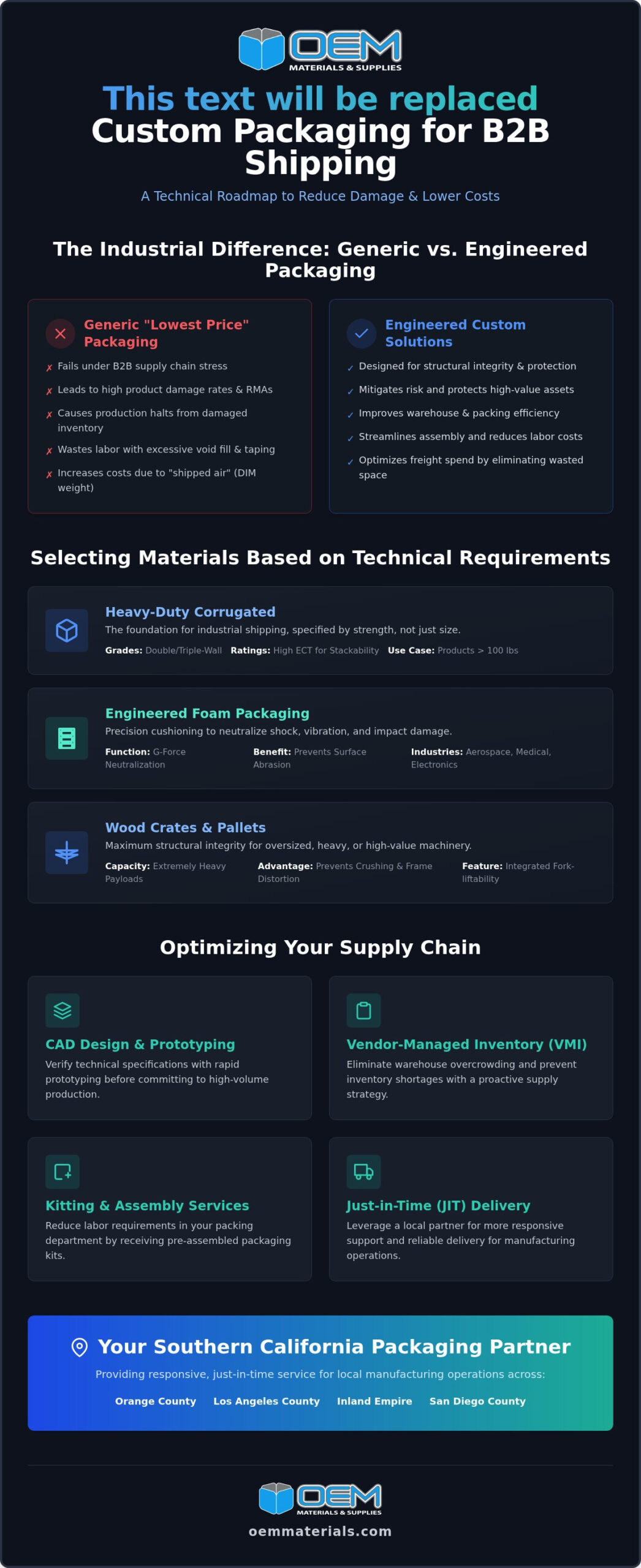
Industrial custom packaging is a technical solution engineered to withstand the specific stresses of the B2B supply chain. It’s built for protection, not just presentation. While retail packaging focuses on shelf appeal and brand recognition, custom packaging for B2B shipping prioritizes structural integrity and load-bearing capacity. Generic boxes often lack the necessary wall strength to survive the rigors of multi-stage freight handling and high-density pallet stacking.
Relying on off-the-shelf containers introduces hidden costs that erode your margins. These include high return rates, expensive damage claims, and the labor required to process RMAs. Adhering to professional packaging and labeling standards ensures that your components remain identifiable and secure throughout the logistics cycle. By shifting to an engineered design, you can capture significant operational savings by reducing material waste and shipping damage.
Precision sizing also plays a critical role in freight expense management. Carriers calculate shipping costs based on dimensional weight (DIM), which penalizes large boxes with low-density contents. Right-sized corrugated boxes eliminate this “shipped air,” ensuring you only pay for the volume your product actually occupies.
Protecting High-Value Assets
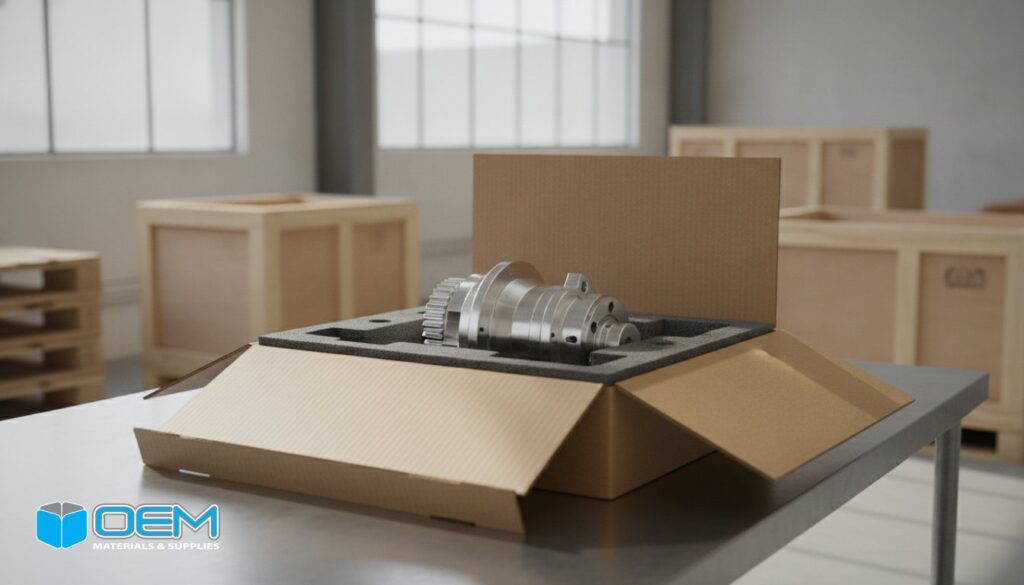
Standard boxes often lead to internal movement. This shifting causes impact damage and vibration fatigue, which is particularly dangerous for sensitive aerospace components and medical electronics. Generic solutions don’t account for the specific G-forces or environmental variables your product might encounter. Precision foam packaging inserts neutralize these risks by securing the item in a fixed position, preventing surface abrasion and structural failure during long-haul transit.
Operational Efficiency in the Warehouse
Custom designs improve the speed of your packing department. When a container is engineered for a specific part, your team doesn’t need to struggle with excessive void fill, bubble wrap, or multiple layers of tape. This streamlined process reduces the time required to pack a single unit, allowing for higher throughput without increasing headcount. Furthermore, professional custom packaging design optimizes palletization. Boxes designed to fit perfectly on a standard pallet maximize load density and improve stack stability, reducing the risk of a pallet collapse in the warehouse or on a truck.
Selecting Materials Based on Product Sensitivity and Weight
Selecting the right material for custom packaging for B2B shipping is a technical calculation based on the product’s fragility, weight, and the anticipated logistics environment. High-density industrial components require materials that offer high compression strength without adding unnecessary tare weight. While standard corrugated boxes suffice for light consumer goods, industrial applications often demand specific Edge Crush Test (ECT) ratings to ensure stackability in high-bay warehouses.
Environmental variables also dictate material choice. International freight exposes shipments to fluctuating humidity and temperature extremes. In these scenarios, specifying moisture-resistant adhesives or incorporating vapor barrier bags becomes essential to prevent structural degradation of the corrugated material. Choosing the wrong grade can lead to box failure under the weight of stacked pallets, especially in humid shipping containers.
Heavy-Duty Corrugated and Wood Solutions
Heavy loads or high-value machinery often exceed the limits of standard fiberboard. When a product exceeds 100 pounds or possesses sharp edges that could puncture single-wall board, we specify double-wall or triple-wall corrugated grades. For oversized equipment or extremely heavy payloads, wood crates provide the necessary rigid structure to prevent crushing and frame distortion. Integrating pallets directly into the primary packaging design ensures the entire unit remains fork-liftable, which significantly reduces the risk of manual handling errors and drops during transit.
Engineered Foam Packaging for Sensitive Components
Sensitive electronics and medical devices require sophisticated cushioning to manage G-force impacts. Engineering the right custom packaging for B2B shipping involves matching the foam density to the product’s fragility rating. Polyethylene (PE) foam is a closed-cell material ideal for heavier items requiring repeatable impact protection. Conversely, polyurethane (PU) foam is an open-cell, softer material designed for lighter, highly fragile components. For circuit boards and semiconductors, static dissipative (ESD) foam is a requirement to prevent electrostatic discharge. Custom foam inserts are precision-cut to the exact dimensions of your device, eliminating internal movement and preventing vibration fatigue.
If you aren’t sure which material grade your product requires, you can request a technical consultation to review your specific weight and sensitivity requirements.
Engineering and Prototyping for High-Stakes Industrial Sectors
Engineering custom packaging for B2B shipping requires more than just measuring a product’s exterior dimensions. It demands an iterative design process that translates technical specifications into functional protection. We utilize CAD software to create precise internal geometries, followed by physical prototypes that undergo rigorous evaluation. This phase ensures that the final solution meets your specific ASTM or ISTA testing requirements before mass production begins. Prototyping allows engineers to identify potential failure points, such as inadequate corner protection or insufficient foam compression, before they result in expensive field failures.
Integrating custom kitting and assembly services further optimizes your production line. By receiving pre-assembled packaging kits, your team avoids the labor-intensive process of gathering disparate components like foam inserts, boxes, and edge protectors. This streamlined approach reduces the time spent at the packing station and minimizes the risk of missing critical protection elements during the shipping process.
Medical Device and Aerospace Requirements
In the medical and aerospace sectors, packaging is a critical component of the product’s regulatory profile. Life science applications often require materials that meet specific cleanliness standards to prevent contamination of sensitive instruments. Aerospace logistics involve high-vibration environments and multi-modal transit that can cause standard containers to fail. Professional custom packaging design ensures that these high-stakes components remain within their required tolerances throughout the entire distribution cycle. This technical approach is essential for maintaining compliance and ensuring the safety of critical equipment.
Prototyping and Short-Run Flexibility
Manufacturers in Southern California often face tight deadlines for product launches and specialized equipment runs. Rapid prototyping and short-run support allow you to validate a design without committing to high-volume minimums immediately. This flexibility is essential for aerospace startups in Los Angeles County or medical device firms in Orange County that require iterative changes during development. Once the design is finalized, transitioning to a high-volume production program is seamless because the technical specifications are already established and tested. Local manufacturing and design support in San Diego County and the Inland Empire significantly reduce lead times compared to offshore suppliers, allowing you to react quickly to supply chain shifts.
Optimizing the Supply Chain with VMI and Kitting Services
Engineering the right custom packaging for B2B shipping is only half the battle. If your warehouse runs out of boxes during a peak production cycle, the efficiency of your design becomes irrelevant. Supply chain optimization focuses on the availability and handling of these materials. By integrating Vendor-Managed Inventory (VMI) and kitting services, manufacturers can shift the burden of inventory management to their packaging partner. This approach ensures you always have the necessary materials on hand without over-allocating capital or floor space to bulky stock.
Just-in-Time (JIT) delivery is particularly valuable for industrial packaging. Corrugated boxes and foam inserts are high-volume items that consume significant warehouse real estate. JIT programs allow you to receive smaller, frequent shipments that match your production schedule. This practice frees up floor space for manufacturing equipment or finished goods inventory, directly improving your facility’s throughput. It also improves cash flow by aligning your packaging expenses with your actual shipping volume.
Vendor-Managed Inventory (VMI) Programs
A professional packaging VMI program operates on data rather than guesswork. Your supplier monitors your usage levels and automatically replenishes stock before a shortage occurs. This model eliminates the administrative labor associated with tracking hundreds of SKUs and generating frequent purchase orders. For high-volume manufacturers, this leads to measurable cost savings by reducing overhead and preventing line shutdowns. You improve operational stability by ensuring that critical shipping materials are always available when a finished product is ready for transit.
Kitting and Assembly Services
Kitting simplifies the packing process by consolidating multiple components into a single SKU. Instead of your warehouse team searching for a specific box, a custom foam insert, and a roll of tape, they receive a complete package ready for immediate use. Consolidating your corrugated, foam, and labels into a single kit reduces the number of vendors and purchase orders your procurement department must manage. This streamlining is especially beneficial for complex assemblies in the medical and aerospace sectors. It ensures that every protective element is present, reducing the risk of human error on the assembly floor. Warehouse managers see an immediate improvement in workflow as packing teams spend less time gathering materials and more time moving product out the door.
To see how a custom VMI or kitting program can improve your operational efficiency, you can contact our team for a supply chain audit.
Selecting a Southern California Industrial Packaging Partner
Proximity is a strategic advantage for manufacturers in Los Angeles and San Diego. When you select a partner for custom packaging for B2B shipping, you aren’t just buying boxes; you are securing a technical support system. Local suppliers provide the responsiveness required to handle sudden production spikes or design changes that national vendors often miss. Physical proximity allows for on-site packaging audits, where an engineer can walk your production line and identify specific opportunities to reduce material waste or improve packing speed.
Technical expertise in specialized sectors like aerospace and medical devices is non-negotiable. A qualified partner should demonstrate a deep understanding of the regulatory and logistical demands unique to these industries. Evaluating a supplier based on their ability to provide rapid prototyping and technical consultations ensures that your packaging is engineered for performance rather than just price. This collaborative approach leads to more reliable protection and long-term cost stability across your entire distribution network.
Serving SoCal Manufacturing Hubs
Local support is essential for factories located in Orange County, Riverside, and the Inland Empire. Choosing a wholesale industrial packaging supplier with local roots significantly reduces transportation lead times and associated freight costs. When your supplier is located within the same regional hub, they can offer more flexible delivery schedules, such as same-day or next-day replenishment for critical items. This geographic alignment supports lean manufacturing principles by allowing you to maintain lower inventory levels while ensuring that your shipping department never faces a stockout of essential materials.
Next Steps for Procurement and Operations
Transitioning to a more efficient packaging program begins with accurate data. Procurement and operations managers should gather specific details, including product dimensions, weight, and projected annual usage, to facilitate a technical recommendation. This data allows for the creation of a precise custom packaging for B2B shipping solution that balances material strength with dimensional weight optimization. Once the initial requirements are established, the next step is to request a physical prototype for testing and evaluation in your specific shipping environment.
Contacting OEM Materials & Supplies for a comprehensive packaging consultation provides an opportunity to review your current supply chain challenges. We focus on identifying functional remedies for high damage rates and excessive labor costs. Whether you need a short-run prototype for a new product launch or a high-volume VMI program for an established manufacturing line, our team provides the technical guidance needed to optimize your industrial packaging strategy.
Scaling Your Industrial Shipping Efficiency
Transitioning from generic containers to engineered custom packaging for B2B shipping is a strategic move that protects both your product and your bottom line. By prioritizing structural integrity and precise material selection, you eliminate the hidden costs of transit damage and inefficient labor. Our specialized support for the aerospace and medical sectors ensures that your most sensitive components remain compliant and secure throughout the distribution cycle.
Reliability in the supply chain comes from more than just high-quality materials. It requires a partner with full-service design and engineering capabilities who understands the logistical landscape of Southern California. Implementing a local VMI program allows you to reclaim warehouse space and maintain inventory stability without the risk of stockouts. If you’re ready to optimize your packing department and reduce departmental overhead, we can help you engineer a solution tailored to your specific technical requirements.
To get started, please request a custom packaging quote and prototype from OEM Materials & Supplies. We look forward to helping you streamline your industrial supply chain.
Frequently Asked Questions
What information is needed to get a custom packaging quote?
To generate an accurate technical recommendation, we require the product’s exact dimensions, total weight, and projected annual usage. It’s also helpful to specify the fragility level or G-force rating for sensitive components. Providing details about the shipping environment, such as pallet stacking height or international transit requirements, allows our engineers to select the appropriate material grade. This data ensures that your custom packaging for B2B shipping provides maximum protection while optimizing dimensional weight costs.
How does custom packaging reduce labor costs in B2B shipping?
Engineered designs reduce the time required to pack a single unit by eliminating the need for complex manual wrap and excessive void fill. When a container is designed for a specific part, the assembly process becomes intuitive and repeatable. Integrated packaging kits allow your team to receive pre-assembled components, further streamlining the workflow. This efficiency permits higher throughput in the packing department without increasing headcount, effectively lowering your total cost per shipment.
Can custom foam inserts be reused for multiple shipping cycles?
Reusability depends primarily on the foam density and cell structure. Closed-cell polyethylene (PE) foam is highly durable and maintains its structural integrity over multiple transit cycles, making it ideal for reusable internal logistics or returnable containers. Conversely, open-cell polyurethane (PU) foam is softer and designed for lighter cushioning, often serving as a single-use solution for highly fragile items. We evaluate your specific supply chain cycle to recommend materials that balance initial cost with long-term durability.
What is the typical lead time for an engineered packaging prototype?
Prototyping speed is a primary advantage of working with a local Southern California partner. While specific lead times vary based on the complexity of the design and material availability, our rapid prototyping capabilities allow for quick iterations from CAD drawings to physical samples. Manufacturers in Los Angeles and Orange County benefit from reduced transit times for prototype delivery, enabling faster testing and validation. This responsiveness is critical for meeting tight production deadlines and product launch schedules.
Does custom packaging help with international shipping regulations?
Yes, custom solutions ensure your shipments comply with global standards like ISPM 15 for wood crates and pallets. We specify heat-treated or plastic materials that meet international phytosanitary requirements to prevent customs delays. Additionally, we can integrate vapor barrier bags and desiccants for sea freight to protect against moisture and corrosion. Adhering to these technical specifications ensures your high-value assets arrive safely and meet the regulatory requirements of your destination country.
What are the benefits of a Vendor-Managed Inventory program for packaging?
A VMI program eliminates the administrative burden of tracking inventory levels and manually issuing purchase orders. We monitor your usage data and automatically replenish stock at your facility, ensuring you never face a stockout that halts production. This model improves cash flow by aligning packaging expenses with actual usage and frees up valuable warehouse floor space. For high-volume manufacturers, VMI creates a more predictable supply chain and reduces the labor costs associated with inventory management.
How do I choose between double-wall corrugated and wood crates?
The choice depends on the payload weight and the required compression strength. Double-wall corrugated is often sufficient for items up to 100 pounds that require high puncture resistance and stackability. However, for machinery or oversized equipment exceeding these limits, wood crates provide the necessary rigid structure to prevent frame distortion. We analyze your product’s weight distribution and the anticipated stacking forces to determine if a heavy-duty fiberboard or a timber-based solution is technically required.
Is custom packaging cost-effective for short production runs?
Custom solutions are highly cost-effective for short runs of high-value components where the cost of a single damaged unit exceeds the packaging investment. Using custom packaging for B2B shipping even for limited quantities prevents expensive field failures and RMAs. This approach is particularly valuable for aerospace and medical device prototypes in San Diego County and the Inland Empire. It provides technical-grade protection for specialized equipment while maintaining a professional and secure shipping cycle.