
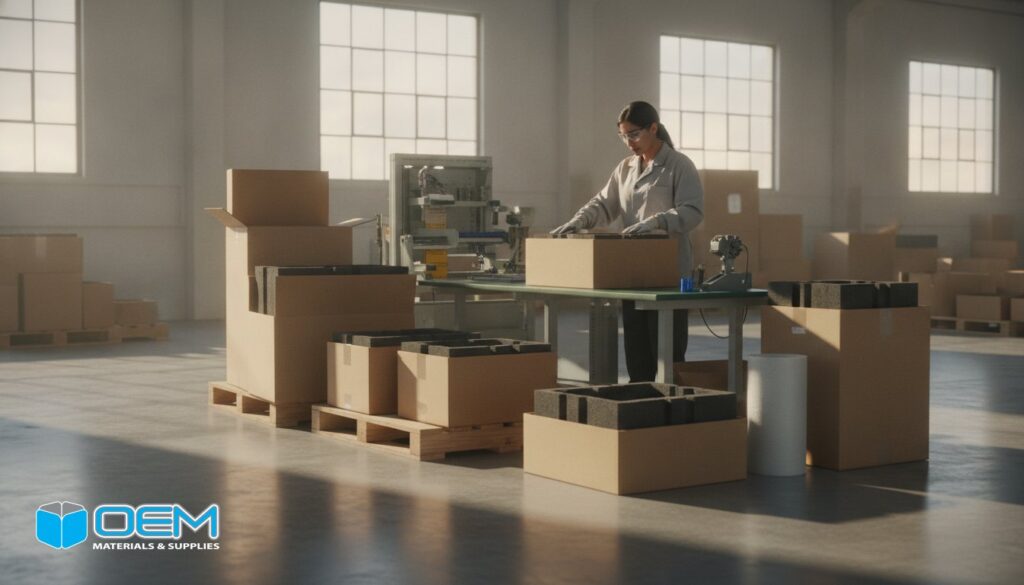
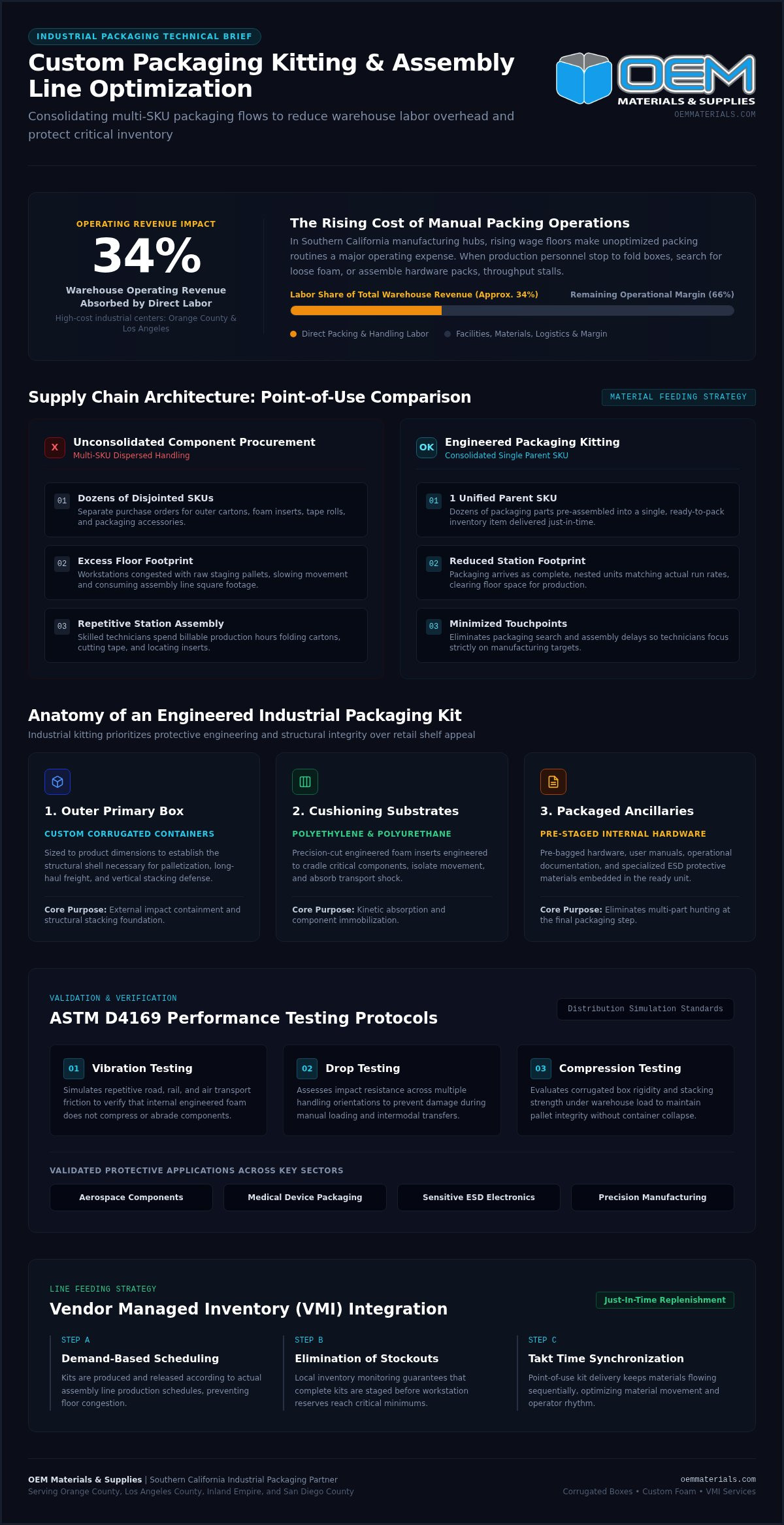
Did you know that labor accounts for nearly 34% of total warehouse operating revenue? In Southern California industrial hubs like Orange County and Los Angeles, rising minimum wages make manual packaging tasks a significant drain on the bottom line. Implementing custom packaging kitting services addresses this by consolidating dozens of separate SKUs into a single, ready-to-use unit. Managing individual corrugated boxes, custom foam inserts, and tape often leads to assembly line bottlenecks and inventory headaches. It’s frustrating to watch skilled technicians spend their shift performing repetitive assembly tasks instead of focusing on core manufacturing goals.
We understand that an efficient workflow requires more than just supplies; it requires a strategic approach to how those materials arrive at your station. This guide explores how engineered kitting and assembly line strategies can lower your total cost of ownership for industrial packaging. You’ll learn practical methods to streamline your manufacturing workflow while protecting your products from damage through consistent, pre-assembled solutions. By optimizing the point of assembly, you can reduce labor overhead and minimize material waste across your entire operation.
Key Takeaways
- Understand how pre-assembling packaging components into single units reduces manual touchpoints and assembly errors on the production floor.
- Learn to select the right combination of custom corrugated boxes and engineered foam inserts to provide structural integrity and product protection.
- Discover how to organize assembly line layouts to follow a logical sequence that minimizes movement and optimizes material flow.
- Identify the specific ways that custom packaging kitting services shift labor burdens away from high-cost manufacturing areas to improve overall profitability.
- Evaluate the operational benefits of partnering with a local Southern California supplier that integrates packaging design with vendor-managed inventory.
Defining Custom Kitting Services in Modern Manufacturing
Custom packaging kitting services represent a strategic shift from transactional supply procurement to integrated logistics management. In a high-volume manufacturing environment, kitting is the process of pre-assembling all necessary packaging components into a single, ready-to-use unit before it reaches the production line. The primary objective is simple: reduce the number of touchpoints during final product packing. Every second an operator spends folding a box or hunting for a specific foam insert is a second of lost production capacity. Touchpoints cost money. By consolidating multiple packaging elements into a single unit, manufacturers eliminate the time spent searching for disparate parts during the final packing stage.
Industrial kitting differs significantly from retail kitting. While retail kits focus on aesthetic presentation and shelf appeal, industrial kits prioritize protective engineering and durability. These kits are designed to protect high-value components for sectors like aerospace and medical device manufacturing. They must survive the rigors of long-haul transit and multiple handling stages without failure. It’s a common mistake to view kitting as just a labor service; it’s an engineering discipline that ensures every part arrives in perfect condition.
The Role of Kitting in Supply Chain Efficiency
Operational managers often face inventory headaches when managing dozens of separate packaging SKUs. Implementing a kitting program allows you to consolidate these items into a single parent SKU. This streamlining is a core component of advanced assembly line feeding and kitting strategies, which aim to minimize material handling costs at the workstation. When a kit is delivered to the line, it contains everything needed for that specific unit, reducing the physical footprint required for packaging storage on the production floor.
Pre-assembled kits are essential for maintaining just-in-time manufacturing schedules. When packaging arrives at the line as a complete unit, it eliminates the need for large on-site stockpiles of raw materials. To further optimize this process, many Southern California manufacturers utilize Vendor Managed Inventory services. This ensures that kits are replenished based on actual production demand, preventing both stockouts and warehouse congestion. It’s about having the right material, in the right configuration, at the exact moment it’s needed.
Key Components of an Industrial Packaging Kit
A well-engineered kit functions as a comprehensive protective system. It typically begins with a primary container, such as custom corrugated boxes designed to the exact dimensions of the product. These containers provide the outer structural foundation needed for stacking and palletization. Without a properly sized outer box, the internal components can’t perform their jobs effectively.
Inside the box, engineered foam inserts provide the necessary cushioning to prevent movement and absorb shock. These inserts are often precision-cut from polyethylene or polyurethane to cradle sensitive components securely. Finally, the kit includes ancillary items like hardware bags, instruction manuals, and required labels. By having every element pre-staged, the packer can complete the process in a fraction of the time required for traditional manual assembly.
Engineering the Kit: Material Selection for Industrial Protection
Material selection is the first step in optimizing a packaging assembly line. When designing custom packaging kitting services, the choice of substrate determines both the protection level and the assembly speed. Custom corrugated boxes provide the necessary structural foundation for every kit. They act as the primary defense against external impacts during transit and storage. Without a rigid outer shell, internal cushioning cannot perform its intended function. A well-engineered box ensures that the kit remains intact throughout the entire distribution cycle.
To verify that these materials hold up under stress, engineers often rely on ASTM D4169 performance testing standards. These protocols simulate the real-world distribution environment through vibration, drop, and compression tests. This data-driven approach is especially critical for sensitive electronic components that require specialized ESD packaging. By selecting materials that meet these rigorous standards, manufacturers can reduce product damage and avoid the high costs associated with returns and replacements.
Custom Foam vs. Standard Cushioning
Standard cushioning like bubble wrap or loose void fill often requires labor-intensive manual wrapping. Custom foam inserts eliminate these extra steps. Because the foam is precision-cut to match the exact product geometry, the operator simply places the item into a pre-defined cavity. This creates a repeatable, error-proof packing method. Polyethylene foam is generally preferred for heavier, rugged items because of its high load-bearing capacity and durability. Polyurethane foam offers a softer touch for delicate, lighter products that require more flexibility. For a deeper look at density and material specs, refer to The Industrial Guide to Foam Inserts. Using pre-cut inserts ensures that every product is protected identically every time.
Corrugated Design for Fast Assembly
The design of the box itself directly impacts line speed. Traditional boxes require taping the bottom flaps, which adds a significant amount of time to the assembly process. Auto-bottom boxes or specialized die-cut designs snap into place instantly. This eliminates the need for excessive packaging tape and reduces the physical effort required from assembly associates. Integrating custom packaging design into the kitting workflow ensures that every fold and flap serves a functional purpose. These designs are engineered to be intuitive, allowing new staff to reach peak productivity faster. If you are looking to optimize your current packaging footprint, you can request a custom prototype based on your specific product dimensions and weight requirements.
How to Set Up an Efficient Packaging Assembly Line
Setting up an assembly line for custom packaging kitting services requires a layout that mirrors your production sequence. Start with raw materials on one end and finished kits on the other. This linear progression prevents backtracking. It reduces the physical steps taken by associates during a shift. Organizing components based on the exact sequence of assembly minimizes the cognitive load on the packer. When the next item needed is always the closest, it’s easier for throughput to increase naturally.
For long-term success, follow the NIST lean management road map to standardize these workflows. Using visual aids like assembly templates or shadow boards ensures that every shift produces identical results. This consistency is vital for maintaining the quality standards required in aerospace or medical device sectors. Standardized work documentation allows for rapid onboarding of new staff without sacrificing accuracy or safety.
Optimizing the Physical Workstation
Ergonomics directly impact speed. Position high-frequency materials, such as custom foam or labels, within the primary reach zone. This is the area reachable with elbows at the side. Integrating tape dispensers and label printers into the bench layout reduces reaching and straining. A cluttered workspace leads to errors and slowed production.
- Mount tools on articulating arms to clear bench space.
- Use tilted bins for hardware to improve visibility and access.
- Incorporate height-adjustable tables to accommodate different operators.
Managing bulk supplies is key. Having a reliable source for wholesale industrial packaging nearby ensures that your line doesn’t stop due to stockouts of basic consumables. Efficient replenishing strategies keep the focus on assembly rather than logistics.
Workflow Management and Quality Control
The choice between one-piece flow and batching depends on your kit complexity. One-piece flow often reduces errors because the associate focuses on completing a single unit before moving to the next. Implementing check-points at the end of the line verifies kit completeness before the box is sealed. This prevents the costly mistake of shipping incomplete kits to the customer.
To finish the process, standardize the application of stretch film and edge protectors for palletized loads. This final step secures the kits for transit and maintains the structural integrity of the entire shipment. This disciplined approach to the assembly line is what makes custom packaging kitting services a viable cost-saving measure for modern manufacturers.
Analyzing the Economics of Kitting and Assembly
Analyzing the financial impact of custom packaging kitting services requires looking beyond the unit price of a box. It’s about the total cost of ownership. Kitting shifts the labor burden away from the high-cost production floor to a more cost-effective assembly environment. When your team receives a ready-to-use kit, they spend their time on the product rather than the packaging. This transition reduces the total time spent per unit and improves overall throughput.
Beyond labor, kitting directly addresses material and freight expenses. Reduced material waste occurs because every component is pre-measured and pre-cut for a specific application. There’s no excess to trim or discard at the workstation. Freight savings are also realized through more efficient cube utilization in shipping. An engineered kit eliminates the “shipped air” problem by minimizing external dimensions without compromising product safety. When you calculate the total cost of ownership, you must include these hidden savings alongside storage and handling fees.
Labor Cost Reduction
The hourly rate of a production engineer is significantly higher than that of a packaging specialist. Utilizing your core team for packaging assembly is an inefficient use of specialized talent. Kitting allows your engineers to focus on manufacturing while the repetitive preparation of boxes and foam is handled upstream. Labor efficiency in kitting is the strategic reallocation of specialized personnel to high-value manufacturing tasks by delegating repetitive packaging assembly to a dedicated partner.
Storage and Inventory Savings
Managing inventory for a single kit SKU is much simpler than tracking five separate component SKUs. This consolidation reduces administrative overhead in procurement and receiving. In regions like Orange County or Los Angeles County, where warehouse space is expensive, reducing your storage footprint is a major operational win. Utilizing just-in-time packaging allows you to keep only the kits you need for immediate production. This approach has a direct impact on cash flow. Capital is no longer tied up in idle raw materials sitting on shelves; instead, inventory is managed as functional kits that move quickly through the facility. If you are ready to evaluate the ROI for your specific project, request a total cost analysis and quote based on your annual usage and product dimensions.
Implementing Kitting Solutions with a SoCal Packaging Partner
Implementing custom packaging kitting services requires a partner that bridges the gap between engineering design and physical execution. Southern California manufacturers face unique logistical challenges, from high warehouse costs to strict transit windows. It’s not enough to simply order components from a catalog; you need a supplier that offers both material design and assembly services under one roof. This dual capability ensures that every element of the kit works in harmony, from the custom foam density to the structural integrity of the outer corrugated box. OEM Materials & Supplies supports your long-term growth by scaling from short experimental runs to high-volume production as your program matures.
Prototyping is a non-negotiable step in this process. Before committing to a large-scale rollout, you must verify the fit and function of the kit in your specific production environment. A physical prototype allows your line workers to test the assembly sequence and identify potential bottlenecks or ergonomic issues. It’s better to discover a clearance issue during a pilot test than during a full production shift. This iterative approach ensures that the final solution is optimized for both product protection and assembly speed.
Local Expertise in Orange County and Los Angeles
Proximity matters when managing complex supply chains. Having a partner based in Southern California provides a distinct advantage for manufacturers operating in San Diego County and the Inland Empire. Local delivery reduces freight costs and allows for more flexible, just-in-time scheduling. For complex projects requiring custom crates or specialized internal blocking, face-to-face consultations help resolve technical details quickly. Meeting the rigorous quality standards of the aerospace and medical sectors requires tight oversight. OEM Materials & Supplies provides the SoCal-based quality control necessary to prevent defects and ensure that every kit meets your exact specifications.
Next Steps for Your Packaging Program
Transitioning to a kitted model starts with gathering accurate data. You’ll need to document your product dimensions, weights, and projected annual usage. This information allows for precise material engineering and accurate cost forecasting. Once the initial data is ready, the next step is requesting a prototype to test on your current assembly line. This hands-on testing ensures that the theoretical design works in the hands of your operators. Contact OEM Materials & Supplies for a consultation to request a quote and begin the process of optimizing your packaging workflow. Providing specific details like part dimensions and shipping requirements helps us deliver a solution that fits your operational needs and reduces your total cost of ownership.
Advancing Your Manufacturing Through Strategic Packaging
Efficient assembly lines depend on the seamless integration of parts and packaging. Shifting the assembly of complex protective systems upstream reduces touchpoints and helps stabilize labor costs. By utilizing custom packaging kitting services, your operation gains the flexibility to scale production without increasing warehouse footprint or administrative overhead. These strategies ensure that your core team remains focused on manufacturing while the technical details of industrial protection are handled by a reliable partner.
OEM Materials & Supplies specializes in custom engineering for the aerospace and medical sectors, providing the precision required for sensitive components. Our local presence in Southern California ensures rapid prototyping and fast delivery to hubs in Orange County, Los Angeles, and the Inland Empire. From engineered foam inserts to heavy-duty corrugated boxes, we provide the technical expertise needed to protect your products and your bottom line. We understand the intricacies of local logistics and the demanding standards of modern distribution.
To begin optimizing your workflow, Request a Custom Kitting and Assembly Quote today. Provide your product dimensions, weight, and annual usage to receive a tailored recommendation from our engineering team. We look forward to helping you build a more efficient and resilient supply chain.
Frequently Asked Questions
What is the difference between kitting and assembly?
Kitting involves gathering individual packaging components into a single ready to use set, while assembly is the physical process of constructing the package or placing the product inside. In the context of custom packaging kitting services, we provide the pre-staged materials so your line workers don’t have to hunt for boxes, foam, or hardware. This separation of tasks ensures that the high-cost production floor remains focused on manufacturing rather than logistical preparation.
How do kitting services reduce shipping damage for electronics?
Kitting reduces damage by ensuring every electronic component is housed in a precision-engineered environment. We utilize anti-static ESD materials and custom-cut foam inserts that prevent movement and absorb shock during transit. By providing a standardized kit, you eliminate the variability of manual wrapping techniques used by different warehouse associates. This consistency is vital for maintaining the integrity of sensitive circuit boards and high-value hardware across Southern California distribution networks.
Can kitting services handle specialized medical device packaging?
Yes, kitting services are designed to meet the rigorous standards of the medical device industry in hubs like Orange County and San Diego. We provide specialized materials that support sterile barriers and cleanroom requirements. Our team works with engineers to develop kits that include everything from custom corrugated boxes to protective cushioning that maintains product orientation. This ensures that devices arrive at healthcare facilities in a state that meets all regulatory and safety protocols.
What data is needed to get a quote for custom kitting services?
To provide an accurate quote for custom packaging kitting services, we require specific data points regarding your product and workflow. Please provide the exact dimensions and weight of the items being packaged, along with your projected annual usage and typical production batch sizes. Information about your current assembly line layout and shipping requirements also helps us engineer a kit that reduces your total cost of ownership while maximizing protection.
Is kitting cost-effective for low-volume manufacturing runs?
Kitting is often highly cost-effective for low-volume runs, especially for high-value aerospace or medical components. While high-volume programs see the most significant labor savings, short runs benefit from the reduced risk of product damage and the elimination of excessive material waste. Rapid prototyping allows you to test the kit’s functionality before scaling. This prevents costly design errors and ensures your limited production time is spent on the actual product rather than packaging assembly.
How does kitting integrate with vendor-managed inventory programs?
Kitting integrates seamlessly with vendor-managed inventory (VMI) programs to create a leaner supply chain. Instead of managing dozens of individual packaging SKUs, our team monitors your stock levels and delivers completed kits just-in-time for your production schedule. This reduces administrative overhead and prevents line stoppages caused by a shortage of a single component, like a specific foam insert or label. It’s a proactive approach to inventory management for SoCal manufacturers.
What materials are typically used in industrial packaging kits?
Industrial packaging kits typically utilize a combination of structural and protective materials tailored to the application. Most kits include custom corrugated boxes for outer strength and engineered foam inserts for internal cushioning. Depending on the product, we may also include mailing tubes, edge protectors, and specialized stretch film. Ancillary items like hardware bags, printed manuals, and custom labels are often integrated to provide a complete, one-touch solution for your packing department.
How can kitting improve warehouse space utilization?
Kitting improves space utilization by consolidating multiple disparate packaging items into a single parent SKU. Instead of dedicating pallet positions to various sizes of boxes, foam sheets, and cushioning materials, you store only the finished kits. This reduction in the number of active SKUs frees up valuable floor space in expensive Los Angeles and Riverside warehouses. When combined with just-in-time delivery, kitting ensures that your facility isn’t cluttered with idle packaging supplies.