

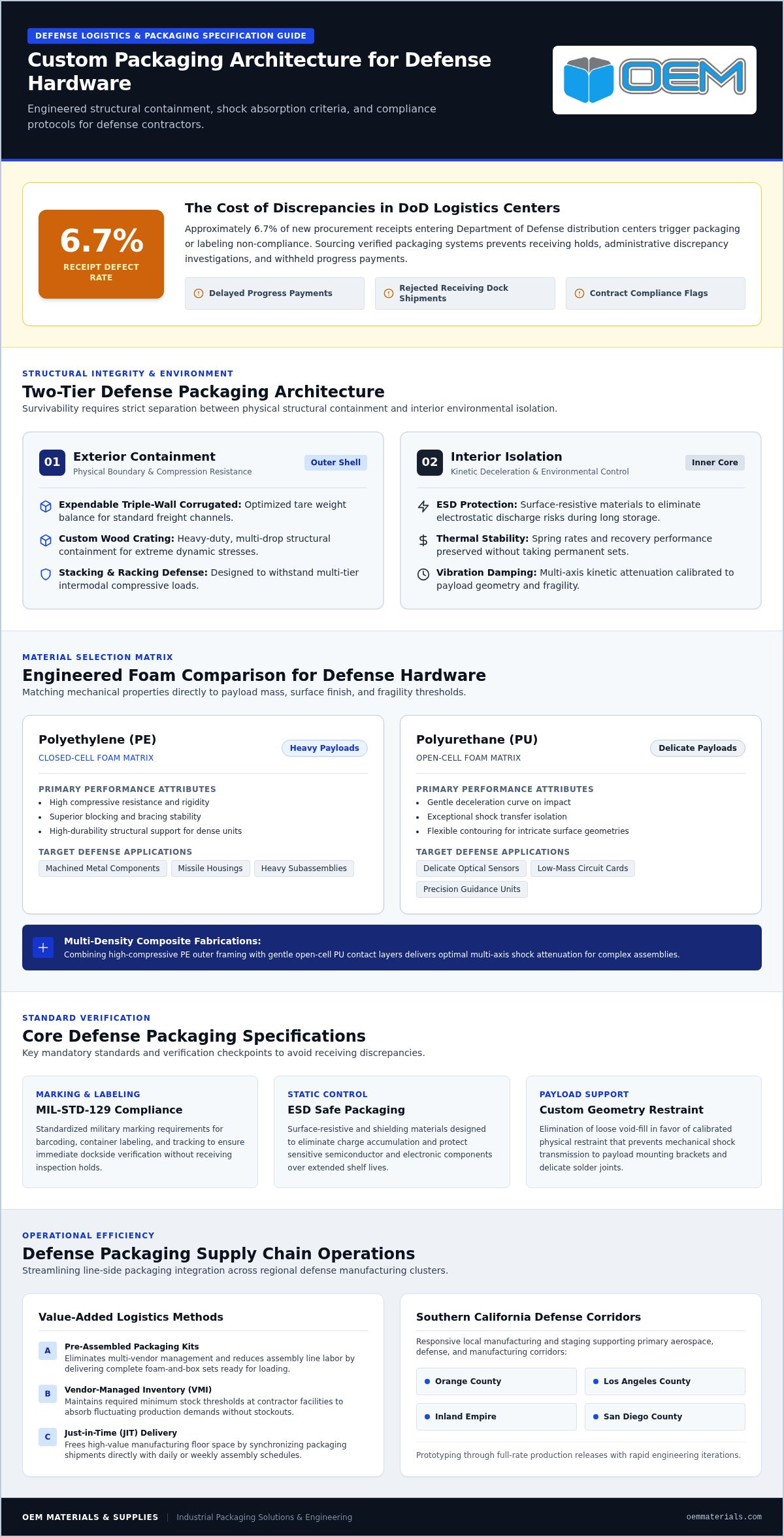
Approximately 6.7% of new procurement receipts entering Department of Defense distribution centers trigger a packaging or labeling defect. For prime contractors and suppliers, that discrepancy often translates into delayed payments, rejected shipments, and administrative headaches. Sourcing dependable custom packaging for defense contractors demands far more than buying heavy-duty boxes off the shelf. When high-value electronics and mission-critical assemblies leave your facility, the packaging must absorb severe transit shock while satisfying rigid compliance standards. You already know that coordinating separate vendors for corrugated cartons, engineered foam, and custom crates drains your production schedule and adds unnecessary assembly labor.
Reliable defense packaging requires engineered material synergy and responsive logistics, not just heavy containers. This procurement guide shows you how to specify, evaluate, and procure custom military-grade packaging to protect sensitive defense hardware and maintain strict contract compliance. We will examine essential material configurations, review critical military standards, and outline how pre-kitted, just-in-time packaging systems keep your assembly lines moving efficiently.
Key Takeaways
- Explore how custom packaging for defense contractors prevents transit damage by matching precision payload geometries to engineered cushioning and heavy-duty containers.
- Compare expendable triple-wall corrugated cartons, engineered foam inserts, and wood crates to balance tare weight against multi-drop structural demands.
- Identify core contractual packaging standards and verification checkpoints to prevent costly receiving discrepancies and shipping holds.
- Follow a step-by-step procurement checklist to assess supplier design expertise, rapid prototyping capabilities, and quality control procedures.
- Streamline packaging operations across Southern California defense corridors using pre-assembled kits, vendor-managed inventory, and just-in-time delivery.
Understanding Packaging Requirements for Defense Contractors
Shipping military-grade equipment involves handling dynamic stress loads that commercial carriers rarely experience. Defense hardware requires packaging engineered to withstand multi-axis vibration, continuous rough handling, and severe environmental shifts. A guidance unit or electronic subassembly cannot simply be placed into an oversized carton with loose void fill. Precision instruments require exact physical restraint and calibrated energy absorption. Procuring robust custom packaging for defense contractors means working with a partner who understands that packaging failure on high-reliability hardware directly jeopardizes defense program schedules.
The Cost of Shipping Failures in Defense Supply Chains
Transit damage in defense logistics is rarely limited to obvious cosmetic dents. Latent damage, such as misaligned optical sensors, fractured solder joints, or cracked circuit boards, often stays undetected until final depot integration. At that stage, receiving docks immediately issue discrepancy reports. This administrative fallout triggers formal investigations, withholding of progress payments, and contract non-compliance marks that threaten future awards.
Survivability requires two distinct protection layers: physical structural containment and interior environmental isolation. Precision-cut custom foam packaging prevents mechanical shock from transmitting directly to payload mounting brackets, keeping components securely seated. Pairing engineered cushioning with the mandatory MIL-STD-129 military marking standard ensures your shipment passes receiving inspection smoothly without dockside delays.
Compliance and Structural Protection Priorities
Every defense procurement contract dictates exact physical protection criteria based on component mass, surface finishes, and electrical fragility. Standard catalog packaging rarely meets these stringent parameters. Packaging systems must perform predictably under real-world logistical pressures:
- Extreme dynamic loads: Outer containers must withstand high compressive forces during multi-tier freight stacking in intermodal shipping containers.
- Thermal stability: Interior foam cushioning must maintain consistent spring rates and recovery performance across wide operating temperatures without crumbling or taking a permanent set.
- Electrostatic discharge: Electronic payloads need surface-resistive materials to eliminate static discharge risks during long-term storage.
Meeting these standards requires agile packaging manufacturing. Whether building five customized prototypes for qualification testing or scaling up for monthly production releases, relying on responsive JIT packaging delivery keeps your packing lines fully operational without tying up floor space with bulky packaging materials.
Core Materials Used in Custom Defense Packaging Solutions
High-performance protective packaging is not just a collection of separate containers and loose filler. True equipment survivability depends on engineered material interaction. The rigid exterior boundary must resist puncture, racking, and overhead compression, while the internal cushioning system isolates specific vibration frequencies and absorbs kinetic deceleration forces. Specifying effective custom packaging for defense contractors requires matching the mechanical properties of each layer directly to the physical vulnerabilities of the payload.
Engineered Foam Packaging: Polyethylene and Polyurethane
Selecting interior cushioning begins with payload mass and surface fragility. Polyethylene foam provides closed-cell structure and high compressive resistance, making it the primary choice for blocking and bracing heavy assemblies, missile housings, and machined metal components. For delicate optics and low-mass circuit cards, open-cell polyurethane foam delivers a gentler deceleration curve that prevents shock transfer during transit drops. Evaluating mechanical resilience and cushion curves through engineering resources on foam inserts ensures the chosen density matches your payload weight. Multi-density fabrications often combine both materials, creating a rigid base with a compliant contact surface. Validated against defense packaging technical specifications, engineered foam prevents harmonic resonance that could loosen critical fasteners.
Heavy-Duty Corrugated Boxes and Die-Cut Solutions
For high-volume subassemblies, heavy-duty corrugated board offers an exceptional strength-to-weight ratio. Double-wall and triple-wall corrugated containers provide substantial edge crush resistance, delivering reliable stacking strength in warehouse racking and multimodal freight containers. Custom die-cut configurations eliminate excess interior volume, lowering freight tare weight and preventing dimensional weight penalties. Evaluating industrial-grade corrugated boxes allows contractors to deploy weather-resistant, single-trip packaging that meets structural load demands without the weight penalty of solid timber.
Heavy Timber Crating and Pallet Bases
Oversized subassemblies, ground support equipment, and payloads exceeding several hundred pounds require structural wood packaging. Custom timber crates provide rigid containment for machinery with asymmetrical geometry or uneven weight distributions. Internal wooden saddles and lag bolts lock heavy components directly to reinforced skids. Integrating heavy-duty industrial pallets ensures warehouse crews and field depots can maneuver assemblies safely using forklifts or pallet jacks without compromising structural integrity. If you need help calculating material load limits for complex payloads, you can request a custom packaging quote from our engineering team.
Evaluating Custom Packaging Formats: Boxes, Inserts, and Crates
Selecting the right packaging architecture depends on logistical cycles, total handling exposures, and component vulnerability. Sourcing effective custom packaging for defense contractors requires matching container mechanics directly to the distribution environment. While some programs demand rugged multi-trip containers for closed supplier loops, others achieve lower overall landed costs with lightweight, high-strength expendable packs.
Fragility Assessment and Shock Absorption Needs
Fragility analysis calculates the maximum G-force an assembly can endure before internal calibration drifts or structural cracking occurs. Standard drop-height metrics dictate the precise cushion thickness required inside the outer container. Precision components benefit from waterjet or CNC-routed cavities tailored to the exact profile of the part. This eliminates generic void fill, keeping parts immobilized against multi-axis vibration during transport.
Expendable One-Way Packs vs. Reusable Transit Systems
Distribution logistics dictate whether expendable or reusable containers provide better operating value. Single-trip packs engineered from triple-wall corrugated and custom foam inserts protect field-bound shipments where return transit is impossible or cost-prohibitive. They eliminate tare weight penalties and remove the need to track return logistics. Conversely, regular shuttle programs between tier subcontractors and prime integration facilities justify heavy-duty wood or composite crates. Evaluating the right approach requires comparing return freight expenses, maintenance requirements, and warehouse storage footprints against initial container fabrication costs.
Environmental Protection and Electrostatic Discharge
Mechanical cushioning alone won’t prevent environmental degradation. Circuit cards and optical sensors require anti-static or conductive foam to prevent latent electrostatic discharge damage. Unpainted metal components and precision-ground surfaces require vapor-corrosion inhibitors and desiccant packs to prevent oxidation during storage in humid depot conditions. On the exterior of the container, high-tension steel or polyester banding can easily crush container walls. Applying heavy-duty edge and corner protectors distributes strapping tension across the load, maintaining carton stacking strength through rough intermodal handling.
Procurement Checklist: Selecting a Packaging Partner for Defense Contracts
Selecting a packaging supplier requires auditing technical competency, production flexibility, and floor-level support. You can’t rely on commodity distributors who merely resell catalog cartons when a contract mandates precise physical containment. Prime contractors need an experienced solutions partner capable of taking a project from initial engineering sketches through serialized production. Sourcing custom packaging for defense contractors demands a disciplined vetting framework that verifies structural capability before placing production purchase orders.
Engineering, Prototyping, and Design Collaboration
Effective defense packaging begins with CAD model integration and physical part digitization. Work with packaging suppliers who provide complete custom packaging design in-house rather than outsourcing drawing reviews to third parties. Fast prototype turnaround allows engineering teams to verify component fitment, connector clearances, and pack-out ergonomics before committing to tooling or high-volume material runs. A prototype drop test identifies stress points early, preventing design revisions during full-rate manufacturing.
Kitting, Pre-Assembly, and Labor Reduction
Assembling multi-part protective packs on your plant floor wastes valuable manufacturing space and inflates direct touch labor. Packaging suppliers should deliver value-added kitting services that eliminate pack-line bottlenecks:
- Pre-bonded assemblies: Outer cartons delivered with die-cut foam inserts permanently bonded in place allow packers to drop components directly into cavities.
- Single-SKU kits: Master packs containing all necessary interior cushioning, secondary dunnage, barrier envelopes, and matching roll stock like stretch film streamline your inventory replenishment.
- Sub-assembly offloading: Outsourcing the assembly of internal dividers and wooden pallet collars frees your certified assemblers to focus on core defense manufacturing.
Supply Chain Resiliency and Quality Assurance
Material consistency across repeated contract releases prevents transit surprises. Verify that your supplier maintains strict lot traceability for closed-cell polyethylene and heavy-duty corrugated board. Review their incoming quality control protocols for verifying board burst strength and foam density tolerances. Dual-sourcing critical raw substrates protects your delivery dates against polymer allocation shortages or paper mill backlogs.
Audit regional proximity as well. Working with a regional manufacturing partner minimizes transport delays and allows supplier engineers to review physical assemblies at your plant. To review your component specifications with an engineering specialist, request a quote and packaging consultation today.
Optimizing Defense Packaging Operations in Southern California
Southern California houses one of the densest aerospace and defense manufacturing corridors in the country. For prime contractors and tier suppliers operating in this industrial base, cross-country freight lines present unacceptable risks to delivery milestones. Sourcing custom packaging for defense contractors through a regional manufacturer removes multi-week transit times for bulky corrugated boxes and structural foam assemblies. Partnering with a supplier operating local warehousing and delivery fleets gives operations managers direct access to responsive, plant-level packaging support.
Vendor-Managed Inventory and JIT Delivery Programs
Floor space in aerospace plants commands a premium. Storing weeks of bulky wooden skids and pre-formed foam cushions clutters staging docks and ties up operational square footage. Implementing an automated packaging VMI program keeps minimum and maximum safety stock levels managed directly by the supplier. Staged packaging inventory releases via scheduled JIT packaging deliveries straight to your packing cells. This approach cushions your production schedule against raw material disruptions while keeping warehouse aisles completely clear for actual hardware production.
Regional Support Across Southern California Aerospace Hubs
Localized logistical coverage provides fast physical response times when contract delivery dates move forward unexpectedly. OEM Materials & Supplies operates direct delivery routes tailored to regional defense hubs:
- Los Angeles and Orange County: Dedicated supply routes serve avionics, optics, and satellite assembly centers requiring rapid sample prototyping and drop-in cushion inserts.
- San Diego County: Reliable transit support serves naval defense, marine hardware, and unmanned systems manufacturers.
- Inland Empire: High-capacity delivery runs provide large-format wooden crates, heavy timber skids, and bulk corrugated cartons across Riverside and San Bernardino facilities.
Initiating Your Custom Packaging Program
Starting an engineered packaging build requires sharing key operational baseline numbers. Engineering teams evaluate exact outer dimensions, finished tare weights, surface coatings, handling environments, and total annual volume requirements. From these data points, packaging designers develop CAD drawings, sample foam cutouts, and test-ready box configurations configured to your payload geometry. You can coordinate directly with regional specialists through OEM Materials & Supplies to begin reviewing physical specifications for upcoming defense contracts.
Upgrade Your Defense Packaging Strategy
Protecting mission-critical assemblies requires a disciplined engineering approach that links interior cushioning directly with outer structural containers. High-reliability components cannot afford transit shock or receiving dock discrepancies. When you match payload vulnerabilities to precision-routed foam inserts, heavy-duty corrugated cartons, or timber crates, you protect both the hardware and your contract delivery milestones.
Procuring reliable custom packaging for defense contractors should streamline your packing operations rather than drain floor labor. OEM Materials & Supplies provides comprehensive packaging design, fabrication, and local fleet delivery throughout Los Angeles, Orange County, San Diego, and Riverside. With localized warehousing, rapid prototype development, and automated VMI programs, our team keeps your pack lines supplied without crowding warehouse aisles. Reach out to our engineering specialists with your product dimensions, payload weight, and anticipated annual usage, or request a custom packaging consultation with OEM Materials & Supplies to strengthen your shipping operations today.
Frequently Asked Questions
What information is needed to design custom packaging for defense equipment?
Designers require your exact part dimensions, gross weight, center of gravity, and maximum allowable G-force fragility rating. Supplying 3D CAD models or physical test parts allows engineers to design precise clearances around delicate connectors and finishes. You should also define the expected distribution environment, handling methods, and long-term storage requirements so the outer container matches physical transit demands.
How do you choose between polyethylene and polyurethane foam inserts?
Base your selection on component mass and surface fragility. Closed-cell polyethylene foam provides firm compressive resistance, making it ideal for blocking, bracing, and immobilizing heavier assemblies. Open-cell polyurethane foam delivers a gentler deceleration curve, which protects lightweight optics and sensitive electronic subassemblies. In custom packaging for defense contractors, multi-layer fabrications often unite both foams to balance structural stability with soft surface contact.
Can custom packaging be engineered for both single-use shipping and depot storage?
Yes, dual-purpose packaging can be built by pairing durable outer containers with resilient interior cushioning. Heavy-duty corrugated cartons or timber crates shield components during freight transit, while closed-cell foam inserts maintain their physical form across extended warehouse holding cycles. Integrating desiccant packs and barrier bags protects internal metal finishes and electrical circuits from moisture damage during multi-year depot storage.
How does vendor-managed inventory benefit defense contractors with limited warehouse space?
Vendor-managed inventory eliminates the need to store stacks of bulky corrugated boxes and foam cushions in active manufacturing bays. Your packaging supplier monitors usage levels and maintains buffer inventory at a regional warehouse, releasing materials in planned stages. This practice frees up high-value floor space for actual hardware integration while preventing line shutdowns caused by sudden packaging stockouts.
What role do packaging kits play in reducing labor costs on manufacturing lines?
Packaging kits consolidate cartons, pre-bonded foam inserts, edge protectors, and stretch film into a single bill-of-materials SKU. Instead of pulling parts from multiple warehouse bins, pack-line personnel receive a ready-to-pack container unit. Assemblers quickly place the payload into designated foam cavities, reducing touch labor, eliminating packing bottlenecks, and maintaining uniform packing quality across shifts.
Why is local packaging supply critical for aerospace and defense contractors in Southern California?
Local suppliers eliminate cross-country transit delays and provide immediate on-site technical support. For plants operating across Los Angeles, Orange County, San Diego, and Riverside, sourcing custom packaging for defense contractors locally allows engineers to verify prototypes in person and arrange scheduled JIT deliveries. Local delivery fleets keep pack lines operational even when defense production milestones accelerate unexpectedly.