
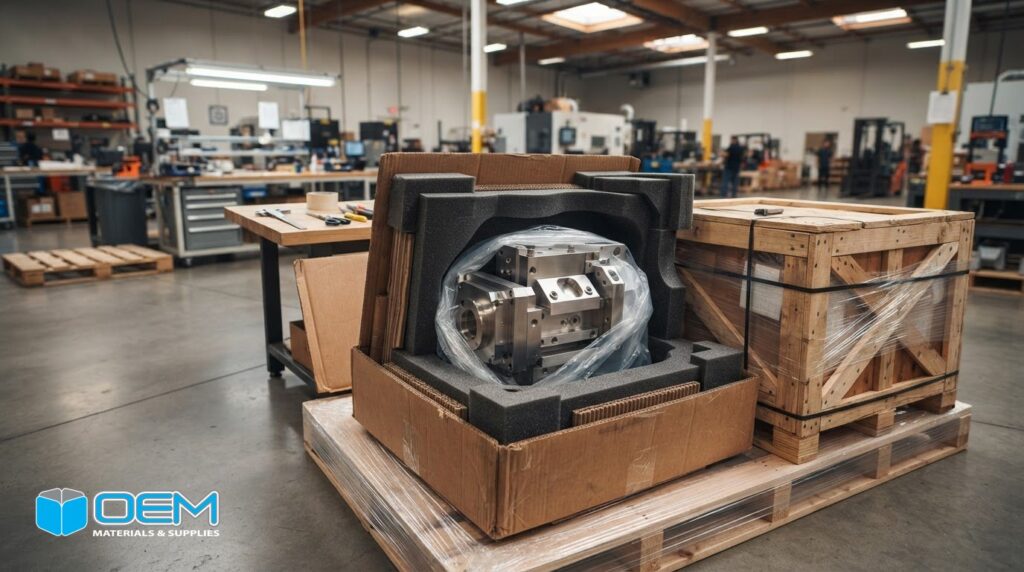
A single hairline scratch or microscopic patch of corrosion can scrap a high-tolerance CNC component before it ever reaches the production floor. Standard corrugated cartons routinely buckle under the weight of dense steel or aluminum, forcing warehouse crews to waste valuable labor hours manually wrapping parts with tape and bubble wrap. Safeguarding exact engineering tolerances requires purpose-built custom packaging for machine parts rather than generic shipping supplies that fail under dynamic transit shock.
You already know that freight damage, surface abrasion, and rejected shipments directly undermine delivery schedules and erode manufacturing margins. In this 2026 buyer guide, you will learn how to evaluate materials, reduce transit damage, and specify engineered custom packaging for heavy or precision machine parts. We cover foam insert selection, moisture and corrosion barriers, and heavy-duty crating specifications to help your facility eliminate transit defects, accelerate pack-out times, and lower total landed costs.
Key Takeaways
- Discover how heavy-duty corrugated containers, fabricated foam inserts, and solid wood crates perform under dense mechanical loads.
- Implement targeted cushioning and barrier methods to protect critical surface finishes, delicate threads, and bare metals against dynamic transit shock.
- Replace labor-intensive manual wrapping with tailored packaging kits that accelerate pack-out speed and lower floor handling costs.
- Optimize outer container sizing and pallet cube utilization to prevent carrier dimensional weight surcharges while maintaining structural rigidity.
- Use a structured technical checklist to specify custom packaging for machine parts accurately, accounting for center of gravity, weight distribution, and distribution routes.
Why Precision Machine Parts Require Engineered Custom Packaging
Precision-machined components leave CNC mills and lathes with surface finishes measured in micro-inches and tolerances held to fractions of a thousandth. Subjecting these components to standard transit conditions without targeted protection invites disaster. Road vibration, harmonic resonance, and sorting drops generate intense dynamic forces that cause metal-on-metal rubbing. When bare surfaces contact each other or abrasive packaging walls, anodized coatings wear away, lapped sealing faces degrade, and fine external threads gall.
Standard packaging rarely solves these industrial transit hazards. Off-the-shelf single-wall cartons lack the structural beam strength needed for concentrated loads. When a dense 40-pound steel spindle or aluminum manifold shifts inside a standard box, the point load concentrates on the bottom flaps or side creases. This leads to box blowouts, puncture failures, and exposed components. Adhering to verified packaging and labeling principles requires containment that accounts for the exact mass and geometry of the part. Specifying engineered custom packaging for machine parts ensures that the package distributes load stresses evenly, preventing transit motion entirely.
The Real Risks of Inadequate Industrial Packaging
Relying on generic supplies creates distinct failure modes on the shop floor and during distribution:
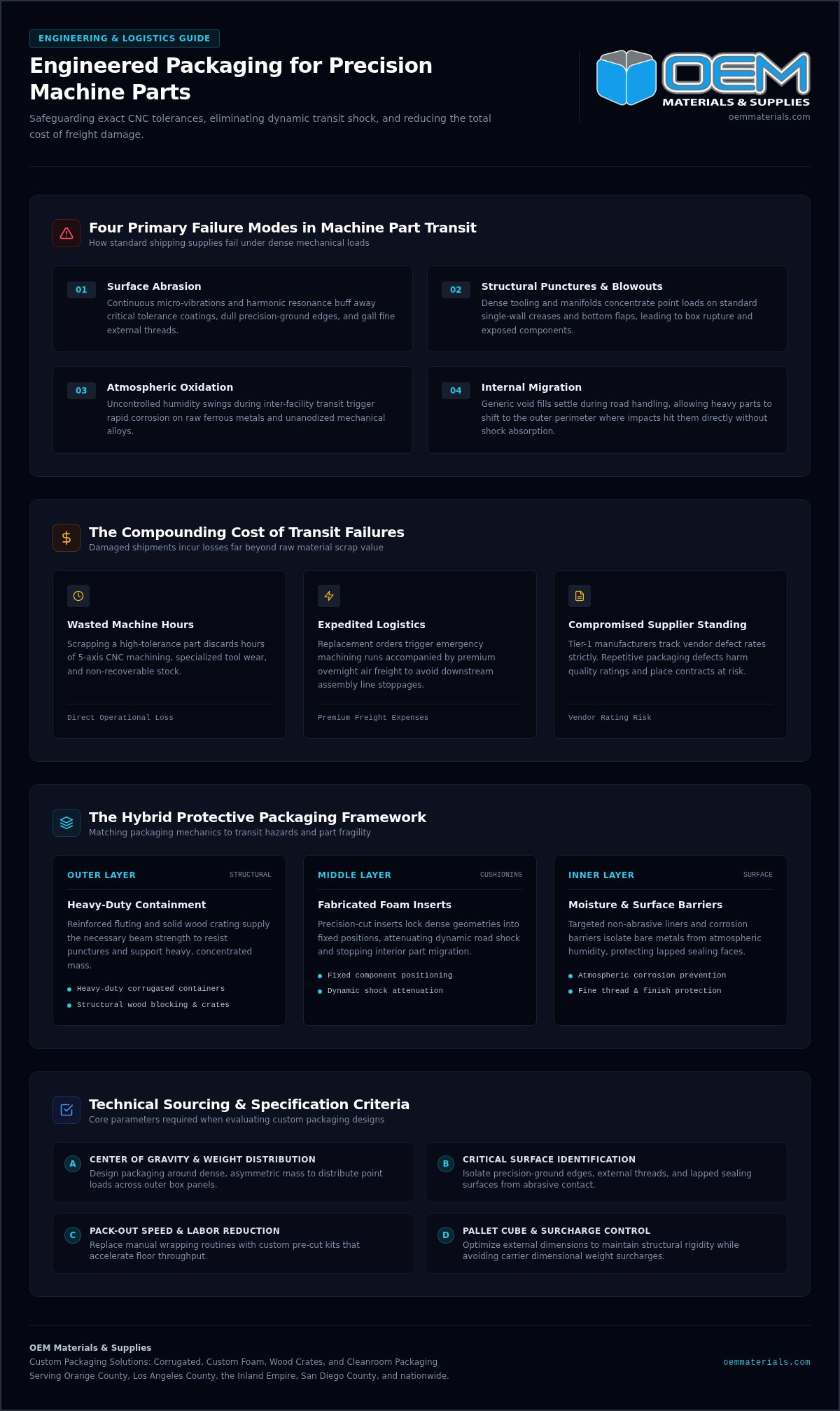
- Surface abrasion: Continuous micro-vibrations buff away critical tolerance coatings and dull precision-ground edges.
- Structural punctures: Dense, sharp-edged tooling components rupture single-wall corrugated board when handled roughly by freight carriers. Specifying heavy-duty corrugated boxes with reinforced fluting stops punctures and corner splits.
- Atmospheric oxidation: Uncontrolled humidity and temperature swings trigger rapid corrosion on raw ferrous metals and unanodized alloys during inter-facility transit.
- Internal migration: Standard void fills like loose foam peanuts settle during transit, allowing heavy parts to migrate to the box exterior where impacts hit them directly. High-performance foam packaging prevents this by locking components into fixed positions.
Calculating the Total Cost of Shipping Damage
The upfront cost of an engineered shipping container is small when compared to the compounding expense of freight failures. When a critical aerospace bracket, medical housing, or automotive drive part arrives damaged, the financial loss extends far beyond simple scrap metal:
- Direct material and machine hours: Scrapping a complex part throws away hours of 5-axis machining time, tool wear, and non-recoverable raw materials.
- Expedited logistics: Replacing rejected shipments requires unscheduled emergency machining runs followed by premium overnight air freight to keep client assembly lines operational.
- Vendor standing: Tier-1 contractors track vendor defect rates ruthlessly. Repeated packaging rejections jeopardize supplier quality ratings and risk losing major manufacturing contracts across Los Angeles and Orange County.
Purpose-built packaging delivers insurance against these compounded losses. Deploying properly engineered custom packaging for machine parts lowers warranty claims, secures part geometry, and protects manufacturing margins across every shipping lane.
Packaging Material Comparison: Corrugated, Foam, Plastics, and Wood
No single packaging material solves every industrial transit risk on its own. While lightweight aluminum brackets might need only light cushioning inside a carton, heavy steel castings require structural wooden blocking to prevent load shifts. Successful protective systems rely on hybrid designs that combine the structural containment of rigid outers with the shock attenuation of fabricated inserts. Following established design frameworks like the ASTM D6198 Standard Guide for Transport Packaging Design ensures that materials match specific transit hazards and component fragilities, making custom packaging for machine parts both structurally sound and cost-effective.
Heavy-Duty Corrugated and Die-Cut Packaging
Corrugated board serves as the outer protective barrier for most small-to-medium industrial parts. Selection depends directly on component mass and wall-bearing demands:
- Single-wall (200# to 275# test): Suitable for lightweight aluminum fittings, small valves, and low-density parts packed in multi-cavity trays.
- Double-wall (350# to 480# test): Standard for mid-weight items such as pump housings, stainless steel flanges, and machined manifolds.
- Triple-wall (1100# test): Delivers exceptional puncture resistance and vertical stacking strength, bridging the gap between heavy paperboard and timber for dense metal goods.
Custom die-cut designs hold parts firmly in place without requiring excessive layers of tape or loose dunnage, speeding up line operations across busy assembly floors.
Engineered Foam Inserts: Polyethylene vs Polyurethane
Interior cushioning must absorb transit shock without bottoming out under heavy loads. Fabricated foam packaging uses two distinct polymers based on weight and surface sensitivity:
- Polyethylene (PE) foam: A dense, closed-cell material engineered for heavy machine components. PE provides high compressive creep resistance, locking sharp tooling and heavy shafts firmly away from outer container walls.
- Polyurethane (PU) foam: An open-cell, softer substrate ideal for low-mass, shock-sensitive equipment, medical components, and easily scratched optical or micro-finished surfaces.
For sensitive electronic housings or aerospace avionics, anti-static (ESD) formulations prevent electrostatic charges from damaging delicate internal circuitry.
Wood Crates and Rigid Outer Containers
When high-tonnage mechanical assemblies exceed corrugated load capacities, solid timber structures become essential. Heavy industrial shafts, rotary tables, and multi-hundred-pound gearboxes rely on custom crates constructed with internal wooden saddles and lag bolts to anchor moving parts directly to the skid base. For closed-loop distribution between machining facilities and regional assembly plants, thermoformed plastic trays and heavy-duty plastic sleeves provide rugged, returnable protection that resists cutting oils and shop debris.
Balancing these materials requires analyzing part mass, surface finishes, and shipping routes. You can request an engineering review to determine the right hybrid substrate configuration for your specific parts.
Critical Engineering Considerations for Machine Part Protection
Machined parts rarely feature uniform geometry or a balanced center of mass. An offset flange on an eccentric shaft creates uneven force vectors that can quickly crush structural cushioning during transit drops. Developing effective custom packaging for machine parts requires calculating part fragility (rated in G-force shock limits), balancing the component mass, and establishing direct load paths that bypass critical functional surfaces.
Corrosion Prevention and Cleanliness Standards
Precision surfaces require chemical and environmental shielding alongside mechanical cushioning. Ferrous alloys, ground tooling, and bare carbon steel corrode rapidly when exposed to relative humidity shifts inside transit containers. Integrating Volatile Corrosion Inhibitor (VCI) poly bags or barrier papers forms an invisible molecular layer that halts rust formation without messy grease coatings. For ocean freight or long-term warehouse storage, adding silica gel or clay desiccants absorbs trapped moisture. When components include integrated sensors, anti-static packaging protects sensitive sub-assemblies from electrostatic discharge.
Cavity Design, Bracing, and Weight Distribution
Dense machine components with sharp gear teeth, precision shoulders, or ground keyways easily puncture standard packaging walls. Using CNC-routed foam inserts ensures an exact nest that supports non-critical surfaces while leaving sensitive threads and edges suspended in free space. Distributing the part weight over a broader surface area prevents localized foam compression. For heavy assemblies packed inside corrugated containers, rigid edge protectors reinforce container corners, preventing the outer box from buckling under dynamic transit loads.
Prototyping, Drop Testing, and Fit Verification
Packaging engineers utilize 3D CAD files (.STEP or .IGES) to design exact protective cavities before cutting production tooling. Rapid physical prototypes allow quality and shipping teams to verify pack-out speed, ergonomics, and part retention directly on the shop floor. Transit simulation testing confirms vibration dampening and impact resistance under realistic logistics stresses. Operations teams can review their physical part drawings with an industrial packaging engineer by submitting their component dimensions for a packaging prototype review.
Optimizing Packaging Efficiency, Storage, and Assembly Workflows
Packaging operations directly affect plant efficiency and operating margins. When technicians spend minutes cutting bubble wrap, rolling tape, and fashioning dunnage, direct labor costs rise quickly. Engineering custom packaging for machine parts solves this bottleneck by turning pack-out into a simple, repetitive process. Purpose-built packs eliminate guesswork, letting production personnel secure components in seconds while maintaining uniform structural protection across every outbound unit.
Cube Utilization and Freight Optimization
Oversized cartons waste money through carrier dimensional weight penalties. Transport carriers charge for dead space, penalizing shippers who pack small, dense items into loose, bulky outer boxes. Sizing custom packaging precisely around component profiles eliminates empty volume and controls dimensional charges. Right-sized containers also match standard GMA wood or plastic pallets perfectly, eliminating overhang that causes freight damage while optimizing trailer cube density. Implementing tailored container sizing delivers measurable packaging cost savings across recurring domestic and export logistics routes.
Streamlining Pack-Out Operations with Pre-Assembled Kits
Pre-configured pack kits cut packaging time on the assembly line. Instead of staging loose cartons, edge pads, and cut foam sheets at individual workcells, plants can source integrated packaging assemblies. Through specialized custom packaging design, foam inserts come pre-glued into corrugated cartons or nested in multi-cavity trays. Assemblers drop parts directly into fitted recesses, verify hardware counts visually at a glance, and seal the box in a single motion.
Vendor-Managed Inventory (VMI) and Just-In-Time Delivery
Bulky packaging supplies consume valuable floor space in busy machine shops and assembly plants. Storing stacks of corrugated cartons and sheets of engineered foam ties up floor square footage that could otherwise hold CNC mills, cleanroom benches, or finished goods inventory. Regional manufacturers leverage vendor programs to keep stock off their production floor:
- Floor space recovery: Packaging inventory stays offsite until needed, converting high-cost manufacturing space into productive assembly areas.
- Stockout prevention: Automated reorder triggers eliminate emergency supply shortages that stall outbound shipments.
- Synchronized supply: Facilities utilize JIT packaging delivery to align supply drops with scheduled production runs across Los Angeles County, Orange County, and the Inland Empire.
Implementing a localized packaging VMI program lets operations managers eliminate inventory carrying costs while ensuring consistent container availability. If your facility is managing high pack-out labor or tight floor constraints, request a packaging workflow assessment to optimize your packaging line.
How to Specify Custom Machine Part Packaging: Sourcing Checklist
Procuring engineered protective packaging requires clear technical data. Simply providing basic box dimensions leaves critical variables open to interpretation, often resulting in loose nests or inadequate load bearing. When sourcing custom packaging for machine parts, giving packaging designers comprehensive part geometry, surface requirements, and distribution metrics ensures the finished system performs reliably from the first production run.
Step-by-Step Packaging Specification Checklist
Before requesting design prototypes or pricing, gather these fundamental parameters:
- Physical dimensions and weight: Record maximum length, width, height, gross weight, and primary center of gravity, noting any asymmetric overhangs.
- Critical surfaces and contact zones: Highlight precision-ground surfaces, sealing faces, bare threading, and designated clamping areas where direct packaging contact is permitted.
- Transit mode and distribution profile: Specify whether parts ship via local courier, LTL freight, multi-leg ocean transit, or commercial air cargo to establish expected shock hazards.
- Production volume and batch cadence: Define initial pilot lot quantities, annual usage forecasts, and batch delivery frequencies to optimize tooling investments.
Collaborating with a Regional Packaging Partner
Partnering with a regional packaging supplier simplifies sampling and speeds up technical iterations. When working across Southern California, proximity allows packaging engineers to visit manufacturing floors directly in Orange County, Los Angeles County, the Inland Empire, or San Diego. Direct physical access lets designers evaluate part handling workflows, measure clearance constraints at assembly cells, and test prototypes in real time rather than waiting days for mailed samples. Sourcing locally reduces logistics lead times and strengthens supply chain resilience.
Requesting Quotes and Design Prototypes
Starting an engineering evaluation is straightforward when you supply native CAD files. Providing 3D models in .STEP or .IGES format allows packaging engineers to import exact component geometry directly into CAM software. Designers program precise CNC foam cuts, evaluate clearances for secondary barrier films, and establish structural wall thicknesses around heavy features.
Once CAD designs are modeled, physical sample prototypes verify fit, component retention, and pack-out ergonomics on your production line before volume tooling begins. When you are ready to engineer reliable protection for finished components, visit our quote page to submit your component dimensions and annual usage requirements for a comprehensive packaging consultation.
Upgrade Your Industrial Packaging Strategy
Protecting high-tolerance components requires moving past generic cartons and manual void fill. Pairing dense closed-cell foams with reinforced corrugated containers or structural wood crates preserves critical surface finishes, controls dimensional freight costs, and speeds up pack-out operations across your facility floor.
OEM Materials & Supplies delivers custom packaging for machine parts to aerospace, medical, automotive, and industrial manufacturing facilities across Southern California and nationwide. From localized vendor-managed inventory and scheduled JIT delivery in Los Angeles and Orange County to fast physical prototyping from native CAD models, we engineer protective solutions built for demanding logistics routes. When you are ready to eliminate transit scrap and streamline your assembly packaging, request a custom packaging quote from OEM Materials & Supplies to begin evaluating your component specifications.
Frequently Asked Questions
How does custom packaging protect precision machined parts during freight transit?
Custom packaging isolates finished metal surfaces from shock, vibration, and abrasive contact during transit. By pairing contoured foam cavities with rigid corrugated outers or heavy-duty wood crates, custom packaging for machine parts locks components into a fixed position. This prevents metal-on-metal collision, eliminates load shifting, and stops external impact energy from transferring into delicate threads, ground bores, or micro-finished surfaces during inter-facility shipping across Southern California freight corridors.
What information is needed to design custom packaging for machine components?
Designers require physical component dimensions, gross weight, center of gravity, and 3D CAD models (.STEP or .IGES files). You should also identify sensitive surface zones, bare threading, anti-corrosion needs, and transport methods like LTL trucking or air cargo. Providing your expected order volumes and assembly line pack-out requirements helps engineers specify appropriate corrugated wall strengths, foam densities, and pre-assembled kit designs tailored to your production workflow.
Which foam density is best for heavy industrial metal parts?
High-density closed-cell polyethylene (PE) foam ranging between 2.0 and 4.0 pounds per cubic foot performs best for heavy industrial parts. Unlike softer open-cell polyurethane, rigid polyethylene resists compressive creep under substantial weight. It won’t bottom out under dense steel or brass assemblies, keeping heavy tooling, spindles, and shafts securely suspended away from outer container walls during repeated transit impacts.
Can custom machine part packaging prevent rust and surface corrosion?
Yes, custom packaging systems prevent oxidation by integrating Volatile Corrosion Inhibitor (VCI) films, barrier papers, and desiccants directly into the pack design. VCI materials release protective vapors that bond to bare metal surfaces on a molecular level, stopping moisture and rust formation during transit or warehouse storage. This chemical protection eliminates the need to apply and degrease heavy oils or messy rust-preventative cosmoline.
Is custom packaging cost-effective for low-volume or prototype machine runs?
Custom packaging remains cost-effective for short runs and prototypes when designed using digital knife tables and CNC foam routing, which avoid expensive hard tooling dies. For high-value aerospace or medical components, the cost of custom packaging for machine parts is minor compared to the severe expense of scrapping a single precision part or paying for emergency replacement machining and expedited freight.
What is the standard turnaround time for custom packaging prototypes?
Initial packaging prototypes typically turn around within several business days once engineers receive complete 3D CAD files or physical sample components. For manufacturers located in Los Angeles, Orange County, Riverside, or San Diego, regional packaging partners provide rapid physical sampling, allowing teams to run immediate drop tests, check cavity tolerances, and evaluate pack-out ergonomics on the factory floor before signing off on volume production.
How does custom packaging reduce shipping and freight expenses?
Custom packaging reduces freight expenses by eliminating excess exterior box volume that triggers carrier dimensional weight penalties. Tailored containers maximize pallet cube density, fitting more units securely onto standard pallets without overhang. Standardizing container sizing also avoids unscheduled freight re-shipments for damaged goods, while pre-configured pack kits cut the manual labor hours required to assemble and tape standard boxes on the shop floor.