
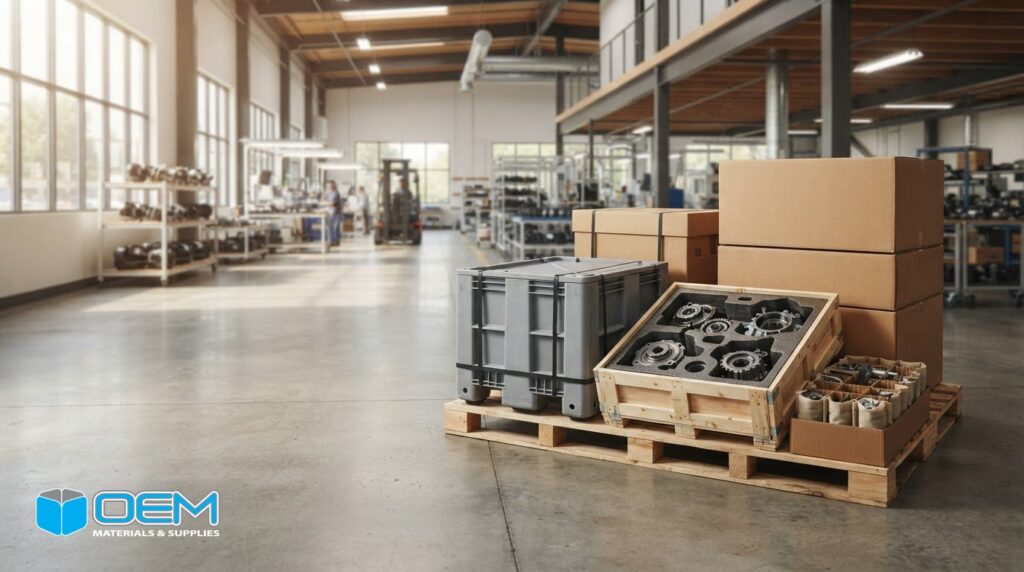
The most durable shipping crate isn’t always the right choice for your assembly line. Automotive packaging efficiency depends on matching container durability directly to part vulnerability. When specifying custom automotive containers, engineering and procurement teams constantly wrestle with a core operational question: should you deploy expendable heavy-duty corrugated cartons or invest in returnable bulk container systems?
You already know the steep costs of transit damage, poor trailer cube utilization, and surface abrasions that lead to immediate part rejections at the OEM plant. Standard boxes often fail under dynamic freight loads, while inefficient interior packaging inflates line-side unpacking labor. This guide evaluates structural substrates, engineered foam dunnage, and returnable versus expendable container systems so you can specify the exact packaging architecture your parts require. We examine stack strength calculations, protective barrier integration, and replenishment strategies that maximize trailer load density while protecting your bottom line.
Key Takeaways
- Match outer shell architectures, from heavy-duty triple-wall corrugated to structural plastic totes, directly to your part’s mass and transit hazards.
- Compare expendable packaging economics against returnable systems based on freight corridors, reverse logistics capabilities, and regional footprint.
- Calculate dynamic stack loads and internal component immobilization requirements to stop cosmetic scuffing and transit fatigue before parts ship.
- Integrate precision foam packaging, custom fabric cells, and molded dividers into custom automotive containers to streamline line-side operator ergonomics.
- Vet packaging manufacturers on rapid physical prototyping, tool design rigor, and local vendor-managed inventory programs that safeguard production uptime.
Understanding Custom Automotive Containers: Types and Material Architectures
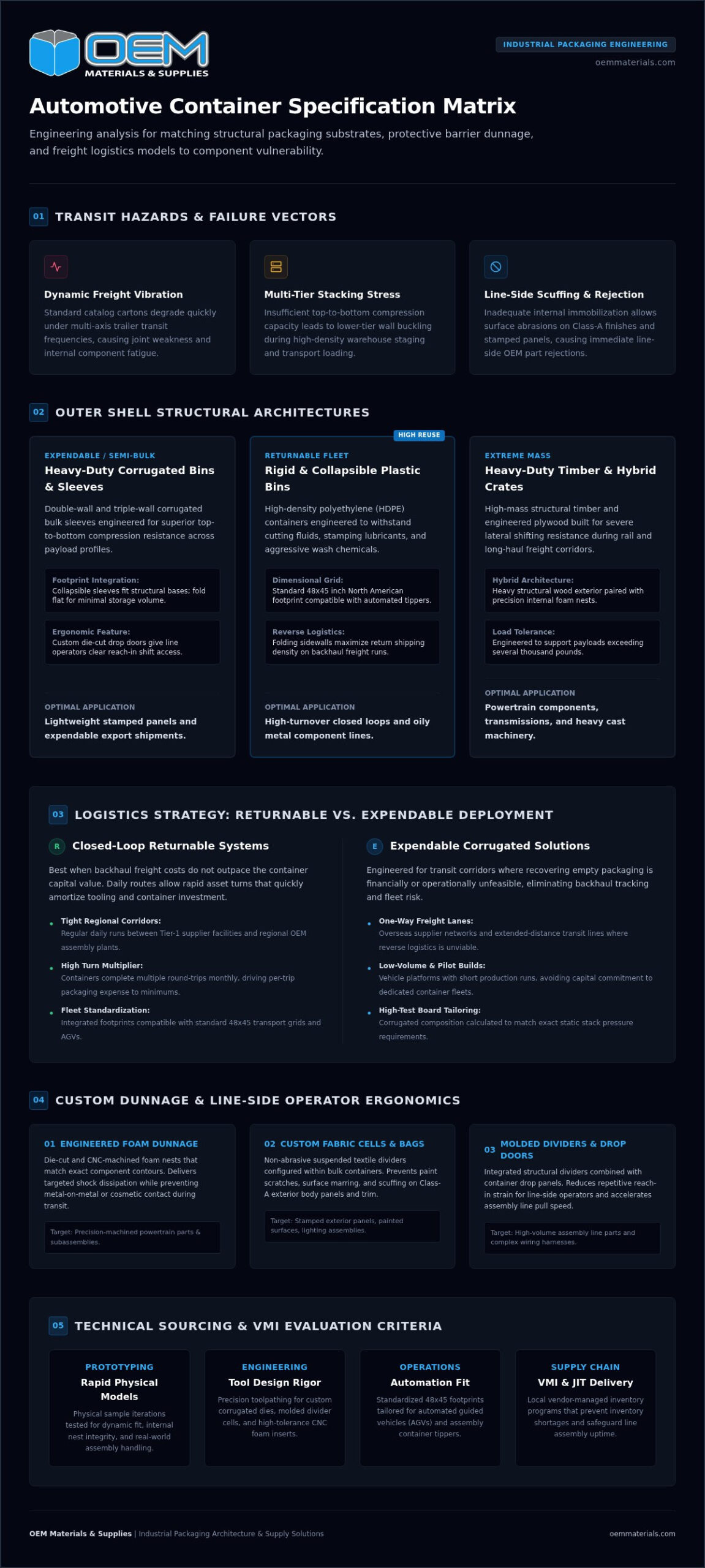
Industrial automotive packaging must endure severe logistical abuse. Tier-1 suppliers ship stamped body panels, complex wiring harnesses, precision-machined powertrain parts, and sensitive subassemblies through extensive freight networks. Standard catalog packaging fails rapidly under dynamic trailer vibration and multi-tier warehouse stacking. Specifying effective custom automotive containers requires an engineering balance of tare weight, compression resistance, and outer footprint compatibility with automated guided vehicles (AGVs) and assembly lines.
Heavy-Duty Corrugated Bulk Bins and Sleeves
Double-wall and triple-wall corrugated bulk bins deliver superior top-to-bottom compression strength for heavy payload profiles. When sourcing custom corrugated boxes, operations managers often specify collapsible corrugated sleeves fitted to structural bases. These systems fold flat during storage, preserving valuable square footage in regional manufacturing facilities. Custom die-cut drop doors give line operators clean reach-in access, reducing ergonomic strain during repetitive shift pulls.
Rigid and Collapsible Plastic Bulk Bins
High-density polyethylene (HDPE) bulk containers withstand cutting fluids, stamping lubricants, and aggressive wash-bay chemicals. In closed loops, adopting reusable packaging cuts long-term per-trip operational expenditures while standardizing container fleets across supply bases. Rigid plastic bins feature folding sidewalls to maximize return shipping density on backhaul freight, built on standard 48×45 inch footprints that lock securely into North American automotive transport grids.
Heavy-Duty Crates and Hybrid Wood Packaging
High-mass mechanical components demand the sheer load-bearing strength of structural timber and engineered plywood. Heavy powertrain components, transmission assemblies, and casting machinery rely on rugged industrial crates that resist severe lateral shifting during rail and long-haul transit. Modern hybrid packaging pairs heavy wood frames with precision foam nests, delivering structural rigidity on the outside and pinpoint surface scratch protection on the inside.
- Corrugated Sleeves: Excellent for lightweight stamped panels and expendable export shipments requiring high vertical stack strength.
- Molded Plastic Bins: Best for high-turnover closed loops handling oily metal components and automated container tippers.
- Timber and Hybrid Crates: Built for dense payloads exceeding several thousand pounds where rigid exterior immobilization is essential.
Returnable vs. Expendable Packaging: Engineering the Right Automotive Container Strategy
A successful packaging strategy rarely relies on a single container type. While returnable plastic bins offer long service life, they become financial liabilities when backhaul freight costs outpace the container value. Packaging engineers must evaluate transport distances, dwell times, and supply loop control to decide between expendable fiberboard and returnable plastic systems. When specifying custom automotive containers, the optimal design reflects the logistical reality of the transit lane, not just the physical geometry of the part.
When to Deploy Expendable Corrugated Systems
Expendable corrugated bulk containers excel in one-way logistics corridors where recovering empty packaging is cost-prohibitive. Overseas supplier shipments, pilot production runs, and low-volume vehicle builds benefit from single-trip fiberboard packaging. Using high-test corrugated sleeves avoids the capital risk of buying large fleets of returnable bins for vehicle platforms with short manufacturing runs. To align board grades with specific stack loads, review our guide on corrugated packaging box manufacturers to balance board composition against static warehouse pressures.
When Closed-Loop Returnable Systems Deliver Maximum ROI
Returnable containers provide significant long-term value in tight regional networks. Daily truck runs between Tier-1 plants and regional assembly facilities allow containers to turn multiple times per month, amortizing upfront tooling and material investments quickly. Molded plastic containers also offer dimensional consistency across hundreds of trips. This exact repeatability ensures robotic de-palletizing cells and automated pick-and-place equipment grip containers without sensor faults or handling jams.
Financial and Environmental Impact Metrics
Evaluating total cost of ownership requires looking beyond the initial container purchase price. Real operating costs include backhaul freight, tracking overhead, periodic container washing, and container shrinkage from lost inventory. Returnable bins significantly reduce solid waste disposal fees at the plant, helping operations meet strict sustainability targets. Meanwhile, expendable corrugated assemblies integrate cleanly into existing recycling streams without specialized reverse processing. For hybrid operations, using returnable plastic outer shells paired with expendable corrugated partitions offers high durability alongside low replacement costs.
Every supply chain carries different transit variables and inventory turn rates. If you need assistance modeling fleet sizing and reverse logistics for your line, request a packaging consultation to evaluate both expendable and returnable configurations.
Core Engineering Criteria for Protecting Automotive Components
Protecting precision components during freight transit requires precise structural engineering, not guesswork. An automotive assembly contains sensitive sub-elements: bare stamped metal susceptible to oxidation, micro-finished exterior trim prone to scratching, and electronic sensor clusters easily damaged by electrostatic discharge. Building dependable custom automotive containers means designing against the full spectrum of static loads, transport harmonics, and environmental hazards encountered from Tier-1 sub-assembly cells to the final integration line.
Edge Crush Test (ECT) and Stacking Strength Calculations
Static warehouse stacking demands accurate Edge Crush Test (ECT) ratings. Stacking containers three or four tiers high in a distribution warehouse creates immense vertical compression forces on lower cartons. Packaging engineers apply dynamic safety factors, usually between 3 and 5, to calculate the necessary McKee compression values. These safety buffers account for ambient humidity, long-term warehouse dwell times, and the cyclic vertical shock experienced inside dry vans traversing highway expansion joints. Adding heavy-duty solid fiberboard or corrugated corner posts reinforces perimeter corners, preventing sidewall buckling under sustained multi-ton loads.
Shock, Vibration, and Part-to-Part Collision Defense
Dynamic transport vibration causes internal part movement that damages Class-A exterior surfaces. Micro-vibrations generate cosmetic scuffing and clear-coat haze on painted bumpers or decorative consoles if contact surfaces lack non-abrasive lining. For bare machined components, uncontrolled internal movement causes metal-to-metal impact, dinging critical mating faces and compromising precision tolerances. Packaging engineers calculate vibration resonance profiles to ensure container divider walls, dunnage pockets, and isolation sleeves absorb harmonic peaks instead of transferring energy into the parts.
Environmental Protection: Moisture, Oil, and ESD Risks
Automotive components face chemical, electrical, and climatic risks throughout distribution. Engineering a reliable container shell requires targeted barrier integration based on the payload chemistry:
- Corrosion Control: Unfinished cast iron or steel stampings require water-resistant outer barrier boards or volatile corrosion inhibitor (VCI) poly linings to prevent oxidation during cross-country freight runs through humid zones.
- Machining Oil Resistance: Powertrain components often arrive with residual stamping oils or rust-preventative coatings. Oil-resistant polymer barrier coatings on corrugated walls stop oil seepage from breaking down the fiberboard matrix and degrading container stacking strength.
- Electrostatic Discharge (ESD) Shielding: Electronic control units (ECUs), sensor suites, and autonomous driving modules require conductive or static-dissipative container linings. These specialty materials bleed off surface charges, preventing electrostatic pulses from damaging onboard microchips.
By engineering custom automotive containers around these physical and chemical demands, manufacturers reduce scrap rates and eliminate costly line-down sorting operations at the plant.
Custom Dunnage and Interior Cushioning Integration
An outer shipping shell only protects against external warehouse impacts. Inside the bin, delicate components face constant abrasion and shock loads if they are allowed to migrate. The true engineering behind effective custom automotive containers lies in precision interior dunnage. Selecting proper dunnage materials depends directly on component mass, cosmetic sensitivity, chemical exposure, and intended cycle life. Engineered interior cavities not only stop part-to-part contact during bumpy transit, but they also optimize orientation so line operators can pick parts rapidly without unpackaging delays.
Engineered Foam Packaging and CNC Routing
Precision-milled foam cradles provide targeted shock absorption for complex, high-value components. Cross-linked polyethylene (XLPE) foam provides a non-abrasive, closed-cell surface that protects high-gloss Class-A painted components and instrument panels from scuffing. When sourcing engineered foam packaging, operations teams often pair XLPE with high-density polyurethane foam to absorb repeated heavy shock pulses around fragile electronics. CNC waterjet cutting allows packaging designers to carve exact 3D pocket contours matching complex automotive CAD data, ensuring heavy castings rest securely in place without point-load stress.
Corrugated and Solid Fiber Partitions
Interlocking partition sets organize bulk containers into clean, multi-cell grids for stamped brackets, lights, and small subassemblies. Laminated with spunbond polypropylene fabric, corrugated partitions cushion sensitive plastic surfaces from friction rub marks. Unlike rigid molded dividers, these die-cut partition sets collapse flat inside the container sleeve during return transit, maximizing trailer pack density on empty backhauls.
Pallet Integration and Unit Load Stabilization
Individual automotive containers must function as a rigid unit load on the plant floor. Incompatible pallet bases cause stack shifting, conveyor jams, and forklift tines puncturing bottom cartons. Securing container sleeves onto heavy duty plastic pallets creates a stable, interlocked footprint that resists transport slippage. Applying heavy-duty edge protectors and high-yield stretch film around the container perimeter prevents lateral wall deflection when trailers bank around highway ramps.
Stop transit damage and accelerate line-side assembly rates with engineered interior dunnage. Send us your CAD models and component weights to request a custom dunnage design tailored to your production workflow.
Sourcing and Supply Chain Execution: Evaluating Custom Automotive Container Manufacturers
Specifying packaging designs is only half the battle. If your packaging supplier cannot maintain reliable delivery schedules or support fast revisions during tooling ramp-up, your entire production schedule risks stalling. Procuring custom automotive containers requires partnering with an engineering-led fabricator rather than a catalog distributor. A capable packaging partner provides both technical design validation and regional logistics infrastructure to maintain assembly uptime.
Rapid Prototyping and CAD Verification
Never approve high-volume production runs based solely on 3D computer models. Digital renderings cannot account for hand-clearance tolerances or physical material memory under dynamic loads. Working with an engineering team capable of full-scale physical prototyping allows operators to conduct physical fit checks on the line. Through our custom packaging design department, engineers test robotic end-effector clearance and verify drop resistance before high-volume manufacturing starts. These physical trials confirm that parts slide smoothly into nested pockets without binding or catching on internal divider tabs.
Regional Logistics: JIT Delivery and VMI Programs
Automotive supply chains operate on lean inventories. Storing truckloads of assembled containers on an active assembly floor wastes valuable manufacturing space. Automotive suppliers across Southern California rely on regional warehousing hubs to balance high packaging volume against tight floor space. Through local warehousing across Orange County, Los Angeles County, and the Inland Empire, our team supports just-in-time delivery and vendor-managed inventory programs. Staging container stock in Riverside and Los Angeles allows manufacturers to pull packaging on demand, avoiding plant shutdowns caused by unexpected shipping delays.
Requesting Quotes and Design Consultations
To accelerate container engineering and establish accurate load profiles, provide your supplier with comprehensive part and transit details during the initial quoting phase. Be prepared to share:
- Part Dimensions and CAD Files: 3D geometry identifies critical contact faces, delicate sensor brackets, and center-of-gravity points.
- Payload Weight and Volume: Exact part weights dictate the required Edge Crush Test (ECT) ratings or plastic sidewall ribbing.
- Transit and Handling Environment: Detailed notes on freight corridors, forklift types, and automated guided vehicle (AGV) interfaces ensure seamless material handling.
Engaging packaging specialists during the initial design phase avoids expensive retooling delays. Connect with OEM Materials & Supplies to review your component specifications and initiate a prototype build.
Engineer Resilient Packaging for Your Automotive Supply Chain
Preventing assembly plant part rejections requires packaging engineered around the real hazards of your freight corridor. Successful operations don’t rely on generic catalog boxes; they match payload fragility to purpose-built custom automotive containers. Whether your components require heavy-duty triple-wall corrugated bulk bins, structural timber crates, or precision-routed foam dunnage, aligning exterior container rigidity with tailored interior support protects critical tolerances and reduces scrap rates.
Reliable packaging performance also depends on responsive supply chain execution. OEM Materials & Supplies combines full-service design and rapid prototyping with local warehouse staging across Los Angeles, Orange County, and Riverside. Our just-in-time delivery and vendor-managed inventory programs keep your production floor supplied with the exact packaging kits you need, right when you need them.
Ready to eliminate shipping damage and optimize trailer load density? Send your part dimensions, weight profiles, and annual volumes to our engineering team to Request an Automotive Container Quote today.
Frequently Asked Questions
What materials are best for custom automotive containers?
The optimal material depends on component mass, transit corridor distance, and surface vulnerability. Heavy-duty triple-wall corrugated board works best for one-way export shipments where container return isn’t practical. High-density polyethylene (HDPE) excels in closed regional loops requiring chemical resistance. For extreme payloads exceeding several thousand pounds, timber crates with internal cross-linked polyethylene foam cushioning provide the necessary structural stability and shock absorption.
How do returnable plastic bulk bins compare to heavy-duty corrugated containers?
Returnable plastic bulk bins provide superior multi-trip durability and washability for closed regional loops, but they carry high upfront purchase costs and require backhaul freight management. Heavy-duty corrugated containers require zero return logistics, eliminate asset loss tracking, and fold flat to maximize plant floor space. Sourcing managers choose corrugated for one-way exports or seasonal production spikes, while plastic bins dominate high-turnover local supply loops.
What information is needed to design a custom automotive container?
Packaging engineers need part 3D CAD files, exact component weights, center-of-gravity locations, and surface finish specifications. You should also provide transit lane data, target pack density per container, and warehouse stacking height limits. Details regarding whether parts are unloaded manually or via automated robotic pick-and-place systems ensure drop doors and internal dunnage pockets provide proper clearance for tooling and line operators.
How do custom automotive containers protect Class-A painted surfaces?
Preventing surface abrasions requires non-abrasive interior contact materials that isolate painted panels from transit vibration. Custom automotive containers utilize closed-cell cross-linked polyethylene foam trays or spunbond polypropylene fabric partitions. These smooth barrier surfaces prevent vibration haze, clear-coat scuffing, and particulate scratching during transport, ensuring parts arrive at Southern California assembly facilities ready for immediate exterior installation without buffing or rework.
What is the standard footprint for automotive shipping containers in North America?
The primary standard footprint for automotive packaging across North America is 48 inches by 45 inches, established by AIAG standards. Sub-modular footprints include 24×15 inch, 24×22 inch, and 32×30 inch container sizes. Adhering to these standard dimensions ensures containers lock securely onto standard plastic pallets, maximize trailer cube utilization inside 53-foot dry vans, and interface smoothly with automated warehouse racking systems.
Can custom automotive containers incorporate ESD protective materials?
Yes, containers can incorporate static-dissipative or conductive materials to safeguard sensitive electronics like engine control units and sensor modules. Packaging engineers integrate carbon-loaded conductive corrugated dividers, anti-static foam inserts, or static-shielding film liners. These materials safely dissipate electrostatic charges before they reach onboard microchips, protecting sensitive electronic assemblies from invisible gate breakdown and circuit damage during transit and line-side handling.
How do vendor-managed inventory programs work for automotive packaging?
Vendor-managed inventory (VMI) transfers packaging stock monitoring and replenishment responsibility to your packaging partner. Suppliers maintain agreed safety stock levels in local warehouses across Los Angeles, Orange County, and Riverside, delivering containers just in time to your facility based on daily production schedules. This structure eliminates packaging stockouts, prevents production line downtime, and frees up valuable factory floor space for active manufacturing cells.