
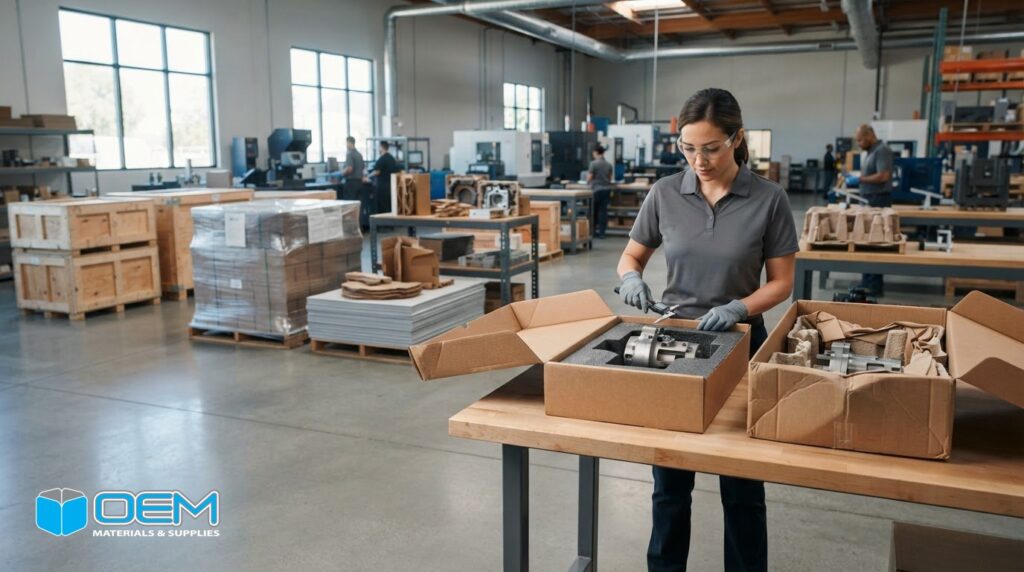
The cost of product damage due to poor packaging often goes well beyond replacing the item. A damaged shipment can also require return freight, inspection, replacement handling, customer service, and time spent resolving the incident. For manufacturers, damage to a component may disrupt downstream operations.
It’s easy to focus on the unit cost or assume that adding more packaging will prevent repeat damage. But upgrades can add material, labor, storage, and handling costs, and the right protection depends on the product and shipping conditions. Start with consistent incident data rather than assumptions.
This article explains how to estimate damage costs and connect incidents to possible packaging failure modes. You’ll learn what costs to include, how to look for patterns across products and shipments, and how to compare practical changes using operational evidence. Options such as corrugated boxes, foam packaging, and cushioning materials can then be evaluated against observed damage and their effect on packing requirements and total fulfillment cost.
Key Takeaways
- Calculate the cost of product damage due to poor packaging by separating confirmed direct expenses from estimated operational impacts.
- Treat packaging failure modes as hypotheses, then compare incident records with observable damage patterns before changing materials.
- Evaluate current and proposed packaging under comparable product and shipping conditions, tracking material use, labor, damage frequency, and documented downstream costs.
- Where practical, use a controlled packaging evaluation and record the configuration and shipment conditions to guide the next decision.
- For recurring damage or complex protection needs, consider reviewing product and shipping requirements with an industrial packaging partner.
What Does Product Damage Due to Poor Packaging Really Cost?
Poor-packaging damage is loss or impairment associated with inadequate protection, fit, containment, or shipment preparation. Packaging is intended to contain and protect products during transport, as outlined in this overview of the science, art, and technology of enclosing or protecting products. A damaged shipment alone, however, doesn’t prove that packaging caused the problem. Handling, the product’s condition before shipment, and transit conditions may also contribute.
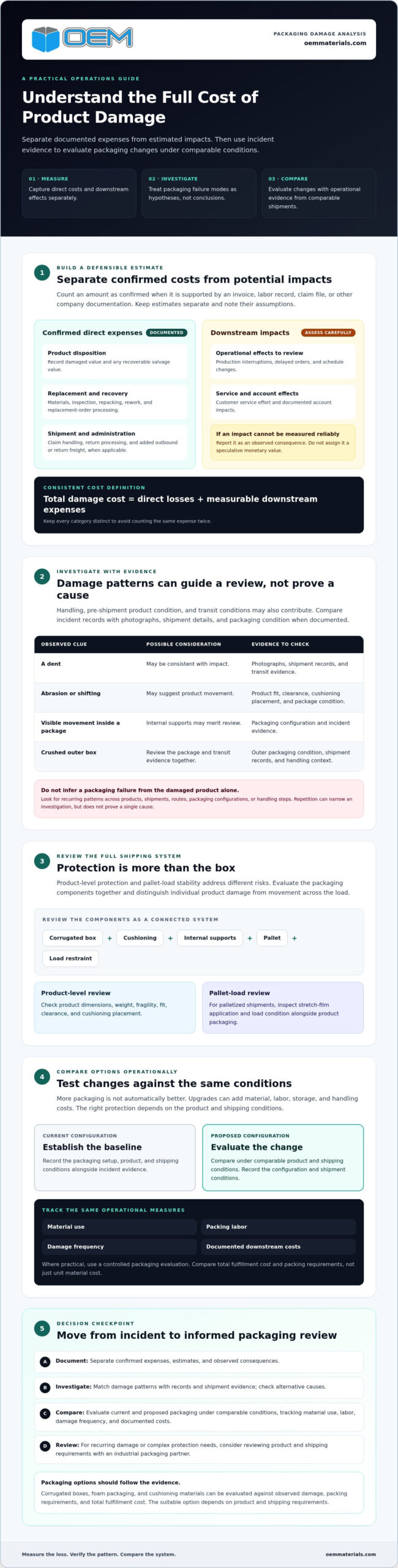
To estimate the cost of product damage due to poor packaging, separate recorded expenses from potential impacts. Mark an amount as confirmed when it appears in an invoice, labor record, claim file, or other company documentation. Keep estimates separate and note their assumptions. This makes the estimate more useful for comparing incidents and evaluating packaging changes.
Which direct costs belong in a damage estimate?
Start with the damaged product’s recorded value, then account for its disposition. If it can be salvaged, record the recoverable value rather than counting the full product value as a loss. Track replacement materials and labor for inspection, repacking, rework, and replacement-order processing separately. Include claim administration, return handling, and added outbound or return freight when applicable. Keep each category distinct to avoid counting the same expense twice.
- Product: Damaged value and recoverable salvage value.
- Replacement and recovery: Materials, inspection, repacking, and rework.
- Shipment and administration: Replacement-order labor, claim handling, return processing, and added freight.
What indirect impacts should operations teams review?
Compare production interruptions, delayed orders, and schedule changes with internal production and shipping records. Note customer service effort and any documented account impacts, but don’t assign them a speculative monetary value. If an impact can’t be measured reliably, report it separately as an observed consequence rather than a confirmed expense.
Total damage cost is direct losses plus measurable downstream expenses. Apply that definition consistently across incidents. A product replacement may be a confirmed direct cost, for example, while the operational effect of a schedule change should remain an estimate unless company records support its valuation. If incident evidence points to inadequate cushioning or product movement, packaging options such as foam packaging may be worth evaluating. The suitable option depends on the product and shipping requirements.
How Packaging Choices Can Contribute to Shipping Damage
Damage patterns can point to packaging features worth reviewing, but they don’t establish the cause by themselves. A dent may be consistent with impact, while abrasion or shifting may suggest product movement. The same damage could also involve handling, pre-shipment product condition, or transit conditions. Treat each possible packaging failure mode as a hypothesis to check against incident records and shipment evidence.
Look for recurring patterns. Does the same product show similar damage across shipments? Is the damage associated with one route, packaging configuration, or handling step? Repetition can help narrow the investigation, but it doesn’t prove a single cause. Check what evidence supports or rules out each possibility before changing packaging.
Match damage evidence to a possible packaging issue
Compare the location and type of damage with photographs, shipment records, and the packaging condition, when documented. Check product fit, clearance, cushioning placement, and closure condition. Visible shifting inside a package may justify reviewing internal supports, for example, while a crushed outer box calls for reviewing the package and transit evidence together. Don’t infer a packaging failure from the damaged product alone.
Consider the complete shipping system
Product-level protection and pallet-load stability address different risks. Review the corrugated box, cushioning, internal supports, pallet, and load restraint as a combined system. At the same time, distinguish damage to an individual product from movement or instability across the load. Product dimensions, weight, fragility, shipping requirements, and distribution conditions all affect which features merit review.
For palletized shipments, inspect stretch-film application and load condition alongside the packaging around each product. Stretch film may be one element to evaluate, but it doesn’t replace suitable product cushioning or containment. The International Safe Transit Association provides resources on transport packaging and performance testing. Select any test approach for the product and distribution conditions under review.
Connect the evidence to the packaging configuration. Repeated abrasion near a contact point may warrant checking clearance and cushioning placement; recurring load shifts may point to reviewing pallet restraint and unit-load stability. These are leads for investigation, not conclusions about cause. A packaging design review can help teams assess product and shipping requirements together before defining a change.
How to Compare Damage Costs With Packaging Improvement Options
A packaging change is worth evaluating when it addresses an observed risk without creating a larger burden in material use, labor, storage, or shipping. Compare the current setup with a candidate under equivalent conditions. Keep the product family, shipment conditions, and reporting period consistent so the results are meaningful. A material change alone doesn’t establish the cost of product damage due to poor packaging. Incident and operating records must show how the outcome changed.
Build a useful baseline before changing packaging
Record shipment volume, product family, damage type, packaging configuration, and incident date. Use invoices, claims, quality records, and labor tracking to establish documented costs rather than relying on generalized benchmarks. Separate confirmed figures from estimates, and label assumptions that need validation. If shipment conditions or reporting periods differ, note those differences instead of treating the results as directly comparable.
Compare packaging alternatives on more than material cost
Consider packing time, assembly effort, storage needs, disposal, and shipping fit alongside damage frequency and documented downstream costs. Depending on the observed issue, a review may include corrugated boxes, foam, cushioning, or crates. Each option should suit the product’s dimensions, weight, fragility, and shipping requirements. A custom packaging design review can help assess those needs. Foam is one possible option when incident evidence points to a cushioning need, not a default solution for every product.
Use a comparison table to make assumptions visible. Keep the same units and definitions across the current and proposed configurations.
| Measure | Current packaging | Proposed packaging |
|---|---|---|
| Materials and configuration | Record materials and setup | Record proposed materials and setup |
| Labor and packing time | Use observed labor records | Measure or estimate, label basis |
| Storage, assembly, disposal | Document current requirements | Document expected requirements |
| Shipment volume and conditions | Define products and period | Match the comparison basis |
| Damage frequency and type | Use incident records | Track consistently after change |
| Downstream costs | Separate confirmed and estimated | Use the same cost categories |
Compare the complete fulfillment impact, not just material expense. Any potential savings depend on product dimensions, materials, and shipping requirements. Judge a proposed configuration using recorded performance and operating demands, and keep estimates distinct until company data can validate them.
A Practical Process for Reducing Packaging Damage
Reducing damage starts with a repeatable review, not an immediate material change. Use the steps below to connect incident evidence to a specific packaging adjustment, then assess the result against your operating requirements.
- Establish a baseline. Define the product family, current packaging configuration, shipment volume, reporting period, and damage categories. Record labor and documented downstream expenses using consistent definitions.
- Inspect incidents. Gather available photographs, packaging samples, shipment records, and quality or claim documentation. Note what is known, what is estimated, and what information is missing.
- Identify likely failure modes. Review the evidence for possible product movement, cushioning gaps, weak containment, or load instability. These are investigation leads, not proof that packaging caused the damage.
- Define a focused change. Adjust a relevant packaging feature, such as fit, cushioning placement, or containment. When a focused evaluation is practical, avoid changing several variables at once.
- Review the result. Compare the same damage, labor, and service measures after the change. Document shipment volume and conditions so differences in the comparison are visible.
Turn damage records into a packaging review
Bring purchasing, engineering, warehouse, quality, and shipping teams into the review. Each group can help verify a different part of the process, from material selection and product requirements to packing steps and shipment handling. Prioritize recurring patterns or incidents that disrupt operations, while recognizing that not every incident is preventable or packaging-related.
Validate a proposed packaging change
Document the current and proposed configurations, materials, labor steps, and applicable shipping conditions. Where practical, define review criteria in advance for a small, controlled evaluation, using company damage records, labor data, and service requirements. Compare equivalent products and conditions over a suitable period, and record differences in shipment volume. If evidence points to a cushioning need, review whether foam packaging and inserts suit the product and shipping requirements.
A material with a higher unit cost may still warrant consideration if documented changes in damage, handling, or rework offset that difference. Conversely, added protection may not be justified if it increases packing effort without addressing the observed issue. Assess the total operational effect, not material cost alone. Any savings depend on product dimensions, materials, and shipping requirements, so validate conclusions against your own records before standardizing a change.
For a packaging review based on your product and shipping requirements, request a packaging quote and include available dimensions, weight, and shipment details.
When to Work With a Packaging Partner on Damage Costs
An internal review may be enough to correct a clear packing error. Recurring damage, inconsistent incident records, or complex protection requirements can call for a broader assessment. A packaging partner can help compare the product, current configuration, and shipping conditions, then identify practical options to evaluate. The goal is a better-informed decision, not an assumption that packaging is the sole cause or that a change will eliminate damage.
OEM Materials & Supplies works with manufacturers on industrial packaging needs, including custom corrugated boxes, foam, cushioning, and crates. Its packaging design support can help teams assess product and shipping requirements, with capabilities for prototypes, short runs, and high-volume programs. The appropriate option depends on the product and distribution conditions, and any cost impact should be checked against operational records.
What information helps a supplier assess packaging needs?
Share product dimensions, weight, fragility concerns, current packaging, and available damage records. Include shipment method, known handling conditions, order volume, and operational constraints such as packing steps or storage space. If you’re considering a new configuration, ask how a prototype or packaging design review could help assess its fit for the product and intended shipments.
Consider packaging supply and process requirements together
A packaging recommendation also needs to work in the warehouse. Review how materials are stored, assembled, and used, along with any supply or production constraints. If box construction is under review, consider corrugated box options alongside the product’s protection requirements. Share annual usage and relevant operating details so the discussion can account for packaging performance needs and supply planning.
For manufacturers in Orange County, Los Angeles, San Diego, and Riverside, OEM Materials & Supplies can discuss packaging requirements and quote options based on the information provided. To scope a useful review, prepare product dimensions, weight, annual usage, current packaging, damage records, and shipping requirements, then contact the team to discuss a quote or packaging design consultation.
Turn Damage Records Into a Better Packaging Decision
A useful estimate of the cost of product damage due to poor packaging includes more than the damaged item. Track confirmed direct losses and measurable downstream expenses, then compare packaging options against consistent incident, labor, and shipment data. Treat damage patterns as evidence to investigate, not automatic proof that packaging caused an incident.
OEM Materials & Supplies supports packaging reviews with custom corrugated, foam, cushioning, and crate options, from prototypes and short runs to high-volume production programs. The right approach depends on product dimensions, materials, and shipping requirements. The company serves manufacturers throughout Southern California and across the United States.
For a packaging quote or consultation, share product dimensions, weight, annual usage, current packaging, and shipping requirements. Request a packaging quote or consultation to start a practical review of your needs. Consistent evidence can help your team make a more confident packaging decision.
Frequently Asked Questions
How do you calculate the cost of product damage due to poor packaging?
Add documented direct losses, including damaged product value, replacement materials, inspection, rework, and added freight. Then review measurable downstream impacts such as labor, delays, and claim administration. Keep confirmed costs separate from estimates, and record the assumptions behind each estimate. Compare results against shipment volume and product mix for the same reporting periods. Otherwise, a change in incident counts could reflect a different number or type of shipments rather than a packaging improvement.
What costs should a business include when a product is damaged in transit?
Start with product loss, replacement or repair, inspection, repacking, and additional freight. Depending on the incident, include staff time, return handling, claim administration, and documented production or delivery disruption. Use invoices, labor records, and incident files to support the estimate. Customer service effort and account effects can be recorded, but avoid assigning a dollar value to reputation or customer impacts unless your company has a defensible method. Apply the same categories consistently.
Can poor packaging cause product damage during shipping?
Yes. Packaging can contribute to damage if protection, fit, cushioning, closure, or load stability doesn’t suit the product and shipment conditions. It isn’t the only possible cause. Handling, the product’s condition before shipment, and transit conditions may also contribute. Review incident records, packaging samples, and shipment details together before deciding that a packaging change is the right corrective action. Treat a suspected packaging issue as a hypothesis to investigate, not a proven cause.
How can a company tell whether packaging is causing damage?
Look for recurring patterns by product, packaging configuration, route, and damage type. Review photographs, incident reports, available handling records, and the condition of the packaging. Check whether the product moves inside its package or whether the palletized load appears unstable. These observations can help narrow the investigation, but they don’t prove cause on their own. Involve operations, warehouse, quality, or engineering staff to assess the evidence and shipment process together.
Is custom packaging worth the additional material cost?
It depends on the product, materials, shipping requirements, packing labor, and damage records. Compare the current configuration with a proposed design using similar products and shipment conditions. Include assembly, storage, and handling effort alongside material use and documented damage costs. Custom packaging may be worth evaluating when records point to a protection or fit issue. Validate the outcome with company data, since results depend on the specific product and its distribution requirements.
What information should I provide for a packaging damage assessment?
Share product dimensions and weight, fragility concerns, current packaging, shipment method, and documented damage patterns. Annual usage, packing steps, storage or handling constraints, and available photographs or damaged packaging samples can also help clarify requirements. OEM Materials & Supplies works with manufacturers in Orange County, Los Angeles, San Diego, and Riverside, as well as nationwide. These details help the team assess relevant packaging options without relying on generic assumptions or unsupported savings estimates.