
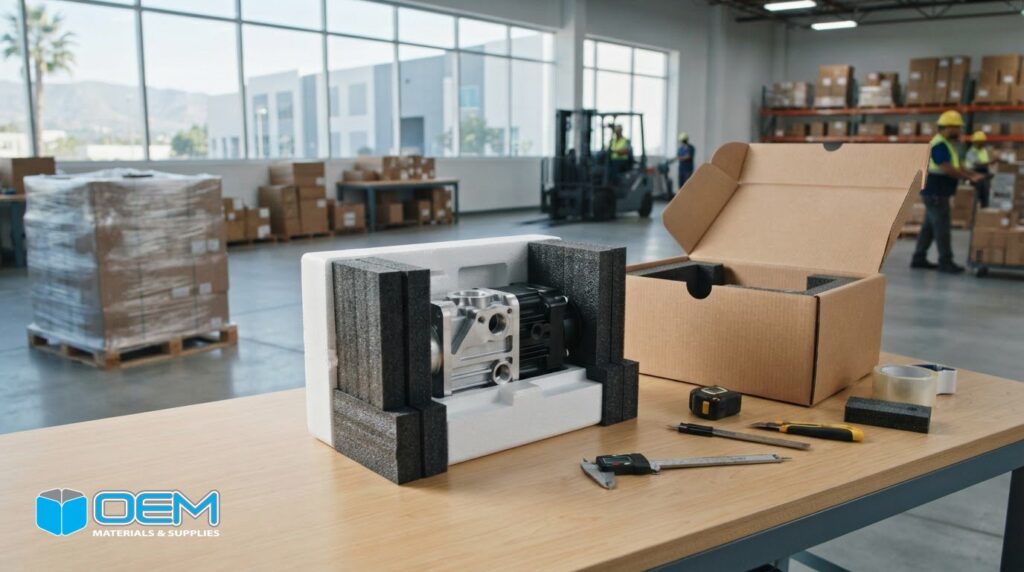
A foam end cap can fit a product and still create problems if it doesn’t work with the outer box or packing process. Choosing foam end caps for product protection means accounting for product geometry, shipping conditions, and how the package is assembled, not just adding cushioning where damage occurs. For manufacturers in Orange County, Los Angeles, Riverside, and San Diego, that system-level fit matters to the teams designing and packing the shipment.
Purchasing, engineering, and warehouse teams often face the same trade-off: general cushioning may leave vulnerable areas exposed, while a close-fitting design can affect packing time or fit across product models. Start by comparing how different end-cap configurations support and position the product.
This guide compares common configurations and explains which product and shipping details inform a practical design. It also covers how to assess fit with the corrugated box and packing workflow, and what information to prepare for a quote or design discussion. Product dimensions, weight, fragility, and shipment details provide a useful starting point. OEM Materials & Supplies develops custom foam packaging from prototypes through production, helping teams address recurring damage or packing concerns with a solution designed around the product and its shipment.
Key Takeaways
- Match foam end caps for product protection to the product’s geometry and the areas most exposed to movement, contact, or impact.
- Compare paired supports, enclosing sets, and designs with internal features by fit and packing motion, not coverage alone.
- Review the end caps with the outer container to weigh protection, material use, packing effort, storage, and reuse.
- Prepare product dimensions, weight, fragile features, shipping method, and expected packing volume for a practical design discussion.
- Use samples to evaluate fit and packing workflow before planning a production solution.
When Foam End Caps for Product Protection Make Sense
Foam end caps are shaped cushioning components positioned at a product’s ends or other defined support areas. They can make sense when damage points to a specific risk: the product shifts in its box, an end or edge contacts the container, or handling exposes a vulnerable area to impact. Rather than surrounding every surface, end caps focus cushioning where the package needs to support or locate the product.
Foam end caps are shaped supports that cushion selected product areas and help position an item within its package. Their role depends on the product, the packing method, and the shipping enclosure. End caps complement the outer package, but selecting them alone does not establish that the full package is suitable for handling and transit.
The broader principles of package cushioning include managing shock and vibration through the complete package design. For buyers, that means connecting observed damage to a specific support need before choosing a configuration. Foam end caps for product protection are worth evaluating when a product has identifiable ends, edges, or support points and the concern is localized rather than spread across its full surface.
Which product and shipping problems can end caps address?
Start with the damage location and the product’s geometry. End caps may suit a component with clear ends that can be supported without covering its entire length. For example, a long, rigid component could rest in shaped supports at both ends inside a correctly sized box. The supports can help locate the part and cushion selected contact areas. Review the center section and other exposed surfaces separately, especially if they could touch the box or another item during shipment.
This distinction helps diagnose recurring damage. Marks concentrated near an end or edge suggest a different packaging need from scratches across a broad face or damage to attached accessories. End caps address localized support requirements. They may not be suitable when the product needs continuous surface separation, multiple contact points, or protection for components packed alongside it.
When are end caps not the whole packaging solution?
The outer box, crate, or other shipping enclosure completes the package system. It must accommodate the product and cushioning while supporting the intended packing arrangement. End caps don’t protect every exposed face by themselves, and loose accessories may need separate retention or cushioning to keep them from moving into the product. Review how the product is loaded, positioned, and removed, not just how the foam sits around it.
When an item needs support across several areas or has a complex shape, broader foam packaging may be more appropriate. OEM Materials & Supplies develops custom foam packaging around product requirements, considering the enclosure and packing workflow alongside the cushioning. This broader view helps distinguish a focused end-cap requirement from a need for more complete product support.
Compare Foam End-Cap Configurations by Product Geometry
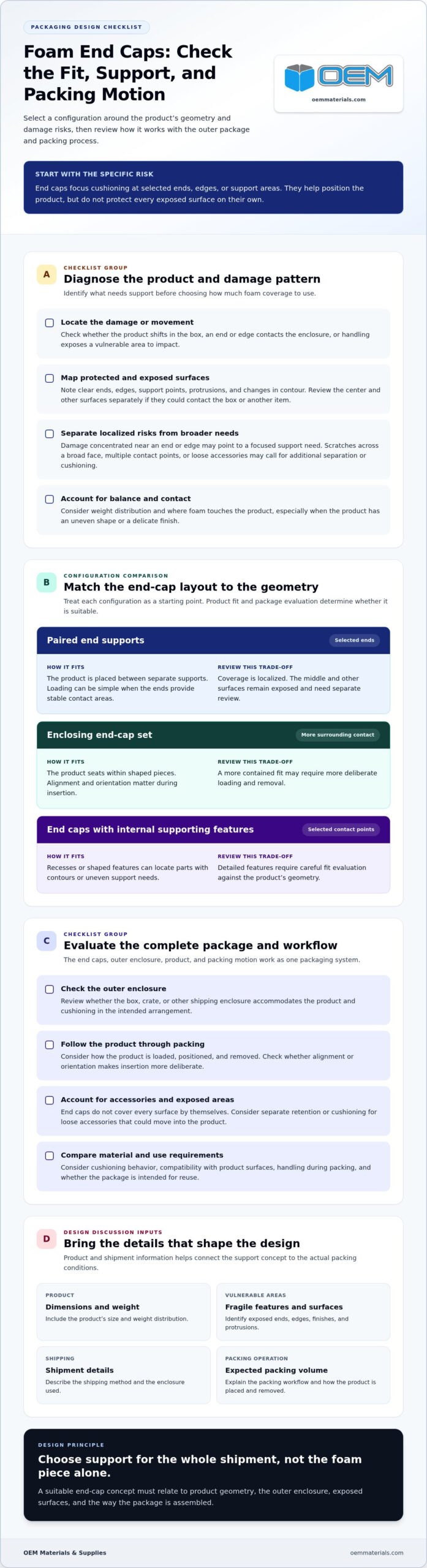
Choose a configuration based on the product’s shape and how operators place it in the package. A design that supports two stable ends may be straightforward to load, while an irregular product or one with sensitive protrusions may need more contact points or broader coverage. Treat configuration labels as a starting point, not proof of performance. Product fit and package evaluation determine whether a concept is suitable.
| Configuration | Support area | Product fit and packing motion | Design trade-off |
|---|---|---|---|
| Paired end supports | Selected ends or end regions | Product is placed between separate supports; loading can be simple when the ends provide stable contact areas. | Uses localized coverage, but leaves the middle and other surfaces exposed for separate review. |
| Enclosing end-cap set | End regions with more surrounding contact | Product seats within shaped pieces; alignment and orientation matter during insertion. | Can provide a more contained fit, but may require more deliberate loading and removal. |
| End caps with internal supporting features | End regions plus selected internal contact points | Recesses or shaped features locate parts with contours or uneven support needs. | Can address specific geometry, though more detailed features require careful fit evaluation. |
How does product shape affect the end-cap layout?
Regular products often offer predictable contact surfaces. Elongated products may be supported at separated points, while irregular shapes can require supports around protrusions or changes in contour. For delicate finishes, consider where and how the foam touches the product. Uneven weight distribution matters too: support locations should account for the product’s balance rather than assuming both ends carry equal load. Map protected and exposed surfaces before deciding how much coverage is needed.
How should buyers compare foam material options?
Compare candidate materials by cushioning behavior, compatibility with product surfaces, handling during packing, and whether the package is intended for reuse. As general examples, polyethylene foam is often selected for a firmer, resilient cushioning approach, while polyurethane foam is a softer option for some delicate items. These are broad material distinctions, not specifications for every application. OEM Materials & Supplies develops custom foam packaging around product and packaging requirements.
For each proposed configuration, check that the product seats consistently, stays oriented as intended, and can be packed without forcing or awkward repositioning. Then evaluate the assembled package, since the box or crate affects available space and how the components fit together. Configuration names alone cannot establish protection, so sample evaluation should reflect the actual product and package. NIST’s packaging and labeling standards information addresses packaging and labeling requirements, a separate consideration from selecting cushioning geometry.
For a configuration discussion, share your product dimensions, weight, shape, and packing requirements so the design can be considered in context.
Evaluate the Complete Package, Not Just the Foam End Caps
A foam end cap can fit the product and still create a poor pack-out if it leaves too much clearance in the box, interferes with closure, or makes loading awkward. Review the product, cushioning, and outer container as one assembly before approving a design. Effective end caps must fit both the product they support and the package that contains it.
A package-level review also makes trade-offs easier to identify. More coverage may address additional contact areas, but it can use more material or take longer to position. A compact design may be easier to store, while a more complex set of parts may need clearer packing instructions. These are project-specific considerations, not automatic savings or drawbacks. Product dimensions, materials, shipping requirements, and packing volume all affect the comparison.
What should the package-level fit review cover?
Start with the end-cap dimensions and the available space inside the selected outer container. Check that the product seats as intended, doesn’t shift into the box, and isn’t pressed at a fragile point. Confirm that the foam doesn’t obstruct flaps, lid placement, or other closure features. The outer container must accommodate the protected product without forcing components into position.
Review the actual packing sequence, too. Does the operator place one end cap first, lower the product into it, then fit the other support? Can the package be closed without repositioning the product or unintentionally compressing components? Include the intended shipping orientation. If the box may be handled or stored in more than one orientation, assess those conditions as part of the package evaluation.
Accessories and product variations can change the result. A cable, bracket, or loose component may need its own location so it doesn’t contact the main product. If several models share packaging, compare their dimensions and contact points rather than assuming one fit works for all. Include the corrugated box in the fit review because its interior dimensions and closure affect the assembled package.
How do reuse and production workflows change the decision?
Define whether the package is intended for one shipment or a planned return-and-reuse cycle. For repeat use, consider how end caps are removed, inspected, stored, and placed back into service. Storage footprint and handling requirements matter alongside product fit. For single-use packaging, priorities may differ, but the full pack-out still needs review.
Production conditions matter as well. Account for how many components operators handle, where packaging is staged, and whether the same sequence is used across shifts or locations. A design that depends on a specific orientation should make that orientation clear and repeatable. If product models change, document the applicable configuration to reduce packing mix-ups.
For a package-level review in Orange County, Los Angeles, Riverside, or San Diego, share the product dimensions, weight, accessories, outer-container details, shipping method, reuse expectations, and expected packing volume through a foam packaging project inquiry. Those details help frame a design discussion around the complete package and the work required to pack it.
Use a Practical Foam End-Cap Selection Checklist
A clear set of requirements helps engineering, operations, and procurement evaluate the same design criteria. Use this checklist to move from product details to a sample review without overlooking the packing process or shipping context.
- 1. Define the product. Record dimensions, weight, orientation, and the surfaces or components most vulnerable to damage. Note protrusions, delicate finishes, and any features that should not bear contact.
- 2. Describe the damage concern. Identify where damage occurs and what it looks like, such as marks on an edge or movement inside the package. Include photos of damaged products or the current pack-out when useful.
- 3. Document the shipment. Note the shipping method, typical handling steps, distribution conditions, and number of units packed together. Include expected packing volume or annual usage to help frame production needs.
- 4. Capture the current package. List the existing foam, box, crate, or other packaging components. Share available drawings, dimensions, or packaging samples if you have them. These can clarify the starting point, but aren’t prerequisites for a design discussion.
- 5. Review the proposed fit. Evaluate the end caps with the product and outer container. Check positioning, exposed areas, closure clearance, and the sequence operators follow to assemble the package.
- 6. Evaluate a sample. Have relevant engineering and packing personnel handle the sample. Observe product fit, movement, ease of loading and removal, and any adjustments needed before planning production.
What product and shipping information should buyers gather?
Be specific about dimensions and weight, and explain which way the product should sit in the package. Describe surface sensitivities, fragile features, accessories, and variations between product models. Shipment details should include the route or distribution context, handling steps, and pack quantity. Photos of existing packaging can show how the product is positioned and where contact or movement may occur.
How should a proposed design be evaluated before production?
Evaluate samples in the actual outer container when possible, using the normal packing sequence and involving the people who handle the pack-out. Record fit issues and workflow adjustments rather than relying only on a visual review. OEM Materials & Supplies supports packaging development from prototypes through production, connecting end-cap requirements with the complete package through custom packaging design.
For a practical discussion, share your foam end-cap requirements with OEM Materials & Supplies, including product dimensions, weight, vulnerable features, shipping method, current packaging, and expected packing volume. This gives the team a useful basis for discussing foam end caps for product protection and next steps toward a sample or production plan.
Move from Foam End-Cap Requirements to a Scalable Packaging Solution
A workable foam end-cap concept needs a clear path from initial requirements to repeatable purchasing. The project can move through four stages: define product and shipping needs, develop a packaging concept, evaluate samples, and plan production. Each stage gives engineering, operations, and procurement a chance to resolve fit or workflow issues before they become routine across orders.
For foam end caps for product protection, the concept should account for the full package. End caps may work alongside a corrugated box, crate, or other compatible components. If accessories need separate placement or the package includes multiple items, a packaging kit or coordinated set of components may support a consistent pack-out. The right combination depends on the product and how it moves through the operation.
- Define: Document product variants, shipment conditions, packing volume, and the damage concerns the design should address.
- Develop: Align the end-cap concept with the outer package and the steps operators use to pack and close it.
- Evaluate: Review samples with the product and package, and capture adjustments needed for fit or handling.
- Plan: Establish approved specifications and expected quantities for prototype, short-run, or high-volume needs.
These stages connect development to sourcing. Prototype and short-run requirements may focus on evaluating a concept or supporting a limited production need. High-volume programs also require planning for recurring quantities, specification consistency, storage, and replenishment. OEM Materials & Supplies supports packaging projects from prototypes through high-volume programs, tailoring the packaging approach to the product and operating requirements.
What does a packaging partner contribute to the project?
A packaging partner can coordinate decisions across cushioning, the outer container, and packing operations rather than treating each component in isolation. For manufacturers in Orange County, Los Angeles, Riverside, and San Diego, local packaging support can connect requirements, sample evaluation, and production planning. Nationwide programs may also need consistent specifications across locations, so teams can work from a shared packaging concept.
How can the solution support repeatable purchasing and operations?
Once a design is approved, clear specifications help purchasing and warehouse teams align on which components to order, how they fit together, and when replenishment is needed. If packing includes multiple components or assembly steps, kitting or assembly may fit the workflow. Vendor-managed inventory can also be considered when coordinating ongoing packaging supply is part of the program.
OEM Materials & Supplies develops custom foam packaging as part of a broader packaging solution. To discuss a project, provide product dimensions, weight, current packaging, and annual usage, along with known damage concerns and shipping details. Request a quote or packaging design discussion to move from requirements toward a sample and production plan.
Set the Next Packaging Decision in Motion
Turn the damage concern into a clear design objective your team can evaluate. That objective gives engineering and operations a practical way to judge whether the proposed package fits the product and the work required to pack it. It also keeps the decision focused on the shipping challenge rather than on a foam component in isolation.
OEM Materials & Supplies develops custom packaging solutions for manufacturers, from early prototypes to production programs. A coordinated design discussion can align foam end caps for product protection with the broader packaging approach and operating needs.
Start a foam end-cap packaging discussion and share product dimensions, weight, current packaging, shipping details, and expected usage to move toward a practical design review.
Frequently Asked Questions
Can foam end caps be used with a reusable shipping package?
Yes, provided the end caps remain suitable for use throughout the planned return cycle. Set an inspection point for incoming packages and define what condition requires review or replacement, such as visible tears, permanent distortion, or a changed fit. Record issues by shipment or return cycle so the team can spot recurring wear patterns. This gives operations a consistent basis for deciding whether components can reenter service.
Can one end-cap design protect more than one product model?
Sometimes. To manage a shared design, create a model-to-packaging reference that identifies approved products and any required orientation or setup differences. Have engineering review product revisions, since even a small change can alter how the package is used. If models require different pack-out steps, document them clearly so warehouse teams can distinguish the correct configuration during mixed production.
Do foam end caps eliminate the need for an outer box?
No. End caps are not a shipping enclosure. The enclosure provides structure for containing the packed item and is selected for the product’s distribution needs. Keep the two decisions linked in purchasing records: an end-cap design approved for one package configuration should not be assumed to fit a replacement box with different interior dimensions or closure features. Review any outer-package change before using the existing foam setup.
Can foam end caps work with automated or high-volume packing?
They may be suitable if the parts can be presented and placed reliably within the existing process. During a production trial, observe whether end caps arrive in the right orientation, feed consistently, and stay positioned through the next packing step. Record stoppages, manual corrections, and operator workarounds. This feedback helps teams decide whether to adjust the foam geometry, staging method, or work instructions before expanding use.
What information helps determine whether foam end caps are a suitable option?
In addition to basic product details, provide the current packaging specification and describe where and how damage appears. A photo of a damaged item beside its packaging can help connect the failure to a contact point or pack-out condition. If you have multiple product revisions, identify which version the proposed design must accommodate. These details keep the design discussion tied to the actual issue rather than assumptions about its cause.
How should foam end caps be stored before use?
Follow the storage and handling instructions established for the selected foam and packaging design. At the warehouse, assign a clearly identified location and keep components separated when similar end caps serve different products. Include the storage method in packing work instructions so staff can retrieve the correct parts without confusing them with other configurations. If the work area or storage arrangement changes, review whether the components remain easy to identify and handle.