
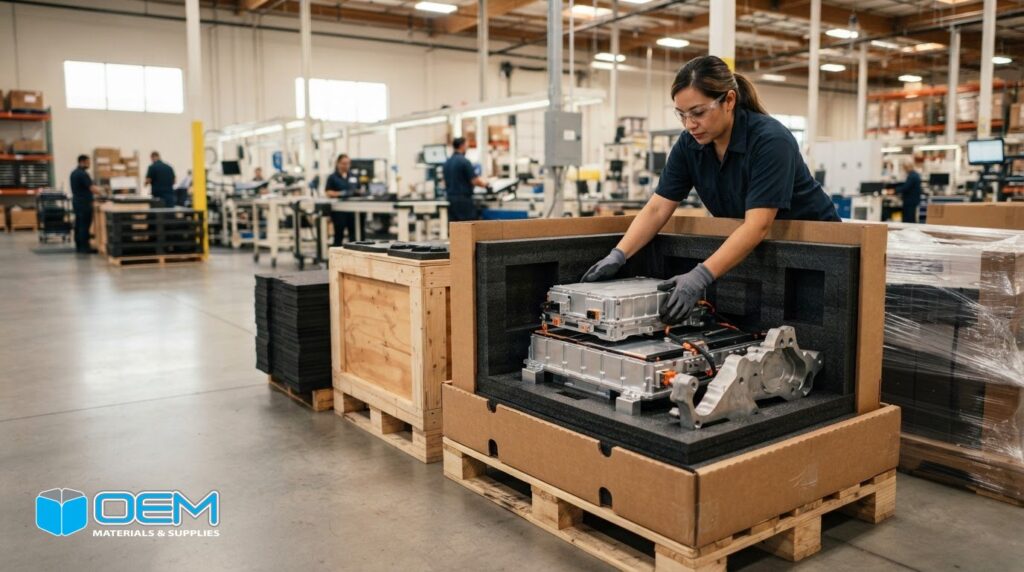
More protection isn’t always better packaging. A configuration that shields a fragile EV component but adds packing steps, consumes warehouse space, or complicates returns may create new operating problems. Effective packaging for electric vehicle components matches protection to the part, the shipment, and the way your team handles it.
High-value batteries, electronic modules, displays, and irregularly shaped parts face different risks in transit and at the production line. The right balance depends on the component’s dimensions and materials, shipping conditions, handling process, and whether packaging will be reused. Those details matter when comparing expendable options with returnable systems or moving a design from prototype to production.
This guide explains how to assess component and shipment risks, compare configurations such as corrugated boxes, foam inserts, and crates, and weigh protection against space, labor, and material use. It also outlines the information needed to develop a scalable packaging plan that fits your operation, from initial trials through ongoing supply.
Key Takeaways
- Match packaging for electric vehicle components to each part’s geometry, fragility, handling path, and shipment conditions.
- Compare corrugated boxes, foam inserts, and crates based on protection needs and how parts are packed and moved.
- Assess expendable and reusable packaging across return logistics, storage, handling, and material use before choosing a format.
- Document dimensions, weight, orientation, shipping route, handling steps, and annual usage to guide design from prototype to production.
- Build a packaging configuration around operational needs, using tailored materials rather than assuming one format fits every component.
Packaging for Electric Vehicle Components: Start with the Part and Its Risks
Start with the component, not a preferred box or cushioning material. Packaging for electric vehicle components should account for the part’s dimensions, weight, geometry, exposed surfaces, handling path, and shipment conditions. Battery-related parts may be large or heavy, while power electronics and smaller assemblies can have delicate features or electrostatic sensitivity. Motors and other irregularly shaped components may need support that limits movement without putting pressure on vulnerable areas.
Electric vehicle systems bring together components with different functions and physical characteristics. That variety makes a single packaging format unlikely to suit every part. Buyers in Los Angeles, San Diego, and other manufacturing centers should map each component’s route, from supplier pickup and facility transfers to production-line delivery, before selecting a configuration.
Protective packaging is the physical configuration that helps shield a part during handling and shipment; a packaging program also coordinates how that configuration is packed, moved, supplied, and returned. The distinction matters: a protective design can address contact or movement, while a complete program must also fit workstations, shipment frequency, storage, and reverse logistics.
Which component characteristics shape packaging requirements?
Record the part’s dimensions, weight, geometry, exposed surfaces, and stable support points. Then consider where movement or contact could cause damage, including between adjacent parts, against an outer container, or during loading and unloading. Component fragility is only part of the assessment. Stacking, transfers, and repeated handling create shipment-level risks that the overall configuration must also address.
Moisture exposure may influence material or barrier choices. For electronics, use electrostatic discharge (ESD) controls when the component specification calls for them. The packaging should support the stated requirements without adding unnecessary materials or handling steps. Foam inserts, for example, can be shaped around a part’s contact points; foam packaging may be one element in a broader configuration.
How do shipping and production conditions change the problem?
Identify whether parts move between suppliers, facilities, production lines, or final assembly. Shipment frequency, packing labor, available storage, and the return path for reusable packaging all affect the design. A container that suits a direct transfer may not work as well across multiple handoffs. Account for how operators place, remove, and identify the part at each stage.
Consider a small electronic assembly: it may need a stable position, separation from neighboring parts, and ESD controls specified for that component. A large, heavy component may instead require support that addresses its weight, shape, and movement during transfers. These examples call for different layouts and handling methods, not simply different container sizes. Documenting those conditions gives the design process a practical starting point.
Compare Corrugated, Foam, and Crate-Based EV Component Packaging
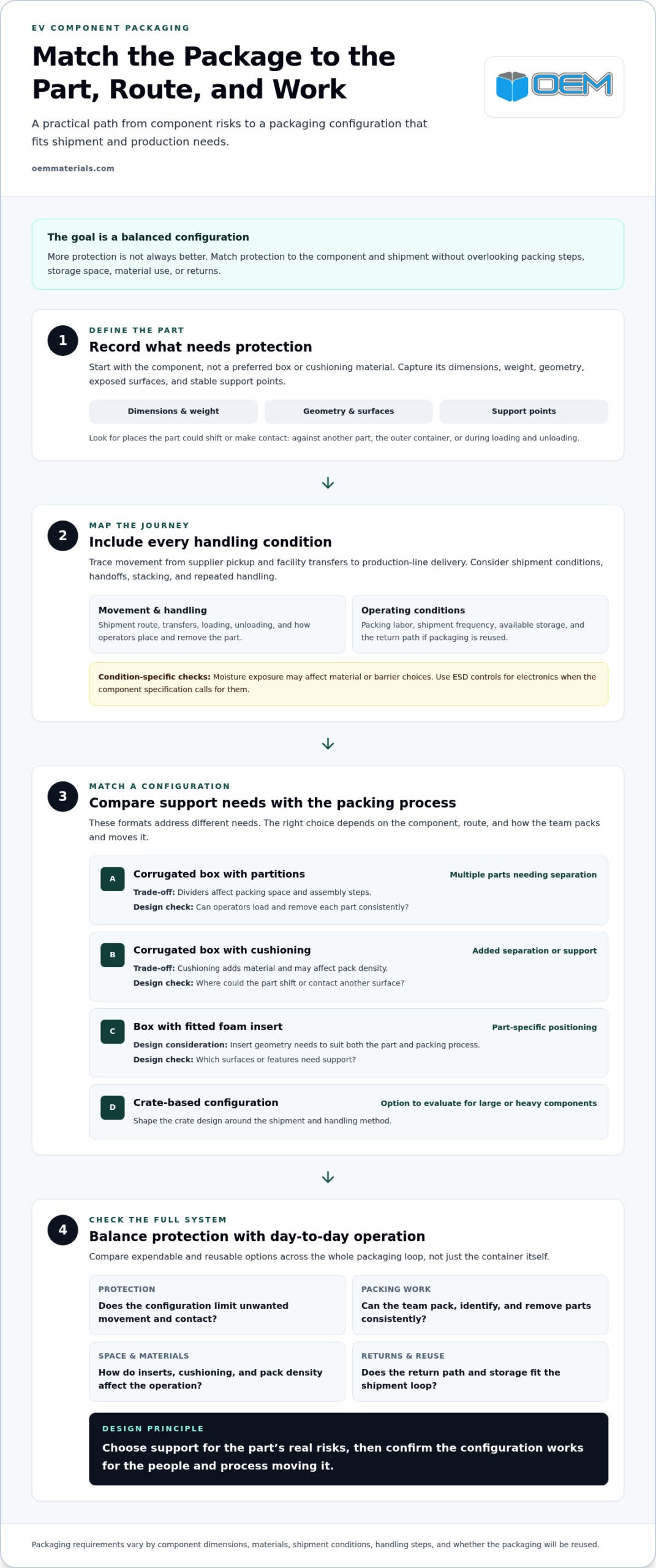
Choose a configuration by matching the part’s support needs to the packing process and shipping loop. Corrugated boxes can serve as an outer container, with partitions or cushioning selected to separate parts and limit unwanted movement. Foam inserts can provide shaped support for specific components. Crates are an option to evaluate for large or heavy shipments. None is automatically the right choice for every route.
When can corrugated packaging support EV parts?
Corrugated packaging can be designed around a component’s dimensions, orientation, and handling steps. Internal dividers may keep multiple parts apart, while cushioning can help control movement within the box. The right layout also needs to work for packers: a complex insert may provide useful positioning but add assembly steps. Buyers comparing custom corrugated boxes should consider the full configuration, including how parts are loaded, removed, and arranged for shipment.
When should buyers consider foam or wood crates?
Fitted foam inserts can support a part at selected contact points, subject to its geometry and design requirements. For material and insert-design context, see this custom foam packaging option. Wood crates may be worth evaluating for large or heavy components, with the design shaped by the shipment and handling method. A Federal Register notice on hazardous materials rules concerns radioactive materials, so it should not be treated as a packaging specification for EV components.
The comparison below helps narrow the design questions before testing a configuration.
| Configuration | Potential use case | Operational trade-off | Design question |
|---|---|---|---|
| Corrugated box with partitions | Multiple parts that need separation | Dividers affect packing space and assembly steps | Can operators load and remove each part consistently? |
| Corrugated box with cushioning | Parts needing added separation or support | Cushioning adds material and may affect pack density | Where could the part shift or contact another surface? |
| Box with fitted foam insert | Components needing part-specific positioning | Insert geometry must suit the part and packing process | Which surfaces or features need support? |
| Crate-based configuration | Large or heavy shipments under evaluation | Storage, handling, and return logistics shape practicality | How will the shipment be moved and, if applicable, returned? |
For packaging for electric vehicle components, compare options using the same part, route, and packing sequence. Review fit, loading effort, shipment frequency, and return path together. OEM Materials & Supplies can help manufacturers assess a configuration around those requirements; share component dimensions and shipment details to begin a packaging discussion.
Evaluate EV Component Packaging Trade-Offs Before Selecting a Design
No packaging format is automatically best for every EV component or shipping route. A reusable container may suit a stable, recurring loop, while an expendable configuration may fit shipments with uncertain return paths. The right comparison accounts for product protection and the work required to pack, store, move, and manage the packaging after delivery.
“Packaging lifecycle cost cannot be inferred from material alone; it depends on how the design performs across the full shipment and handling loop.” For packaging for electric vehicle components, cost outcomes depend on product dimensions, selected materials, shipment requirements, and operating conditions. Compare complete workflows rather than judging a design by its container or cushioning in isolation.
What changes the balance between expendable and reusable packaging?
Begin with the return loop. Determine whether packaging comes back reliably, how it will be collected, and who coordinates its return. A reusable design requires space at receiving points and a process for staging, handling, and returning empty packaging. If shipments travel between facilities on a predictable route, that loop may be easier to manage than one involving multiple destinations or changing suppliers.
Also assign responsibilities. Decide which teams own reusable containers, track their movement, and manage any cleaning or inspection steps required by the operation. Expendable packaging avoids a return cycle, but still requires material replenishment, storage, and disposal or recycling processes. Neither approach is automatically less costly or more sustainable. Those outcomes depend on the actual route, reuse pattern, materials, and facility practices.
How should teams balance protection, pack density, and labor?
Review the packing sequence at the workstation. Count the actions needed to position the part, add dividers or cushioning, close the package, and prepare it for shipment. A design that separates components effectively may take more time to assemble; a simpler pack may leave parts less controlled. Observe the process with the actual component and operators, rather than assessing the package only as a drawing or sample.
Pack density matters, but it shouldn’t override fit, access, or protection requirements. Tighter packing can reduce unused space while making parts harder to load or remove. More generous spacing may ease access but increase the package footprint and storage demand. For a fitted insert, assess whether its contours support the intended part position without obstructing safe removal. Custom foam packaging can be considered as one element of that design, based on the component and handling requirements.
Before selecting a configuration, compare the same operating factors for each option:
- Shipment frequency, destinations, and reliability of packaging returns
- Storage needs for both loaded and empty packaging
- Packing and unpacking steps, including component access
- Material use, replenishment, and end-of-use handling
- Protection requirements across transfers and warehouse handling
Documenting these factors gives procurement, engineering, and operations teams a shared basis for evaluating alternatives. Revisit the comparison if the route, shipment volume, or production process changes, since those conditions can shift the practical balance between expendable and reusable designs.
Validate an EV Packaging Design from Prototype to Production
A design that looks suitable on paper still needs to work with the actual part and the people packing it. Treat validation as a project-specific review, not as a certified testing protocol. The goal is to identify fit, access, packing, and handling issues before selecting a production configuration. For packaging for electric vehicle components, this review should use representative parts and reflect the route and operating conditions the package will encounter.
What information should the packaging design brief contain?
Start with a practical brief that gives the design team enough information to build a relevant concept. Include part drawings or dimensions, weight, orientation, quantity per shipment, and surfaces or features that need protection. Describe how the part is packed, stored, transported, and received, including any handling constraints or limits on available space.
Production context matters, too. Record annual usage, expected shipment frequency, and variation between component models or revisions. If parts change over time, identify which dimensions or features may shift so the packaging can be evaluated for those variations. Collaborative custom packaging design can bring product, engineering, and operations requirements into the same development process.
How can teams review a prototype before scaling?
Move from concept to prototype in a sequence that keeps decisions visible:
- Document requirements. Gather part, shipment, handling, and production information, and note unresolved questions.
- Develop a concept. Select a preliminary configuration and define how the part will be positioned, supported, and packed.
- Review a prototype. Use a representative part to check fit, access, closure, and the complete packing and unpacking sequence.
- Prepare for production. Record agreed design details, review the workflow with the teams who will use it, and account for expected usage and part variations.
During the prototype review, observe the whole task. Can the operator place the component in the intended orientation without forcing it? Does the part stay positioned as the package is closed and moved through routine handling? Can receiving staff remove it without unnecessary manipulation? For fitted protective inserts, assess whether the contact areas and contours support the part as intended; foam packaging may be one element of the configuration.
Record issues as specific observations, such as a tight insertion point, difficult access, or a part that shifts during handling. Revise the concept and review it again before settling on a production design. This creates a clear basis for decisions across engineering, procurement, and operations.
To develop a packaging concept around your component and workflow, submit part dimensions, weight, shipment quantity, and annual usage.
Build a Scalable EV Component Packaging Program with OEM Materials & Supplies
A packaging design needs to work beyond the prototype. For automotive and electronics manufacturers, the next step is aligning the approved configuration with packing tasks, replenishment, and production demand. OEM Materials & Supplies works with manufacturers on packaging design and configurations using corrugated boxes, foam inserts, and crates, tailored to component protection and operating requirements.
That support can extend from prototypes and short runs to high-volume programs. The design and supply plan should account for how packaging reaches the packing area, how operators use it, and how availability is managed as usage changes. For packaging for electric vehicle components, this operational view helps connect a part-specific configuration to the production flow it must support.
What can an integrated packaging partner help coordinate?
Packaging decisions affect more than the container. A partner can coordinate the protective configuration with packing operations and replenishment needs, so the selected materials fit both the component and the workflow. Kitting or assembly may also suit programs that combine components or packaging tasks before they reach the production line. This can help organize packing work around the way a manufacturer receives and uses parts.
Delivery cadence belongs in the plan as well. If packaging demand follows production schedules, just-in-time packaging delivery can support supply planning. Vendor-managed inventory may also support replenishment, based on the program’s usage and inventory requirements. These services are relevant when they address a specific operational need, not as automatic additions to every packaging design.
OEM Materials & Supplies serves manufacturers across Southern California, including Orange County, Los Angeles County, the Inland Empire, and San Diego County. Coordinating design and supply requirements can be useful for production operations distributed across those areas, particularly when teams need a consistent packaging approach.
What should buyers provide to request a useful packaging quote?
Bring the information that connects the part to its shipping and production context. Drawings or dimensions and the component’s weight help define the packaging envelope. Handling requirements clarify what the package must accommodate during packing, movement, storage, and receiving. Include the shipment route and quantity per shipment, along with annual usage and relevant production timing.
- Component drawings, dimensions, weight, and orientation
- Surfaces or features requiring protection and known handling constraints
- Shipment route, quantity per shipment, and packaging return needs
- Annual usage, expected volume changes, and production timing
Share any current packaging samples or observations from the packing process if available. These details help frame a quote around the actual component and workflow, rather than an assumed standard configuration. They also give the discussion a practical starting point for prototypes, short runs, or a broader production program.
For a packaging quote, send your component dimensions, weight, shipment needs, and annual usage.
Make Your Next Packaging Decision Operationally Ready
A packaging design should remain useful as production changes. Treat it as a working part of the operation, and revisit it when a component revision, shipment route, or packing workflow changes. That gives engineering, procurement, and operations a shared basis for deciding whether the current configuration still fits, rather than waiting for damage, packing delays, or supply interruptions to expose a mismatch.
For packaging for electric vehicle components, the next step is to connect the design decision to the conditions your teams actually face. Bring a current component drawing or packaging sample, along with the route and production transition you’re planning. This helps focus the discussion on a practical configuration and the information needed to scope the work.
Request a packaging quote to start planning a solution around your parts and operation. A clear brief can move the project forward with confidence.
Frequently Asked Questions
What information should I provide for an EV component packaging quote?
Provide the part’s dimensions, weight, drawings, and any known handling constraints, along with shipment quantities and annual usage. A current packaging sample or clear photos can help show how the component is positioned now. Note part revisions, mixed-model shipments, and production timing too. These details help frame packaging for electric vehicle components around the parts and operating conditions your team needs to address.
Does every electric vehicle component need custom packaging?
No. A standard packaging configuration can be suitable when it accommodates the component, packing method, and shipment requirements. Custom design is useful when the part’s shape, exposed surfaces, required separation, or handling process calls for a more specific fit. For example, a regularly shaped part shipped in a consistent configuration may need less customization than an assembly with projecting features or several contact-sensitive surfaces.
Can one packaging design work for multiple EV component models?
Sometimes, if the models share compatible dimensions, orientation, support points, and handling needs. A common outer container with model-specific internal positioning may be one approach to assess. Compare the largest and smallest parts, along with any features that vary between revisions. Confirm that each model can be packed and removed as intended, and identify parts that need a separate configuration rather than forcing one design across the group.
When should EV manufacturers consider reusable packaging?
Consider it when shipments follow a dependable route and empty packaging can return through an established process. Map who collects, stores, inspects, and redistributes the packaging, then check that each location can handle those tasks. A recurring transfer between facilities in Orange County, Los Angeles, San Diego, or Riverside may offer a clearer return path than shipments to changing destinations. Evaluate the complete loop, not reuse alone.
How can packaging address electrostatic-sensitive EV electronics?
Start with the electronic component’s handling and packaging specification. If it calls for electrostatic discharge (ESD) controls, select packaging and handling practices that align with those requirements. Don’t assume ordinary cushioning provides ESD protection. Keep the component’s ESD needs visible in work instructions and packaging identification so staff can distinguish the required configuration from packaging intended for parts without the same sensitivity.
What should a team review when evaluating a packaging prototype?
Use a representative component and have the people who pack and receive it work through the normal process. Note any difficulty positioning the part, closing the package, or removing the component without unwanted contact. Check the packaging after routine movement and handling, then record observations by issue and location. This gives the design team actionable feedback and helps distinguish a fit problem from a workflow or training concern.
Can packaging design support both prototype and high-volume production?
Yes. A design can begin with a prototype, then be refined as the team learns more about the part and packing process before production needs increase. Keep the approved configuration, component revisions, and packing instructions aligned as the program changes. OEM Materials & Supplies supports packaging programs across production stages, with kitting, assembly, just-in-time delivery, and vendor-managed inventory available to support broader operations.