
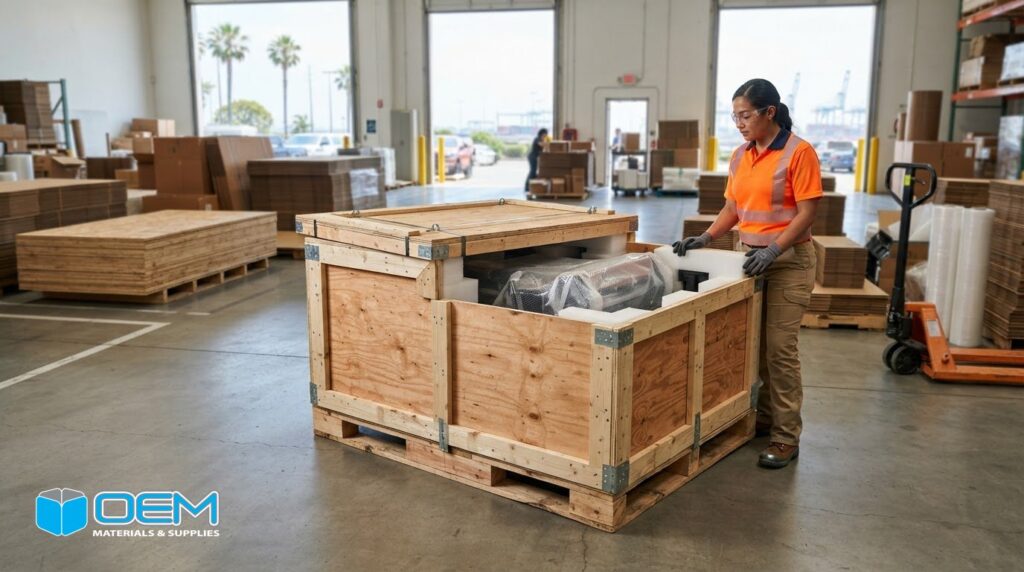
A treatment mark addresses one export requirement. It does not tell you whether a crate will support the product, withstand handling, or fit the shipment plan. For buyers searching for ISPM 15 certified wood crates san diego suppliers, it is important to separate wood-packaging treatment and marking requirements from the overall packaging design. A mismatch between the crate, protective materials, and shipment details can create avoidable complications.
Start by confirming the requirements that apply to the shipment’s destination and wood packaging. Then specify the crate around the product and its journey. This guide explains what ISPM 15 treatment and marking represent, what shipment details to gather, and how crate construction and internal cushioning work together to protect goods in transit. You’ll have a practical framework for discussing export-crating needs with a packaging partner that considers the crate and protective packaging as one system.
Key Takeaways
- Understand what ISPM 15 treatment and marking address, and why destination requirements should be reviewed for each shipment.
- Separate wood-packaging compliance from crate structure and product cushioning so each part of the packaging plan serves its purpose.
- Compare solid-wood crates, plywood construction, and other packaging options based on materials, construction, and shipment needs.
- Prepare a useful crate brief with product dimensions, weight, known center of gravity, handling points, and fragility concerns before requesting a quote.
- Evaluate ISPM 15 certified wood crates san diego buyers need by considering crate design and internal protection together.
What ISPM 15 Means for Wood Crates Shipped from San Diego
ISPM 15 is an international phytosanitary measure for wood packaging used in cross-border trade. It sets requirements for treating and marking regulated wood packaging to help limit the spread of pests through international shipments. For a San Diego shipper, the standard may affect the crate or other wood packaging used to move goods abroad, but it does not determine whether the crate is structurally suitable for the product.
Keep those decisions separate. The ISPM 15 mark communicates treatment-related information about regulated wood packaging. Crate design addresses the product’s dimensions, weight, support, and handling. Internal foam or other cushioning can provide additional protection when the item needs it. A mark does not demonstrate that a crate is designed to prevent damage, and it is not a guarantee of shipment clearance.
What does an ISPM 15 mark tell a buyer?
The mark is a compliance indicator for regulated wood packaging. It communicates information associated with the packaging’s treatment and approval under the standard. Inspect the mark as part of export preparation, but do not treat it as proof that every shipment requirement has been met. Destination-country rules and shipment circumstances can affect what else is needed. For a general overview, see the ISPM 15 Wikipedia article; for current requirements, consult official guidance from the International Plant Protection Convention and USDA APHIS.
When should a San Diego shipper consider export wood packaging?
Review the packaging plan when a shipment is intended for international movement, especially if the crate uses solid wood. Requirements depend on the destination and materials used, so do not assume a crate suitable for domestic freight will meet the needs of an export route. Check applicable destination guidance early enough to include packaging requirements in the purchase order and shipment plan.
For shipments from San Diego, consider the full route, not just the point of origin. Cargo may pass through multiple handling stages before reaching its destination. The crate must support the item through those stages, while its materials and applicable treatment requirements must align with the destination. Confirm current official requirements for the specific route and packaging before dispatch. A shipment that moves domestically may have different packaging considerations from one that crosses an international border.
That distinction is central to ISPM 15 certified wood crates san diego procurement: the mark addresses treatment-related compliance, while crate construction and cushioning address the physical demands of shipping. OEM Materials & Supplies provides wood crate solutions for industrial packaging needs. Share the destination, product dimensions, weight, and handling requirements to develop a crate specification around the shipment, rather than relying on the mark alone.
How ISPM 15 Treatment, Marking, and Crate Design Work Together
An export crate has three distinct jobs: meet applicable wood-packaging requirements, support the load, and protect the product inside. Those jobs affect one another, but they are not interchangeable. Treatment and marking address regulated wood packaging under current requirements. Crate design accounts for product dimensions, weight, support points, and planned handling. An interior protection system helps control movement and contact during transit.
Compliance marking does not establish adequate cargo protection. A mark communicates information about the wood packaging; it does not show that the crate is sized or built for a particular item. A crate can have compliant treatment and still need a different base, stronger supports, or an interior designed around a fragile component.
How does treatment differ from crate engineering?
Treatment addresses requirements for regulated wood packaging under the rules that apply to the shipment. Crate engineering is a separate design decision: it determines how the structure will support the load through handling and transit. Do not assume a treated or marked crate is suitable for every product or route. Confirm current official requirements for the destination, then specify the crate for the actual cargo.
Marking also serves a different purpose from shipment identification. The ISPM 15 mark relates to the wood packaging’s treatment status. Shipping marks identify or route cargo according to the shipper’s logistics process, while handling symbols communicate instructions such as orientation or careful handling. Clear, consistent information helps teams interpret the package, but symbols do not replace a sound crate design or handling procedures.
How do cushioning and blocking support the crate?
Blocking and cushioning help locate the product inside the crate and limit unwanted movement or contact. Their layout should match the item’s geometry, weight distribution, and vulnerable surfaces. For example, a product with a delicate protrusion may need clearance around that area, while a heavy assembly needs support that prevents shifting. Custom foam packaging can form a protective interior shaped to the product’s contact points.
Build the specification as a coordinated package. Share accurate product dimensions and weight, identify approved lift or handling points, and describe known fragility concerns. Include relevant transit conditions, such as the planned handling method or mode of transport, when available. These details help connect the crate’s structure with its internal supports instead of treating cushioning as an afterthought.
For buyers evaluating ISPM 15 certified wood crates san diego shipments require, this separation makes procurement clearer: confirm applicable wood-packaging requirements, define structural needs, and specify interior protection. OEM Materials & Supplies can bring crate and protective-packaging requirements into the same project discussion. Share shipment and product details for a project-specific quote.
ISPM 15 Wood Crates vs. Plywood and Other Shipping Options
Choose export packaging based on the load and its route, not a material label alone. A heavy assembly with defined lifting points may need a rigid crate, while a lighter, compact item may suit a different format. Construction also matters for wood-packaging requirements: do not assume every crate containing plywood is automatically outside ISPM 15 rules. Material composition and how the package is built can affect which requirements apply, so verify current official guidance for the specific shipment.
| Option | Potential fit | Decision points |
|---|---|---|
| Solid-wood crate | Heavy, oversized, or irregular cargo that needs structural support and defined handling points. | Assess load support, lifting and handling, route, reuse plans, and applicable wood-packaging treatment and marking requirements. |
| Plywood construction | Shipments where panel construction can meet the needed enclosure and support requirements. | Review the exact materials and construction. Exemptions may apply to certain manufactured wood products, but do not infer an exemption from the word “plywood” alone. |
| Corrugated packaging | Shipments where the product’s weight, dimensions, and handling conditions can be supported by a box-based package. | Consider stacking, handling, product fragility, and any added interior cushioning required for the route. |
Decision rule: Select construction based on the shipment and applicable destination requirements. Reusability, handling equipment, and packaging constraints can all influence the choice. A reusable crate may suit a return loop, while a one-way route or restricted package dimensions may point to another format. These are project-specific considerations, not a substitute for checking destination requirements.
When might solid-wood crate construction fit the shipment?
A custom solid-wood crate may fit a load that needs a rigid base, bracing, or secure attachment points for handling. These structural features address how the cargo is supported; they do not establish whether treatment and marking rules apply. Buyers comparing custom wood crate options should define the load, handling plan, route, and reuse expectations as part of the specification.
When should buyers compare plywood or corrugated packaging?
Compare alternatives when the cargo and route allow a different balance of support, enclosure, and handling. Corrugated packaging may suit products that do not require a rigid crate, provided the package is designed for the load and shipping conditions. Plywood construction also deserves a material-level review rather than a blanket assumption about compliance. If the product needs a shaped protective interior, foam packaging can support it inside the chosen outer package, but does not replace any wood-packaging requirements.
For buyers sourcing ISPM 15 certified wood crates san diego shipments may require, compare the complete package: outer construction, cargo support, protective interior, route, and destination requirements. That approach helps purchasing and operations teams specify packaging around the shipment instead of selecting by material name alone.
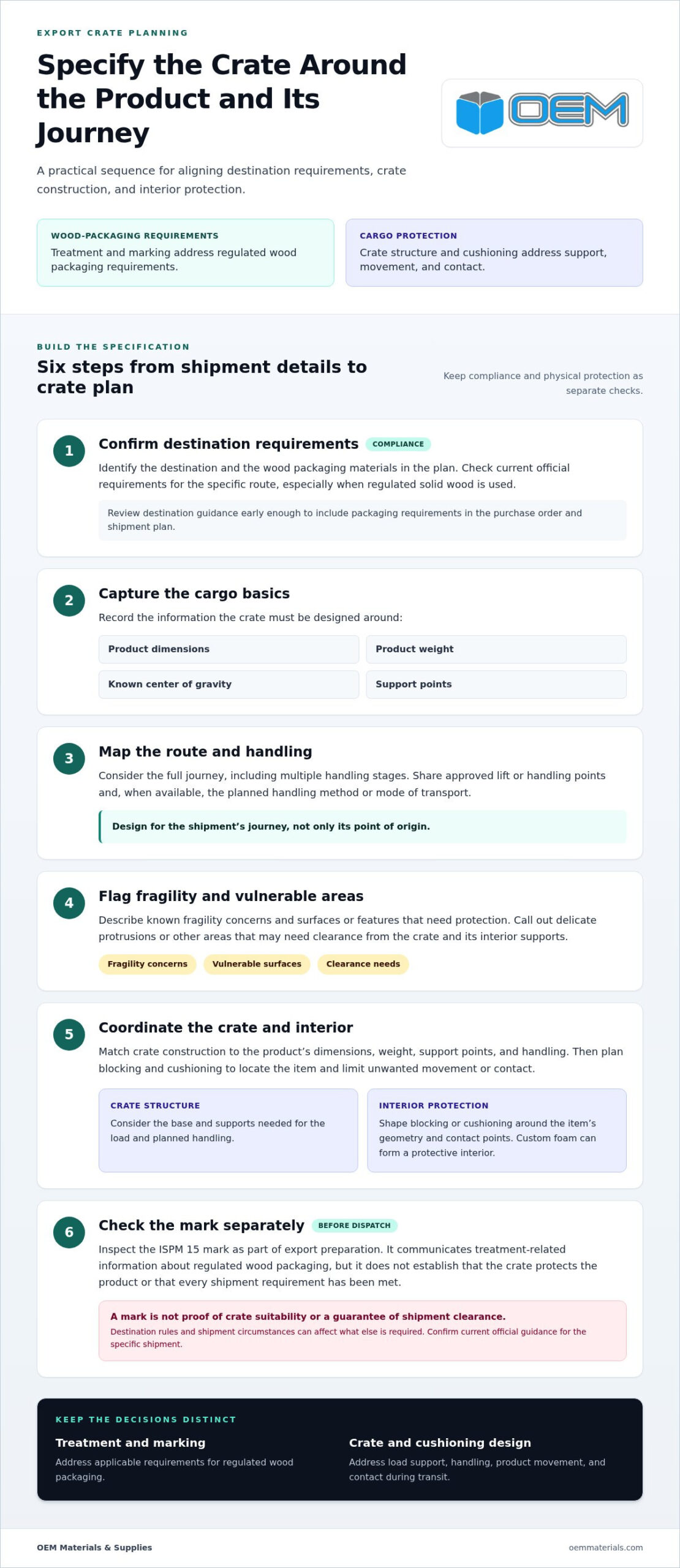
How to Specify an Export Crate for a San Diego Shipment
A useful crate quote starts with a clear project brief. Share enough product, handling, and routing information to connect the crate design with the shipment’s actual requirements. For export cargo, include the destination and any customer or official packaging specifications rather than relying on assumptions about what the route requires.
- Product dimensions and weight: Provide the item’s overall dimensions and shipping weight. Note protrusions or features that affect how it fits inside the crate.
- Center of gravity: Include its location if known, especially when it affects balance during lifting or positioning.
- Orientation and handling points: Identify the required shipping orientation, approved lift points, and any areas that must remain clear.
- Stacking and fragility: State no-stack limits, delicate surfaces, vulnerable components, and other damage concerns.
- Internal protection: Describe cushioning needs and whether components ship assembled, together, or separately.
- Route and delivery: Share the destination country, known routing details, shipping mode, delivery location, and target ship date.
- Specifications and order pattern: Attach customer or contract requirements and applicable official destination guidance. Include annual usage or expected order frequency when relevant to planning.
What product and handling details should the brief include?
Give dimensions for the product as it will be packed, not only its nominal drawing size. Include orientation, lift or handling points, and no-stack constraints so the proposed package can account for how the item is positioned and moved. Describe vibration, moisture exposure, or repeated handling when those conditions are relevant to the route. Identify whether cushioning must protect specific surfaces or keep separate components from contacting one another.
What export and delivery information helps scope the project?
Destination and delivery details help frame the packaging specification. Identify the destination country, known route, shipping mode, target ship date, and final delivery location. Attach customer specifications or current official destination requirements when available, rather than translating assumptions into crate instructions. This gives the design process a defined basis and helps surface packaging constraints before the crate is specified.
OEM Materials & Supplies’ custom packaging design support brings product, protective-interior, and shipment details into one project specification. For buyers sourcing ISPM 15 certified wood crates san diego shipments may require, distinguish the desired crate structure from applicable wood-packaging requirements. Share dimensions, weight, handling needs, destination, and expected order pattern to request a project-specific crate quote.
Source Wood Crates for Export Shipments in San Diego
Export crating is a packaging decision, not just a wood purchase. The crate must suit the cargo, handling plan, and shipment route, while the packaging brief must account for destination-specific wood-packaging requirements. OEM Materials & Supplies serves manufacturers in San Diego and across Southern California, including Orange County, Los Angeles, and Riverside, with industrial packaging solutions such as crates, foam packaging, cushioning materials, and custom packaging design.
Considering these elements together helps prevent a common specification gap: a crate may be sized for the product but lack suitable internal support, or the protective interior may be planned without accounting for how the crate will be handled. Start with the cargo and route, then align the outer structure and interior protection with the application. Identify any treatment or marking requirement separately and support it with the applicable project requirements and evidence. Crate design alone does not establish compliance.
What should a buyer expect from a packaging partner?
A useful review considers the cargo, handling points, route, delivery constraints, and packaging limitations as one project. Product dimensions and weight shape the crate; fragility and contact points inform cushioning; handling and routing help define practical constraints. OEM Materials & Supplies’ custom packaging design support brings crate construction and protective-interior needs into a coordinated packaging specification for the shipment.
Bring the destination’s requirements into the discussion early. Requirements can depend on the destination and the materials and construction used, so avoid relying on a general description such as “export crate.” If the project requires treatment or marking, identify the specific requirement and the documentation that applies to the shipment. Keep those compliance details distinct from decisions about structural support, product fit, and cushioning.
How can San Diego buyers request a useful crate quote?
Send the information that defines the project: product dimensions and weight, destination, shipping mode or known route, handling requirements, delivery constraints, and customer or contract specifications. Include fragility concerns, required orientation, and internal protection needs. If the shipment is recurring, add annual usage or the expected order pattern. A complete brief gives the project discussion a practical basis and focuses recommendations on the actual application.
For ISPM 15 certified wood crates san diego procurement, include destination requirements alongside product and handling details so the packaging scope is clear. Request a quote for your wood-crate project with available specifications, dimensions, weight, destination, and expected usage.
Move Your Export-Crate Project Forward
Make the packaging specification part of the shipment’s working documentation. Keep approved crate and interior-protection details aligned with the product configuration and planned route. If the cargo or destination changes, revisit the specification before the package is built. Clear handoffs between purchasing, engineering, and shipping teams help prevent outdated assumptions from carrying into packing.
For ISPM 15 certified wood crates san diego shipments require, treat the applicable wood-packaging requirement as one defined part of the project, alongside the product’s needs and handling conditions. OEM Materials & Supplies helps manufacturers develop packaging around project details, with crate design and protective materials considered together.
To move your export-crate project forward, contact OEM Materials & Supplies to discuss your packaging needs. Include the product dimensions, weight, destination, and expected usage to give the project team a clear starting point.
Frequently Asked Questions
Is ISPM 15 required for every wood crate shipped from San Diego?
No. The requirement depends on the shipment’s destination, route, and packaging materials. A shipment with a domestic leg before export still needs to be assessed according to its final destination and route, not just its first carrier. For ISPM 15 certified wood crates san diego shipments, include the destination and any transit countries in the shipping plan, then use current official guidance to determine which requirements apply.
What does the ISPM 15 stamp on a wood crate mean?
The mark identifies treatment-related information for regulated wood packaging. As a practical step, photograph the mark during packing and retain the image with the shipment’s internal records. That helps the shipping team refer to the specific crate if a question comes up later. Keep the crate identification tied to the correct shipment rather than relying on a loose image or a general supplier record.
Can plywood crates be used without an ISPM 15 mark?
Possibly, depending on the actual materials and construction. For a crate that combines plywood panels with solid-wood framing or bracing, document each component instead of describing the whole package simply as “plywood.” That material breakdown gives the shipping team a clearer basis for reviewing applicable requirements. Use current official guidance for the destination before treating any construction as exempt from a marking requirement.
What happens if an export crate doesn’t meet the destination requirements?
The shipment may face additional review or disruption, and the exact response depends on the destination and circumstances. If a discrepancy is found before dispatch, pause release while the team compares the crate, its markings, and shipment records against the applicable requirements. This creates an opportunity to resolve inconsistent information before the package enters the route, without assuming a particular remedy or outcome.
How do I prepare for a wood-crate quote in San Diego?
Along with basic product and shipment details, provide a drawing or clear photos of the item and note its part number or revision when available. Identify the number of units per shipment and whether the product configuration changes between orders. These details help distinguish a one-time packaging need from a repeat application and reduce ambiguity when reviewing the crate’s fit, access, and handling requirements.
Does an ISPM 15 mark guarantee that a shipment will clear customs?
No. The mark alone does not establish that every customs or import requirement has been met. Keep the wood-packaging information coordinated with the shipment’s other records, and assign responsibility for reviewing those records before dispatch. A complete export review should account for the cargo and destination paperwork as well as the packaging, since the mark addresses only the wood-packaging aspect of the shipment.
Should I use foam inside an ISPM 15 wood crate?
Consider foam if the product needs a controlled contact surface or separation from adjacent components. Before specifying it, identify surfaces that must not be contacted, any product-specific material restrictions, and whether the item has electrostatic-sensitivity requirements. Share those constraints with the packaging team so the interior can be evaluated for the actual product. The right choice depends on the item and its handling conditions.