
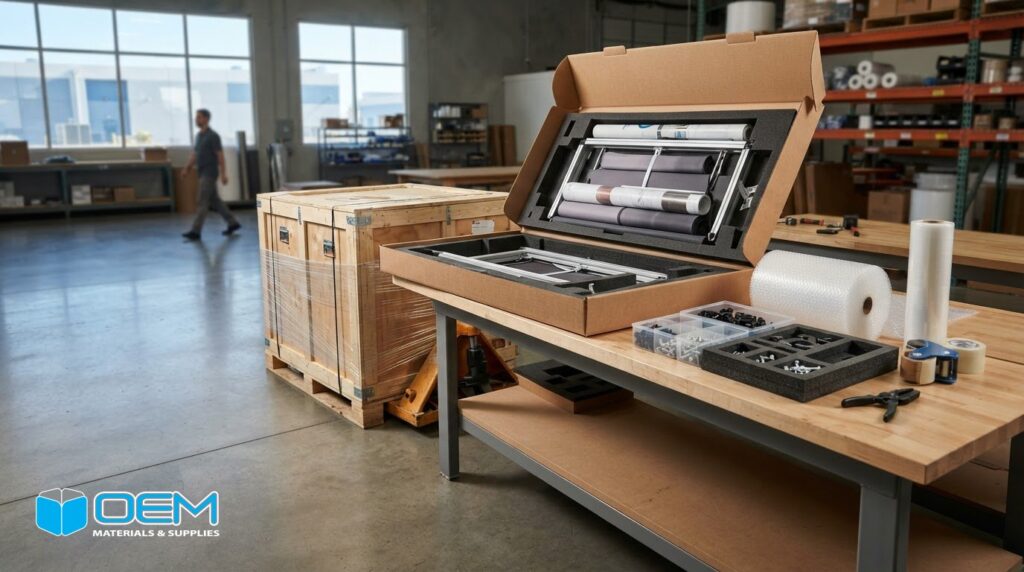
A package that protects a trade show display in transit can still make setup, storage, and return shipping harder than necessary. Custom packaging for trade show displays should protect graphics, structures, and smaller components throughout the event cycle while fitting the way your team packs and handles them. The right solution depends on the display’s dimensions, vulnerable surfaces, shipping method, and expected reuse.
Corrugated boxes, foam inserts, and wood crates each suit different handling and protection needs. This guide explains how to compare those formats, plan for efficient packing and movement, and account for reuse when specifying a solution. It also covers the project details that help shape a useful packaging recommendation, including component dimensions, layout, and shipping requirements. Cost outcomes depend on the display, materials, and shipping needs, so start with a clear project brief.
Key Takeaways
- Plan packaging around the full event cycle, from outbound shipping through return transport, rather than focusing only on the first shipment.
- Build a useful project brief with display dimensions, component weights, quantities, and annual usage.
- Compare custom packaging for trade show displays by protection needs, handling, storage, and expected reuse.
- Evaluate fit, component separation, access, closure, and repeat packing before moving into production planning.
- Match boxes, foam inserts, or crates to the display and shipping requirements. Cost outcomes depend on dimensions, materials, and shipping needs.
Why Custom Packaging for Trade Show Displays Must Cover the Whole Event Cycle
Choosing a display before planning its packaging can leave a gap in the project. A frame may fit the booth and graphics may meet presentation needs, but those decisions do not establish how each component will be protected, moved, or stored. Packaging designed only for outbound shipping can also create problems at teardown, when staff need to repack components quickly for the return trip.
Consider the full route: outbound shipping, receiving, venue handling, setup, teardown, and return transport. Different people may lift, open, move, or repack the display at each stage. A box suited to a controlled shipment may be awkward in a crowded staging area. Loose components can shift when the package is opened or closed repeatedly. Custom display packaging is a transport and handling system designed to protect each component and make packing, movement, storage, and reuse practical.
That approach reflects the broader functions of Packaging, including protection and transport, while adapting the package to the item and its handling route. For a display with delicate surfaces and separate hardware, packaging design can define where each part sits and how it is accessed. OEM Materials & Supplies provides foam packaging to help separate and cushion display components.
Which parts of a trade show display need protection?
Assess the structural frame, panels, graphics, hardware, and accessories separately. Frames may need protection from impact or bending. Finished panels and graphics can be vulnerable to abrasion or surface contact. Small hardware can get misplaced or rub against larger parts, while accessories may need their own space to avoid pressure on presentation surfaces. Dust or residue may also be a concern for parts that need to look clean at setup.
Record each component’s dimensions and shape before laying out the package. Long rails, broad panels, irregular brackets, and small fittings need different positions and separation. The layout should keep parts organized without forcing a tight fit or leaving unnecessary room for movement.
How event logistics affect packaging requirements
A one-way shipment may prioritize protection for a single journey. A display used at recurring events also needs a repeatable way to pack, unpack, store, and return its components. Identify who handles each step, from the warehouse team preparing the shipment to event staff packing after teardown. Clear component locations and practical access help keep the process understandable when staff change between events.
Consider the actual handling route. Venue access, staging space, movement between receiving and booth areas, and the equipment used to move packages can all affect package dimensions, closures, and component arrangement. For shipments in Los Angeles and Orange County, as in other Southern California locations, planning around the people and handling steps helps align protection with real event operations, not just the display’s dimensions.
How to Specify Custom Trade Show Display Packaging
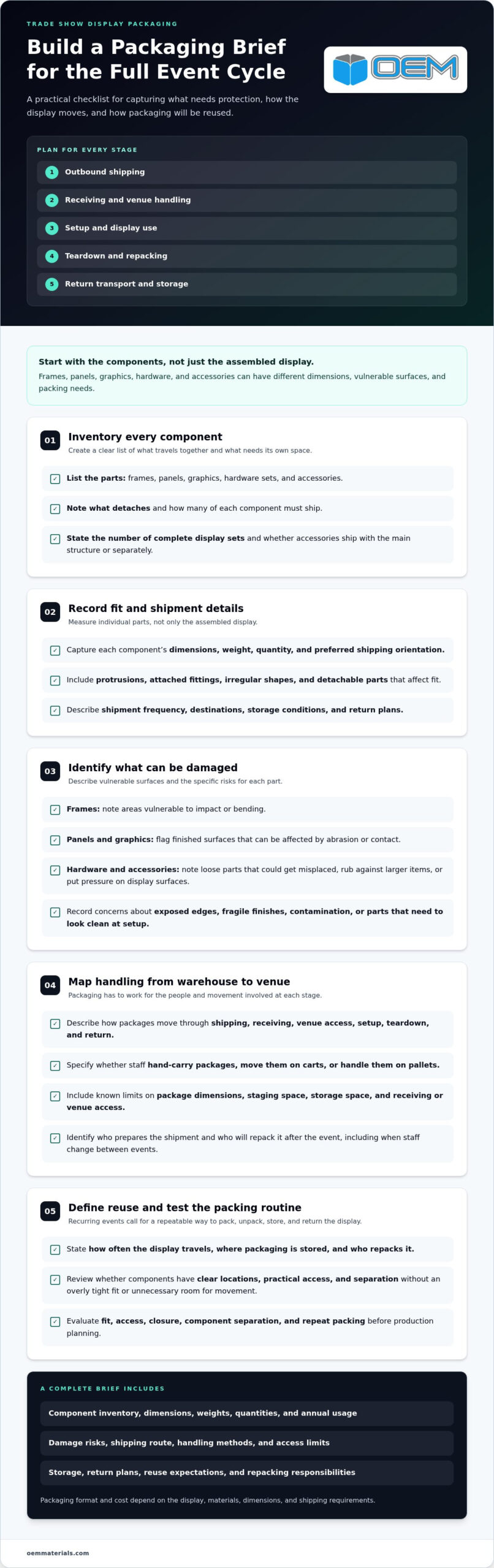
A useful packaging brief translates the display into clear design requirements. Start with a component inventory, then record dimensions and weights, assess damage risks, map handling, and define expected reuse. This sequence connects the display’s physical characteristics to the shipment and to the people who will pack and move it.
For custom packaging for trade show displays, provide component dimensions, weights, quantities, and annual usage. Include measurements for individual components, not only the assembled display. These details help inform material and design recommendations that fit the display and its shipping requirements. OEM Materials & Supplies provides custom packaging design to align package layouts with protection and handling needs.
- Inventory components. List each frame, panel, graphic, hardware set, and accessory. Note which parts detach and how many of each must ship.
- Record dimensions and weight. Measure each item in its shipping orientation, including protrusions or attached fittings that affect fit.
- Assess risks. Identify fragile finishes, exposed edges, graphics, and areas vulnerable to abrasion, impact, bending, or contamination.
- Map handling. Describe how packages move through shipping, receiving, venue access, setup, teardown, and return.
- Define reuse. State how often the display travels, where packaging is stored, and who will repack it between events.
What display and shipment details belong in the packaging brief?
For every component, record dimensions, weight, quantity, and preferred orientation. Note fragile finishes, printed graphics, protrusions, detachable parts, and surfaces that should not rub against other items. Describe shipment frequency, destinations, storage conditions, and return plans. For example, a panel stored flat may need a different layout from a long frame section packed alongside hardware. Clear details give the packaging designer a practical basis for reviewing fit and separation.
A complete brief also states how many complete display sets are being packaged and whether accessories ship with the main structure or separately. For general packaging and processing context, PMMI, The Association for Packaging and Processing Technologies, provides industry resources. Keep the project brief specific to the display, its components, and its route.
How handling and reuse shape the design
Specify whether staff will hand-carry packages, move them on carts, or handle them on pallets. Include known limits on storage space or access at receiving and at the venue. Frequent reuse makes practical access, repeatable closure, and an easy-to-understand layout especially important.
Internal fit affects the packing routine. Separate spaces for panels, frame sections, and hardware help keep parts organized and reduce contact between vulnerable surfaces. Describe who packs and unpacks the display and what steps they follow. To prepare a brief for a display project, submit its dimensions, weight, quantities, and annual usage through the packaging quote request.
Corrugated Boxes, Foam, or Crates: Comparing Display Packaging Options
No single format fits every exhibit. Compare packaging against the display’s dimensions, vulnerable surfaces, movement through the shipping process, storage space, and expected reuse. Custom packaging for trade show displays may use corrugated boxes, foam inserts, or crates. The final design should reflect the components and shipment requirements.
| Option | Display dimensions and fragility | Handling, storage, and reuse |
|---|---|---|
| Corrugated box | Consider for components that can be arranged within a box footprint, with internal protection suited to their shape and vulnerability. | Assess how the box will be moved, stacked, opened, stored, and reused for the planned shipment cycle. |
| Foam inserts | Useful to evaluate when individual parts need defined positions or separation from one another. | Consider whether the insert makes packing and unpacking clear and repeatable for the people handling the display. |
| Wood crate | Assess for display configurations whose size, component arrangement, or handling needs call for a different package format. | Review the movement route, available storage space, and whether the package will be used for recurring shipments. |
These formats can also work together as parts of a packaging system. For example, consider an outer container alongside internal separation and support. The right combination depends on the component layout and how the package will be handled.
When a custom corrugated box may fit the requirement
Start with the display’s overall dimensions, weight, component arrangement, and shipping process. A custom-size box can be designed around the shipment instead of forcing parts into a general-purpose container. Internal packaging can position components and limit contact between vulnerable surfaces. Review corrugated box options as part of a project-specific assessment, including how box dimensions affect packing, movement, and storage.
A box may suit a set of components that can be arranged together, while parts with distinct shapes may need separate internal positions. Consider the display’s measurements, material requirements, and shipping process together when comparing corrugated formats.
When foam inserts or a wood crate merit evaluation
Evaluate engineered foam inserts when display parts need individual positioning, separation, or support within the package. An insert can be laid out around component shapes to help keep parts organized during packing. See engineered foam inserts as an option to assess against the display’s fragility and handling needs.
A wood crate merits evaluation when the display’s configuration, size, or movement requirements point toward that format. Compare available storage space and the handling process with the crate’s intended use. Neither foam nor a crate is an automatic upgrade. Each should solve a defined packaging need within the overall design.
A Practical Design and Evaluation Process for Display Packaging
Packaging design should move through a defined review before production planning begins. A structured process connects the display’s requirements to a package that protects components and supports the way staff will pack, move, and unpack them. For custom packaging for trade show displays, evaluate the design under realistic handling conditions, not just from a drawing or a one-time fit check.
- Review requirements. Confirm the component inventory, dimensions, weights, vulnerable surfaces, shipment method, storage conditions, and planned reuse.
- Develop the packaging design. Set the package layout, internal support, component separation, and closure around the display and its handling needs.
- Evaluate a prototype. Pack and unpack the components in sequence. Check fit, access, protection, and whether the contents remain organized.
- Refine the design. Adjust the layout or packing steps if parts shift, surfaces contact one another, or the process is difficult to repeat.
- Plan production. Document the approved configuration and packing method so production and event teams can work from the same requirements.
Keep the evaluation focused on actual use. A package may fit the display but still be difficult to open in a limited staging area or repack after teardown. Record problems during the trial and make practical adjustments before production planning.
What to evaluate in a packaging prototype
Give each component a defined position and confirm that parts can be packed consistently. Check whether staff can reach, remove, and replace components without dragging them across other surfaces or disturbing nearby items. Test the closure and compare package dimensions with the planned shipping process, including movement and storage. Have the people who will handle the display perform the packing trial.
How packaging services can support repeat event programs
For a recurring event program, kitting and assembly can bring display components and packaging materials together in an organized set. This can make the contents easier to identify and prepare for shipment. Just-in-time delivery is another supply-planning option when packaging needs to align with event schedules. OEM Materials & Supplies provides just-in-time packaging services to support planned packaging requirements.
For businesses coordinating displays across Orange County, Los Angeles County, the Inland Empire, and San Diego County, regional planning can help align packaging needs with warehouse and event schedules. The right design and any cost comparisons depend on display dimensions, materials, and shipping requirements. Include those details, expected quantities, and annual usage when requesting a packaging quote.
Build a Custom Packaging Plan for Your Trade Show Display
A dependable packaging plan starts with the display’s physical requirements and the way your team will use it. Dimensions and component vulnerability help determine package layout and protection. Shipping methods affect how the package needs to move, while event frequency and reuse influence how it should open, close, and store. These factors work together. A design that protects the display but slows packing may not fit the program’s operational needs.
OEM Materials & Supplies supports manufacturers with packaging design, corrugated boxes, foam inserts, and crates. The appropriate approach depends on the display configuration and shipping requirements. Kitting and assembly can help organize display components and packing materials, while vendor-managed inventory can support packaging supply planning. The goal is to align packaging with defined protection needs and the work required before and after each event.
What to prepare before requesting a packaging quote
Assemble a project brief with dimensions, weights, quantities, and photographs of the display and its separate components, if available. Add shipping routes, event frequency, storage conditions, packing responsibilities, and return requirements. Note recurring damage, difficult packing steps, or labor concerns. Annual usage helps show how packaging fits into the broader event program rather than treating each shipment as a one-time project.
Include practical details that might affect the design, such as which components travel together and who handles packing after teardown. If dimensions are approximate, identify them as estimates. Clear information helps frame the design discussion and supports recommendations based on actual use rather than assumptions.
How OEM Materials & Supplies supports packaging programs
Packaging design connects the display’s protection requirements with a workable package configuration. Corrugated boxes, foam inserts, and crates can be evaluated according to the display’s component layout, shipping, and reuse needs. Kitting and assembly can organize components and packaging materials, while vendor-managed inventory can help coordinate packaging supply for ongoing programs. These services support manufacturers across Southern California and, where relevant, customers nationwide.
For purchasing and operations teams in Los Angeles, Orange County, the Inland Empire, and San Diego County, a complete project brief also helps coordinate decisions among the people responsible for shipment, storage, and event preparation. Cost comparisons depend on the display’s dimensions, selected materials, and shipping requirements, so evaluate recommendations against the complete project rather than a single packaging component.
Share your display dimensions, weight, annual usage, and shipping requirements to begin planning a project-specific solution. Request a custom packaging quote from OEM Materials & Supplies.
Put Your Display Packaging Plan Into Practice
Once the packaging approach is selected, make it part of the display’s operating documentation. A clear packing sequence, component map, and assigned handling responsibilities give warehouse and event teams a shared reference for future shipments. That record can also help identify when a display change or new shipping route calls for a packaging review.
Custom packaging for trade show displays works best when the design reflects how your team will handle and reuse the package. Turn your display requirements into a project brief that supports a practical packaging recommendation. Include component details, shipment plans, and expected usage so the discussion can focus on your operating needs.
Start a custom packaging quote request with OEM Materials & Supplies. A clear brief gives your team a solid foundation for the next event and the ones that follow.
Frequently Asked Questions
Can trade show displays be shipped assembled?
Yes, if the assembled display and its packaging can move through the planned shipping and receiving route. Check the complete package dimensions against access points, storage space, and available handling equipment, not just carrier limits. Also consider whether the display’s joints, attachments, or projecting elements can tolerate the handling involved. If assembled shipping creates access or protection concerns, shipping sections separately may be more practical.
How can packaging help protect trade show graphics from scratches?
Use a clean, nonabrasive protective layer over the graphic surface, and avoid placing labels, straps, or other materials directly on the printed face. Select a protective material that suits the graphic’s finish, since material that marks or transfers residue can create a different problem. During handling, lift graphics by their edges when practical, and keep hands and work surfaces clean to limit scuffs and surface contamination.
Can custom packaging be reused for multiple trade shows?
Yes, custom packaging can be planned for repeated trips. After each use, inspect its structure, closures, and internal supports, and replace components that no longer hold or protect the display properly. Store the package where it is protected from moisture and crushing. A simple condition record can help the operations team identify wear early and distinguish routine maintenance from a need to revise the packaging.
What information should I provide to get a packaging quote?
Provide a current drawing or component schedule that distinguishes the assembled display from the parts as they will ship. Identify the quantity of each component in a complete package, note drawing revisions, and mark any measurements that are estimates. Photos can clarify parts that are difficult to identify from a drawing. Also state whether the request is for design, a prototype, or production packaging so the quote reflects the project scope.
What packaging works for oversized or irregular trade show displays?
The packaging format depends on the display’s shape and the route it must travel. For an oversized assembly, assess whether it can be divided into sections that are easier to move and store. For irregular parts, account for projections and points that could catch during handling. Check package dimensions against warehouse aisles, doorways, and venue access areas so the chosen format works beyond the shipping dock.
How can packaging reduce labor during trade show setup and teardown?
Align removal and installation tasks with the order in which the team will use each display section. A teardown checklist can assign responsibility for disconnecting modules and verifying associated hardware before packing begins. This helps prevent delays caused by missing fasteners or unclear task ownership. For setup, make sure the first components needed are accessible without requiring the team to unload unrelated items first.