

A low packaging price can conceal a higher operating cost. The hidden costs of cheap packaging show up after the purchase order, when a box fails to protect a product, takes longer to pack, uses excess shipping space, or requires extra handling. Unit price matters, but it doesn’t capture the full impact on production, warehousing, and delivery.
Procurement may compare supplier quotes while operations tracks damage, rework, packing time, and storage demands. Both views matter. Compare options against the same product and supply-chain conditions, including dimensions, weight, materials, shipment method, and packing workflow. This article explains what to measure before changing packaging and how to assess whether custom corrugated boxes, foam packaging, cushioning, or crates fit specific handling and shipping requirements. The goal is a sourcing decision based on total operational impact, not the lowest line item.
Key Takeaways
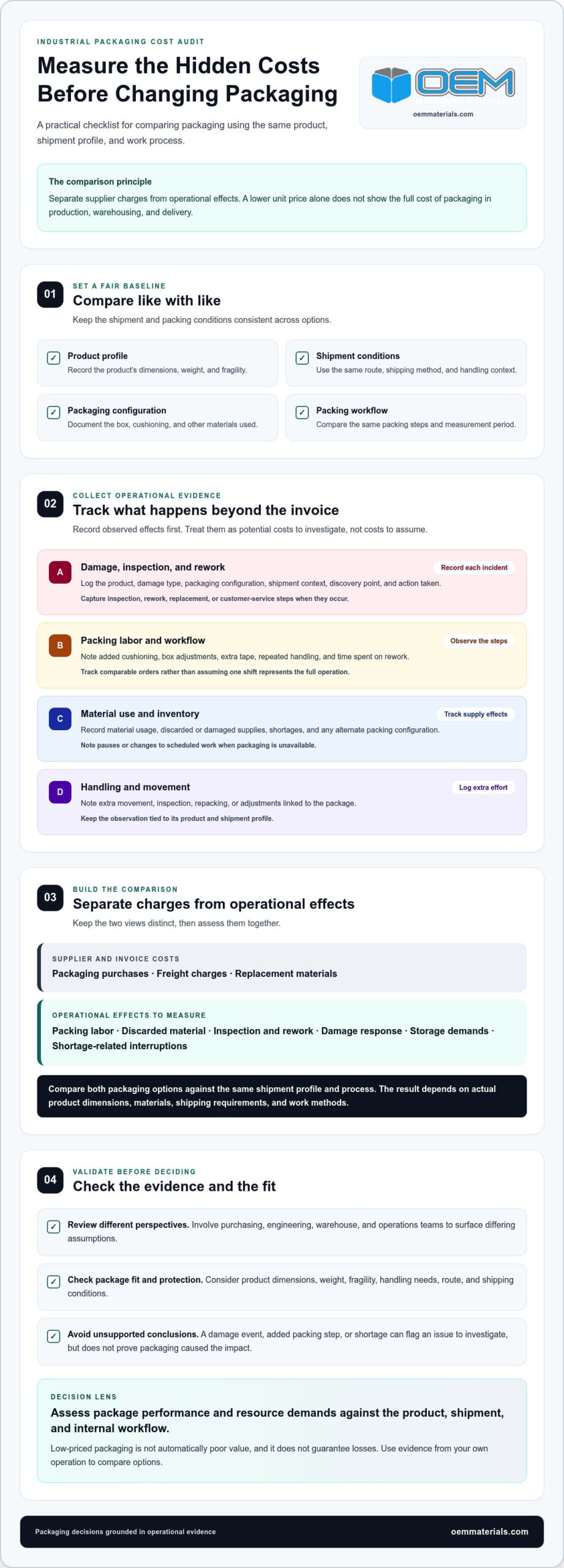
- Separate supplier charges from operational impacts when measuring the hidden costs of cheap packaging.
- Document damage, rework, packing steps, and supply needs before assigning costs to a packaging issue.
- Compare packaging options using the same product, shipment profile, and measurement period.
- Involve purchasing, engineering, warehouse, and operations teams to surface different assumptions.
- Assess fit, protection, and packing workflow, then match materials to the project’s requirements.
What Are the Hidden Costs of Cheap Packaging?
The hidden costs of cheap packaging are project-specific impacts beyond the material price on a supplier’s quote. Some expenses appear directly on invoices, such as packaging purchases, freight charges, or replacement materials. Others require internal tracking: employee time spent packing, product damage found at receiving, discarded material, or delays caused by a packaging shortage. These effects can influence the full cost of moving a product through a Southern California operation, but they don’t apply equally to every shipment.
Packaging protects products, supports handling, and helps organize shipments. The broad functions of packaging and labelling offer useful context, but a sourcing decision depends on how a specific package performs in your process. Low-priced packaging isn’t automatically poor value, and it doesn’t guarantee losses. The key question is whether its performance and resource demands fit the product, shipping conditions, and internal workflow.
Purchase price versus total packaging cost
Unit price shows what packaging costs per piece. It doesn’t include the labor needed to use it, material discarded during packing, or effort spent inspecting and reworking a shipment after a problem. To compare options, separate invoiced amounts from operational effects, then measure both against the same shipment profile and process.
Hypothetical example: A manufacturer packs the same component in two box designs. One costs less per box but requires workers to add cushioning and tape. The other uses a different box-and-cushioning configuration that may be quicker to assemble. Without tracking packing steps, material use, and damage records, the manufacturer can’t tell which option has the lower total operating cost. The result depends on actual product dimensions, materials, shipping requirements, and work methods.
Which hidden costs may apply to an industrial shipment?
Potential cost categories include product inspection, rework, replacement, and customer-service effort after damage. Extra packing steps can add labor across repeated shipments, while excess material may increase waste or take up storage space. These are possibilities to investigate, not costs to assume. For a fragile component, foam packaging is one option to assess for product fit and protection alongside the existing packing process.
- Damage: Record the incident, affected product, and resulting response.
- Labor: Observe packing steps and time spent on added protection or rework.
- Material and inventory: Track usage, discarded material, and shortages that disrupt packing.
- Handling: Note extra movement, inspection, or repacking linked to the package.
Start with evidence from your own operation. A damaged shipment, an added packing step, or a material shortage may identify an issue to investigate, but it doesn’t establish the full financial impact by itself. The relevant categories depend on the product, packaging materials, shipping profile, and internal processes.
How Can Cheap Packaging Affect Damage, Labor, and Inventory?
A packaging issue can affect more than the shipment itself. A product may arrive at a warehouse visibly damaged, require inspection before use, or need repacking before it can move to the next operation. If it reaches a customer, staff may also need to coordinate a replacement or explain a delay. Record and evaluate each step, but don’t attribute the issue to packaging until the evidence supports that conclusion.
Packaging cost comparisons should include measured operational effects, not just the quoted price of the materials. Fit and protection depend on product dimensions, weight, fragility, and handling needs, as well as the route and shipping conditions. The same package can perform differently across products or processes, so tie observations to a specific shipment profile.
Damage, inspection, and rework impacts
When damage is discovered, record where it was found and what happened next. A receiving team may isolate the item, inspect it, and decide whether it needs rework or replacement. If the issue reaches a customer, customer-service staff may need to communicate status and next steps. For further context on these downstream effects, see Reducing Product Damage Costs from Poor Packaging.
Build a consistent incident record before comparing packaging options. Include the product, damage type, packaging configuration, shipment context, discovery point, and action taken. Photos and inspection notes can help distinguish a repeated pattern from an isolated event. Avoid assigning a universal damage rate or attributing an incident to packaging without evidence. Handling, product condition, and other shipment factors may also be relevant.
Packing labor, waste, and stock availability
At the packing station, observe whether employees add cushioning, adjust the box, apply extra tape, or handle the item more than once. Record which steps occur and how often. Repeated adjustments may point to a process or fit issue, while unused or damaged materials can indicate avoidable waste. Track comparable orders rather than assuming one shift represents the full operation.
Material availability matters, too. If a box or cushioning material is out of stock, staff may need to pause, use an alternate configuration, or rearrange scheduled work. These interruptions can affect packing consistency and replenishment planning. For Southern California operations coordinating packaging supply with production schedules, just-in-time packaging services can support planned deliveries around operational needs.
Separate what the team directly observed from what it estimates. Log extra handling, packing adjustments, material use, stockouts, and resulting workflow changes. Then compare similar shipments over the same measurement period. This gives purchasing, warehouse, and operations teams a shared evidence base without treating every issue as a packaging failure.
For a packaging review, share shipment and packaging details to discuss options suited to your product and process.
How to Compare Cheap Packaging with a Higher-Performance Option
A fair comparison tests packaging against the same job. Use the same product, shipment profile, packing process, and measurement period where practical. Otherwise, changes in order mix or shipping conditions can make an option appear better or worse for reasons unrelated to packaging.
Packaging comparisons are meaningful only when product requirements and measurement methods match. Before testing an alternative, document the product’s dimensions, weight, fragility, and relevant shipping requirements. Record the current materials, packing steps, and damage incidents. Keep one-time design or setup considerations separate from recurring measures such as material use, packing time, and supply availability.
Set a fair baseline for packaging alternatives
Use a side-by-side record for the current package and the proposed option. Enter actual observations where available. If a value is unknown, mark it “Not measured” rather than filling the gap with an estimate that could be mistaken for a result.
| Measure | Current packaging | Option under review |
|---|---|---|
| Purchase cost | Record quoted or invoiced amount per packaging unit. | Record on the same basis and note the source. |
| Material use | Document each packaging component used per shipment. | Record components and quantities using the same method. |
| Packing steps | List assembly, protection, sealing, and adjustments. | Observe the same workflow and note any added or removed steps. |
| Damage records | Count documented incidents for the defined shipment group. | Use the same incident criteria and tracking period. |
| Supply needs | Note items required and availability issues observed. | Record required items and any observed supply interruptions. |
Keep the observation period and shipment mix consistent. If the options are used for different products or routes, separate the results rather than combining them. A comparison should report what was measured, not promise savings based on untested assumptions. Results depend on product dimensions, materials, shipping requirements, and internal processes.
Compare corrugated packaging by fit and workflow
For corrugated boxes, assess how the dimensions and construction fit the product and packing sequence. A box that leaves excess space may require additional cushioning; a different configuration may change material use or handling. Custom design can address fit, protection, and workflow together, but its effect depends on project requirements. Compare an industrial corrugated box with the existing option using the same product and shipment conditions.
Review the findings with purchasing, engineering, and warehouse teams before deciding. Purchasing can validate the quoted unit basis, while packers can confirm whether recorded steps reflect normal work. Keep the raw observations with the comparison so future sourcing decisions can use the same criteria.
How to Audit Packaging Costs Before Changing Materials
A packaging audit gives your team a defensible basis for change. It separates measured effects from assumptions and reveals where purchasing, engineering, warehouse, and operations may be using different definitions of “cost.” For businesses in Orange County, Los Angeles, the Inland Empire, and San Diego, shipment profiles can vary across customers, routes, and facilities. Evaluate the specific products and processes involved instead of applying one broad average.
What packaging data should the team collect?
Start with product dimensions and weight, the current packaging configuration, and annual usage where available. Record what each shipment uses, including the box or crate, cushioning, and other protective materials. For every measurement, note its source, the period covered, and any limits. That context helps the team interpret results without treating incomplete records as firm conclusions.
- Define the shipment. Select the product or product group, destination or shipment profile, handling requirements, and packaging configuration under review. Keep unlike products or shipping conditions separate.
- Document current materials and workflow. List packaging components and describe the actual packing sequence. Note where employees add protection, adjust the package, or handle the product more than once.
- Collect operational evidence. Track packing time, material consumption, documented damage observations, rework, and replenishment interruptions. Use available annual usage to understand how often the configuration is used, but don’t assume usage alone represents a cost impact.
- Compare like with like. Evaluate a revised configuration against the same product, shipment conditions, and measurement period where practical. Mark unavailable information as unknown, and keep estimates separate from observed data.
- Review the findings across teams. Purchasing can clarify quote and invoicing assumptions. Engineering can assess product and packaging requirements. Warehouse staff can validate packing observations, while operations can identify schedule or workflow effects. Resolve differences before drawing a conclusion.
How should a packaging trial be reviewed?
Before a trial begins, agree on its scope and what a successful result would mean. Measures might include material use, packing steps, recorded incidents, or supply interruptions, depending on the issue being investigated. Use the same tracking method for the current and revised packaging, and note changes in product mix, staff process, or shipment conditions that could affect the comparison.
Review results by product or packaging configuration rather than relying on a facility-wide average. A trial involving one item may not represent other products, even within the same operation. Facilities in Orange County, Los Angeles, the Inland Empire, and San Diego may share regional supply networks while handling different products, shipping patterns, and workflows. Keep conclusions specific to the conditions tested. Results depend on product dimensions, materials, shipping requirements, and processes.
For a packaging change, request a project-specific packaging assessment with available product dimensions, weight, and annual usage.
How Packaging Design and Supply Support Can Reduce Cost Uncertainty
Packaging design brings product fit, protection, and packing workflow into one evaluation. Rather than changing a material based only on its quoted price, a design review can use the product’s dimensions, weight, shipping conditions, and handling process to define what the package needs to do. This gives teams a clearer basis for assessing the hidden costs of cheap packaging without assuming that a particular design will automatically reduce cost.
When does custom packaging design merit evaluation?
Consider a tailored design when the same product repeatedly shifts inside its package, requires extra packing adjustments, or has a documented protection concern. Custom packaging design can assess fit, protective materials, and packing steps together. Prototypes and evaluation at different production scales help teams examine a design before applying it more broadly. Performance still depends on project requirements and shipment conditions.
The right configuration depends on the job. Custom corrugated boxes can be evaluated for dimensions and packing sequence. Foam inserts may suit products needing shaped support, while cushioning materials can address other protection needs. Crates can be considered for products or shipments with different handling requirements. These options are not interchangeable by default. The design needs to reflect product characteristics, materials, and the shipping environment.
A useful review considers what workers do at the packing station as well as how the finished package protects the product. For example, a design that organizes components for a consistent packing sequence may be worth evaluating if teams currently assemble materials or adjust protection for each order. Documenting those steps helps engineering and operations judge whether the proposed arrangement suits the actual process.
How can supply programs support packaging operations?
Packaging kits can bring selected components together for a project, while kitting and assembly services can consolidate related preparation tasks. Just-in-time delivery can coordinate packaging supply with planned operational needs. Vendor-managed inventory can support replenishment planning around agreed requirements and usage information. These approaches address supply processes, not package performance itself, so assess them alongside product and workflow requirements.
For manufacturers across Orange County, Los Angeles County, the Inland Empire, and San Diego County, operating schedules and shipment needs can differ by facility and product. A supply plan should account for how materials are used, where replenishment interruptions occur, and which teams rely on each packaging component. Clear usage and inventory information gives purchasing and operations a shared starting point for discussing support.
For a packaging project, request a project-specific packaging quote and include product dimensions, weight, shipment needs, and annual usage. These details help frame a recommendation around the package and the operation it must serve.
Make Your Next Packaging Decision With Clearer Evidence
A packaging decision can shape how a product is handled long after the sourcing review ends. Record why the selected configuration fits the application, along with the product or process conditions it was designed around. That context gives future teams a reference when product designs, shipping patterns, or operating requirements change, rather than leaving them to rely on an outdated specification without knowing its purpose.
The hidden costs of cheap packaging are easier to assess when decisions stay connected to a defined application. Use the review to establish a clear basis for the next sourcing choice, then revisit it when requirements materially change. A focused project discussion can clarify which packaging considerations matter for your operation.
Share the product dimensions, weight, shipment needs, and annual usage when available. Request a packaging quote to discuss your project requirements and next steps.
Frequently Asked Questions
Does cheap packaging always create higher costs later?
No. A lower-priced option may be appropriate for a standardized product with stable handling and shipping needs. The decision can change if the product, route, or packing process changes, so revisit packaging selection when those conditions shift. Practical triggers include a product redesign, a new destination, or recurring exceptions to the established packing instructions.
How can a manufacturer estimate the cost of packaging-related product damage?
Use the company’s accounting records to distinguish costs actually incurred from operational disruption that is harder to assign a value to. Check that the same loss isn’t counted twice, such as recording both a full product replacement and the same product value as a separate damage expense. Finance, quality, and customer service can reconcile their records against the shipment disposition to produce a consistent estimate.
Can packaging design reduce packing labor?
It may help if a design makes the packing sequence easier to follow consistently across operators or shifts. Clear component placement and standardized instructions can reduce variation in how a package is prepared. Account for the transition, too: employees may need updated work instructions or time to learn a revised method. Evaluate labor effects after the new process is in regular use, not only during initial training.
What information should purchasing teams collect before comparing packaging suppliers?
In addition to product and shipment requirements, maintain a controlled record of the approved packaging configuration, drawing or reference, and revision date. Ask that proposals identify the configuration they cover so quotes can be compared against the same requirement. Note assumptions about order quantities or packaging units, and route proposed changes through the internal approval process before they become the operating standard.
How can packaging inventory shortages affect production schedules?
Packaging can become a constraint when a finished product is ready to move, even if manufacturing is on schedule. Planners can identify which packaging components are tied to specific orders and include them in readiness reviews before release. This makes missing items visible earlier and helps teams coordinate priorities without relying on last-minute substitutions that may require internal review.
Is custom corrugated packaging suitable for short production runs?
It can be suitable when a specific product or shipment requirement calls for a box configuration that standard packaging doesn’t address. For a short run, clarify how the design will be identified and controlled if the product or packaging changes later. This helps prevent teams from using an outdated configuration or holding packaging that no longer matches the current product.
Can vendor-managed inventory help with packaging replenishment?
Yes. It can support replenishment planning when the parties establish how usage and inventory information will be shared and kept current. Before implementation, define which packaging items are included, who maintains the underlying records, and how changes in demand are communicated. Those details help the program align with actual consumption rather than outdated assumptions about what the facility needs.