
A lower quoted unit price can still produce a higher packaging operating cost. A total cost analysis for outsourced packaging compares more than materials: it accounts for the labor, storage, inventory, freight, coordination, and product damage tied to each approach.
It’s easy to see why teams start with unit price. It’s simple to compare, while internal labor and operational costs can be difficult to measure consistently. But outsourcing may reduce some in-house work and add freight or coordination tasks, so the quoted price alone doesn’t show whether the change makes financial sense.
This article shows how to compare in-house and outsourced packaging using the same cost categories. You’ll identify cost drivers that may be hidden in daily operations and build a practical evaluation from your internal data, product requirements, and shipping needs. The right comparison accounts for materials, labor, inventory, storage, freight, and risk, with results depending on product dimensions, materials, and shipping requirements.
Key Takeaways
- Compare outsourced and in-house packaging across materials, labor, inventory, storage, logistics, and quality impacts, not just unit price.
- Include engineering and packaging design effort when it’s part of your current operation.
- Use the same time period, scope, and unit of comparison to make your total cost analysis for outsourced packaging more consistent.
- Gather current specifications, material usage, labor time, inventory, and logistics records to ground the comparison in internal data.
- Weigh documented cost differences against protection, production, and supply needs, including the potential workload impact of design support, kitting, assembly, or replenishment services.
Total Cost Analysis for Outsourced Packaging Starts Beyond the Unit Price
A packaging quote shows what a buyer pays for specified materials. It doesn’t show the full cost of getting those materials ready for production, keeping them available, and using them to protect finished goods in transit. A total cost analysis for outsourced packaging compares direct expenses, such as purchased boxes and cushioning, with indirect costs tied to labor, storage, inventory management, and operational effort.
This approach follows the broader idea of Total Cost of Ownership (TCO), which considers costs beyond an item’s initial purchase. For packaging, the relevant categories depend on the buyer’s current process and the functions included in each sourcing model. Outsourcing may transfer design, sourcing, or replenishment tasks to a supplier, but it doesn’t guarantee a lower total cost. Freight, coordination, or other requirements can offset internal workload reductions.
Why packaging unit price can give an incomplete comparison
A low material quote may exclude work performed by purchasing, warehouse, engineering, or production teams. Receiving cartons, moving them to storage, tracking stock, preparing components, and replenishing line-side supplies all take resources. Record these activities separately from the material purchase price so they don’t disappear from an in-house estimate.
Compare equivalent packaging functions and shipping conditions. A product that needs a custom corrugated box and foam insert has different material, handling, and freight considerations from one shipped in a standard carton. Product dimensions, weight, protection requirements, order patterns, and shipping profile can all affect the comparison. Using a supplier’s unit price without matching those requirements can make two unlike solutions appear comparable.
What outsourced packaging can include
Outsourced packaging can cover more than material sourcing. Packaging design can assess product fit, protection, material use, and handling together. A supplier may also source components such as corrugated boxes, engineered foam, cushioning, or crates. Include design and engineering effort in the model when your internal team currently performs that work, and compare equivalent design responsibilities across both options.
Other services address different operating tasks. Kitting groups specified packaging components; assembly prepares packaging or kits for use. Just-in-time delivery coordinates deliveries with operational needs, while vendor-managed inventory shifts agreed inventory monitoring and replenishment work to the supplier. These are distinct functions, not automatic parts of every outsourced material purchase. For example, just-in-time packaging delivery may change how much inventory your team handles, while its value depends on your usage patterns and receiving process.
Build the comparison around the work actually included. List who designs, orders, receives, stores, prepares, and replenishes each packaging component. That establishes a clear baseline for the next step: assigning consistent costs to each responsibility and comparing the full operating impact.
Which Costs Belong in an Outsourced Packaging Total Cost Model?
Once the comparison scope is set, the next challenge is making the numbers credible. Use a consistent method to convert operational records into comparable inputs, and label each figure as measured, allocated, or estimated. This distinction helps reviewers understand which results come directly from company records and which depend on assumptions.
For each packaging program, connect a cost to the activity that creates it. Avoid counting the same work under multiple departments, and don’t treat existing labor as a cash saving unless the expense can actually be removed or redirected. Apply the same accounting rules to the in-house baseline and the outsourced option.
Direct and internal operating costs to measure
Use purchasing records to establish the amount and mix of boxes, foam, cushioning, crates, and related materials consumed. Reconcile purchases against stock changes where possible, since material received during the period may not all have been used. If engineering or packaging design work is part of the current process, record the effort tied to the packaging program rather than assigning unrelated engineering time to it.
For employee tasks, use a consistent time sample or internal labor records. Separate recurring work from one-time activities, such as setting up a new package or training employees on a revised process. Treat space and administration consistently as well: use your company’s existing allocation method, and note the basis instead of creating a new estimate for only one sourcing model.
Logistics, damage, and variability to assess
Use freight invoices, delivery records, and receiving logs to understand how each model affects inbound movement and handling. Compare delivery frequency and shipment patterns with the actual receiving process at the facility. If shipments vary by destination or packaging configuration, keep those cases distinct rather than averaging them into a figure that hides meaningful differences.
Quality impacts require a clear link between an event and its cost. Review records for damage, rework, returns, or repacking, then document how each event is valued. If a record confirms an incident but doesn’t establish its financial effect, report the event separately. Don’t assign a hypothetical loss or credit to either model.
- Material records: Purchases, usage, and stock movement for the packaging in scope.
- Labor records: Time by task, with recurring activities separated from one-time setup.
- Inventory and space records: Stock history, storage use, and the method used to allocate internal resources.
- Logistics records: Freight documentation, delivery patterns, and receiving activity.
- Quality records: Documented incidents and the method used to assign any associated impact.
Keep the source and assumptions beside each figure so procurement, operations, and finance can review the same basis. For a project-specific quote informed by your product and usage details, submit your packaging requirements.
Outsourced vs. In-House Packaging: Compare the Full Operating Impact
A useful total cost analysis for outsourced packaging compares who performs each task, what resources it takes, and which costs are documented. Outsourcing can shift purchasing, inventory, or preparation work to a supplier, but it rarely removes every internal responsibility. A higher quoted unit price may still merit evaluation if it includes functions your team currently performs. The comparison must account for the full scope, not assume that a higher or lower quote determines the better option.
| Cost or responsibility | In-house model | Outsourced model |
|---|---|---|
| Materials | Your team selects and purchases packaging components. | A supplier may source specified materials; your team still defines product and packaging requirements. |
| Labor and preparation | Employees receive, stage, kit, assemble, or pack components. | Kitting or assembly may shift specified preparation work to the supplier; receiving and line-side handling may remain internal. |
| Storage and inventory | Your team manages stock levels, warehouse space, and replenishment. | Supplier-supported replenishment, just-in-time delivery, or vendor-managed inventory may change inventory tasks and delivery patterns. |
| Logistics | Your team coordinates purchases and deliveries under the current process. | Supplier deliveries add or change freight, receiving, and coordination requirements. |
| Service and quality | Your team manages design work, specifications, and quality expectations. | A supplier may support design or preparation, while your team retains responsibility for product requirements and acceptance criteria. |
What may remain in-house and what may shift to a supplier
Map responsibilities by task, not by department. For example, your purchasing team may continue to approve specifications while a supplier coordinates replenishment. If employees currently assemble packaging kits at the production line, outsourced kitting may move that preparation upstream. Receiving, inspection, and decisions about whether packaging meets product needs may still involve your staff. Include only the work actually changing in the comparison.
How packaging design can change the comparison
Design affects both the package and the work required to use it. Review box dimensions, protective materials, product fit, and packing steps against handling and shipping conditions. A package that is difficult to load may consume more packing time; a design change may alter material quantities or storage needs. These are factors to measure, not guaranteed savings. Custom packaging design can assess fit, protection, materials, and handling together.
The better option depends on actual product requirements, shipping conditions, service scope, and documented operating costs. Keep retained responsibilities visible, then compare the same categories across both models. This makes tradeoffs clearer without assuming every task or expense disappears when packaging is outsourced.
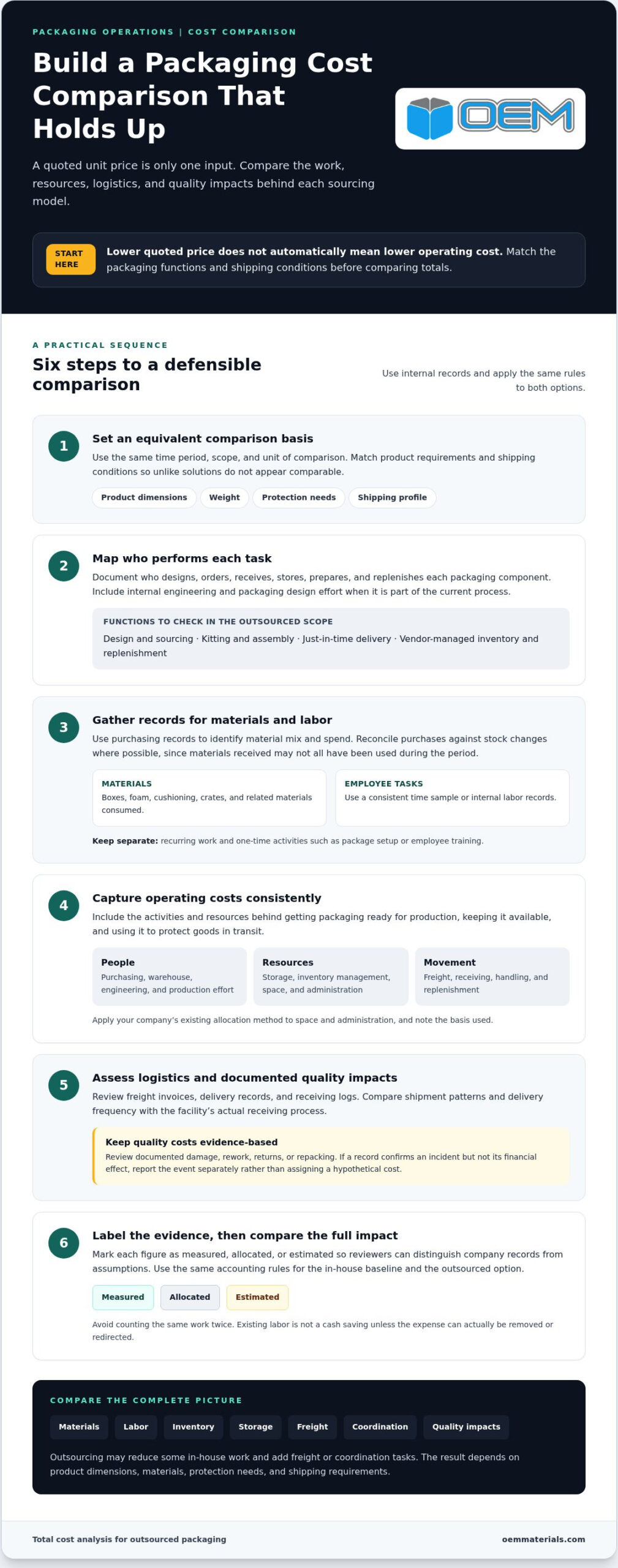
How to Build a Defensible Packaging Cost Comparison
A reliable comparison starts with a defined scope, not a supplier quote. Use the same products, facilities, time period, and unit of comparison for both models. For manufacturers operating across Orange County, Los Angeles County, the Inland Empire, and San Diego County, account for the delivery routes and receiving locations involved. The goal is to compare equivalent packaging performance and responsibilities using records your team can review.
Collect comparable operating data before requesting proposals
Build a baseline from current specifications and operating records. Capture product dimensions and weight, annual usage, shipping method, and protection requirements. Document packing steps, staffing effort, storage limits, and replenishment patterns. This information gives suppliers a consistent scope and helps purchasing compare proposals for corrugated packaging against the same product and operating requirements.
Use the following sequence to keep the evaluation consistent:
- Set the comparison period and unit. Choose a period that reflects normal demand and a common basis, such as packaging per finished unit or per shipment. Apply it to both the current process and the proposed model.
- Define products and protection needs. Record dimensions, weight, handling conditions, shipping method, and packaging performance requirements. Include existing box, foam, cushioning, or crate specifications where relevant.
- Document current operations. Note material use, labor time by task, inventory levels, storage constraints, delivery frequency, and receiving workload. Identify the source for each figure so estimates aren’t mistaken for measured costs.
- Match the service scope. Specify whether the comparison includes design, prototypes, kitting, assembly, replenishment, or materials only. Compare the same responsibilities, or clearly show where they differ.
Test service fit, implementation, and inventory assumptions
State the expected program scope, including prototype needs, production volume, product variations, and anticipated usage. A design or assembly approach suited to a short run may not map directly to a high-volume program, so assess actual requirements. Include implementation tasks such as reviewing samples, approving specifications, updating work instructions, and coordinating the transition. Assign these tasks only where your process requires them.
Next, compare supplier-supported replenishment with your current ordering and stock-control process. For vendor-managed inventory, define which inventory tasks would shift and which internal approvals or receiving duties would remain. Assess just-in-time delivery against current delivery frequency, route, facility schedule, and stock needs. Don’t assume a different replenishment model reduces labor or storage without evidence from your records.
Keep assumptions visible, especially for freight, labor allocation, and quality impacts. Separate confirmed costs from estimates and note what operational data could change the result. Cost outcomes depend on product dimensions, materials, and shipping requirements. To discuss a packaging cost comparison, share your product dimensions, weight, and annual usage.
Turn the Packaging Cost Analysis Into a Practical Sourcing Decision
Use the cost comparison to guide a sourcing decision, not to declare one model universally better. Review documented costs alongside product protection, production needs, and supply continuity. A lower operating estimate matters only if the packaging performs as required and materials arrive in a way that supports the production schedule. Cost outcomes depend on product dimensions, materials, and shipping requirements.
Consider the work your team needs to manage. Design support may help address fit, protection, and packing steps. Kitting or assembly may shift preparation tasks away from production staff, while managed replenishment may change how your team tracks and orders packaging. Evaluate each option against the current process and its recorded workload.
Match sourcing options to production and packaging requirements
Match the program scope to demand. A prototype or short run may call for a different review process than recurring, high-volume production. Assess custom corrugated boxes, foam inserts, or crates according to the product’s dimensions, protection needs, handling, and shipping conditions. Keep required performance consistent when comparing options.
Then weigh the tradeoffs. A solution that supports product protection but requires more internal packing time should be evaluated against both factors. If supply continuity is a priority, include replenishment responsibilities and delivery timing in the decision. Use the evidence gathered for each model, and identify any assumptions that still need validation through a prototype or operational review.
Prepare a clear brief for a packaging quote
A focused project brief helps connect your cost analysis to a practical packaging recommendation. Include the product and current process details that affect material selection, handling, and shipping, along with the program scope you need evaluated.
- Product details: Dimensions, weight, and any relevant handling or protection requirements.
- Demand: Annual usage, production volume, product variations, and prototype or short-run needs.
- Shipping conditions: Shipping method, destination or facility locations, and known handling considerations.
- Current packaging: Materials and components in use, such as boxes, foam, or crates, plus any available specifications.
- Operational challenges: Current labor, inventory, packing, storage, and replenishment issues, described without presuming a particular savings outcome.
This information helps frame a project-specific comparison around actual requirements rather than assumptions. For a practical next step, request a project-specific packaging quote and include your product dimensions, weight, annual usage, and shipping conditions.
Set Up Your Next Packaging Decision
A useful total cost analysis for outsourced packaging gives your team a repeatable basis for sourcing decisions. Apply the same method when product mix, demand, shipping routes, or production workflows change. That makes it easier to revisit assumptions and see whether the current packaging program still fits operational needs.
For a project-specific review, bring the cost comparison together with the packaging requirements. OEM Materials & Supplies can support programs with custom corrugated boxes, engineered foam, and wood crates, alongside design, kitting and assembly, just-in-time delivery, and vendor-managed inventory. The right combination depends on the product, production scope, and shipping conditions, not a unit quote alone.
Start with the information your team already has: product dimensions and weight, current packaging, annual usage, and shipping conditions. Request a project-specific packaging quote to discuss the requirements and identify a practical next step for your operation.
Frequently Asked Questions
How much does outsourced packaging cost compared with handling it in-house?
Compare the options using the same demand forecast and accounting period, then test how the result changes if usage rises or falls. A break-even view can help show how much internal packaging work would need to change for one model to become preferable. Keep assumptions separate from recorded figures, and don’t treat current labor as avoidable if employees would simply move to other necessary tasks. This makes the cost analysis more useful for sourcing decisions.
What information should I provide to get an accurate packaging quote?
Along with basic product and order details, provide a drawing or sample if available, and explain how the item is oriented and handled during packing. Identify any product variations that use different packaging and note which components must be supplied together. If a current package is causing assembly delays or inconsistent packing, describe the specific issue. These details can help clarify design intent and distinguish required features from preferences.
Can outsourced packaging support prototypes as well as high-volume production?
Yes. For a prototype, define what needs to be evaluated, such as product fit, assembly sequence, or protection during handling. For a larger program, establish how approved revisions will be communicated before production uses them. Treat prototype feedback as a controlled design input, not an informal change. This helps preserve the learning from early samples as a packaging program moves into repeat orders.
Does outsourcing packaging include kitting and assembly?
It can. To scope the work clearly, provide a bill of materials for each kit, identify the required quantities of each component, and describe the order in which items should be packed or presented. Clarify how completed kits will be labeled or identified within your receiving process. That level of detail helps prevent ambiguity about what constitutes a complete kit and supports a more accurate comparison with your current workflow.
Is vendor-managed inventory suitable for manufacturing packaging supplies?
It may suit operations with recurring packaging demand and a clear way to share usage or stock information. Consider first whether consumption can be tracked reliably and whether responsibility for exceptions, such as an unexpected production change, is understood. A pilot scope limited to selected materials or a facility can help the team assess the process before applying it more broadly. The right fit depends on inventory practices and communication between the parties.
What happens to packaging specifications when a supplier supports the program?
Specifications should remain controlled documents that your team can review and approve. Establish who may request a change, who authorizes it, and how the current approved version is identified on orders and production records. When a product or package is revised, retire outdated documents from active use. This simple change-control practice reduces the chance that different teams work from conflicting drawings or material instructions.
Can packaging suppliers support manufacturers across Southern California?
Yes. OEM Materials & Supplies supports manufacturers in Orange County, Los Angeles County, the Inland Empire, and San Diego County. For a business operating at multiple sites, identify which locations use each packaging configuration and how orders are coordinated across them. That information helps define a workable program across facilities while accounting for differences in local receiving procedures and production schedules.