
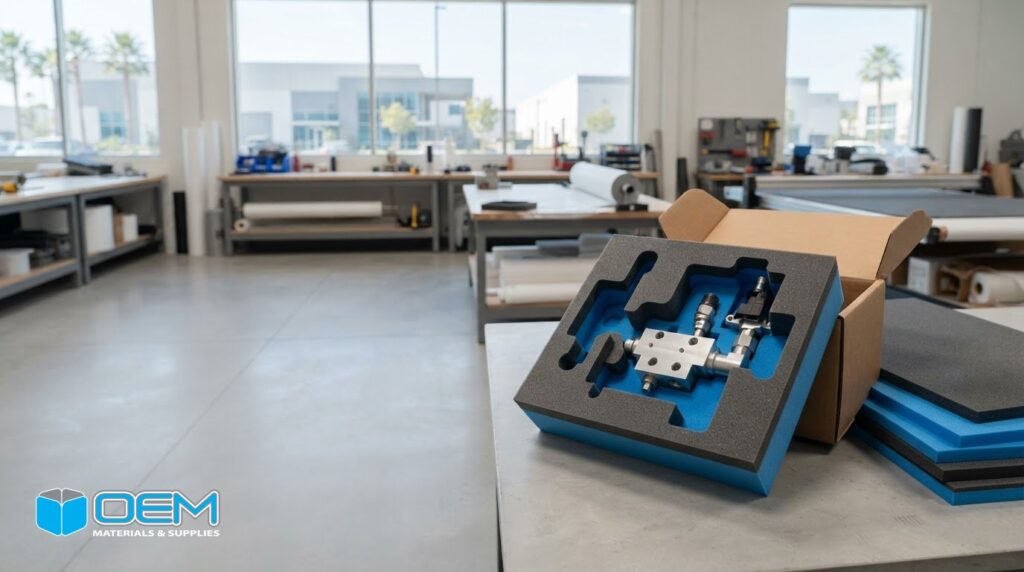
XLPE foam is a closed-cell material made from cross-linked polyethylene resin, with molecules joined through a chemical or irradiation process. Its structure provides cushioning and impact resistance while limiting moisture passage. A cross-linked polyethylene foam fabricator in Orange County can shape the material into inserts and other custom components to suit specific products and handling needs.
Choosing foam is only part of the solution. Density, thickness, and fabrication method all affect how well it performs. This article explains what XLPE foam is, how its densities and configurations relate to commercial and industrial uses, and how fabrication turns the material into a protective component. It also covers practical considerations for a custom project, including product fit, cushioning needs, and production volume.
Key Takeaways
- XLPE’s closed-cell structure supports cushioning and impact resistance while limiting moisture passage, making material properties relevant to product and handling requirements.
- Compare foam density and thickness against the load and the risk of compression; heavier components may call for denser material to resist bottoming out.
- Match the fabrication method to production volume: water-jet or CNC routing can suit prototypes and short runs, while die-cutting can serve larger runs.
- Custom foam configurations can support packaging and other commercial or industrial uses, including thermal insulation, gaskets, and expansion joints.
- Coordinate foam packaging with the outer box and packing process to create a protective solution suited to the product’s dimensions and shipping needs.
What is Cross-Linked Polyethylene foam?
Cross-linked polyethylene (XLPE) foam is a closed-cell material made from polyethylene resin. Its molecules are joined through chemical cross-linking or irradiation, forming a structure that helps limit the passage of air, moisture, and water vapor. XLPE is also resistant to many chemicals, oils, and solvents. These properties make it useful when packaging needs cushioning that retains its shape during handling and transport.
Custom foam fabrication turns a material specification and product geometry into a protective component. For an industrial insert, the design considers the item’s dimensions, weight, contact points, and packaging configuration. A shaped cavity can locate a machined part, while separate cutouts can keep components apart. Density and thickness affect how the foam responds under load, so the design should reflect the product and its handling conditions.
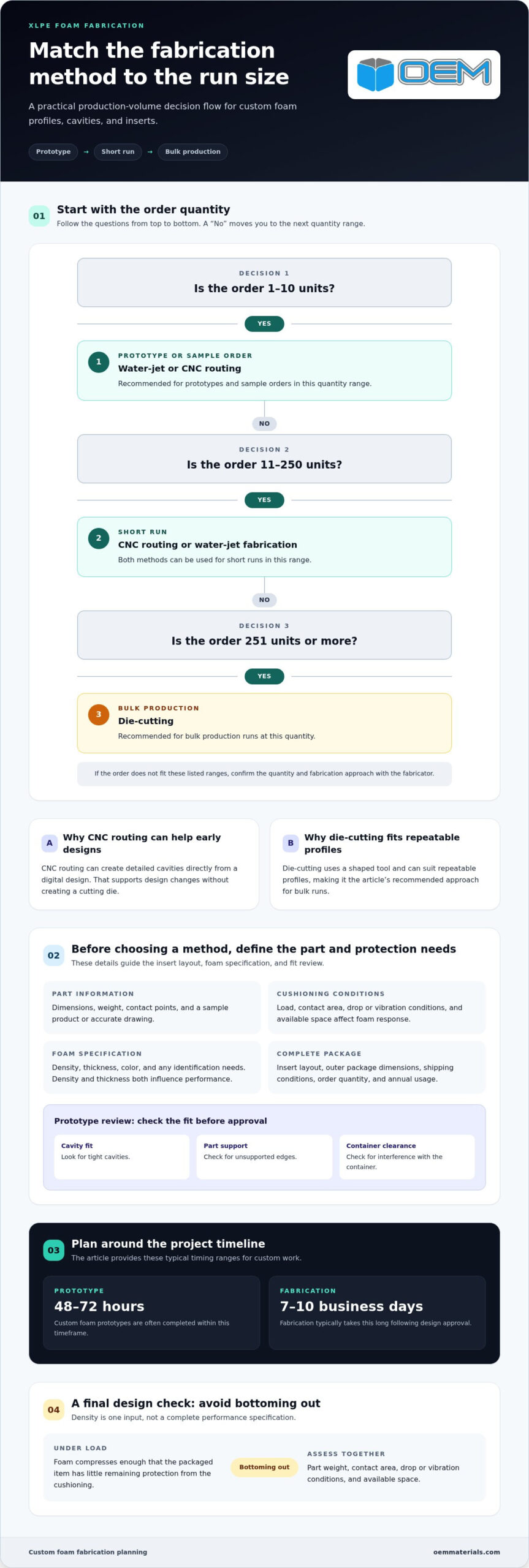
A practical project starts with a sample product or accurate drawing. The fabricator then develops the insert layout, selects a foam type, and produces a prototype for fit review. Prototype checks can reveal tight cavities, unsupported edges, or interference with the container. Custom foam prototypes are often completed within 48 to 72 hours, while fabrication typically takes 7 to 10 business days following design approval.
Which certifications and safety standards should a fabricator meet? Requirements depend on the application and customer specifications. Define the required material documentation, dimensional tolerances, and any application-specific testing in the project documents before approving production.
Can local fabricators cut, route, laminate, or thermoform XLPE foam to custom specifications? Cutting and routing are established methods for creating custom profiles and cavities. Lamination and thermoforming may suit some designs, depending on material compatibility, geometry, and the processes available.
Custom-cut shapes depend on the foam’s available dimensions and the equipment used. Broad, shallow cavities may fit within a single sheet, while a deep insert may require stacked layers. Bonding layers can create a thicker assembly, but seams and alignment matter when positioning a product. A drawing or sample helps identify fit constraints before the layout is approved.
Tooling choices also affect how a project moves from prototype to repeat production. CNC routing can produce detailed cavities directly from a digital design, which supports design changes without creating a cutting die. Die-cutting uses a shaped tool and can suit repeatable profiles. For prototypes and sample orders of 1-10 units, water-jet or CNC routing is recommended; short runs of 11-250 units can use CNC routing or water-jet fabrication. Die-cutting is recommended for bulk production runs of 251 or more units.
Available densities, thicknesses, and configurations
XLPE foam is supplied in different densities, thicknesses, and configurations. Density, measured in pounds per cubic foot, helps describe how much material occupies a given volume. Common industrial cushioning densities include 1.7 lb and 2.2 lb per cubic foot. A 1.7 lb density is described as an industrial standard for many cushioning needs, while higher-density material can suit heavier loads.
For components that need more resistance to bottoming out, polyethylene foam densities of 4 lb or 9 lb per cubic foot may be appropriate. Bottoming out occurs when cushioning compresses enough that the packaged item receives little remaining protection from the foam. Density alone doesn’t determine performance. Part weight, contact area, drop or vibration conditions, and available space all affect the foam’s response.
Thickness is another design variable. A thin sheet can separate surfaces or cushion a broad, light component. A thicker section provides more material between a part and its container, but a deep cavity may require layered construction. For example, a custom insert for a heavy machine component needs to support the part without excessive compression. Assessing product geometry and load helps determine a suitable density and thickness combination.
Firmness and density are related, but they are not interchangeable specifications. Identify the product’s weight, dimensions, fragile contact points, and packaging orientation. Then specify the desired foam density and thickness, along with any color or identification needs. These details give the supplier practical criteria for matching material properties to cushioning requirements and protecting the package during manufacturing and shipment.
Which Orange County suppliers provide XLPE foam in different thicknesses, colors, and firmness levels? Evaluate local foam fabricators and industrial packaging suppliers by whether they can supply the required material and make the requested configuration. Include thickness, density, color, and firmness in your inquiry so each response addresses the same specifications.
What information should you provide for an XLPE foam fabrication quote? Include the part’s dimensions and weight, a drawing or sample, the desired insert layout, foam thickness and density, color requirements, order quantity, and annual usage. Add the outer package dimensions and shipping conditions to ensure the proposed configuration fits the complete packaging system.
Density and thickness choices should follow the application, not a general preference for “superior” cushioning or durability. A sample part or drawing helps clarify fit, while the order quantity helps determine a suitable manufacturing approach. For a project-specific recommendation, share your foam specifications and quote request.
Fabricators can make custom XLPE foam components in a range of densities, thicknesses, and configurations for packaging applications.
California polyethylene foam suppliers
California manufacturers can source polyethylene foam from material distributors or suppliers that also fabricate finished components. The distinction matters: a warehouse ordering sheets for internal conversion has different needs from a team requiring ready-to-use inserts. A cross-linked polyethylene foam fabricator in Orange County can support projects that require cut or shaped components rather than unconverted stock.
Supplier logistics depend on where the foam enters the operation. A manufacturer in Irvine may receive components at a production site, while an Anaheim warehouse may need deliveries coordinated with its receiving schedule. Businesses operating across Orange County, Los Angeles County, Riverside County, or San Diego County should identify each destination and specify whether orders go to one facility or several.
California fabrication services can include cutting profiles and preparing layered inserts for specific packaging layouts. A component with a handle or connector, for example, may need a cutout that leaves the feature accessible. Providing packaging dimensions alongside the part drawing shows how the foam fits into the finished pack, rather than treating the insert as a standalone piece.
Material terminology matters when discussing a project with a supplier. XLPE is cross-linked polyethylene, while polyurethane is a different foam material with distinct properties. If the project involves chemical exposure, describe the substance and the component’s contact conditions. A part packed near equipment that uses lubricants, for example, presents a different specification question from one stored in a clean, dry warehouse.
Do Orange County fabricators offer local pickup, delivery, or shipping for custom foam orders? Pickup, delivery, and shipment are possible fulfillment options, depending on the supplier and order requirements. Include the destination, receiving schedule, and package dimensions in your request to help determine a workable handoff or delivery plan.
To compare suppliers efficiently, prepare one project record with the part drawing, insert layout, quantity, and destinations. For a program serving Irvine and San Diego, specify whether both locations will use the same configuration. Note receiving constraints, such as dock access or preferred delivery windows. These details help purchasing evaluate fulfillment alongside fabrication scope and keep specifications consistent across facilities.
Import planning may also shape the questions buyers ask about stock and delivery. Southern California ports handled 4.1 million loaded import containers in the first five months of 2026. For a foam order tied to a production schedule, ask suppliers how they track material availability and communicate changes that could affect fulfillment. Clarify whether the requested service includes only fabrication or also packaging, staging, and coordination with the receiving facility. If the order supports several sites, consistent labeling and clear destination details can help teams manage the handoff.
California SB 54 packaging regulations are a compliance consideration for facilities. Buyers should raise applicable packaging requirements when discussing finished inserts and order preparation, rather than waiting until delivery arrangements are set. Sharing how the foam will be packed, where it will be received, and what internal handling is expected gives the supplier useful context for the request. This can also help purchasing compare proposals on the full scope of service, including material, fabrication, and fulfillment, while keeping the packaging plan aligned with facility needs.
Commercial and industrial foam fabrication
Commercial XLPE fabrication supports packaging, thermal insulation, expansion joints, and industrial gaskets. An Orange County fabricator specializing in cross-linked polyethylene foam can develop components around the part’s function and installation requirements. A shipping insert must secure a product inside its package, while a gasket must fit between mating surfaces. Defining the application first keeps the design focused on its intended use.
In Orange County manufacturing operations, foam components can protect assemblies moving between production, storage, and distribution. For an electronics assembly, a package layout can position components while keeping connectors accessible for inspection. For a replacement machine part, an insert can provide a designated resting place during storage. In either case, the layout should account for how workers place and retrieve the part.
Thermal applications require a different design brief. XLPE is used in HVAC duct insulation, pipe insulation, and thermal packaging. A pipe-insulation component must suit the pipe’s route and installation sequence. A thermal package must fit the product and container without obstructing closure. Drawings that show the application’s boundaries help coordinate the foam shape with adjoining parts.
For expansion joints and gaskets, define the interface rather than treating the foam as a generic cushion. Specify the gap or mating surfaces, the component’s intended position, and any edges that must remain exposed. For example, a gasket around an access panel needs a profile that follows the panel perimeter while preserving the opening. These details guide the fabrication drawing and review.
Which fabricators in Orange County, California work with cross-linked polyethylene foam? Industrial foam fabricators and packaging suppliers that process XLPE can make custom components. Provide the application, a part drawing or sample, and the intended end use so the project can be designed around its functional requirements.
Before production, review the proposed configuration against the full assembly. A packaging insert must fit the container, support the product, and allow practical removal. An insulation component must align with the surfaces it covers. A gasket or joint component must match its installation location. Reviewing these interfaces can reveal design conflicts before the foam is incorporated into the larger system.
For teams coordinating across design, purchasing, and production, maintain one approved drawing that identifies component orientation and placement. If a kit contains several foam pieces, label each position and its associated part on the layout. This gives operators a clear packing reference and helps purchasing communicate the same configuration when ordering repeat components.
For custom XLPE components, look for Orange County industrial foam fabricators or packaging suppliers with XLPE processing capabilities. Share the application, a part drawing or sample, and the intended end use so the project can be assessed against its requirements.
Cross-linked polyethylene foam fabrication
Fabrication turns XLPE stock into a component shaped for a specific part. Start with a product drawing or physical sample, then define the surfaces that need support. A foam insert for an irregular machine part, for example, needs cavities that follow its profile without blocking access points. The finished layout must also match the inner dimensions of its case or shipping container. These specifications guide cutting and help avoid unnecessary fit changes.
Production volume helps determine the cutting process. Water-jet or CNC routing is recommended for prototype and sample orders of 1-10 units. These methods let teams evaluate fit before committing to a larger run. For short runs of 11-250 units, CNC routing or water-jet fabrication can produce the required geometry. Die-cutting is recommended for bulk production runs of 251 or more units.
Each fabrication method serves a different production need. CNC routing follows a programmed tool path, making it suitable for cavities and profiles with multiple features. Water-jet fabrication cuts foam without relying on a shaped die. Die-cutting uses a tool made to the part’s outline, supporting repeat production of that profile. Choose a method based on geometry, expected quantity, and the likelihood of design changes.
Review the first fabricated piece against the actual product. Place the part in the cavity, confirm that the intended contact areas align, and check that it can be removed without disturbing nearby pieces. For a multi-part kit, compare every cavity with its assigned component. A drawing communicates dimensions, but a physical fit review can reveal access or handling issues that are not obvious on paper.
Layered construction can provide greater overall thickness than a single foam sheet. Each layer may have its own cutouts, creating stepped cavities or separate support levels. The drawing should identify the order and orientation of the layers, along with openings that must remain clear. This is especially important when an insert needs to secure a component while keeping connectors, controls, or inspection points accessible.
A production-ready specification should identify the foam material, density, thickness, part geometry, cavity layout, quantity, and package dimensions. It should also show the product’s orientation and the surfaces that must remain unobstructed. For repeat orders, keep the approved drawing and sample as a shared reference for production teams. This helps ensure later cuts match the accepted design.
For a custom XLPE insert, request a fabrication quote with a drawing or sample, order quantity, and packaging dimensions. These details help connect the cutting method to the required configuration and production run.
OEM Materials & Supplies: Corrugated Boxes
OEM Materials & Supplies helps businesses coordinate protective packaging for products that need both cushioning and an outer container. Corrugated boxes provide the shipping enclosure, while foam packaging helps position and cushion products inside. Packaging kits bring components together for a consistent packing process. Mailing tubes and cores suit products or materials designed for cylindrical packaging.
Consider these options when a foam insert is only one part of the shipping requirement. Sharing the product dimensions, weight, packaging configuration, and expected usage helps clarify which combination fits your operation. If your packaging needs include corrugated boxes as well as foam, OEM Materials & Supplies can help coordinate a solution. Contact OEM Materials & Supplies to discuss your packaging requirements.
Move from Foam Design to a Packaging Plan
Connect the foam design to how your team packs, stores, and ships each product. A useful project brief identifies the part being protected, its handling path, and the constraints of the packing station. This context helps an engineer or purchasing manager assess whether a proposed insert works in the actual operation, not just on a drawing.
When evaluating a cross-linked polyethylene foam fabricator in Orange County, bring a product drawing or sample and explain what the packaging needs to accomplish. Include fit concerns, handling requirements, and anticipated production changes. A focused discussion helps clarify design priorities before fabrication begins.
OEM Materials & Supplies can help align foam packaging with the broader packaging plan. Share your project details to begin the conversation and identify a practical next step. Contact OEM Materials & Supplies to discuss your packaging requirements. A clear starting brief helps your team move forward with purpose.
Frequently Asked Questions
What types and densities of cross-linked polyethylene foam do Orange County fabricators offer?
Orange County fabricators can provide XLPE in forms suited to packaging inserts and other cut components. Choose density based on the part’s weight, contact area, and expected handling, not simply a preference for maximum firmness. For a useful comparison, request the material’s technical data and describe the product’s support points. Include color and surface requirements so the proposed foam also suits identification and assembly needs.
What are the minimum order quantities and lead times for custom XLPE foam fabrication in Orange County?
Minimum quantities and schedules depend on the design, production setup, and approval process. A straightforward repeat part differs from a new layout that requires sample review or design changes. To plan purchasing, provide the expected order pattern, annual usage, drawing revision, and required in-hand date. Before repeat orders, confirm who approves the final sample and how drawing changes will be handled.
Do Orange County XLPE foam fabricators serve packaging, marine, automotive, medical, or construction applications?
XLPE is used in packaging and medical products, as well as in commercial applications such as thermal insulation, industrial gaskets, and expansion joints. Automotive, marine, and construction projects need a defined use case rather than a broad industry label. Specify whether the foam will cushion a shipped component, insulate a part, or fill a joint. Its function helps determine the relevant geometry and material requirements.