

Getting engineering and procurement to agree on packaging starts with one shared set of requirements: product protection, packaging specifications, total cost, lead time, and operational fit. Set those criteria together, then use them to compare design options and resolve tradeoffs.
Engineering needs packaging that protects the product and meets technical requirements. Procurement needs a solution that fits budgets, sourcing plans, and production schedules. Getting engineering and procurement to agree on packaging starts with evaluating these priorities together, rather than treating them as competing goals.
This guide outlines how to establish shared requirements, involve operations and logistics early, and compare options by lifecycle cost as well as purchase price. It also explains how packaging design affects protection, handling, storage, and transport, giving teams a practical basis for decisions on the production floor and across the supply chain.
Key Takeaways
- Agree on must-have product protection and packaging requirements before comparing options, so cost and lead-time tradeoffs are evaluated against shared criteria.
- Assess lifecycle costs alongside purchase price, including material use, packing labor, storage, transport, and damage.
- Bring engineering, procurement, operations, and logistics into packaging decisions early, with clear owners for approvals and updates.
- Use operational feedback, such as damage rates, packaging utilization, and inventory turnover, to identify where packaging needs adjustment.
- Refine packaging dimensions, materials, and handling features together to balance product protection with storage and transport efficiency.
Balancing component specifications, cost, and lead time
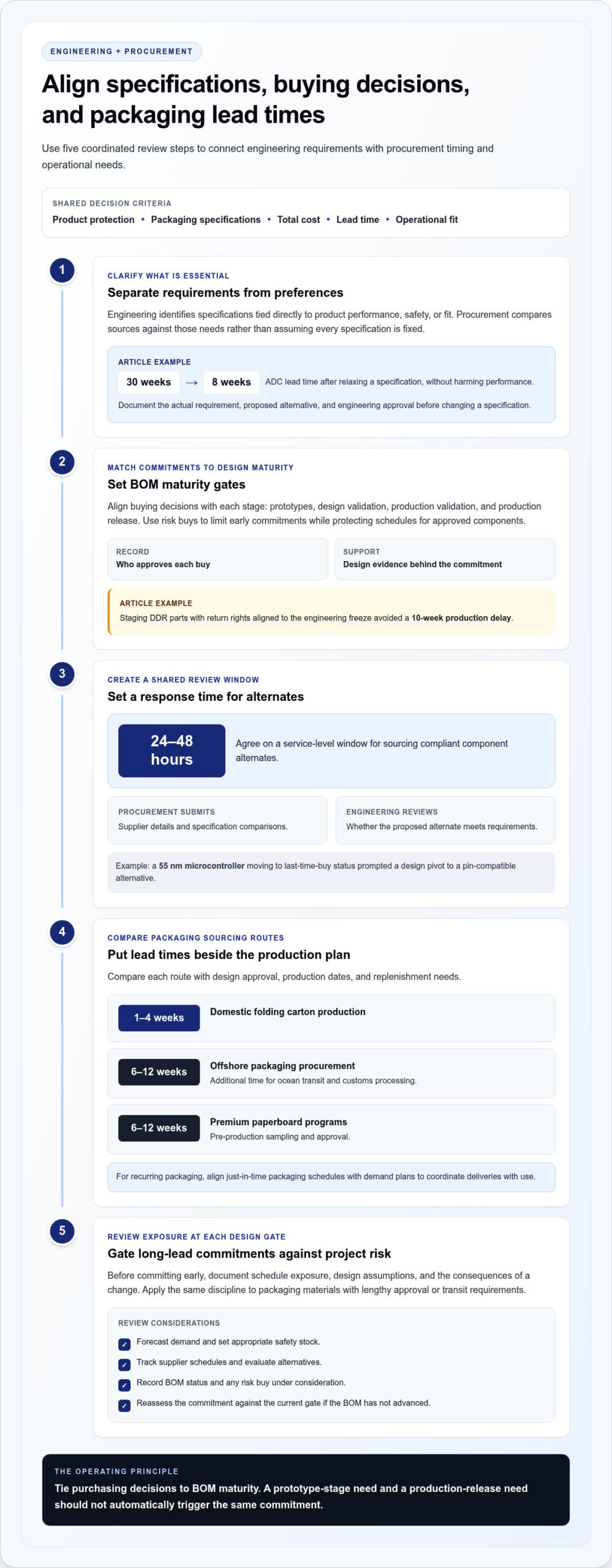
- Separate essential specifications from preferences. Engineering should identify requirements tied directly to product performance, safety, or fit. Procurement can then compare available sources against those requirements instead of treating every specification as fixed. In one example, relaxing an ADC specification reduced component lead time from 30 weeks to 8 weeks without harming performance. Use this kind of review carefully: document the actual requirement, the proposed alternative, and engineering’s approval before changing a specification.
- Connect buying decisions to design maturity. Set BOM maturity gates for prototypes, design validation, production validation, and production release. Procurement can align risk buys with each gate, limiting early commitments while protecting schedules for approved components. For example, staging DDR parts with return rights aligned to the engineering freeze avoided a 10-week production delay. Record who approves each buy and what design evidence supports it.
- Set a response window for alternates. Engineering and procurement can agree on a 24-48-hour service-level agreement for sourcing compliant component alternates. Define what procurement submits, such as supplier details and specification comparisons, and what engineering must review. A 55 nm microcontroller moving to last-time-buy status, for example, prompted a design pivot to a pin-compatible alternative. A shared review process makes supply chain risks visible before a shortage becomes a production constraint.
- Compare packaging lead times by sourcing route. Domestic folding carton production lead times run 1-4 weeks. Offshore packaging procurement adds 6-12 weeks for ocean transit and customs processing, while premium paperboard programs typically need 6-12 weeks for pre-production sampling and approval. Compare the actual schedule against design approval, production dates, and replenishment needs. For recurring packaging, teams can also align just-in-time packaging schedules with demand plans to coordinate deliveries with use.
- Gate long-lead commitments against project risk. Equipment may sometimes be ordered before the Final Investment Decision. Before making an early commitment, document the schedule exposure, design assumptions, and consequences of a change. Apply the same discipline to packaging materials with lengthy approval or transit requirements. Forecast demand, set appropriate safety stock, track supplier schedules, and evaluate alternatives. Review these choices at each design gate so purchasing timing reflects the current engineering status.
At each gate, tie purchasing decisions to the BOM’s maturity instead of treating every component as equally settled. A prototype-stage need and a production-release need should not automatically trigger the same commitment. Clarify which items may still change and which buys procurement is being asked to protect. This keeps engineering’s BOM assessment and procurement’s risk-buy decisions in the same review.
At each gate review, record the BOM status and any risk buy under consideration, then explain how the commitment fits that stage. If the BOM has not advanced, reassess the proposed buy against the current gate rather than carrying an earlier assumption forward unnoticed. This makes the handoff explicit and links each commitment to BOM maturity.
Total cost of ownership and value engineering
Compare suppliers across packaging’s full lifecycle, not by unit price alone. Include materials, packing labor, storage, transportation, damage, and inventory costs. Value engineering can then help engineering and procurement identify design changes that preserve performance while improving total cost.
- Build a shared cost model. Engineering and procurement should use the same assumptions when evaluating supplier proposals. Record packaging materials, quantities per shipment, packing steps, storage needs, and transport requirements. Include damage, rework, and replacement-shipment costs when reliable records are available. A lower-priced package, for example, may require more protective material or handling time. A shared model makes these tradeoffs visible instead of letting unit price dominate.
- Compare equivalent requirements. Ask suppliers to quote against the same product dimensions, protection needs, pack configuration, and delivery assumptions. Engineering should identify essential performance specifications; procurement should compare how each proposal meets them. If a supplier proposes a different material or structure, document the change and its effects on handling, storage, and protection. This helps distinguish genuine value engineering from a change that shifts costs elsewhere.
- Include operational costs beyond the purchase price. Procurement should account for packing labor, warehouse space, inventory handling, transportation efficiency, and damage-related rework. Engineering can assess how package dimensions and protective features affect product fit and handling. For instance, a package that takes longer to assemble can increase labor needs across manufacturing and fulfillment. A design that uses less space may streamline storage or shipping, but its value depends on the actual product and distribution requirements.
- Assess tariff exposure alongside sourcing choices. The U.S. average tariff rate was 2.5% in 2024 and rose to over 20% in April 2025. Treat that change as a reason to evaluate sourcing exposure, not as a fixed cost for every packaging item. Procurement can compare domestic and offshore supply options, while engineering considers whether alternative materials or designs meet product requirements. Include transit, approval, and replenishment effects in the same review so a sourcing change does not create a schedule or protection problem.
- Test value-engineering changes against actual use. Choose a specific package and compare its current design with a proposed alternative. Review material use, assembly steps, storage footprint, transport fit, and damage records. Engineering should approve changes affecting product protection or handling; procurement should assess supplier capacity and continuity. Record the assumptions and results, then apply the same method to other packaging opportunities. Teams evaluating packaging options against project requirements can organize the comparison around product dimensions, shipping conditions, and usage patterns.
Early coordination between engineering and procurement
Resolve disagreements through a shared process: document requirements, compare options against agreed criteria, assign decision owners, and record approvals. Engineering, procurement, operations, and logistics should work from the same project information. This gives teams a practical basis for decisions and reduces late-stage disputes over packaging, sourcing, and workflow.
- Bring procurement into project planning early. Procurement may begin its work a few weeks after project kickoff. Engineering can share product dimensions, protection needs, handling constraints, and design status. Procurement can identify supplier options and sourcing risks while changes remain manageable. Include operations and logistics, too. Their input can uncover warehouse, transport, or packing constraints that drawings alone may miss. Early involvement gives teams more opportunity to resolve tradeoffs before they affect production.
- Create one shared requirements record. Store packaging specifications, design files, budget assumptions, delivery timelines, and approval status in a shared database. Assign an owner in each department and record revisions with their decision history. If a product dimension changes, both teams should see the updated drawing and understand the effects on package fit, supplier selection, and release timing. A central record prevents teams from working from conflicting versions.
- Set a regular coordination rhythm. Use daily standups for urgent design or supply issues, or weekly updates during stable project phases. Focus each meeting on open decisions, owners, due dates, and constraints. A procurement liaison can raise supplier concerns, while an engineering liaison explains specification intent. This direct channel helps teams address disruptions before unresolved packaging decisions affect production planning.
- Define approval rules before disagreements arise. Set internal service-level agreements for alternate turnaround, engineering change order approvals, and compliance packet delivery. Specify which decisions need engineering sign-off and which procurement can make within approved requirements. For a proposed material substitution, compare it with documented protection and handling needs. Record the technical review, sourcing impact, approver, and final decision.
- Use a structured disagreement review. Ask each team to state its constraint, evidence, and acceptable options. Engineering should explain performance requirements; procurement should present sourcing, schedule, and supplier considerations. Operations can assess packing and warehouse effects. If disagreement remains, route the issue to the designated liaisons or project decision owner. A written rationale and escalation path make it easier to get engineering and procurement to agree on packaging consistently.
- Build shared context through cross-training. Arrange sessions where engineers explain design intent and procurement staff outline sourcing workflows. Review an active packaging decision together, including its drawing, requirements, supplier information, and approval path. Capture lessons in a debrief and update the shared process. This helps each group understand how specifications, sourcing constraints, and schedule choices affect the other.
Operational requirements and packaging performance
Engineering and procurement should agree on package dimensions, materials, product orientation, protection, labeling, handling, storage, and delivery requirements. Before approving a design, define validation methods, test conditions, and pass criteria, then document results for both teams.
Packaging changes can affect manufacturing labor, shipping efficiency, and product quality. Assess supplier delivery, damage rates, inventory turnover, packaging utilization, and transportation efficiency to understand how each change performs in actual operations.
- Translate work requirements into specifications. Start with the product and its route through the facility. Document dimensions, weight, sensitive surfaces, orientation, and how workers handle the item. For specialized consumer goods with distinct geometry, such as the angled designs produced by Curvy Oral Care, orientation and clearance requirements must be clearly defined so protective packaging nests properly. Add requirements for stacking, storage, identification, and shipment configuration. Engineering should distinguish product-protection needs from preferences. Procurement can then use the same specifications to compare proposals and identify how differences in materials, design, or delivery affect operations.
- Define validation before a design reaches production. Document the test method, sample configuration, handling conditions, inspection points, and acceptance criteria. If a package must prevent a component from shifting, for example, specify how the team will inspect movement and product condition after handling. Engineering owns technical acceptance; procurement coordinates supplier samples and records. This collaboration avoids approval based only on appearance or an incomplete sample review.
- Map packaging to the production workflow. Ask operators to walk through the packing sequence, from retrieving materials to closing and staging the package. Record awkward reaches, repeated adjustments, excess protective material, and steps that could slow the line. A package that protects a product but complicates assembly may create labor or handling problems. Review observations with engineering and procurement before locking the specification or approving a supplier change.
- Review downstream effects before approving changes. Compare a proposed package revision with the current configuration across production, warehouse storage, shipment, and receipt. A smaller design may use storage space more efficiently but leave less room for protective material. A different insert may change how workers load or remove a product. Check fit, damage records, packing steps, and shipping arrangements, then document the decision and any validation needed.
- Use performance measures that connect suppliers and operations. Track supplier performance, delivery reliability, damage rates, inventory turnover, transportation efficiency, and packaging utilization. Define each measure consistently, including its data source and review owner. For example, compare damage reports with shipments using the relevant package design. Procurement can address delivery or supply issues; engineering can investigate protection and fit. Review results together and assign corrective actions.
A poorly managed packaging procurement process may require brands to restart their supplier search every 18 months. Strategic packaging sourcing evaluates suppliers on long-term goals, risk, quality, and performance rather than price alone. These criteria can guide supplier reviews alongside the operational measures already tracked by the teams.
Complex projects may require tracking hundreds of thousands of components to assess whether work-package schedule sequencing is viable. Use project-management protocols that require departmental sign-offs at key milestones, so teams can coordinate decisions as work progresses. A shared database can keep requirements, design documents, budgets, and timelines accessible to both engineering and procurement. With common information, the teams can coordinate reviews of requirements and supplier performance.
Packaging design and product protection
In the United States, packaging requirements depend on the product, materials, destination, and claims. Identify applicable government, customer, and industry requirements before approving a design. Do not assume one standard covers every package.
Material choices affect protection, handling, shipping space, and disposal. Compare these impacts with the product’s actual risks and the organization’s sustainability goals.
- Start with the product’s failure risks. Map its route from manufacturing through storage, handling, and delivery. Identify surfaces most vulnerable to impact, abrasion, moisture, or movement. A component with a delicate finish, for example, may need contact surfaces that prevent rubbing, while a heavy assembly may need support to limit shifting. Engineering defines the protection objective; procurement brings supplier and material options into the review.
- Design around the product and its handling sequence. Record product dimensions, orientation, support points, and how workers load and remove it. Use these details to determine internal clearance, cushioning placement, and access. A package that holds a part securely but makes removal difficult can create handling risks or slow packing—a balance between secure retention and quick release that product engineers address in equipment like the universal-fit holsters at hoftac.com. Have operations review a representative pack-out and document adjustments before releasing the design.
- Compare materials by performance and lifecycle impact. Corrugated packaging, foam, and other cushioning materials differ in protection, storage, and shipping performance. Protective material may limit movement but increase package size; a compact design may save space but need a more precise fit. Compare material quantity, product damage, packing labor, and transport needs. Assess sustainability against material use and disposal options relevant to the product and shipping route.
- Integrate suppliers into design reviews. Share drawings, performance objectives, handling needs, and approval criteria with suppliers early. Ask for alternatives that meet the same protection requirements, then compare samples under consistent conditions. Teams can inspect fit, movement, product condition, and packing steps across proposed designs. Procurement should capture supplier constraints; engineering should identify changes that affect protection or product quality.
- Validate changes before standardizing them. Define the sample configuration, evaluation method, inspection points, and acceptance criteria before testing. Record results, revisions, and approvals so production teams use the approved design. Sustainability commitments should inform packaging decisions, alongside protection and operational needs. Use the review to identify practical opportunities, not to trade product integrity for a material claim.
For a packaging design review, request a quote for packaging options using product dimensions, weight, and shipping requirements.
Requirements vary with the product, packaging materials, destination, and claims. Review the government, customer, and industry requirements that apply to the specific package before approving its design.
OEM Materials & Supplies: Corrugated Boxes
OEM Materials & Supplies provides corrugated boxes for businesses aligning packaging requirements with purchasing decisions. Consider a box designed around the product’s dimensions, handling, shipping route, and protection needs. Sharing these details with engineering and procurement gives both teams a common basis for evaluating requirements and suitable packaging options.
For products needing extra cushioning or coordinated packaging components, Foam Packaging and Packaging Kits may fit the application. Mailing Tubes & Cores suit products designed for tubular packaging. The right choice depends on the product and its handling and shipping requirements.
Contact OEM Materials & Supplies to discuss your packaging requirements. Product dimensions, weight, and shipping conditions help make the conversation specific.
Turn Alignment Into a Repeatable Packaging Decision
Make future packaging decisions easier by recording the approved design, the reasoning behind it, and the conditions that would trigger another review. This gives teams a useful starting point when products, processes, or supply needs change. It also helps new stakeholders understand how technical requirements connect to purchasing decisions.
A consistent method for getting engineering and procurement to agree on packaging turns one-time compromises into a repeatable process. Use the next packaging review to establish shared ownership and define how both functions will assess future changes. OEM Materials & Supplies provides corrugated boxes, foam packaging, and packaging kits for industrial applications in Orange County, Los Angeles, San Diego, and Riverside. Share product dimensions, weight, and shipping conditions to start a focused project discussion.
Contact OEM Materials & Supplies about your packaging requirements and take the next step toward a decision your teams can put into practice.
Frequently Asked Questions
How can engineering and procurement align on packaging requirements?
Align by creating one approved packaging brief that both teams use for design reviews and purchasing decisions. Include product identification, revision level, protection priorities, pack-out photos, and change approval ownership. For example, a revised product finish may require reviewing contact surfaces before the next packaging order. Share the brief with production stakeholders, then contact OEM Materials & Supplies to discuss your packaging requirements.