

The lowest quote may not be the best fit for a production operation. To compare packaging suppliers, assess how they manage quality specifications, supply continuity, sourcing, communication, and delivery coordination. Common packaging supplier service issues include inconsistent materials, inventory shortages, slow responses, and deliveries that don’t align with production needs. Each can contribute to product damage, added labor, or interruptions on the floor.
Price matters, but dependable service also depends on whether a supplier can meet your packaging requirements consistently and communicate clearly when plans change. This guide explains how to compare the capabilities that shape day-to-day operations, from quality checks and defect handling to continuity planning, inventory support, communication, and delivery coordination.
Key Takeaways
- Compare packaging quality against documented specifications, sample performance, and clear defect-handling practices.
- Assess how a supplier plans for material shortages, equipment interruptions, and other disruptions to supply continuity.
- Review sourcing, inventory visibility, and contingency planning to understand how packaging needs are managed as demand changes.
- Look for clear communication on quote timing, order changes, contacts, and escalation when issues arise.
- Coordinate delivery expectations across locations by aligning order details and receiving requirements with operational needs.
1. Quality specifications, samples, revisions, and defect handling
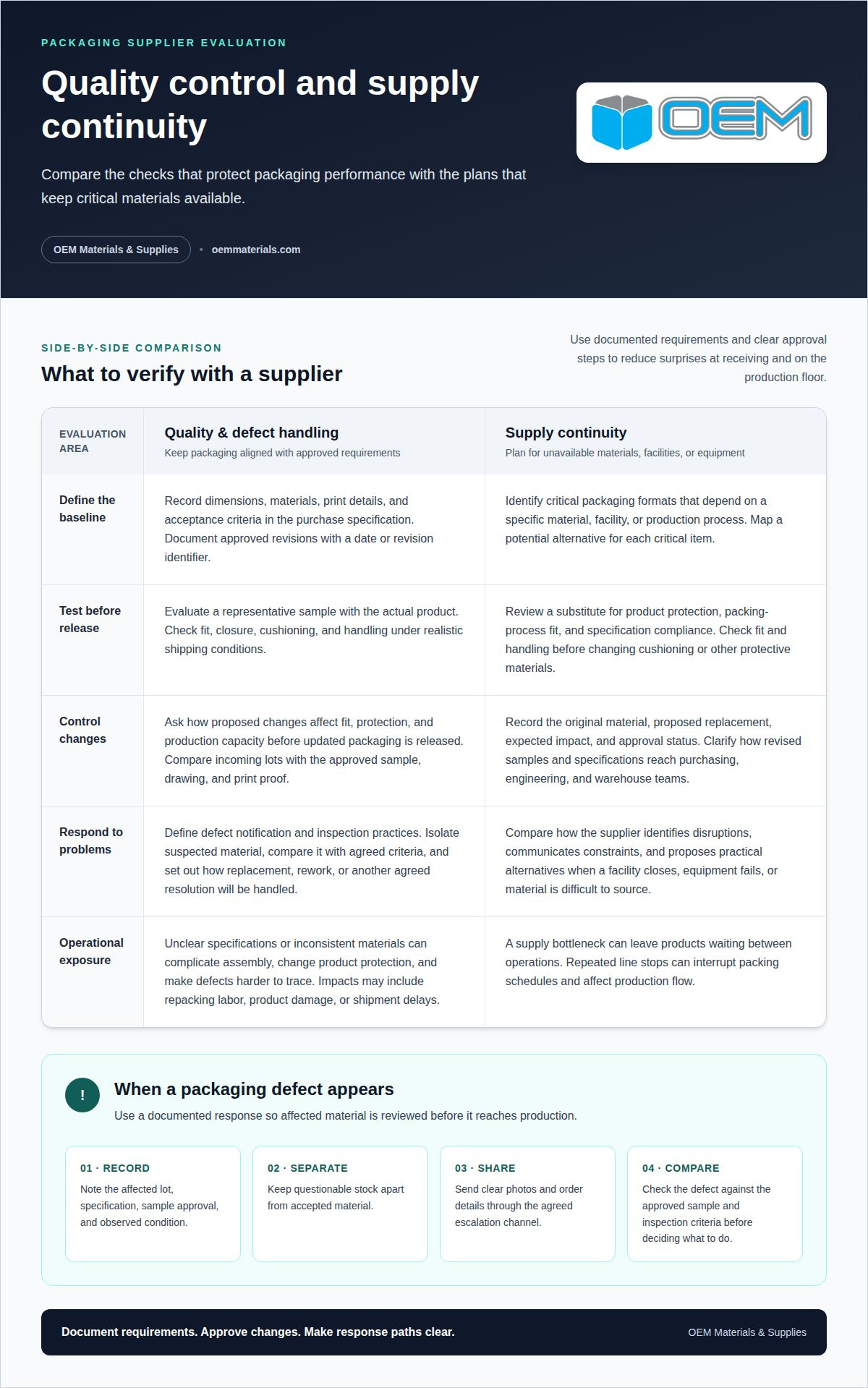
Packaging defects often stem from unclear specifications, material variation, or uncommunicated process changes. A box made to an outdated drawing, for example, may fit poorly or let the product shift in transit. Improper storage or handling can also damage packaging before shipment. Record dimensions, materials, print details, and acceptance criteria in the purchase specification.
Use a representative sample to evaluate the packaging design before approving production. Pack the actual product, then assess fit, closure, cushioning, and handling under realistic shipping conditions. A sample that looks acceptable on a workbench may still allow a fragile component to shift in transit. For products needing a fitted protective solution, foam packaging can be evaluated as part of the sample and product-fit review.
For food packaging, the U.S. Food and Drug Administration identifies 21 CFR as a relevant regulatory issue. Buyers should also define applicable material and labeling requirements in the specification. Quality checks can then compare incoming lots with the approved sample, drawing, and print proof. Inspection should begin as soon as a suspected defect appears, so affected material can be isolated before it reaches production.
Suppliers may use different materials, tolerances, or inspection methods for similar packaging. That inconsistency can complicate assembly, change product protection, and make defects harder to trace. Standardize specifications across repeat orders where practical, and document approved revisions with a date or revision identifier. A packaging partner should explain how a proposed change affects fit, protection, and production capacity before updated packaging is released.
Contract terms and service-level agreements should define specifications, inspection criteria, defect notification procedures, and remedies for nonconforming packaging. Set out how the parties will handle replacement, rework, or another agreed resolution, including responsibility for affected orders. Clear terms prevent disputes about whether a defect meets the agreed acceptance criteria. These common packaging supplier service issues are easier to manage when the process is documented.
Packaging defects can increase costs through wasted materials, repacking labor, product damage, or shipment delays. A weak insert, for example, may let a component move inside its box, causing damage and extra inspection work. Incorrect labels can also disrupt identification and traceability. The impact depends on where the defect is found: at receiving, on the production line, or after shipment.
When a defect appears, record the affected lot, packaging specification, sample approval, and observed condition. Separate questionable stock from accepted material, then share clear photos and order details through the agreed escalation channel. Compare the defect with the approved sample and inspection criteria before deciding what to do. This evidence helps distinguish a one-time handling problem from a recurring specification or process failure.
Supply continuity when facilities, machines, or materials are unavailable
A supplier’s continuity plan matters when a facility closes, equipment fails, or packaging material becomes difficult to source. Disruptions can slow production, increase waste, and affect package quality. A bottleneck may leave products waiting between operations, while repeated line stops can interrupt packing schedules. Compare how a supplier identifies these risks, communicates constraints, and proposes practical alternatives.
Start with packaging materials that could halt a shipment or production run. Identify which formats depend on a specific material, facility, or production process, then map an alternative for each critical item. A substitute must still protect the product, fit the packing process, and meet the agreed specification. Changing cushioning material, for example, may affect product movement inside the package, so review fit and handling before using it.
Ask how substitutions are evaluated and approved. A sound process records the original material, proposed replacement, expected impact, and approval status. It also clarifies how revised samples or specifications reach purchasing, engineering, and warehouse teams. This prevents an unapproved change from appearing at receiving or on the production floor. Planning ahead gives the operation a clear decision path when the usual material is unavailable.
Sustainability claims need the same discipline. Recycled or renewable packaging materials may support company goals, but they still need to protect the product during storage and transit. Review documentation for material claims, performance needs, and end-of-life options. Recycling and disposal depend on the material combination and available facilities. A package made of several bonded materials, for example, may require a different disposal process from a single-material format.
Certifications and material documentation can clarify what a sustainability claim covers. Keep relevant records with the packaging specification, and define who reviews changes to them. Consider the full packaging solution, including protective components and outer packaging, rather than judging one material in isolation. This gives procurement and operations a shared basis for comparing alternatives without treating a recycled-content claim as proof of suitability.
Packaging optimization can reduce material use and transport space. Right-sizing a carton can leave less room for the product to shift, while a minimal design may use fewer materials and still protect it effectively. Test the proposed format with the actual product and packing method before adopting it. The right decision balances protection, material use, handling, and supply consistency instead of prioritizing a single sustainability measure.
Document a continuity plan with trigger points, approved alternatives, responsible contacts, and steps for communicating schedule changes. Review it when packaging specifications or production needs change. For help aligning protective packaging choices with product requirements, request a packaging quote with product dimensions, weight, and shipping conditions.
3. Sourcing, inventory management, and contingency planning
Inventory planning starts with understanding which packaging items support finished goods and production schedules. A shortage of one box style can hold up a shipment even when other packaging is available. Map each item to its use, replenishment process, and supply-chain dependencies. This helps purchasing distinguish routine stock from materials that need closer monitoring or a defined contingency.
Packaging suppliers manage stock shortages and backorders through timely communication, updated availability information, and sourcing or substitution options. Sudden demand changes are easier to handle when buyers share revised forecasts and priorities early. A supplier’s network may also provide access to specialized materials beyond its direct range, offering another route when an established source cannot meet demand.
Inventory systems can bring stock levels, shipment tracking, reports, and alerts together. Packaging inventory management software is useful when purchasing, warehouse, and operations teams need a shared view of available material and incoming orders. For example, an alert for a low carton balance can prompt a replenishment discussion before stock runs short. The system is most useful when its records reflect actual receipts and usage.
Electronic vendor-managed inventory, or eVMI, can improve visibility by sharing inventory information electronically between a buyer and supplier. It works best when both sides agree on item identification, usage data, replenishment signals, and responsibility for exceptions. A vendor-managed inventory program can coordinate replenishment around actual packaging needs rather than isolated purchase orders.
Account management should connect inventory data to operational priorities. A designated contact can coordinate questions about a backorder, increased demand, or a revised delivery schedule. Clear escalation paths help teams identify which items affect production or customer shipments first. A packaging shortage tied to a scheduled finished-goods order, for example, may need more urgent attention than excess stock for a slower-moving product.
Contingency planning should identify alternative sourcing paths and the conditions for using them. Record which specifications must remain unchanged and which alternatives need technical approval. Review demand assumptions and item priorities as production plans evolve. A gradual supplier transition can also reduce internal confusion and prevent disruption to product flow.
Compare suppliers by inventory visibility, sourcing network, replenishment process, and communication when exceptions arise. Ask how their role as a manufacturer, broker, or wholesaler with storage and distribution affects the supply path. Track backorders and shipment updates against operational requirements, then adjust reorder decisions when actual usage differs from forecasts. This makes inventory management an ongoing supply-chain process.
4. Supplier communication, contacts, and escalation
Communication determines whether packaging decisions keep pace with production demand. A supplier should acknowledge a quote request promptly and say when to expect the quote. Some businesses need answers within hours to move plans forward, while a response that takes days may not suit a tight schedule. Agree on the preferred contact method and how to flag urgent requests.
Demand planning also depends on sharing changes early. Updated production forecasts, product launches, and shifts in shipping schedules help suppliers plan sourcing and capacity. Forward planning and transparent communication can help manage long packaging lead times. A change to a finished-goods schedule, for example, gives procurement and the supplier a chance to discuss quantities and delivery timing before a shortage disrupts packing.
Proofing errors often point to gaps between supplier contacts or review stages. A wrong dimension, outdated artwork, or missed revision can slip through when purchasing, engineering, and marketing use different files. Use one controlled proof that identifies the revision, material, dimensions, print details, and approval status. Specify who can approve changes, then distribute the final version to everyone responsible for ordering or receiving packaging.
Escalation should identify the issue, its operational impact, and the action needed. A useful report includes the purchase order, affected item, quantity, relevant photographs, and required decision date. Send it to the supplier contact responsible for the account, then use the agreed escalation contact if the issue blocks production or shipment. Keep messages and decisions together so every team works from the same record.
For a supplier dispute, compare the order and approved specification with the delivered packaging, document the difference, and state the requested resolution. Set a clear response deadline tied to the operational need, then record the agreed corrective action. If repeated issues require a supplier change, plan the transition in stages: qualify the replacement packaging, approve samples, schedule initial orders, and keep existing supply in place until the new flow is ready.
Service expectations work best when they are specific. Terms can define quote acknowledgment, update frequency for delayed orders, notice of specification changes, and escalation paths for quality or delivery concerns. Assign each expectation to a named contact or team. For regulated applications, identify who handles packaging documentation and compliance questions, and how revised records reach the appropriate buyer or engineer.
Review communication performance using real examples, such as late proof corrections or unanswered order-status requests. Separate a one-time misunderstanding from a recurring process gap. Confirm which supplier capabilities support the required response, sourcing coordination, and revision control. Clear ownership helps buyers resolve issues without relying on informal messages that can leave production, purchasing, and receiving teams with conflicting instructions.
5. Delivery coordination across locations
Deliveries can miss expectations when purchase orders, receiving schedules, and site instructions do not match. A shipment to a central warehouse may follow different receiving rules from one sent directly to a production facility. Set a delivery plan for each destination, including the receiving contact, delivery window, order reference, and packaging requirements. Clear site-level instructions reduce confusion at dispatch and receiving.
There is no single late-delivery frequency that applies to every packaging supplier or shipment. Performance depends on the agreed delivery date, order readiness, transportation, receiving constraints, and communication about changes. Measure each order against its promised date, and record partial shipments separately. This can show whether delays recur at a particular location, for a specific item, or at a particular stage.
For multiple locations, standardize order details while preserving necessary site differences. Use consistent item descriptions and packaging specifications, then identify each destination’s address, receiving hours, and unloading requirements. A warehouse may accept palletized deliveries, while a production site needs packaging staged near a particular work area. Accurate instructions help prevent misrouted shipments and avoidable handling after arrival.
Agree on how suppliers communicate shipment status and schedule changes. A useful update identifies the affected order, destination, revised arrival estimate, and any action required from the receiving team. If one order serves several facilities, define whether it will ship as separate deliveries or a consolidated load. Share the final plan with purchasing, warehouse, and operations contacts so each location can prepare.
Delivery expectations are easier to manage when they are measurable and consistent. Define what counts as on time, how partial orders are recorded, and who reports a missed window. Review exceptions with the supplier using order records and receiving information. Repeated delays at one site may point to a routing or scheduling issue; recurring shortages across locations may call for revised ordering and allocation practices.
Packaging standards should remain consistent across destinations when products and handling conditions are the same. If transit routes, storage conditions, or receiving processes differ, evaluate whether packaging needs adjustment. Testing representative shipments can reveal damage risks before a format is adopted widely. Keep approved specifications and delivery instructions aligned so location-specific changes do not create unexpected differences in product protection.
Coordinate forecasts, order releases, and receiving capacity before production peaks or planned shutdowns. This gives the supplier and each site a shared view of timing and priorities. Include item details, quantities, delivery locations, and required dates when requesting a quote or delivery plan. Request a packaging quote to align packaging requirements with your delivery schedule.
OEM Materials & Supplies
OEM Materials & Supplies helps manufacturers match packaging choices to product protection, handling, and supply needs. When reviewing a supplier issue, clear requirements make the next discussion more productive: identify the product, shipping conditions, packaging specifications, and delivery constraints. Corrugated boxes, foam packaging, packaging kits, and mailing tubes and cores support different needs across manufacturing and distribution.
Bring forward the issue that needs attention, such as transit damage, inconsistent packaging, or a format that complicates packing. Product dimensions, weight, and shipping conditions help frame the packaging discussion and guide a practical recommendation. OEM Materials & Supplies can evaluate packaging options against those requirements.
Contact OEM Materials & Supplies to discuss your packaging requirements and next steps.
Make supplier performance part of ongoing planning
Use the comparison as a practical baseline for future purchasing decisions, not a one-time selection exercise. Record the capabilities your operation depends on and revisit them when product requirements, production plans, or shipping patterns change. This keeps supplier expectations aligned with current operating needs rather than outdated assumptions.
Recurring common packaging supplier service issues can also reveal gaps in internal processes. Changes in product dimensions, order timing, or receiving procedures may affect packaging performance even when supplier processes remain consistent. Keep relevant teams aligned as requirements evolve, and use each review to clarify what matters most for the next order.
OEM Materials & Supplies works with manufacturers on packaging needs across corrugated boxes, foam packaging, and packaging kits. Share the product and shipping requirements behind your next packaging decision to start a focused discussion. Contact OEM Materials & Supplies to discuss your packaging requirements. A clear starting point can help move your next decision forward with confidence.
Frequently Asked Questions
How do they manage sourcing and supply chain reliability?
Reliable sourcing starts with understanding who makes, stores, and distributes each packaging item. A supplier’s sourcing network and inventory process can shape its response when demand changes or an item is unavailable. OEM Materials & Supplies serves manufacturers in Orange County, Los Angeles, San Diego, and Riverside as an industrial packaging supplier. Align item specifications and order priorities with the supplier’s role in your supply chain.
What are the most common customer service issues with packaging suppliers?
Common packaging supplier service issues often show up as unclear order status, inconsistent follow-through, or confusion about who owns a problem. Keep purchase order details, delivery records, and issue correspondence tied to the same order reference to reduce disruption. If a shipment arrives incomplete, for example, this record helps distinguish a short shipment from a receiving or counting discrepancy.
What are common pricing, billing, and unexpected fee disputes with packaging suppliers?
Billing disputes often arise when an invoice and purchase order list different quantities, specifications, or order revisions. Compare the invoice with the accepted quote and purchase order, including item description, unit of measure, quantity, and delivery details. Ask for any discrepancy to be explained against the agreed documents. Clear written scope and approval records help purchasing teams resolve mismatches without relying on informal assumptions.
What are typical communication and response-time problems with packaging suppliers?
Typical communication problems include unacknowledged quote requests, unclear response expectations, and updates that omit the affected order or next step. A useful process states when a quote is expected, who owns the request, and how urgent changes are flagged. If a request lacks product dimensions or shipping details, the supplier can specify what information is needed to prepare a useful response instead of leaving it unresolved.
What are common issues with custom packaging design, proofs, and production approvals?
Custom packaging approval can break down when teams review different drawing or artwork versions. Maintain a controlled record connecting the approved proof to its revision, product, and intended order. Assign approval authority across engineering, purchasing, and brand teams before production release. If product or labeling requirements change after approval, route the update through the same review process so obsolete files do not guide a later order.
How can businesses evaluate and compare packaging suppliers for reliability and service?
Compare suppliers using consistent operational evidence rather than broad claims. Review order records for delivery performance, quantity accuracy, issue resolution, and clarity of communication about changes. Then assess whether their products fit your packaging requirements and whether their contacts understand your production priorities. A small, representative order can show how specifications, receiving details, and updates work together before you rely on a supplier for a broader program.