
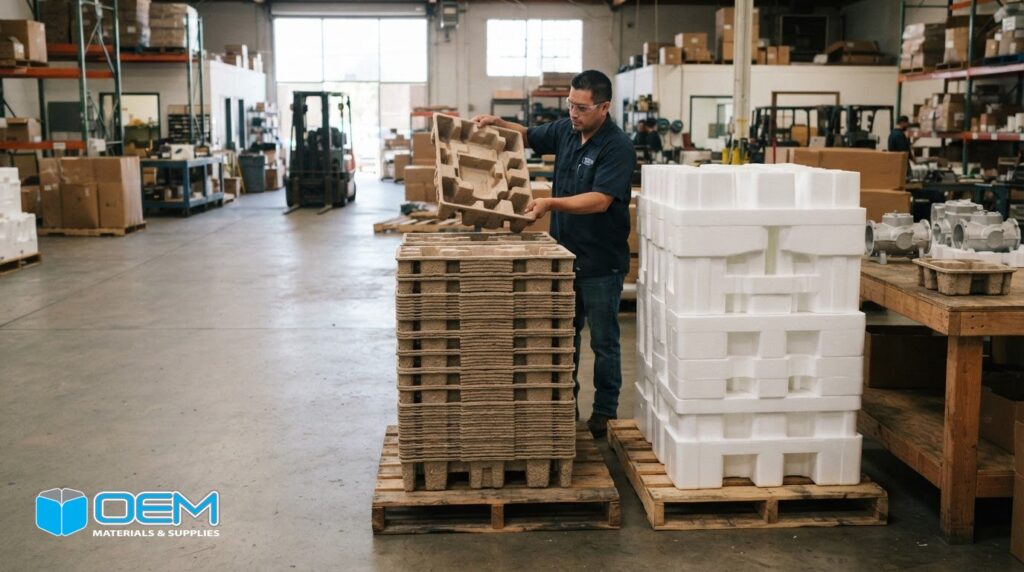
The lower-cost insert can become the more expensive packaging choice. In a molded pulp vs. expanded polystyrene (EPS) cost comparison, EPS often has the lower per-unit cost in bulk, while the overall decision also depends on tooling, product fit, freight, storage, and damage risk. Unit price matters, but it doesn’t tell the whole story.
It’s reasonable to focus on material cost when comparing packaging options. This guide explains when EPS can offer bulk savings and when molded pulp’s design or end-of-life characteristics may affect overall value. It also compares recyclability, impact resistance, and shock absorption, and outlines the key cost factors to consider when matching protective packaging to a product and shipping operation.
Key Takeaways
- EPS often has a lower unit cost at bulk volumes, but compare total packaging costs, including freight, storage, damage, and disposal.
- Tooling, order volume, product geometry, and manufacturing requirements all influence molded pulp economics. Assess tooling across forecasted production needs.
- Recyclability depends on local collection options and packaging design. Coatings or adhesives can affect how molded pulp is handled at end of life.
- Match protective packaging to the product’s impact and vibration risks. Compare fit and performance through testing before changing an existing insert.
- For a molded pulp replacement, account for potential packaging redesign as well as material choice, dimensions, and shipping requirements.
What Is Molded Pulp Packaging?
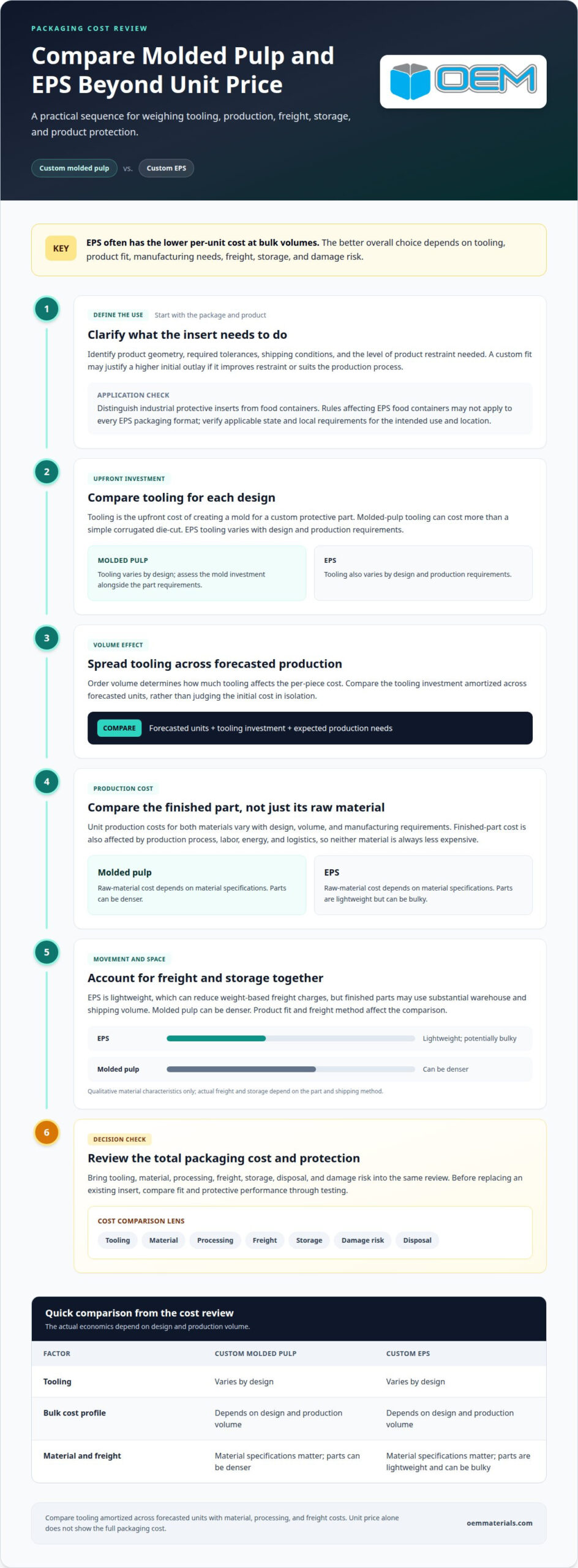
Molded pulp packaging is made by forming pulp into protective inserts, trays, or containers. For custom designs, the relative cost of EPS and molded pulp depends on factors such as design, production volume, and tooling.
Tooling and Per-Piece Costs
Tooling is the upfront cost of creating a mold for a custom protective part. Molded-pulp tooling can cost more than a simple corrugated die-cut, while EPS tooling costs vary by design and production requirements.
Order volume determines how much tooling affects unit cost. Buyers can spread the mold investment across forecasted production and compare the result with EPS. Product geometry and required tolerances also affect tooling needs. A custom fit may justify a higher initial outlay if it improves product restraint or suits the production process.
Unit Production and Material Costs
Unit production costs for EPS and molded pulp vary with design, volume, and manufacturing requirements, so neither material is always less expensive.
These factors alone do not determine the finished insert’s price. Production process, part design, labor, energy, and logistics also affect total cost. EPS is lightweight, which can reduce weight-based freight charges, but finished parts may take up substantial warehouse and shipping volume. Molded pulp can be denser, so product fit and freight method matter.
| Packaging option | Tooling | Bulk cost profile | Material and freight considerations |
|---|---|---|---|
| Custom molded pulp | Varies by design | Depends on design and production volume | Raw-material cost depends on material specifications; denser parts |
| Custom EPS | Varies by design | Depends on design and production volume | Raw-material cost depends on material specifications; lightweight, bulky parts |
Compare tooling amortized across forecasted units with material, processing, and freight costs.
State restrictions on EPS food containers may affect food-packaging decisions. The scope and current status of rules vary, so verify applicable state and local requirements before making a purchasing decision. The application matters to purchasing teams: a food container and a protective insert for industrial shipments are different uses. Identify the package’s intended use before evaluating potential regulatory impacts on a product line.
Restrictions on EPS food containers do not necessarily apply to every EPS packaging format. Industrial buyers evaluating protective inserts should distinguish those applications from foodservice use and verify the rules that apply to their specific product and location.
For Los Angeles shipments, compare the insert, outer packaging, and freight as one system. A fitted foam packaging solution can be assessed against product geometry, shipping conditions, and required protection.
Recyclability and end-of-life handling
Molded pulp generally fits paper recycling streams, while EPS offers strong moisture resistance and protective performance. Lifecycle assessments summarized in the market data report molded pulp packaging with 30-70% lower carbon emissions than EPS, but actual end-of-life results depend on collection access, coatings, and disposal infrastructure.
Molded pulp and corrugated packaging are recyclable in most paper curbside streams. EPS recycling is less common in municipal programs, even though the material is technically recyclable in many locations. Local collection systems determine whether packaging can move from a recycling bin to a recovery facility. A recyclability claim does not guarantee convenient curbside handling.
Effective EPS recovery remains limited. Globally, less than 10% of EPS packaging is effectively recycled, and rates in many regions are closer to 1-2%. EPS is extremely lightweight and bulky relative to its weight, which makes collection and transportation challenging. These figures describe effective recovery, not whether the material can be recycled through a specialized process.
Molded pulp can be compostable under industrial conditions and often under home-composting conditions. The outcome depends on the packaging’s composition and the composting system available. Adhesives or moisture-resistant coatings can complicate processing, and many industrial composting facilities will not accept molded-pulp packaging when contamination risks are present. A coated molded-pulp tray, for example, may have a different disposal route from an uncoated fiber insert.
EPS is not compostable; its end-of-life route typically depends on access to plastic collection and recycling. Molded pulp is described as biodegrading in ninety days, while EPS foam can persist in landfills for decades. These comparisons should not replace practical disposal guidance: landfill conditions, local services, and packaging treatments affect what happens after use.
There is also a performance trade-off. EPS resists moisture, while uncoated molded pulp can weaken with excessive moisture exposure. Pulp packaging may need a protective coating for damp shipping conditions, but the coating can hinder recycling or compostability. Packaging that protects a product effectively can also reduce replacement shipments, so sustainability decisions should consider damage prevention as well as material recovery.
When assessing sustainability claims, separate three questions: Is the material technically recyclable or compostable? Does the local waste system accept it? Do coatings, adhesives, or product residue affect its disposal route? This helps purchasing teams compare packaging based on real handling conditions, not material labels alone.
For a packaging review that weighs product protection against end-of-life needs, request a packaging quote with the product’s shipping conditions and current insert details.
Impact resistance and shock absorption
Protective packaging must control movement and manage force during transit. EPS typically absorbs energy well during high-impact events, while molded pulp can provide moderate shock protection and hold a product in a shaped cradle. The better fit depends on product fragility, weight, shipping conditions, and where support is needed.
EPS provides effective protection against single impacts because its foam structure compresses on impact. It can be molded around a bottle to reduce movement inside the shipping box. For a glass bottle shipment, a close fit can limit contact with the outer carton during a drop. EPS and some other foams also isolate vibration better than molded pulp, which can matter for products exposed to repeated handling or transport vibration.
Molded pulp uses its shape to manage force. Ribs, walls, cavities, support points, and deformation zones can distribute impact around a product. Performance depends on wall thickness, rib geometry, contact areas, pulp formulation, and moisture conditions. A formed cavity can restrain a component, but molded pulp’s lower compressibility makes it less reliable for some heavy or delicate products, including glass bottles.
These differences matter in industrial applications such as electronics. An insert must prevent movement and cushion sensitive parts during handling and shipment. Rigid support and a precise cradle may suit molded pulp; high-impact exposure or a need for vibration isolation may favor EPS. Neither material should be selected by unit cost alone. A lower-cost insert can increase total costs if it allows product damage.
For a practical comparison, evaluate samples fitted to the actual product geometry. Before committing to production, run drop tests against the current EPS specification and review whether contact points, cavity depth, and retention keep the item stable. Packaging buyers can also use ISTA-compliant tests and a small-scale production trial before a full SKU rollout. These steps can reveal fit or cushioning problems before wider deployment.
Packaging performance also depends on how loads are supported during storage and transit. EPS can collapse under long-term static loads if it is not properly supported. For stacked shipments, consider load placement and support conditions as well as the insert’s impact cushioning. A design that withstands a drop may still need sufficient support under sustained pressure.
EPS can deform in heat and become brittle in cold conditions, potentially affecting performance across changing shipping environments. Molded pulp can weaken with excessive moisture, creating a different design challenge on damp routes. Test conditions should reflect the actual distribution path, including expected temperature and moisture exposure, rather than relying only on the material name or a lab sample.
For shipments where molded pulp cannot provide enough cushioning, a foam packaging design can be compared against the current insert using the product’s dimensions, weight, and handling requirements. The decision should protect the product while controlling movement, shock, and vibration throughout the logistics cycle.
Bulk cost efficiency of EPS versus molded pulp
At high production volumes, EPS often has the lower unit cost. That makes it a strong option when purchasing priorities center on packaging spend and lightweight protection. Molded pulp may still compete on total operating cost if its structure reduces storage volume, improves transport efficiency, or suits an established recycling stream. A molded pulp vs expanded polystyrene (EPS) cost comparison should include these operating factors as well as unit price.
Compare the full logistics cost, not just the price per insert. Include packaging, warehouse space, shipment capacity, product damage, and disposal. A low-cost EPS part may use more cubic volume, while molded pulp may require more weight-based freight capacity. The balance depends on part geometry, shipment frequency, and available storage.
Nesting can improve molded pulp’s bulk efficiency. Nested parts stack closely, reducing the space used during inbound transport and warehouse storage. A Germany comparison estimates molded pulp’s volume advantage over EPS at approximately 50%. That estimate illustrates why dense parts can still use space efficiently when their design supports nesting.
Another comparison describes molded pulp as shipping 40% more compactly than plastic foams. This potential space benefit matters when trucks or storage locations reach volume limits before weight limits. EPS remains lightweight, so it can reduce weight-based freight charges. But finished EPS components can still consume substantial cubic space.
Model these trade-offs using the actual packaging configuration. For example, compare how many inserts fit on a pallet, how many pallets fit in a shipment, and how much warehouse space each option uses. Then account for transport frequency and inbound replenishment. A compact, nestable design may improve capacity, while lightweight EPS may suit shipments priced primarily by weight.
Damage and disposal also affect the business case. Packaging that lowers purchase cost but allows product damage can increase replacement shipments and handling. Disposal costs and local recycling access can further change total economics. In markets with environmental levies or producer-responsibility costs, those charges may shift the comparison beyond unit price.
For a fair bulk comparison, use the same product, outer carton, shipping lane, and forecasted volume. Separate one-time tooling from recurring unit costs, then calculate the space and freight required for each design. Keep assumptions consistent: a change in box size or pallet pattern can alter transport capacity even when the protective insert is unchanged.
EPS is often more economical when low per-piece cost and light weight are the main priorities. Molded pulp becomes more competitive when nesting, storage utilization, or disposal conditions carry greater weight. A molded pulp vs expanded polystyrene (EPS) cost model should reflect product dimensions, packaging design, shipping requirements, warehouse constraints, and expected production volume.
What factors affect molded pulp and EPS packaging prices, such as size, design, and material grade?
Design complexity affects how a package is tooled and produced. A tray with several cavities, support ribs, and precise contact points requires a different mold design from a simple insert. Molded-pulp quotes can also reflect pulp type, production process, surface requirements, tolerances, labor, and energy. Each specification can change the manufacturing work, even when product dimensions stay the same.
Wall geometry is a key molded-pulp design variable. Wet-pressed pulp packaging does not have a universal minimum wall thickness; the achievable thickness depends on the tooling, pulp formulation, part geometry, and performance requirements. Figures such as 0.7 mm or 0.9 mm should be treated as design-specific examples, not general specifications. The required wall thickness and structural support from ribs, curves, and cavity walls should be confirmed with the manufacturer for the intended application.
Draft angles also shape the mold and finished part. The required draft depends on the molded-pulp process, tooling, surface, and part geometry. A range such as 3 to 5 degrees may apply to particular designs, but it is not a universal specification. Deep cavities or near-vertical walls may need design changes, so confirm draft requirements with the manufacturer. Those adjustments affect mold geometry and part fit, making the initial product drawing an important input to the pricing process.
Tolerances affect both tooling and production requirements. An insert intended for manual packing may have different fit requirements from one used in a pick-and-place system. Molded-pulp parts can be designed for automated feeding when the required tolerances and process capability are established. Identify the required repeatability early, since tighter control can change the manufacturing approach.
Material grade and finish matter, too. Pulp formulation and surface requirements shape the finished part, while a moisture-resistant coating may add a production step. For EPS, material costs can respond to oil-price changes and environmental levies. Compare equivalent specifications, including any treatments, rather than treating “molded pulp” or “EPS” as a complete material grade.
Production volume affects how setup work is allocated across parts. A forecasted run and expected repeat orders provide a better basis for comparison than a one-time quantity alone. Replacing an EPS insert with molded pulp may require a packaging redesign rather than a direct material substitution. That redesign can change cavity layout, support points, and tooling requirements.
For a useful pricing specification, document the product drawing, critical contact areas, target tolerances, finish, moisture exposure, and production process. Include any automated feeding requirements and forecasted volume. These details help purchasing teams compare designs consistently and distinguish material-driven differences from the cost of engineering and manufacturing the part.
OEM Materials & Supplies
OEM Materials & Supplies helps industrial buyers connect packaging decisions with product protection, packing workflows, and shipping requirements. When comparing molded pulp with EPS, assess how each option fits the product and distribution process instead of treating material cost as the only factor.
Corrugated Boxes, Foam Packaging, and Packaging Kits can support different parts of a complete packaging system. Product dimensions, weight, annual usage, and shipping conditions help frame a practical comparison of insert fit, outer packaging, and packing consistency. This information can also reveal where an existing packaging setup may need adjustment.
For a packaging comparison grounded in your operation, contact OEM Materials & Supplies.
Build the Next Packaging Decision Around Your Operation
Use the molded pulp vs. expanded polystyrene (EPS) cost comparison as a starting point for a packaging decision that fits your production and distribution needs. Define the product’s dimensions, weight, handling conditions, and expected usage. Then assess how the selected design fits your packing workflow and shipping configuration.
A useful next step is to document the current package and the problem you want to solve. For example, note recurring product damage, excess space in cartons, or difficulty handling packaging materials. These details help focus a review on practical improvements rather than changing material for its own sake.
OEM Materials & Supplies can help evaluate packaging options around your product and shipping requirements. The right recommendation depends on the specific application. Share the relevant details and request a packaging quote to start a focused discussion. A clear set of requirements gives your team a stronger basis for the next packaging decision.
Frequently Asked Questions
Which Material Makes Sense for Which Use Case?
Choose EPS when lightweight cushioning, insulation, or high-impact protection is central to the application. Molded pulp can suit products that need a shaped cradle and a fiber-based packaging format. For electronics, glass, or precision components, decide based on fit, transit hazards, and product sensitivity. A material that works for one SKU may not suit another with different geometry or shipping conditions.
What is the typical cost per unit of molded pulp packaging in the U.S.?
There is no single typical U.S. unit cost that applies to every molded-pulp design. A shallow tray and a complex insert require different tooling, materials, and production processes. Order quantity also affects how setup costs are allocated. For a useful estimate, define the part dimensions, pulp requirements, tolerances, forecasted quantity, and shipping needs. Those details make a project-specific quote more meaningful than a broad per-unit benchmark.
What is the typical cost per unit of EPS packaging in the U.S.?
EPS unit cost varies with part size, design, material grade, order volume, and production requirements. A simple protective block is not directly comparable to a custom-molded insert with defined cavities. Freight and storage can also change delivered cost. For procurement planning, specify product geometry, required protection, annual usage, and shipping configuration, then compare quotes using the same assumptions and packaging scope.
How do molded pulp and EPS costs compare at different order volumes?
At higher volumes, EPS often benefits from low per-piece production costs. Molded pulp’s tooling investment is spread across more units as orders increase, which can narrow the unit-cost gap. At lower volumes, setup costs have a greater effect on each part. Compare a short-run forecast with the expected production program, including potential demand changes, rather than relying on a single order quantity.
What are the tooling and mold costs for molded pulp versus EPS packaging?
Tooling costs can differ between molded pulp and EPS, depending on the part and manufacturing approach. Tool complexity, cavity layout, product tolerances, and production volume all affect the comparison. For example, a tray holding several components may need a different mold design from a simple end cap. Include tool amortization and any design revisions in the project cost model.
How do shipping, storage, and packaging weight affect total cost for molded pulp and EPS?
Weight and cubic volume affect freight in different ways. EPS is lightweight, but bulky finished parts can use substantial trailer or warehouse space. Molded-pulp parts may weigh more, while nesting can improve storage and inbound transport efficiency. For shipments serving Orange County, Los Angeles, San Diego, or Riverside, compare the actual pallet pattern, carton dimensions, shipping route, and storage method.
How do recycling and disposal costs compare for molded pulp and EPS in the U.S.?
Costs depend on local collection, facility acceptance, and how packaging is prepared for disposal. Paper recovery may accommodate molded pulp, but coatings, adhesives, or product residue can affect handling. EPS recovery may require a separate collection route, adding sorting or transport steps where curbside programs do not accept it. For a U.S. operation, include internal labor and waste-hauling requirements alongside any material recovery fees.