
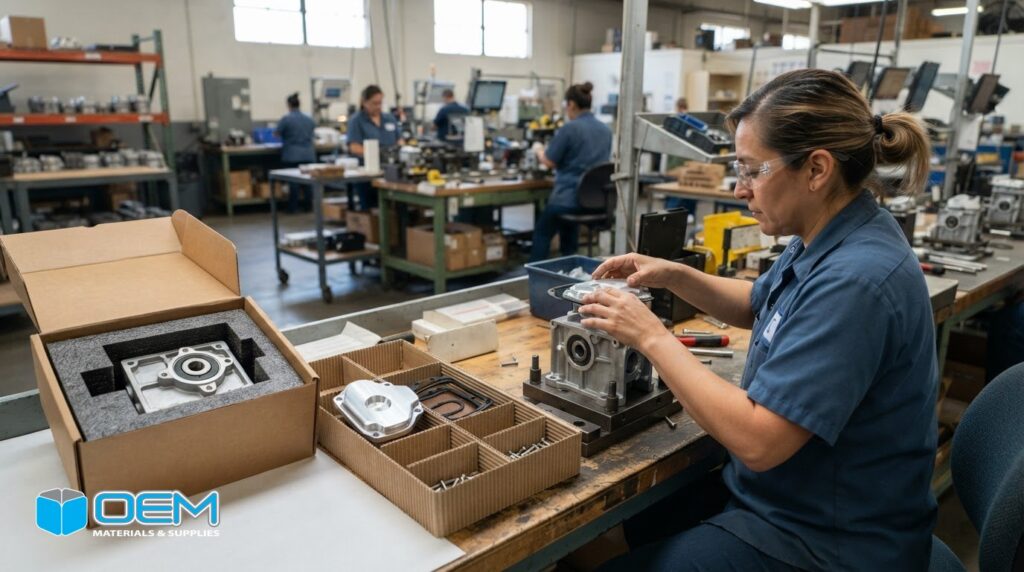
Kitting and assembly solve different production problems, but they work best as one coordinated workflow. For San Diego OEMs, packaging kitting and assembly services can bring parts together for later use or physically join them into a finished or partially finished product, then prepare the result for packaging.
Keeping these steps aligned matters when production teams manage component accuracy, labor, floor space, and inventory at once. Kitting groups the required parts into a ready-to-use set; assembly joins parts to create a product. Planning both together can reduce unnecessary handling and help catch missing or incorrect components before an order moves forward.
This article explains where kitting ends and assembly begins, how the processes fit into a production and packaging workflow, and what outsourcing can help address. It also covers the operational factors to consider when deciding whether outside support fits your product, packaging, and inventory needs.
Key Takeaways
- Distinguish assembly, which joins parts into a product, from kitting, which groups components for a later step.
- Coordinate parts lists, labels, and quality checks to help identify missing or incorrect components before orders move forward.
- Match packaging kits to how products will be stored, distributed, or delivered, including the protection and organization each stage requires.
- Assess outsourcing against practical constraints such as labor capacity, available floor space, inventory flow, and packaging requirements.
- Use product dimensions, component requirements, and shipping needs to shape a packaging approach that fits your operation.
Assembly as joining parts into a complete or partial product
Assembly physically joins components to create a complete or partially completed product. For example, a fastener, housing, and circuit board may be joined into a subassembly before final production. The work follows a defined sequence, directing each part to the station where it is needed. The output can then move to another production step, packaging, or fulfillment.
Kitting serves a different purpose: it groups parts, products, or stock-keeping units into one bundle. A kit might contain the housing, fasteners, and instructions needed for a later assembly task. It does not join the components; it organizes them for production, retail orders, or shipment preparation. This distinction helps teams assign labor and define handoffs.
San Diego manufacturers can assess a contract packaging provider by matching its process to the product, work sequence, packaging requirements, and expected production pattern. Ask how parts are identified, how assembly steps are documented, and how completed work moves into packaging or shipment preparation. A pilot run can reveal unclear instructions before a recurring production program begins.
San Diego providers may support packaging, assembly, inspection, and kitting as coordinated workflow steps. For medical devices and other regulated products, align handling, assembly, and packaging procedures with the product’s documented requirements. A medical-device component, for example, may need a defined sequence and suitable protective packaging; avoid assuming that every provider or package meets a particular regulatory standard.
Project fit depends on location, product category, and where work occurs in the production flow. A San Diego electronics manufacturer may need components grouped before assembly, while an aerospace supplier may need completed subassemblies protected for internal transfer. Foam packaging can help separate or cushion items inside a package when the product and shipping needs call for it.
Start a pilot by documenting the product configuration, part sequence, packaging method, and acceptance checks. Review the output for missing components, incorrect orientation, or unclear work instructions. Once the workflow is stable, recurring production can follow the same controlled sequence, with updates whenever components or packaging requirements change.
Production timelines depend on the number of steps, component readiness, packaging design, and handoffs between teams. A lean workflow places kitting close to the assembly task, limits repeated handling, and moves completed units directly toward packaging or fulfillment. Clear labels and organized part containers help workers identify components without searching through unrelated inventory.
Kitting and Assembly: What’s the Difference, and How Do They Work Together?
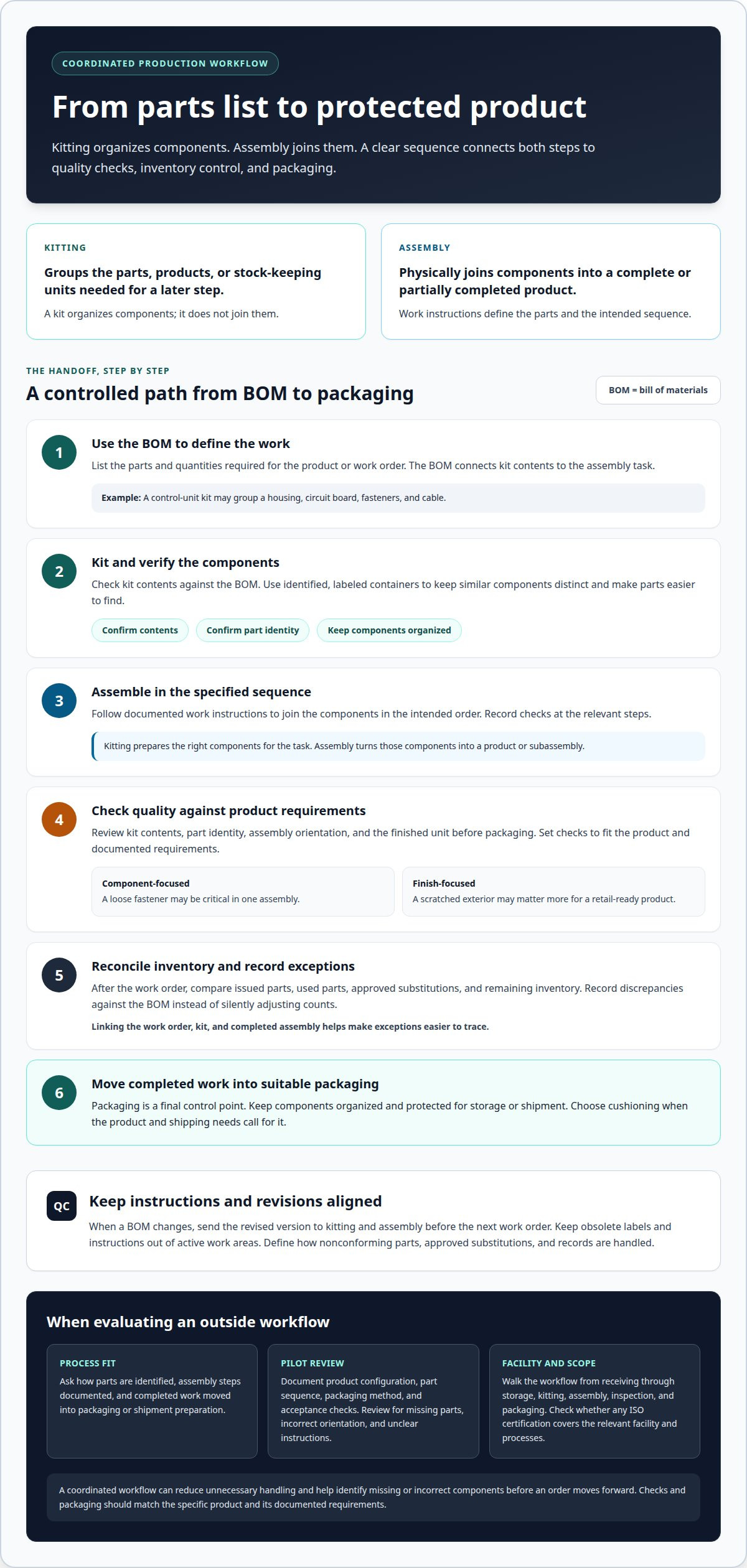
Kitting organizes components; assembly joins them. A bill of materials (BOM) connects the steps by listing the parts and quantities required for a product or work order. For example, a control-unit kit might group its housing, circuit board, fasteners, and cable. Assembly then follows the work instructions to join the components in the intended sequence.
A coordinated workflow uses the BOM to define what goes into each kit and what the assembler needs. Kitting verifies parts against the list and uses labeled containers to keep similar components distinct. At assembly, workers follow the specified sequence and record checks at relevant steps. Coordinating these activities can reduce unnecessary handling and help identify missing or incorrect components before an order moves forward.
Quality checks should reflect the product and the client’s documented requirements. A practical sequence can include checking kit contents against the BOM, confirming part identity, inspecting assembly orientation, and reviewing the finished unit before packaging. The checks depend on the product: a loose fastener may be critical in one assembly, while a scratched exterior may matter more for a retail-ready product.
Inventory reconciliation closes the loop. After a work order, compare issued parts, used parts, approved substitutions, and remaining inventory. Record discrepancies against the BOM rather than silently adjusting counts. Clear labels on organized part boxes help workers identify and sort components efficiently. Linking the work order, kit, and completed assembly also makes exceptions easier to trace.
When assessing a San Diego packaging and assembly provider, check whether any ISO certification covers the facility and processes relevant to your work. Certification alone does not establish that every job follows a particular product’s instructions.
A site visit at a San Diego facility can help assess work areas, part storage, process documentation, and how managers handle exceptions. Walk the workflow from receiving through storage, kitting, assembly, inspection, and packaging. Observe how staff identify lots, separate rejected components, and manage approved substitutions. Focus on the actual work location and the steps assigned to the contract.
Partner quality systems should define how revisions, nonconforming parts, and records are handled. If a BOM changes, the revised version should reach kitting and assembly before the next work order begins. Keep obsolete labels and instructions out of active work areas. These controls support consistency across pilot runs and recurring production without relying on memory or informal handoffs.
Packaging is part of the final control point: components must remain organized and protected through storage or shipment. Cushioning materials can help protect products inside a package when the product and shipping conditions call for them. To discuss a packaging workflow, submit a project quote request with the product configuration and packaging requirements.
Contract kitting and assembly for manufacturers
Contract work moves a defined production task outside a manufacturer’s own facility. Depending on the product and workflow, the scope might cover component sourcing, custom kitting, assembly, inspection, or packaging. For example, a San Diego electronics manufacturer could define a kit of connectors and housings for a downstream assembly station. Clear boundaries prevent confusion over which party supplies parts and controls each step.
Set up the program with a written work package. Include the current parts list, approved component sources, assembly sequence, packaging instructions, and acceptance criteria. For recurring orders, identify who approves revisions and how outdated instructions are removed. These controls give contract facilities a consistent reference and help manufacturers track changes between pilot work and ongoing production.
Controlled-environment inspection starts by defining the conditions required for the product and task. Specify the work area, permitted materials, handling sequence, inspection points, and records before production begins. A sensitive electronic component, for example, may require separation from unrelated materials and protective handling. A medical-device project may have different documented requirements. Match the inspection plan to the product rather than assuming one environment suits every job.
California requirements for contract packaging, labeling, and assembly depend on the product category and activities performed. Manufacturers should map applicable requirements to work instructions and label content, then assign responsibility for approvals and records before production starts.
Schedule III-V controlled substances call for a separate operational review. Before a contract facility handles these products, define authorized access, custody transfers, inventory reconciliation, and recordkeeping with the responsible compliance personnel. Specify how discrepancies, damaged units, and rejected materials are contained and escalated. These are planning controls, not a substitute for product-specific legal guidance.
Facility reviews can test whether documented procedures match actual work. Walk the route from receiving to storage, kitting, assembly, inspection, and finished-goods staging. Observe how staff identify lots, segregate rejected components, and manage approved substitutions. For sourcing decisions, review process documentation and quality records relevant to the contracted task rather than relying on a general capability statement.
A pilot run can test instructions, part presentation, inspection records, and packaging before recurring production. Record defects and process questions, revise the work package, then release the approved version for the next run. Establish a direct contact for engineering changes and production exceptions, so updates reach every station and no team continues using obsolete instructions.
For a packaging workflow that includes protective materials, match the package to product dimensions, handling, and shipment conditions. A foam packaging design can be considered when components need organized cushioning. To discuss a project’s packaging requirements, request a quote with the product configuration and expected workflow.
Packaging kits for storage, distribution, or delivery
A packaging kit combines the materials and components needed for a defined packing task. A kit for an electronic device might include a protective insert, an outer carton, and placement instructions. Contents depend on the product, destination, and handling steps. Organizing them together helps make packing repeatable across production orders.
Build the kit around its final use. A product held in finished-pack storage may need protection from contact with nearby items, while a shipment may need cushioning suited to its route and handling. For a retail order, presentation and included components can matter alongside protection. Document each kit’s contents, packaging sequence, and intended destination before fulfillment begins.
Plan storage around the finished package, not just the unboxed product. Confirm how packages will be identified, arranged, and moved through the warehouse. A device carton, for example, should have a clear product identifier and consistent handling orientation. Keep kit components grouped by order or production task to reduce searching and prevent unrelated parts from entering a package.
How do San Diego kitting companies handle inventory, fulfillment, and shipping? They can organize kit components against order requirements, record parts issued and used, and prepare finished kits for fulfillment. Shipping preparation then matches each packed order with its destination and handling instructions.
Inventory control begins with a reliable contents list. When releasing a kit, staff can compare required components with available stock and record shortages before packing starts. After fulfillment, reconcile components used against the order record. If a product uses lot or batch identifiers, link them to the finished package’s records to make inventory discrepancies easier to investigate.
Quality control should verify both contents and packing sequence. For a device kit, confirm the correct product, protective materials, accessories, and documents before closing the package. A final inspection can also catch an incorrect label or incomplete order. When packaging requirements change, update the kit instructions and remove obsolete versions from active packing stations.
Distribution needs influence packaging choices. A kit moving between a production floor and a nearby warehouse may need a different configuration from one prepared for parcel delivery. Specify the product dimensions, handling method, and whether the package will be stored or shipped. Custom packaging design can align the package layout with product protection and packing steps.
For recurring orders, define how replenishment signals, shortages, substitutions, and order changes are recorded. Keep kit contents tied to the current product configuration, and make finished packages easy to identify at staging. These steps give warehouse and fulfillment teams a clear handoff from packing through storage, distribution, or delivery.
Outsourcing labor, space, and inventory management
Outsourcing can shift defined packaging work away from a manufacturer’s production floor. For OEMs evaluating packaging, kitting, and assembly services in San Diego, the practical question is which constraint needs attention: labor capacity, usable space, or inventory flow. A manufacturer facing a temporary increase in boxed orders, for example, could outsource kitting and packing while keeping product assembly in-house. A clear scope defines the handoff and responsibilities.
Plan labor around the task, not a general headcount estimate. Map the sequence from receiving components to preparing kits, packing finished products, and staging orders. Then identify where internal teams lose time, such as searching for parts or switching between production and packing duties. A defined work package helps determine which steps to outsource and which skills should stay on-site.
Floor space is another constraint. Packaging materials, components, work-in-process, and finished goods can compete for the same warehouse area. Moving a defined activity off-site may free space, but it also adds a transfer and coordination point. Compare the proposed workflow with the current one: note where materials are stored, where work happens, and how completed orders return to distribution.
Inventory control depends on clear ownership and timely records. At each handoff, document the parts or packaging released, quantities used, and any balance returned. If a kit requires a housing and fasteners, for example, the work record should connect those components to the relevant order. Reconcile shortages and substitutions before the next production release, rather than carrying unexplained differences forward.
To streamline replenishment, establish a shared process for forecasts, order changes, and stock signals. Just-in-time delivery can align packaging arrivals with production needs, while vendor-managed inventory can define how stock levels and replenishment decisions are handled. The right approach depends on demand patterns, storage capacity, component availability, and the consequences of a shortage.
Outsourcing does not eliminate coordination work. Manufacturers still need an owner for specifications, revisions, quality expectations, and delivery schedules. For an outsourced packaging workflow, compare internal labor and space constraints with added freight, transfer steps, and inventory visibility. Results depend on product dimensions, materials, shipping requirements, and workflow design, so evaluate the full operating process rather than labor alone.
The clearest takeaway: outsource a bounded task with documented inputs, outputs, and inventory records. Start with one product family or packaging workflow, establish the handoff, then review order accuracy and material reconciliation before expanding the scope. To discuss a packaging workflow and its material needs, request a quote with product dimensions, weight, and usage details.
OEM Materials & Supplies
OEM Materials & Supplies supports manufacturers in San Diego, Orange County, Los Angeles, and Riverside with packaging materials suited to product protection, packing, and shipment preparation. Turn to the company when your workflow needs packaging organized around product dimensions, handling, or delivery requirements.
For example, corrugated boxes can serve as outer packaging, while foam packaging and cushioning materials can help protect products inside. Packaging kits can bring selected components together for a defined packing task. Mailing tubes and cores are another option for products suited to tubular packaging.
Share your product dimensions, weight, packaging requirements, and usage needs to support a practical recommendation. Contact OEM Materials & Supplies to discuss packaging for your operation.
Define the Next Step for Your Packaging Workflow
For San Diego OEMs, packaging kitting and assembly services should be evaluated against the production decisions they need to support next. Identify the product family, where packaging work enters the process, and the outcome operations needs to improve. This keeps project discussions grounded in actual workflow requirements rather than a broad request for outside support.
Before moving forward, gather the details that shape packaging recommendations: product dimensions, weight, handling conditions, and annual usage. Note any packaging changes planned for upcoming product revisions. These inputs help match packaging to the product and its movement through your operation.
OEM Materials & Supplies can help San Diego manufacturers assess packaging needs alongside their production and shipment requirements. Request a quote from OEM Materials & Supplies to discuss your product and packaging requirements. A clear starting point can help your team plan the next step with confidence.
Frequently Asked Questions
What is Assembly?
Assembly is production work that delivers a configured component or product ready for its next operation. For purchasing teams, the key is defining the deliverable: a subassembly for another production line or a finished unit ready for packaging. Specify the approved configuration, completion criteria, and receiving interface in the work order. This helps align outsourced work with engineering decisions and downstream production needs.
What is custom kitting in a supply chain context?
Custom kitting adapts a component set to a particular order, product variant, or work cell. For example, a service-parts team may need different combinations for separate equipment models, with each set assigned to the correct order. This requires linking kit configuration to current product data and demand planning. That connection helps teams avoid preparing sets for outdated configurations or the wrong destination.
Packaging, kitting, and assembly service providers in San Diego
OEM Materials & Supplies supports manufacturing programs with kitting and assembly alongside packaging supply. For a San Diego project, define which product families and production stages need support, then clarify how the work connects with your internal engineering and operations teams. Sharing the product configuration, order pattern, and handoff requirements helps establish a scope that fits the workflow without disrupting existing production responsibilities.
San Diego contract packaging and kitting companies with local facilities
Treat a local-facility requirement as a logistics criterion, not something to infer from a provider’s San Diego service area. Map where inbound materials are received, where work is performed, and where finished orders are dispatched. That route determines transfer points and scheduling needs. For a San Diego program, document facility handoffs in the project scope before assigning inventory ownership or delivery responsibilities.
Minimum order quantities and turnaround times for San Diego kitting services
Minimum quantities and turnaround depend on kit complexity, component availability, packaging requirements, and production scheduling. A program using stocked components may need a different plan from one requiring custom-designed packaging or coordinated sourcing. To build a workable schedule, define the order pattern, approval milestones, and required delivery date. Include expected usage so replenishment planning reflects demand rather than a one-time estimate.
Risks and quality controls when outsourcing packaging and assembly
Outsourcing risks include mismatched demand forecasts, unclear ownership of customer-supplied components, and delays when product revisions arrive mid-run. Reduce exposure by defining who authorizes changes, how open orders are handled, and how obsolete materials are addressed. Test the communication path with a real order change before recurring work begins. This helps planning, receiving, and production teams act on consistent, current information.