
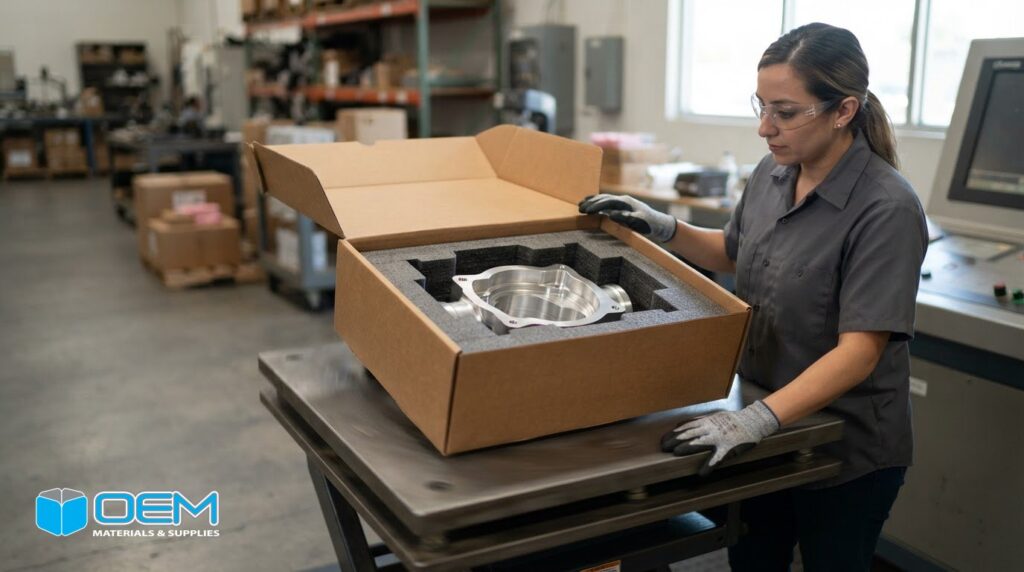
Generic dunnage can be enough to separate and support parts, but it may not protect surfaces that are finish-critical or machined. Engineered transit packaging should match the product’s vulnerabilities: use dedicated pockets or fixtures to prevent shifting, and foam or soft liners where sensitive surfaces could contact hard materials.
It makes sense to look for a simple, efficient packing method. The key is to match protection to the actual transit risks, rather than adding material without considering how the product moves and what it may contact.
This article explains how to choose dunnage and cushioning, optimize packaging materials and dimensions, and select transit tests for your product and distribution environment. You’ll also learn when generic support is suitable, when custom foam is a better fit, and how compression, vibration, drop, and edge or corner tests can assess protection.
Key Takeaways
- Match packaging materials and internal supports to the product’s vulnerabilities and the conditions it will encounter in transit.
- Use compression, vibration, drop, and edge or corner tests to investigate specific damage risks.
- Balance cushioning and package dimensions by protecting the product without adding material that doesn’t address the risk.
- Select test procedures for the actual shipping environment, including carrier handling and distribution route.
- Use generic dunnage for basic separation and support; choose dedicated pockets or soft contact surfaces when parts can shift or surfaces need added protection.
1. Protective packaging engineering and material optimization
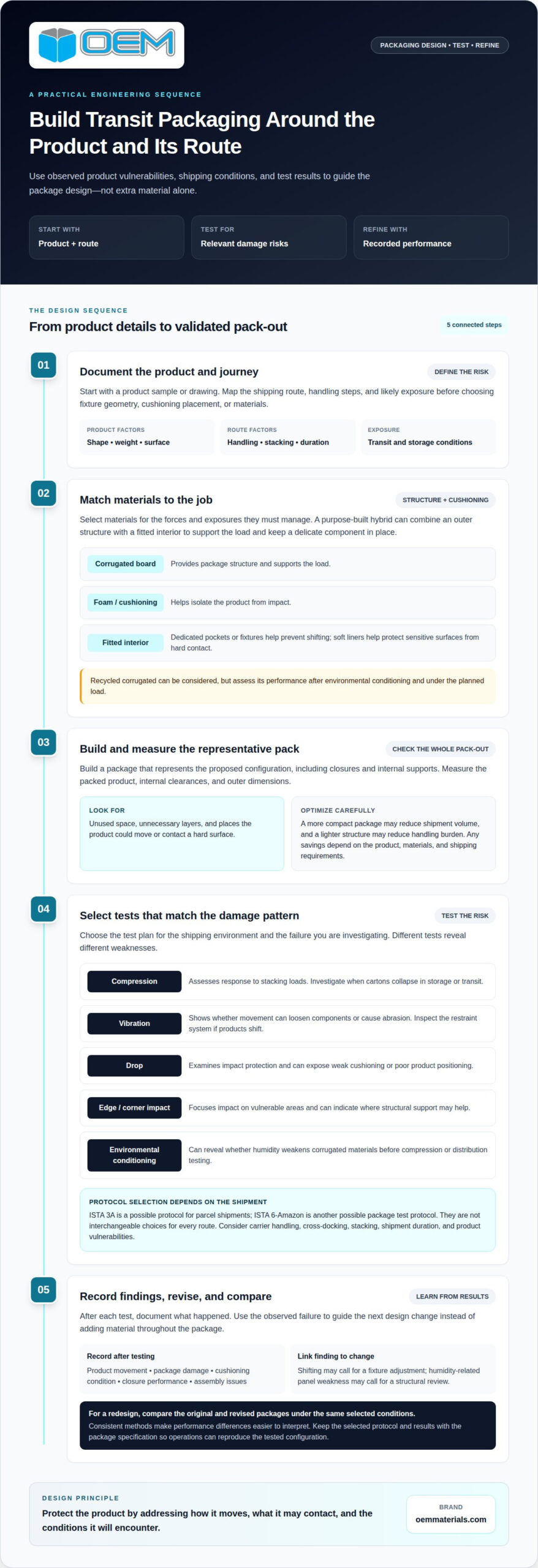
Engineered transit packaging starts with the product, its shipping route, and its handling conditions. Packaging for a machined component, for example, must prevent movement without allowing contact with steel or other hard surfaces. Begin with a product sample or drawing, then map the route, handling steps, and likely exposure. Those details guide fixture geometry, cushioning placement, and material selection. Designing around the actual product offers more reliable protection than simply adding material.
Choose materials according to the forces and exposures they must manage. Corrugated board provides structure, while foam and other cushioning materials help isolate a product from impact. A hybrid system can combine corrugated material, foam, thermoform, and other substrates in a purpose-built package. For example, a corrugated outer structure with a fitted interior can support the load and keep a delicate component in place. The right combination depends on the product’s shape, weight, surface, and transit environment.
Packaging tests help show whether materials perform under relevant conditions. Environmental conditioning can reveal whether humidity weakens corrugated materials before compression or distribution testing. This matters when shipments cross humid environments or remain in storage before dispatch. Test the proposed package configuration, including its closures and internal supports. Results for one material or format do not prove that a different design will perform the same way.
Recycled corrugated materials can be part of material optimization, but the package must still provide the required protection. Compare board performance after environmental conditioning and under the planned load. If a package deforms, review its panel structure, dimensions, and load paths before adding material throughout. For example, reinforcing a load-bearing area may address compression better than increasing cushioning around the product. Testing helps identify which change improves performance.
To optimize material use, weight, and freight dimensions, review the complete pack-out rather than just one component. Measure the packed product, internal clearances, and outer dimensions, then identify unused space and unnecessary layers. A more compact package may reduce shipment volume, while a lighter structure may reduce handling burden. Any freight or material savings depend on the product, materials, and shipping requirements. Keep protection at the center of the design.
Use a controlled design sequence: document the product and route, select candidate materials, build a representative package, and test it under relevant conditions. Record damage points, package deformation, and assembly issues after each test. If the product shifts, adjust the fixture; if corrugated panels weaken after humidity exposure, reconsider the structure. These steps help operations optimize the package using observed performance instead of guesswork. Southern California manufacturers shipping across varied routes can use foam packaging as one element of a tested protective design.
2. Compression, vibration, drop, and edge/corner testing
Choose a supplier that can connect the test plan to your product, shipping route, and damage history. Ask for a clear protocol, documented results, and recommendations linked to observed failures. This helps distinguish a packaging weakness from a handling condition the package was not designed to withstand.
Each test reveals a different type of failure. Compression testing assesses how a package responds to stacking loads. Vibration testing shows whether movement can loosen components or cause abrasion. Drop testing examines impact protection, while edge and corner tests focus impact on vulnerable areas. A crushed corner after delivery points to a different design issue than repeated scuffing inside the package.
Match the test sequence to the damage pattern. If cartons collapse in storage or transit, investigate compression alongside the actual stacking arrangement. If products shift or loosen, include vibration testing and inspect the restraint system afterward. A drop test can expose weak cushioning or poor product positioning. Edge and corner impacts can show where added structural support may help more than extra cushioning throughout the package.
Packaging testing laboratories and consultants in the United States can translate a logistics profile into a test plan and assess the package afterward. For a redesign, compare the original and revised packages under the same selected conditions. Consistent methods make performance differences easier to interpret. Confirm that the test scope covers the shipping environment and the damage pattern you are investigating.
Standards and protocols should fit the shipment, not just the product category. ISTA 3A is a possible protocol for parcel shipments, and ISTA 6-Amazon is another possible package test protocol. These protocols are not interchangeable choices for every route. Consider carrier handling, cross-docking, stacking, shipment duration, and product vulnerabilities when selecting tests. Keep the chosen protocol and results with the package specification, so operations can reproduce the tested configuration.
Validation should include more than a pass or fail. Record package damage, product movement, cushioning condition, and closure performance after each test. If a redesigned package improves one area but creates a new weakness, revise the design and repeat the relevant tests. A controlled comparison helps identify which change addressed the failure, rather than attributing results to several changes made at once.
When test findings point to a packaging change, share your package details with OEM Materials & Supplies to discuss a suitable next step.
3. Balancing package protection with freight dimensions
Start by measuring the product, its protective components, and the finished package. Compare the outer dimensions with the product’s orientation and handling needs. Reducing unused space can make a package more compact, but removing support can increase movement. For example, a narrow clearance around a stable component may work, while a fragile projection needs room and cushioning. Freight planning should account for the complete package, not just the product’s footprint.
Cushioning, bracing, and corner protection serve different purposes. Cushioning helps isolate the product from impact; bracing limits movement within the package. Corner protection can reinforce exposed edges during stacking and handling. A long, narrow assembly, for example, may need support near its ends and along its length. Position supports to carry forces through the packaging structure, rather than through delicate product features. Protective cushioning materials can be selected as part of that system.
Transit shocks and vibration can cause damage even when the outer package looks intact. Design the interior to manage movement and keep the product from repeatedly contacting the package walls. Engineered shock absorption and vibration dampening can isolate products from transit forces more effectively than simply adding thick cushioning. A component that shifts during vibration may need a closer-fitting fixture, not more cushioning. Test the complete packed configuration under relevant transit conditions.
Moisture and punctures call for different protective measures. Environmental exposure can weaken corrugated materials, while a sharp edge may puncture a package during handling. Identify exposed surfaces and likely contact points, then select barriers or structural support for those risks. For metal parts, dry packing and condensation control can help reduce corrosion risk in transit. Package dimensions should accommodate these protections without creating unnecessary voids or obstructing pack-out.
Electronics and other static-sensitive parts need ESD-safe, non-abrasive contact surfaces. Keep the product from rubbing against surfaces that could damage its finish or create unwanted contact. For example, a fixture can secure an electronic assembly while soft contact areas protect its exterior. Select materials for both electrical sensitivity and physical transit forces. A package that controls vibration but ignores static exposure does not address the product’s full vulnerability.
Optimize the design by reviewing product dimensions, package dimensions, support locations, and handling steps together. Compare the packed footprint before and after each design change, then test whether protection remains effective. If reducing package size causes a component to press against a wall, restore clearance or reposition the support. The right balance depends on product geometry, materials, freight requirements, and the actual distribution environment.
4. Product boxes and envelopes used for shipping
Choose a box or envelope based on the product’s shape, vulnerability, and shipping method. A rigid component may need a corrugated box with internal support, while a flat, non-fragile item may fit an envelope. Neither format is suitable by default. Start with the shipment’s route and handling steps, then determine whether the package can hold the product securely without excess space or pressure on sensitive areas.
Corrugated strength matters when a box must resist stacking, repeated handling, or compression during distribution. Review the packed configuration, including closures, supports, and how the package sits during transport. For example, a box that protects a product upright may perform differently if its orientation changes during sorting or transfer. Package dimensions should reflect the product and its protection, not simply match a convenient stock size.
Envelopes suit shipments that do not need a rigid outer box, but product geometry still matters. Sharp edges, projecting features, and delicate surfaces may need extra protection to reduce the risk of damage in an envelope. An electronic part, for example, needs contact protection and restraint suited to its sensitivity. If an envelope cannot prevent movement or protect vulnerable areas, use a box-based design instead. Choose the format according to the product’s failure risks.
Choose test protocols for the shipment’s actual distribution environment. Parcel shipments may use ISTA 3A, while ISTA 6-Amazon is another possible package test protocol. These are options, not universal requirements. Consider the carrier path, handling steps, product vulnerabilities, and package format. For shipments involving multiple carriers, cross-docking, or long-distance travel, use transit-focused tests and robust unitization to assess the complete shipping system.
Capture real-world conditions before setting the test plan. Document the origin and destination, carrier handoffs, cross-docking, stacking, package orientation, and any temperature or moisture exposure. Note how the shipment is packed and secured, including how packages are grouped. A package moving through a parcel network may face different handling from a unitized shipment transferred between facilities. The test should represent the route being evaluated.
Use damage records to define what validation must reveal. A crushed box calls for attention to compression and stacking; a punctured envelope points to contact hazards and package construction. Product movement or surface abrasion calls for a review of internal restraint and contact points. After testing, inspect both the outer package and the product. Record deformation, broken closures, shifted supports, or visible product damage, then relate each observation to the test conditions.
For a redesign, compare the original and revised packages using the same selected protocol and shipping configuration. Keep product orientation, closure method, and unitization consistent so results reflect the packaging change. If a revised corrugated box passes one test but fails under another relevant condition, adjust the design and repeat that part of validation. This process ties packaging decisions to actual logistics rather than assumptions about a shipment.
5. Custom foam inserts and dunnage
Generic dunnage can separate and support parts when surface contact is not a concern. Custom foam is typically a better choice for machined or finish-critical surfaces. The distinction is practical: dunnage creates space between items, while a fitted insert can locate a part and limit movement. For a component with a finished face, use a dedicated pocket or soft liner at contact points. Avoid relying on loose fill to protect surfaces from abrasion.
Start insert design with the part’s shape, orientation, and contact areas. A sample or accurate drawing helps define a nest that supports the component without pressing on vulnerable features. Each pocket should keep its part in position through handling and storage. If parts move inside a returnable container, identify where they shift and adjust the fixture. A dedicated nest can make loading and unloading more consistent across operations.
Material selection depends on the product and its transit conditions. A soft liner can protect a machined surface, while the insert’s geometry provides structural support. For example, a metal part with exposed finished faces needs protection from hard contact and neighboring parts. Electronics may also require ESD-safe, non-abrasive contact surfaces. Choose the material and layout together: suitable cushioning cannot make up for a fixture that allows excessive movement.
Returnable packaging must work at the point of use, not just during transport. Design the fixture around line-side orientation, accessibility, and handling height. A part loaded from above may need a different pocket layout from one removed from the side. Check how workers grasp each component and whether the nest allows removal without scraping adjacent surfaces. These details affect pack-out, return handling, and the package’s place in the supply chain.
Environmental conditions and storage also matter. Corrugated structures can weaken in humidity, so reusable systems and inserts should be assessed in their actual operating environment. Consider package performance during storage, transport, and line-side use. If higher part volume changes the stack or loading pattern, reassess support locations and access. A design that suits one handling process may create friction when operations change.
Use damage evidence to guide revisions. Scratches suggest contact or abrasion; displaced parts point to inadequate location or restraint. Adjust the pocket, liner, or dunnage arrangement, then evaluate the revised pack-out under relevant handling conditions. Keep part orientation and loading steps consistent during comparisons. Request a quote for packaging support with the part dimensions, weight, and handling requirements.
OEM Materials & Supplies
OEM Materials & Supplies helps manufacturers match packaging components to product protection and shipping needs. Corrugated boxes, foam packaging, and packaging kits can support different combinations of outer structure, cushioning, and pack-out requirements. Mailing tubes and cores suit products that need a different shipping format. The right choice depends on product dimensions, weight, surface sensitivity, handling, and shipping route.
Turn to OEM Materials & Supplies when damage patterns, shifting parts, or inefficient packing call for a closer look at your packaging configuration. Sharing product dimensions, weight, and shipping requirements can help identify suitable packaging components. Contact OEM Materials & Supplies to discuss your packaging needs.
Make the Next Packaging Change Deliberate
Treat your packaging specification as an operational tool, not a one-time document. When product geometry, handling, or shipping routes change, review whether the existing design still suits the new conditions. A clear record of the tested configuration also helps purchasing, warehouse, and production teams maintain consistent pack-out.
For your next packaging review, gather the product’s dimensions and weight, the current package configuration, and the transit conditions that matter. This provides a practical starting point for engineered transit packaging and connects protection goals with day-to-day operations. Corrugated boxes, foam packaging, and packaging kits can each contribute to a suitable configuration, depending on the application.
Contact OEM Materials & Supplies to discuss your packaging requirements and potential next steps. With the relevant product and shipping details in hand, you can move toward a packaging decision that fits your operation.
Frequently Asked Questions
Do I need custom foam, or is generic dunnage enough?
Generic dunnage can work when parts need basic separation and support without sensitive surface contact. Custom foam is a better fit for machined or finish-critical parts that need dedicated pockets, controlled positioning, or soft contact surfaces. For example, loose separators may keep unfinished components from striking each other, while a fitted nest can hold a finished component in place. The deciding factors are surface sensitivity, part movement, and handling requirements.
How do I protect parts from corrosion or ESD in transit?
For corrosion protection, use dry packing and condensation control suited to the shipment’s environmental exposure. For static-sensitive parts, specify ESD-safe, non-abrasive contact surfaces and keep the product from shifting against other materials. These measures address different risks, so one cannot replace the other. An electronic component with exposed metal surfaces, for instance, may need both static control and moisture management in its packaging plan.
What causes most transit damage to parts?
Transit damage can result from impact, vibration, compression, product movement, or environmental exposure. Damage can also occur when shipments face over-capacity stacking, handling outside the intended distribution route, or other unplanned conditions. A bent edge may indicate impact, while a surface scratch can point to movement or contact inside the package. Reviewing product condition alongside package deformation helps identify likely failure modes and guide design changes.
What testing should you request?
Choose tests based on observed damage and the shipment’s distribution conditions. Compression testing can investigate crushing or stacking problems; vibration, drop, and edge or corner tests can assess other handling risks. Include environmental conditioning when humidity could affect corrugated packaging. Test the complete shipping configuration, including closures and internal supports. After testing, inspect the product and package for movement, damage, deformation, and changes to protective components.
What is engineered transit packaging?
Engineered transit packaging is a system designed around a product’s vulnerabilities and distribution conditions. It combines an outer package, internal support, and protective materials to address risks such as impact, vibration, compression, or environmental exposure. The design accounts for how the product is packed, handled, and shipped. Its purpose is to tailor protection to the application rather than rely on a generic package configuration.
What materials and design methods are used for transit packaging?
Engineered transit packaging can combine corrugated board, foam, thermoform, and other substrates in a purpose-built structure. The design may use a dedicated pocket, nest, or fixture to locate a part, with cushioning or soft liners at sensitive contact points. Material selection depends on product geometry, surface finish, weight, handling, and transit conditions. For example, a corrugated outer structure can pair with a fitted interior to restrain a delicate component.
What are the main standards for transit packaging testing in the United States, including ISTA and ASTM?
No single test protocol suits every shipment. ISTA 3A is a possible protocol for parcel shipments, and ISTA 6-Amazon is another possible package test protocol. ASTM methods may also be relevant depending on the test objective. Choose a procedure based on the actual distribution environment, carrier handling, and product vulnerabilities. Document the selected protocol and tested package configuration so the evaluation can be reproduced consistently.
How much does transit packaging cost, and what factors affect the price?
Pricing depends on the project and is provided after a quote request. Key factors include product dimensions and weight, material selection, package construction, shipping requirements, and the level of internal protection needed. A design for a compact, stable part differs from one for a delicate product requiring dedicated support. Product and shipment details help OEM Materials & Supplies prepare a quote suited to the application rather than a generic estimate.