
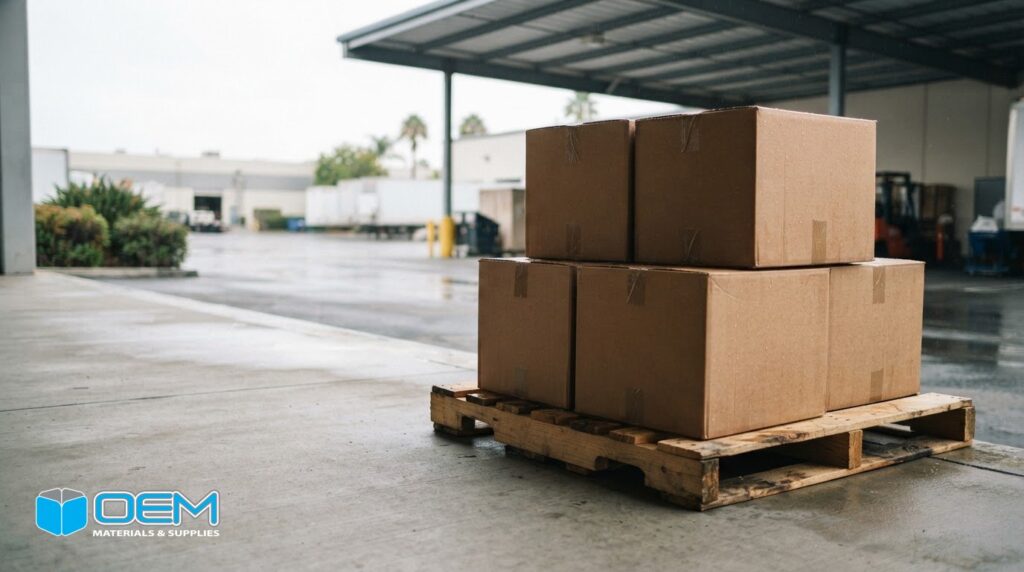
Weather-resistant doesn’t mean waterproof. Weather-resistant shipping boxes in Southern California help resist moisture, but they aren’t sealed enclosures. Moisture-sensitive products may need an inner bag, liner, coating, or another barrier. That distinction matters when shipments face rain, humidity, or time outdoors.
Choosing the right box means balancing exposure protection with the product’s dimensions, weight, and support needs. Pricing depends on the specific requirements and is provided after a quote request. Box size, construction, closure, load, and shipping conditions all affect the recommendation.
This article explains what weather resistance can and can’t do, which packaging details affect performance and cost, and how to match a box to a shipment. You’ll also learn when additional protective packaging may help reduce moisture risk and prevent damage in transit.
Key Takeaways
- Estimate box costs by considering dimensions, construction, closure, load, and shipping conditions rather than relying on a single standard price.
- Choose moisture barriers based on the product’s exposure needs; a weather-resistant carton alone does not create a waterproof package.
- Match box construction and internal support to the shipment’s weight and handling conditions to reduce the risk of damage.
- For shipments in Los Angeles, San Diego, and Orange County, provide product dimensions, weight, and expected usage to help guide a suitable packaging recommendation.
- Custom sizing and order volume affect packaging decisions, so assess how the box will fit the product and shipping process before selecting a solution.
Weather-resistant box dimensions and prices
Box dimensions affect product protection and shipping charges. Start with the product’s length, width, and height, then allow room for cushioning and any moisture barrier. A compact electronics component, for example, needs a different interior fit than a long mechanical part. Measure the packed item, not just the bare product, before selecting a carton.
Distinguish interior from exterior dimensions when comparing box options. Interior measurements determine product fit; exterior measurements affect storage and carrier handling. Corrugated board adds to the outside dimensions, so a carton’s listed interior size won’t match its exterior footprint. Record both measurements and the packed weight for each shipment configuration.
Box pricing depends on the specific requirements and is provided after a quote request. Dimensions, construction, order quantity, and shipping needs affect the quote. A custom fit can reduce unused space, while extra room may be needed for cushioning or a liner. Compare the complete package design, not just carton dimensions, when evaluating costs.
Shipping charges may also reflect dimensional weight. The carrier dimensional-weight calculation uses a divisor of 139. Measure the sealed package’s exterior dimensions to estimate how its size may affect billing. In 2026, the stated UPS and FedEx large-package thresholds include a longest side exceeding 96 inches or length plus girth greater than 130 inches. These thresholds matter for oversized cartons, not typical small parcels.
Are weather-resistant boxes compatible with USPS, UPS, and FedEx shipping requirements? The material itself doesn’t prevent carrier shipment; package dimensions, weight, closure, and labeling still need to meet applicable carrier rules. For oversized equipment transported on California state highways, California Department of Transportation (Caltrans) regulations govern physical transport.
What alternatives to weather-resistant boxes, such as plastic mailers or reusable totes, work best for shipping? Plastic mailers can suit flexible, non-fragile items that don’t need rigid support. Reusable totes can work for repeat internal distribution routes, while rigid cartons are better suited to products needing a defined protective enclosure.
For shipments across Southern California, document product dimensions, packed weight, destination, and exposure conditions before comparing box options. This gives packaging teams a consistent basis for matching the carton to the shipment. Review corrugated box options alongside the required interior fit and exterior shipping dimensions.
Limits of weather resistance
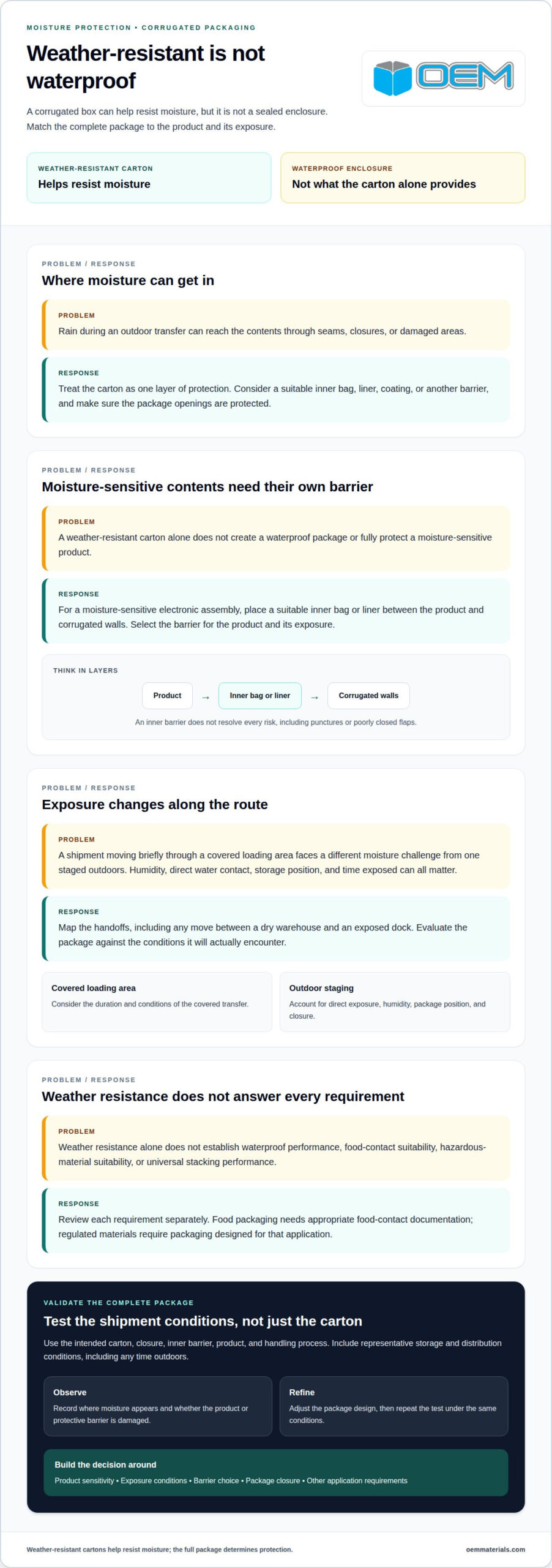
Weather-resistant corrugated boxes resist moisture, but they are not waterproof enclosures. A carton exposed to rain during an outdoor transfer can still let water through its seams, closure, or damaged areas. Coatings or wet-strength construction help address moisture exposure, but don’t turn the box into a sealed container. Treat the carton as one layer of a packaging system, not the complete moisture-control plan.
For a moisture-sensitive electronic assembly, place a suitable inner bag or liner between the product and corrugated walls. A coating or another appropriate barrier may also suit the application. Choose the barrier based on the product and its exposure, then ensure the closure protects the package openings. An inner barrier doesn’t resolve every risk, such as punctures or poorly closed flaps.
Weather resistance alone doesn’t establish waterproof performance, food-contact suitability, hazardous-material suitability, or universal stacking performance. These are separate requirements. For example, a carton used for food packaging needs appropriate food-contact documentation, while a shipment containing regulated materials requires packaging designed for that application. A box that performs well under one storage condition may not meet different product or handling requirements.
Exposure duration matters. A carton moving briefly through a covered loading area faces a different moisture challenge from one staged outdoors. Humidity, direct water contact, storage position, and package closure all affect the completed package. A Southern California shipment may move between a dry warehouse and an exposed dock, so evaluate each handoff rather than judging performance from the warehouse alone.
Test the completed package under representative storage and distribution conditions, including any time outdoors. Build the test around the actual shipment: use the intended carton, closure, inner barrier, product, and handling process. Record where moisture appears and whether the product or protective barrier is damaged. Then adjust the package design and repeat the test under the same conditions.
- Identify exposure: document rain, humidity, outdoor staging, and handling points.
- Protect the contents: select an inner bag, liner, coating, or other documented barrier for the product.
- Assess other requirements: review food-contact, hazardous-material, and stacking needs separately.
- Test the full package: include the actual closure and distribution conditions in the evaluation.
For a package moving through a Los Angeles County facility or an exposed loading dock, describe its moisture exposure and product sensitivity in a packaging quote request. That context helps focus the packaging discussion on the real risk, not just the carton material.
Matching box construction to exposure and load
Choose the corrugated construction based on both moisture exposure and shipment load. Board grade matters, but box size, closure, contents, support, and exposure duration also affect performance.
Moisture and Weather Resistance Ratings
W5c and V3c identify wet-strength, single-wall corrugated constructions used for weather-resistant cartons. These grade identifiers describe board construction, not a guarantee that a completed package is waterproof. Compare the specified grade with the shipment’s exposure, load, and box dimensions. A grade alone cannot establish food-contact suitability, hazardous-material suitability, or stacking performance.
Sealing and Packing for Outdoor Exposure
For outdoor exposure, close the carton securely and protect contents with an appropriate inner barrier when moisture sensitivity calls for one. UPS recommends water-resistant packaging and a tight seal when shipping frozen water. Pay close attention to the package closure and seams, then assess how the contents and support affect the sealed carton during handling.
A regular slotted carton made with wet-strength corrugated board can address moisture exposure, but its load still needs assessment. A 110-pound industrial shipment is an example of a load that can cause a generic box to fail. That example underscores why weight alone is not a complete specification. Box dimensions, load distribution, closure, and internal support all shape how the carton performs.
For shipments weighing over 100 pounds, triple-wall corrugated and custom wood crates are identified as reliable packaging materials. This does not mean every shipment above that weight requires the same construction. Product geometry, handling, and exposure conditions affect the choice. For this section, focus on corrugated construction and avoid treating a heavier board as a substitute for adequate internal support.
Consider a long metal component with its weight concentrated at one end. A box selected only by total load may not adequately support that concentrated force. Add internal blocking or cushioning where needed, and position the product to distribute support across the package. The completed arrangement should prevent shifting that could stress carton panels or open the closure during transit.
Exposure time affects the packaging decision. A carton crossing a covered dock briefly faces different conditions from one stored outdoors before pickup. Specify whether the package may encounter rain, damp surfaces, or extended outdoor staging. Include the closure method and contents in your review, since even a suitable board can underperform if water reaches vulnerable seams.
Use a repeatable selection process: record shipment weight and dimensions, identify moisture exposure, choose suitable wet-strength construction, and assess closure and support together. Then test the completed package under representative distribution conditions. For weather-resistant shipments in Southern California, this process ties material choice to the actual load and route instead of relying on a grade label alone.
Where can businesses buy weather-resistant shipping boxes in Los Angeles, San Diego, and Orange County?
Businesses in Los Angeles, San Diego, Orange County, and Riverside can source weather-resistant shipping boxes in Southern California from OEM Materials. For purchasing teams, the key is matching the order to the shipment rather than selecting a carton by its label alone. Provide product dimensions, packed weight, moisture exposure, and expected order volume when requesting options.
Start by defining the operating need at the facility. A Los Angeles manufacturer shipping components to customers may need a different carton plan from an Orange County distributor moving products between warehouses. List the product, its handling conditions, and whether packages wait outdoors. These details help narrow down the required construction and inner protection before you compare standard and custom dimensions.
San Diego businesses should consider the route from packing area to carrier handoff. A package leaving a climate-controlled warehouse may encounter uncovered staging or loading. Document those transfer points, then describe exposure duration and closure method. This gives OEM Materials useful context for recommending weather-resistant shipping boxes in Southern California without assuming every shipment needs the same box.
For recurring shipments, organize purchasing data by product family. A manufacturer with several component sizes can group items by packed dimensions, weight, and exposure profile. This makes it easier to identify where a standard carton may fit and where a custom size could reduce unused space. Include anticipated usage patterns, but don’t choose a larger order solely to simplify purchasing.
Before placing an order, align the packaging specification with operations, procurement, and shipping teams. A warehouse manager can describe stacking and handling; an engineer can explain product fragility; and procurement can consolidate recurring requirements. For example, an electronics shipment may need an inner moisture barrier as well as a corrugated outer box. The carton alone may not meet the full packaging need.
- Share product data: provide dimensions, packed weight, and product orientation.
- Describe exposure: identify outdoor staging, moisture contact, and transit handling.
- Explain usage: note recurring shipments and the range of products packed.
- Coordinate internally: combine warehouse, engineering, and purchasing requirements.
Regional sourcing should account for the destination and receiving process. A carton shipped to an Orange County customer may face different storage conditions from one routed to a San Diego facility. Include those differences in the specification rather than assuming every delivery across Los Angeles, Orange County, and San Diego County has the same requirements.
Use this information to request a packaging recommendation based on the actual shipment. A clear specification helps buyers compare carton fit, construction, and protective components consistently, while keeping the purchasing decision tied to product needs and Southern California distribution conditions.
Do Southern California packaging suppliers offer custom-sized or bulk weather-resistant boxes?
Yes. Southern California packaging suppliers can offer custom-sized corrugated boxes and bulk ordering for business shipments. The right choice depends on product dimensions, board construction, moisture exposure, and packing workflow. A manufacturer shipping the same component repeatedly may benefit from a consistent carton specification, while a business with varied products may need several sizes.
Custom sizing starts with the packed product, not the bare item. Account for cushioning, an inner moisture barrier, and the space needed to load or remove the product. For example, a metal assembly with a protective sleeve needs more interior clearance than the assembly alone. Record interior dimensions and confirm how the packed unit sits inside the carton before finalizing the specification.
A custom carton can help control excess space and stabilize a product in transit. But reducing box dimensions too aggressively can leave too little room for protective materials or make packing difficult. Consider the full packing sequence, including product orientation, inserts, closure, and movement through the warehouse. A practical design should fit both the item and the operation.
Bulk purchasing is useful for repeat shipments with stable packaging requirements. Before setting order quantities, review usage by product family, storage capacity, and the risk of design changes. An electronics manufacturer, for instance, may ship one component consistently while revising another during product updates. Separating those demand patterns can help prevent excess inventory of cartons that no longer fit.
Provide a supplier with a clear packaging specification. Include:
- Product information: dimensions, packed weight, shape, and orientation.
- Protection needs: moisture exposure and any inner bag, liner, or cushioning.
- Order details: recurring usage, product variations, and available storage space.
- Handling context: packing steps, closure method, and warehouse movement.
For Southern California businesses, one carton size may not suit every facility or destination. A Los Angeles operation shipping multiple product families could need distinct carton dimensions, while a repeat shipment from Orange County may use one established specification. Bulk orders should reflect actual patterns rather than assume every shipment has identical requirements.
Custom sizing and bulk ordering work best when procurement, engineering, and warehouse teams share the same specifications. That alignment helps prevent mismatched cartons, unnecessary packing adjustments, and inventory tied to an outdated design. To request a quote for your packaging requirements, send your box dimensions, packed weight, and expected usage.
OEM Materials & Supplies: Corrugated Boxes
OEM Materials provides corrugated boxes for business shipping and handling needs. Turn to its custom packaging solutions when standard dimensions, product support, or moisture exposure call for a more considered specification. Box size, load, closure, and any inner barrier should work together for the shipment.
For a product that needs additional cushioning, foam packaging or a packaging kit may complement the corrugated outer box. Share the product dimensions, packed weight, exposure conditions, and expected usage so the packaging requirements are clear. Explore corrugated box options as part of that assessment.
Contact OEM Materials & Supplies to discuss your packaging requirements.
Move Your Packaging Decision Forward
Make packaging review part of product and process changes, not just a response to shipping damage. A revised product configuration, new handling method, or different distribution route can change package performance. For weather-resistant shipping boxes in Southern California, scheduled reviews help keep the packaging approach aligned with changing operations.
OEM Materials offers corrugated boxes, foam packaging, and assembled packaging kits for industrial shipping needs. These options can support a coordinated package design when the outer carton alone doesn’t meet the product’s protection requirements.
Contact OEM Materials & Supplies to discuss your packaging needs and identify a practical next step for your operation.
Frequently Asked Questions
Are weather-resistant corrugated boxes waterproof?
No. Weather-resistant corrugated boxes are not waterproof containers. For shipments that must remain dry during direct water exposure, don’t rely on the carton as the sole containment layer. Define the acceptable product condition at delivery, then choose packaging designed to meet that requirement. This distinction is especially important when water contact could disrupt production or make components unusable.
Do moisture-sensitive products still need inner protection?
Often, yes. Inner protection can separate a product from the carton and add another layer to the shipping system. For instance, a precision-machined part with a moisture-sensitive finish may need a protective wrap suited to its surface and storage process. Ensure the inner material is compatible with the item and doesn’t interfere with assembly, inspection, or unpacking at the receiving facility.
What types of weather-resistant shipping boxes protect packages from rain and humidity?
Weather-resistant corrugated cartons are used for shipments that may encounter moisture. The appropriate carton depends on the package’s complete construction and intended distribution, not just a general label. For recurring shipments, document the selected carton and packing method in the work instructions. This helps staff use the same configuration across shifts and reduces variation between packages.
Are waterproof corrugated shipping boxes available in Southern California?
Weather-resistant corrugated boxes are available from OEM Materials for industrial packaging needs in Southern California, including Los Angeles, Orange County, San Diego, and Riverside. However, “weather-resistant” should not be interpreted as “waterproof.” If the specification requires a waterproof enclosure, make that performance requirement explicit in the packaging design. Assess the box material and any additional protective components as a complete system.
How do water-resistant, waterproof, and moisture-resistant shipping boxes differ?
These descriptions shouldn’t be treated as interchangeable performance ratings. “Waterproof” implies a stronger protection claim than resistance to moisture, while “water-resistant” and “moisture-resistant” describe limited resistance without defining every condition. In procurement documents, state the actual exposure and the required product condition at receipt. Clear language helps suppliers and internal teams evaluate the same packaging need instead of relying on broad labels.
What shipping box materials and coatings withstand Southern California heat and sun?
Heat and sunlight performance depends on the specific package and exposure, so don’t assume a corrugated material or coating suits every outdoor use. Consider whether cartons sit in direct sun, remain in a vehicle, or wait under a covered receiving area. For electronics or other heat-sensitive products, evaluate the product’s handling requirements separately from the carton’s role in protecting it during shipping.
What are the prices of weather-resistant shipping boxes in Southern California?
Pricing depends on the specific order and is provided after a quote request. Relevant considerations include carton design, construction, quantity, and shipping application. Purchasing teams can compare options more effectively against one consistent specification. Clearly state customizations and recurring order requirements so the quote reflects the packaging configuration the operation intends to use.
How can businesses choose weather-resistant packaging for coastal versus inland Southern California?
Choose based on the facility’s actual storage and transfer practices, not its coastal or inland location alone. A shipment from a coastal warehouse may remain indoors, while an inland delivery may include exposed handling. Review procedures at shipping and receiving points, then align the packaging specification with those workflows. This approach supports consistent decisions across Los Angeles, Orange County, San Diego, and Riverside.