
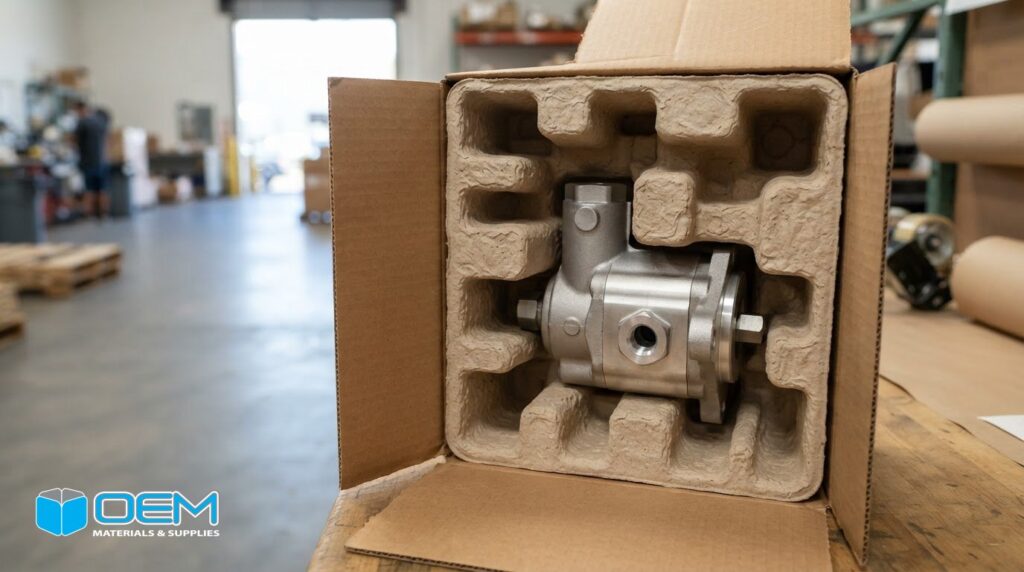
Molded pulp starts as recycled paper and becomes a shaped protective insert. For businesses evaluating eco-friendly molded pulp inserts in Los Angeles, the process is straightforward: recycled paper is mixed with water, pressed into a mold, and dried. The finished insert is shaped to fit around a product.
That process matters, but it does not answer every operational question. Insert performance depends on the product’s shape, the support it needs, and the conditions it will face in storage and transit. Design and order requirements also affect production costs, so weigh sustainability goals alongside fit, protection, and production scale.
This article explains how molded pulp inserts are made, what affects production costs, how the material performs, and what to consider at end of life. It also outlines how to assess fit for your packaging operation and how OEM Materials & Supplies’ related packaging solutions can support broader needs in Southern California.
Key Takeaways
- Assess insert design against product geometry, required support, and transit conditions to determine whether molded pulp fits the packaging job.
- Estimate production needs by considering tooling, order volume, and design complexity, not material choice alone.
- Plan for end-of-life handling by considering whether recycling or composting facilities are available to your customers.
- Account for moisture exposure when evaluating molded pulp’s protective performance; according to the U.S. Environmental Protection Agency, its resistance to liquids can help protect packaging from moisture.
- Compare molded pulp with complementary packaging options, such as corrugated boxes, foam packaging, or packaging kits, to build a complete shipping setup.
What is Molded Pulp Packaging?
Molded pulp packaging uses fiber shaped into a protective form around a product. In a typical process, paper is mixed with water, formed in a mold, and dried.
Some molded pulp packaging is made from 100% recycled paper. According to the U.S. Environmental Protection Agency, molded fiber can use secondary fibers such as waste newsprint, as well as wood fibers. The fiber mix and finished shape depend on the design and intended use.
Custom insert design starts with the product’s shape and packaging requirements. Those details inform a mold that supports the item and fits inside its outer packaging. The insert’s cavities, walls, and contact points determine how the product sits during packing and transport.
Molded Pulp Insert Styles
Insert styles range from a single formed tray to fitted top-and-bottom pieces or a multi-cavity layout. A tray can hold one product, while separate cavities keep several components organized. The right format depends on the item’s shape, the number of parts in the package, and how workers load and remove each piece.
For example, an electronics kit containing a device and accessories may need a separate recess for each component. A narrow product may need a shaped channel to limit side-to-side movement. Compare each design with the packing sequence and identify which areas need support.
Custom-Fit Designs and Sizing
Custom sizing starts with the product’s overall dimensions and its vulnerable edges, corners, or protrusions. The insert must also fit the shipping package’s interior. Account for product orientation, how it is placed in the insert, and the clearance needed to remove it without forcing the fit.
A prototype lets the team assess fit before production. Place the product in the sample, inspect its contact points, and see whether it stays positioned during handling. Electronics companies should prototype and test molded pulp packaging for adequate protection and a snug fit, then revise the design if needed.
Tooling and design connect product requirements to a manufacturable insert. The process typically progresses from product measurements and packaging goals to a proposed layout, mold development, and sample evaluation. Revisions may change cavity depth, support locations, or the arrangement of multiple parts. These steps help align the insert with both the product and the packing workflow.
When assessing custom molded-pulp inserts and packaging suppliers in Los Angeles, focus on how they translate product geometry into a workable design. Share the product dimensions, orientation, components packed together, and shipping package constraints. Those inputs help define the mold and insert layout. For products needing a different cushioning approach, foam packaging options may also fit the broader packaging plan.
Cost considerations for production at scale
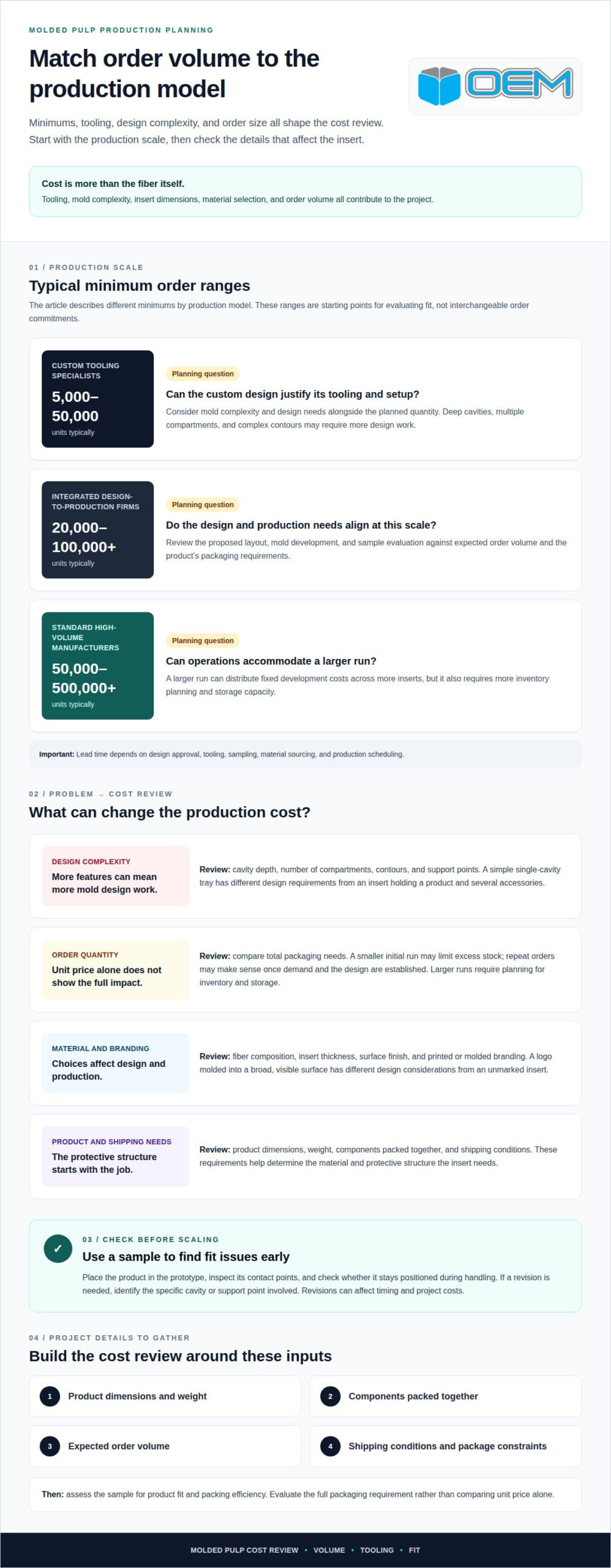
Custom tooling specialists typically require minimums of 5,000 to 50,000 units. Standard high-volume manufacturers typically require 50,000 to 500,000 or more units. Integrated design-to-production firms typically require 20,000 to 100,000 or more units. Lead time depends on design approval, tooling, sampling, material sourcing, and production scheduling.
Production cost reflects more than the fiber itself. Tooling, mold complexity, insert dimensions, material selection, and order volume all affect the project. A simple tray with one cavity has different design requirements from an insert that holds a product and several accessories. Each feature can affect mold design and manufacturing steps.
Tooling is an important early consideration for custom production. The mold must form the intended shape and support the insert’s required features. Deep cavities, multiple compartments, and complex contours may require more design work. A prototype helps assess fit and identify revisions before production begins. Revisions can affect timing and project costs.
Order volume affects how tooling and setup costs are distributed across units. A larger run can spread fixed development costs over more inserts, but it also requires more inventory planning and storage capacity. A smaller initial run may limit excess stock, while repeat orders can make sense once demand and the design are established. Compare total packaging needs, not just unit price.
Material and branding choices add further variables. Fiber composition, insert thickness, surface finish, and printed or molded branding can affect design and production. For example, a logo molded into a broad, visible surface presents different design considerations from an unmarked insert. Product dimensions and shipping requirements also matter because they determine the material and protective structure the design needs.
Build a cost review around clear project details: product dimensions, weight, components packed together, expected order volume, and shipping conditions. Then assess a proposed sample for product fit and packing efficiency. If the insert needs revision, identify the specific cavity or support point involved. This makes design changes easier to evaluate before production scales up.
For adjacent packaging needs, cushioning materials can complement an insert within a broader shipping setup. To request a quote for those materials, contact OEM Materials & Supplies with product dimensions, weight, and expected usage. Those details help frame the packaging requirements.
Recyclability, biodegradability, and compostability
Molded-fiber packaging described as made from 100% recycled newspaper is both 100% recyclable and biodegradable. Those attributes support material recovery and biological breakdown, but they describe different end-of-life pathways. Recycling processes fiber for reuse, while biodegradation refers to material breaking down over time. Neither term alone establishes that a specific insert belongs in every local collection stream.
For a Los Angeles packaging program, plan the disposal route alongside the insert design. First, identify whether customers or receiving sites can access recycling or composting facilities. Then communicate the intended route clearly in packaging instructions, where appropriate. Facility acceptance matters: molded pulp’s recyclable or biodegradable properties do not mean every location will process it.
Compostability is a separate consideration. A biodegradable material can break down biologically without being suitable for every composting system or accepted at every facility. A molded newspaper insert, for example, may have a different disposal route from packaging with attached components or coatings. Evaluate the complete packaging assembly, not just the fiber tray.
For procurement teams, end-of-life planning starts with a material review. Document whether the insert is paper fiber, identify other packaging components, and determine how those parts separate after unpacking. A shipping package that combines a molded pulp insert with plastic film or a label may require customers to sort materials. Clear instructions can distinguish the fiber component from other materials.
How do molded pulp inserts compare with foam and plastic inserts for protection and sustainability? Molded pulp is fiber-based and has recyclable and biodegradable attributes, while foam and plastic have different material properties and disposal pathways. Protection depends on the product, insert geometry, and shipping conditions, so compare package performance alongside end-of-life requirements.
Prototype evaluation can help connect these priorities. Place the product in the insert, assess whether it stays supported during handling, then review how the assembled package’s materials separate. For instance, an electronics shipment may use a molded pulp tray inside a corrugated carton, with other components packaged separately. This layout makes the fiber insert easier to identify after unpacking.
Before choosing a disposal message, map the expected end-of-life route for each package component. Confirm that the intended recycling or composting facilities are available to shipment recipients. Matching the design and material information to local processing options makes environmental claims more useful in practice. It also gives purchasing and operations teams a clearer basis for comparing packaging choices.
Barrier properties and water resistance
Molded pulp can help manage moisture exposure, but it is not a universal liquid barrier. The U.S. Environmental Protection Agency states that molded pulp’s high resistance to liquids can help protect packaging from moisture. This may suit a package exposed to damp handling, but it does not establish suitability for every exposure or shipment.
Start by identifying where moisture could reach the package. A shipment may encounter condensation, damp warehouse floors, or brief rain during unloading. Those conditions differ from direct liquid contact or prolonged outdoor storage. Map likely exposure points, then decide whether the molded pulp insert needs additional protection from another packaging layer.
Evaluate the full package, not just the insert. A molded pulp component can hold a product in position, while a cardboard carton provides the outer enclosure. If the carton may get wet, the package’s overall moisture performance depends on more than the insert. Keep this distinction clear in specifications and packaging reviews.
Plastic film or a bag can add a layer between the product and moisture. That layer may affect how the package is opened, sorted, or disposed of after delivery. For example, an electronics shipment could use a molded pulp insert to position the product and a separate protective wrap around sensitive components. Review the role of each material independently.
Use a practical evaluation sequence. First, define expected moisture exposure during storage and transit. Next, inspect the insert and surrounding package for openings or exposed edges. Then test a representative packed product under the handling conditions expected in your operation. Record where moisture appears and whether the product remains protected.
Product geometry also affects moisture planning. A recessed cavity may hold a component securely, but exposed surfaces and package openings still matter. For a device with connectors or delicate finishes, identify the areas that must stay dry. Design the packaging around those areas rather than assuming the molded insert creates a sealed enclosure.
Compare molded pulp, foam, and plastic by assigning each material a clear role. The insert may position the product, while a separate layer manages moisture exposure. A cardboard carton may protect the assembly during ordinary shipment, but assess its role against the route and handling environment. No single material choice meets every packaging requirement.
Before approving a design, document the exposure scenario, package layers, and inspection results. For example, a shipment stored indoors differs from one staged near an open loading area. This review helps teams specify where molded pulp fits and where another barrier layer may be needed. It also keeps moisture protection distinct from cushioning and product support.
California and Los Angeles-area supplier options
Businesses sourcing molded pulp in Southern California can compare packaging options against their operations. A purchasing team in Los Angeles County may prioritize coordination with a central warehouse, while an Orange County manufacturer may focus on production scheduling across facilities. The review can also account for receiving and distribution needs in the Inland Empire or San Diego County.
Start with how packaging materials move through your supply chain. Identify where inserts will be received, stored, and brought into packing operations. For example, a company shipping from a Los Angeles County facility may need packaging delivered to a separate fulfillment location. Mapping those handoffs helps define a supply plan around the actual workflow.
Clarify how project communication will work across engineering, purchasing, and warehouse teams. Identify who approves design changes, receives samples, and manages production orders. If a product revision affects insert geometry, a documented approval process can keep the production design aligned with the item being packed.
Regional logistics also depend on practical receiving details. Note the destination facility, dock or receiving procedures, storage constraints, and delivery contact. A business operating across Orange County and the Inland Empire may need materials routed to different locations. Make each destination clear when discussing a supply plan.
Consider how supplier coordination fits your production calendar. A plant in San Diego County may have different receiving windows and inventory routines from a Los Angeles County warehouse. Share the planned usage pattern and identify production periods when packaging demand changes. This gives the supplier useful context for discussing order scheduling and shipment planning.
For sustainability reviews, document material information and the disposal guidance your company intends to communicate. Keep these records with the packaging specification so purchasing, engineering, and customer-facing teams use consistent descriptions. If shipments move between counties or reach customers elsewhere in California, account for disposal options relevant to those destinations.
Use a written evaluation that reflects each operating location’s needs. Compare how the proposed packaging fits the product, packing sequence, receiving process, and distribution route. Keep the same project information for discussions across Los Angeles County, Orange County, the Inland Empire, and San Diego County. This makes operational differences visible without assuming every site has identical requirements.
For a project serving Southern California facilities, organize product dimensions, weight, usage, shipping destinations, and receiving requirements before requesting a quote. Request a packaging quote with those details to begin a project-specific discussion.
OEM Materials & Supplies
OEM Materials & Supplies helps businesses plan packaging around product protection, packing workflow, and shipping needs. For a molded pulp insert project, the surrounding package matters too. Corrugated boxes can enclose the packed product, while foam packaging may suit applications needing a different cushioning approach. Corrugated box options can be considered alongside the insert’s dimensions and the product’s shipping requirements.
Packaging kits can also help organize compatible packaging components for a repeatable packing process. Share product dimensions, weight, annual usage, and shipping conditions when evaluating a packaging setup. These details help clarify how the insert fits into the complete package and where complementary materials may be useful.
Contact OEM Materials & Supplies to discuss your packaging requirements.
Put Your Packaging Requirements Into Action
For Los Angeles businesses considering eco-friendly molded pulp inserts, the next step is to create a shared project brief. Align purchasing, engineering, and warehouse teams on product protection, packing workflow, material preferences, and end-of-life goals. A clear brief keeps design decisions connected to how products move through your operation.
OEM Materials & Supplies can support the broader packaging setup with corrugated boxes, foam packaging, and packaging kits. Consider these options alongside your insert requirements to organize a complete shipping approach. Include product dimensions, weight, annual usage, and shipping conditions when describing the project.
Contact OEM Materials & Supplies to discuss your packaging requirements and identify a practical next step for your operation.
Frequently Asked Questions
Which Los Angeles manufacturers make eco-friendly molded pulp inserts?
Los Angeles businesses can source custom molded pulp through manufacturers serving the regional packaging market. For a custom project, distinguish the company that develops and produces the molded-fiber component from suppliers coordinating the complete shipping package. This clarifies who handles tooling decisions and production, and how the insert integrates with the carton or other packaging materials used at your facility.
What types of molded pulp inserts are available for product packaging?
Insert formats vary by task, from holding one item in position to organizing several items in a shipment. For a service kit, the design can assign each component a defined position, helping packers follow a consistent arrangement. For equipment shipped with accessories, consider how the insert separates items and supports access during unpacking, not just how it holds the product in transit.
What materials and recycled content are used in molded pulp inserts?
Ask for the fiber composition and recycled-content information for the specific insert under consideration. Procurement teams can record those details in material documentation and compare them with packaging sustainability criteria. Also clarify whether the finished insert includes coatings, inks, or attached components, as these affect how the complete package is assessed and described to customers. Do not assume every molded pulp design uses identical feedstock.
What is the typical cost of custom molded pulp inserts in Los Angeles?
A single typical cost cannot represent custom inserts with different tooling and production requirements. For a useful purchasing comparison, request quotes based on the same projected order quantity and design scope. Review how each proposal accounts for tooling, production, freight, and future repeat orders. This separates one-time development charges from recurring packaging expenses and lets purchasing teams compare proposals consistently without relying on a general market average.
What design files, samples, and specifications are needed to order custom inserts?
Along with a drawing or model, include its revision and identify critical product features that must align with the insert. Mark the product’s orientation and any mating parts packed with it. If a physical sample represents the production item, note any differences from the final version. These details help avoid design decisions based on outdated geometry or an incomplete product configuration.
Do Los Angeles molded pulp packaging suppliers offer local prototyping and delivery?
Local prototype access and delivery depend on where tooling and production take place. For a Los Angeles operation, coordinate sample review with the team responsible for packing and receiving. Plan delivery around the receiving location, storage conditions, and production schedule. This connects prototype approval with practical handling at the facility, rather than treating sample development and routine material flow as separate decisions.
What are the durability, moisture, and shipping risks of molded pulp inserts?
Uneven product weight can create a shipping risk if an insert supports the wrong surfaces. A narrow contact point, for example, may concentrate the load instead of distributing support across the product. After handling, inspect the packed item for movement, marks, or changes in position. Also consider stacking and package orientation in storage, since the product’s position inside the carton affects how loads reach the insert.