
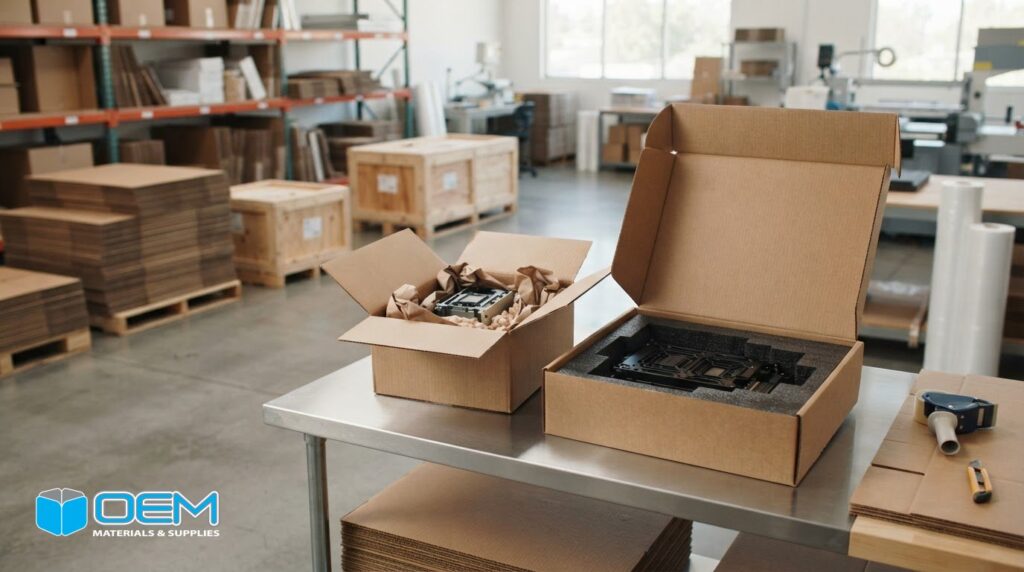
After searching for Uline custom boxes, compare catalog sizes with a box designed around your product. Consider order quantity, storage, shipping, local support, and quote details. A Uline alternative for custom boxes in Southern California may fit better when standard dimensions leave excess space, such as an eight-inch product in a ten-inch box. The best option depends on how packaging fit affects your operation.
Catalog boxes make sense when their inside dimensions protect the product and suit your packing process. Otherwise, excess space can complicate cushioning and packing. The decision is less about choosing a supplier by name and more about matching the box to your product and inventory needs.
This comparison explains catalog and custom options, how order volume and storage factor in, and what to include in a quote request. It also covers how shipping needs and local support can shape your next step. Use product dimensions, weight, and expected usage to assess the trade-offs.
Key Takeaways
- Compare catalog and custom boxes against product fit, packing workflow, and protection needs before choosing an option.
- Balance order quantities with available storage and expected usage to avoid tying up space in excess packaging inventory.
- Consider how Southern California support and shipping requirements affect replenishment and day-to-day operations.
- Prepare product and shipping details for a quote so packaging recommendations reflect the job, not just the box dimensions.
- See where corrugated boxes and related packaging options from OEM Materials & Supplies fit into your next purchasing decision.
Choosing between catalog purchases and custom packaging
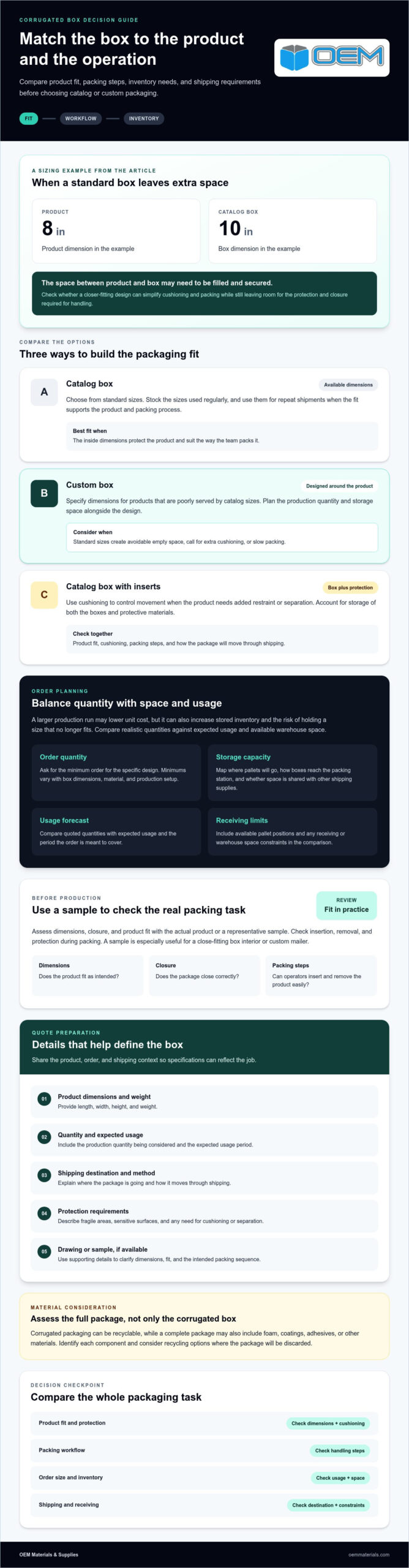
A catalog box is practical when its inside dimensions protect the product and suit your packing process. Consider a custom design when standard sizes create avoidable empty space, require extra cushioning, or slow packing. For example, an eight-inch product in a ten-inch box leaves space that may need to be filled and secured.
Compare the full packaging task, not just the box. Check product dimensions, weight, fragility, how workers pack it, and how it moves through shipping. Custom-engineered corrugated boxes can match a product’s footprint, while foam packaging or cushioning materials can help protect sensitive surfaces. A corrugated box design should account for the product and the handling steps it faces.
| Option | Product fit | Quantity and storage | Best use |
|---|---|---|---|
| Catalog box | Choose from available dimensions | Stock the sizes used regularly | Repeat shipments that fit standard sizes |
| Custom box | Dimensions designed around the product | Plan production quantity and storage space | Products poorly served by catalog sizes |
| Catalog box with inserts | Use cushioning to control movement | Store boxes and protective materials | Products needing added restraint or separation |
Choose an option that fits the product, packing steps, storage capacity, and shipping method. If a custom box reduces empty space, confirm that it still leaves room for the cushioning and closure needed for safe handling. The right dimensions can also make packing more consistent for operators.
For a custom packaging quote, provide the product’s length, width, height, and weight, along with the quantity and shipping destination. Include a drawing or sample if available, and describe fragile areas or surfaces that need protection. These details help define the dimensions, material, and protective components before production.
Branded packaging can display a company name, logo, or other artwork and shape a customer’s first impression of a shipment. Keep the unboxing sequence functional: specify where the product sits, how it is removed, and where printed elements should appear. Reviewing a sample helps teams assess fit, presentation, and packing steps before a larger order.
Are sustainable or recyclable custom packaging options available from Southern California suppliers? Corrugated packaging can be recyclable, while the full package may also include foam, coatings, adhesives, or other materials. Identify each component and consider the recycling options where the package will be discarded. Buyers seeking a Uline alternative for custom boxes in Southern California can compare materials and fit alongside quantity, storage, and shipping needs.
How should quantity and storage enter the comparison?
Order size affects production planning, inventory exposure, and warehouse space. Compare your expected usage with available space before committing to a custom run.
Physical Samples and Minimum Orders
A physical sample lets your team assess dimensions, closure, and product fit before ordering production quantities. Use the actual product or a representative sample to check insertion, removal, and protection during packing. This is especially useful for a custom mailer or a close-fitting box interior.
Minimum order quantities vary with box dimensions, material, and production setup. Ask for the minimum for the specific design, then compare it with expected usage and storage capacity. A forum contributor researching this topic described ordering enough boxes to fill one or two pallets. That example shows how pallet space can shape a practical order size.
Minimum Orders and Volume Pricing
Minimum order quantity is the smallest production run, while volume pricing shows how the unit cost changes across order quantities. Compare the options with your usage rate, not just the per-box price. A larger run may lower unit cost but increase stored inventory and the risk of holding a generic size that no longer fits the product.
For a useful comparison, request quotes at quantities your operation can realistically receive and store. Include the expected usage period, available pallet positions, and any receiving or warehouse space limits. Keep dimensions and material consistent across options so the quantity comparison is meaningful.
What are the minimum order quantities for custom boxes from local Southern California suppliers? They vary by design, dimensions, material, and production setup. The practical minimum is the quoted run size that matches the box specification and your operation’s storage capacity.
How long do custom box quotes, samples, and production take from Southern California suppliers? Timing depends on how complete the specifications are, sample review, design changes, and production scheduling. Provide final dimensions and approve the sample promptly to keep the process moving.
Before committing, map the order from receiving to use. Confirm where pallets will go, how boxes will reach the packing station, and whether storage space is shared with other shipping supplies. If a catalog size already fits, smaller replenishment orders may be easier to manage than storing a custom run.
For custom corrugated boxes, compare quoted quantities with your forecast and warehouse plan. Before requesting options, prepare product dimensions, weight, expected usage, and receiving constraints. This gives the supplier a clearer basis for discussing sample requirements and production quantities.
Local Southern California support and nationwide shipping
Southern California businesses can compare regional corrugated converters and packaging distributors as alternatives to catalog ordering. Orange County, Los Angeles County, the Inland Empire, and San Diego County each have distinct delivery routes and warehouse locations to consider.
For custom sizes, printing, and short production runs, compare suppliers using the capabilities stated in their quotes. Provide dimensions, print requirements, order quantity, and delivery destination to see whether each proposal suits your operation. Assess each supplier against those requirements rather than relying on a regional label.
Local support matters when packaging changes affect a production line or warehouse workflow. A revised insert, for example, may change how a product is loaded, protected, or removed. Share a sample or drawing, explain the packing sequence, and identify the problem the change should solve. Clear details help the packaging team evaluate the design instead of treating it as a generic box request.
Compare ordering and delivery as part of the same decision. A supplier serving Los Angeles may be convenient for one warehouse, while a destination in San Diego changes the route and receiving plan. For nationwide shipments, consider how the packaging performs throughout the carrier journey, not only during local delivery. Product dimensions, weight, handling needs, and destination all inform packaging choices.
Shipping supplies also affect replenishment. A warehouse receiving boxes in bulk needs room for pallets and a clear process for moving supplies to packing stations. Smaller, repeated deliveries may require more time to receive and organize. Map the receiving process, storage location, and point of use before comparing delivery arrangements.
Proximity alone doesn’t settle the comparison. Review the quote for box dimensions, material, printing, quantity, and inserts, then compare those details with the product and packing steps at each facility. Warehouse constraints, such as limited receiving hours or space near the packing line, may also affect the best delivery plan.
For a practical comparison, use the same specification sheet for every supplier. Include product dimensions, weight, protective inserts, print file or artwork requirements, quantity, and delivery locations. Ask each supplier to quote the same configuration. This makes differences easier to identify and prevents a low quote from representing a different box or scope of service.
Local support in Orange County, Los Angeles, Riverside, and San Diego can help teams coordinate samples, design revisions, or replenishment. Nationwide shipping matters when products leave the region or packaging must reach multiple facilities. Compare both needs with the warehouse’s receiving process and each shipment’s protection requirements.
Custom box pricing and quoting
Custom box pricing depends on the project and is provided after a quote request. Key factors include dimensions, material, quantity, printing, product weight, protective components, and shipping requirements.
To get a custom box quote from a Southern California manufacturer, send a drawing or sample, product dimensions, weight, requested quantity, and delivery destination. Include print files or artwork requirements, along with any insert or closure details. These inputs help define a consistent scope for each option.
Compare quotes line by line. A plain corrugated box is not equivalent to one with printing, inserts, or a different material specification. Record box style, inside dimensions, material, print coverage, quantity, and delivery terms on one comparison sheet. This gives purchasing teams a consistent basis for evaluating proposals.
Quantity affects the quote because production setup and material use vary with the order. Request pricing for quantities your operation can receive and store, rather than comparing an impractical volume with a smaller buying plan. For example, a warehouse with limited pallet space may prefer repeat orders to storing a larger run. Compare total requirements and storage impact, not only the unit price.
Weight and shipping requirements also shape the design. A lightweight product may need less restraint inside the box than a heavy component that can shift during handling. Share the product’s actual weight, how it is packed, and whether it ships individually or with other items. For fragile equipment, identify sensitive surfaces and areas that need support. These details guide the box and protective packaging specification.
Retail presentation can add requirements beyond those of industrial transit packaging. If customers see the package, describe the intended unboxing sequence, printed information, and how the product should sit inside. A production box may prioritize efficient packing and protection, while a retail package may also require a defined presentation. State these requirements clearly in the quote request.
Use these steps to compare proposals:
- Set one box specification with dimensions, material, and print requirements.
- Request matching quantities and delivery destinations from each supplier.
- Separate box costs from inserts or other custom packaging components.
- Review sample fit and packing steps before approving production.
Suppliers can assess options more accurately when a quote includes the product, packing process, and shipping destination. A component shipped individually, for example, may need a different configuration from the same component packed inside a larger assembly. Share changes to dimensions or artwork before production begins, since revisions can affect the specification and quoted scope.
A clear quote gives procurement and operations teams a defined basis for purchasing. Compare each proposal against the same product details, quantity, and delivery plan, then select the configuration that supports protection, packing efficiency, and storage needs.
Information to include in a custom box quote
A quote package should identify the exact product version and packaging revision under review. Assign a part number or clear internal label, then state which drawing revision governs the request. This helps suppliers, engineers, and buyers avoid discussing different versions of the same component. If the product changes after approval, record the change before requesting revised pricing or production.
Define how measurements are referenced. State whether box dimensions are inside or outside measurements, and identify the units used on drawings. For an irregular component, mark its orientation and show which face points upward during packing. An annotated drawing can clarify details photographs may hide, such as recessed areas, protrusions, or surfaces that must not contact the box.
Describe the packing sequence as an operator would perform it. Note whether the product enters vertically, needs a protective sleeve, or must be secured before the box closes. For example, a finished panel may need a designated face protected from abrasion. This process description gives engineering and purchasing a shared basis for evaluating the package without relying on assumptions.
Separate mandatory requirements from preferences. A handling instruction or required identification label may be essential, while a preferred opening style may allow alternatives. Identify any documents that must travel with the shipment, such as an assembly identifier or packing list. Clear priorities help the design address operational needs first and keep optional choices visible.
Ask for the written proposal to identify its scope and revision. It should match the referenced drawing and state which components or services it includes. Keep earlier proposals on file with their revision labels so an updated design is not confused with an obsolete version. This record is useful when engineering, procurement, and production review the same request at different times.
Before approval, share the specification with the people who will use it. Engineering can check product orientation and protection requirements. Warehouse staff can review the packing sequence and handling instructions. Procurement can confirm that the proposal matches the approved revision. Document requested changes in one controlled version rather than separate email comments.
A clear specification makes the quote useful beyond the initial purchase. It gives receiving, production, and fulfillment teams a common reference when the packaging is reordered or introduced at another facility. To start that process, submit your packaging requirements with the relevant drawing or specification revision.
OEM Materials & Supplies: Corrugated Boxes
OEM Materials & Supplies is a practical next step when catalog dimensions, protection, or packing workflow don’t fit your operation. Its corrugated boxes address the core shipping container, while foam packaging, cushioning materials, and packaging kits can support broader protection needs.
Bring product dimensions, weight, expected quantity, and shipping destination to the discussion. For example, a component that shifts inside a standard box may need a different configuration or added cushioning. These details frame the packaging requirement around the product and how your team handles it.
Contact OEM Materials & Supplies to discuss your box requirements and next steps.
Set the next packaging decision in motion
After choosing a packaging direction, make it part of your operating procedure. Assign someone to maintain the approved specification, and define what triggers a review, such as a product redesign or a change in packing workflow. This gives future purchasing decisions a clear starting point.
OEM Materials & Supplies can support your team as it moves from comparison to implementation. A consistent handoff between purchasing, engineering, and operations helps keep the selected approach aligned with production needs.
Bring your team’s priorities to the conversation and identify the outcome you want the packaging to support. Contact OEM Materials & Supplies to discuss a practical next step.
Frequently Asked Questions
What is the next action after a Uline custom boxes search?
Identify the shipment or production issue behind the search, then choose a product for an operational trial. Have an operator pack it using the proposed design and record any loading difficulty, handling concern, or damage after normal transit. Ask engineering and warehouse staff to review the trial together. Their feedback can help determine whether to approve the design, revise it, or keep the current packaging.
How can a custom-box alternative keep the comparison honest?
Set acceptance criteria before reviewing proposals, such as packing without product interference and clear access to required labels. Ask reviewers to record whether each proposal meets those criteria instead of relying on general impressions. Keep the approved design and revision accessible to purchasing, engineering, and operations. Record any assumptions or exclusions separately so they don’t become unintended requirements.
Which Southern California custom box suppliers deliver to Los Angeles, Orange County, San Diego, and the Inland Empire?
OEM Materials & Supplies serves manufacturers in Los Angeles County, Orange County, San Diego County, and Riverside in the Inland Empire, as well as customers across the United States. For organizations with facilities in multiple regions, document which site will use each packaging configuration. This connects packaging instructions to the correct product and operating location.
What box materials, strength ratings, and printing options do local custom box suppliers offer?
OEM Materials & Supplies offers single-wall, double-wall, and triple-wall corrugated boxes, as well as weather-resistant W5C / V3C boxes. Custom printing is available in up to four colors, inside or outside. To assess a construction, describe how the package is handled and stored, and what the product requires during shipment. Printing requirements can include branding or information operators need to identify the contents.
What should I compare when choosing a local box supplier versus Uline?
Compare how each supplier handles design changes and repeat orders, not just the initial purchase. Review how an approved configuration is documented and how revised artwork or product updates are incorporated into future orders. An engineering change that alters a component, for example, may require packaging review before production resumes. Clear revision control helps prevent outdated instructions from reaching the packing floor.
How long do custom box quotes, samples, and production take from Southern California suppliers?
Timing depends on how complete the specifications are, sample review, design changes, and production scheduling. Providing final dimensions and approving the sample promptly can keep the process moving.