
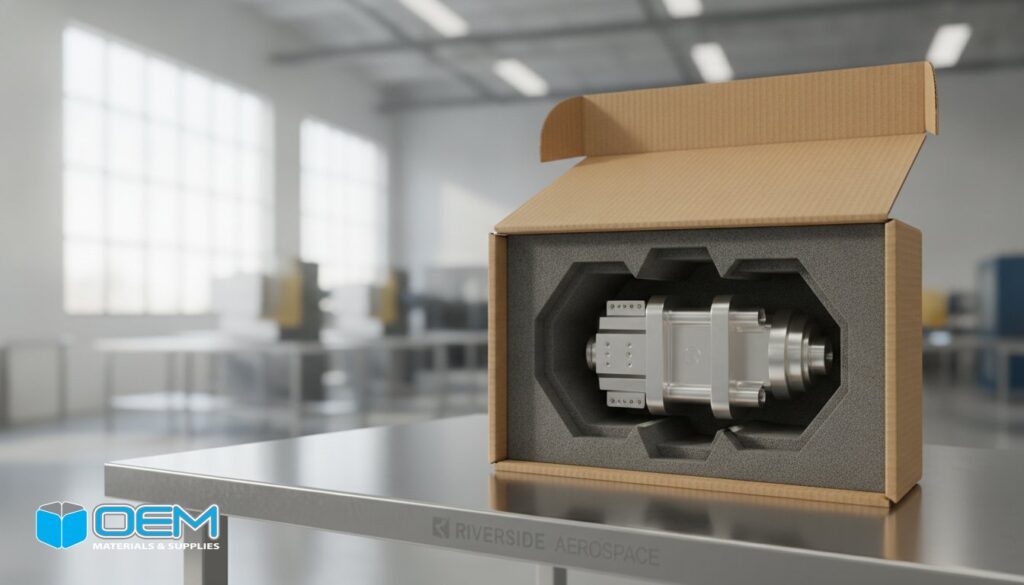
With polyurethane resin prices spiking by nearly 9% in a single week during the first quarter of 2026, Riverside manufacturers face an environment where packaging waste is a direct threat to the bottom line. Procurement professionals can no longer rely on guesswork when securing high-value shipments. Sourcing the right custom foam inserts riverside is now a critical requirement for any operation looking to mitigate the logistical pressures of the Inland Empire. You likely already know that standard cushioning often fails to protect sensitive aerospace components or medical devices during the heavy vibration and frequent handling typical of Southern California freight corridors.
Product damage during truck transit leads to expensive returns and stalled production cycles. This guide provides the technical framework you need to select the ideal foam densities and fabrication methods to achieve zero-damage shipping results. You will learn how to evaluate material performance, compare precision fabrication techniques like CNC routing and die-cutting, and leverage vendor-managed inventory (VMI) to eliminate packaging stockouts. By the end of this article, you will have a clear roadmap for streamlining your assembly line integration with a reliable local partner that understands the specific demands of your industry.
Key Takeaways
- Identify the specific foam densities required to protect sensitive aerospace and electronic components from the high-vibration environment of Inland Empire trucking routes.
- Evaluate the cost-to-precision ratio of different fabrication methods, including CNC routing for complex geometries and die-cutting for high-volume production runs.
- Reduce logistical overhead and transit times by sourcing custom foam inserts riverside from a local partner capable of providing rapid prototyping and just-in-time delivery.
- Streamline your packaging process by integrating engineered foam with custom corrugated boxes and kitting services to minimize manual labor on the assembly line.
- Maintain operational continuity through Vendor Managed Inventory (VMI) programs that prevent packaging stockouts and stabilize supply chain costs.
The Role of Custom Foam Inserts for Riverside Manufacturers
Custom foam inserts are precision-engineered interior packaging components designed to secure products within a container by providing a tailored fit that prevents movement. For manufacturers in Riverside, these inserts serve as the primary defense against shock and vibration throughout the industrial logistics chain. Selecting high-quality custom foam inserts riverside ensures your products survive the rigors of local transport without the mess of generic filler. Unlike commodity packaging, engineered solutions eliminate the variability and mess associated with loose-fill package cushioning materials like packing peanuts or crumpled paper. Every insert is designed to meet specific G-force requirements, ensuring that your product arrives in the same condition it left the facility.
Protecting High-Value Assets in the Inland Empire
The Riverside and San Bernardino corridor presents unique logistical challenges. High truck traffic and frequent stops across the Inland Empire increase the risk of vibration-induced damage for sensitive aerospace components and medical instrumentation. Standard packaging often fails to mitigate these repetitive stresses. By utilizing custom foam inserts riverside companies can ensure that delicate automotive parts and electronics remain stationary regardless of road conditions. This precision fit also allows for a reduction in overall box dimensions. When you optimize the internal footprint, you reduce the volume of corrugated boxes required, which directly lowers dimensional weight shipping costs. This is particularly valuable for high-volume manufacturers where even a small reduction in box size yields significant annual freight savings.
Improving Assembly Line Efficiency
Operational efficiency is just as critical as product protection. Manual packing with generic materials is slow and prone to human error. We provide foam packaging solutions that are often pre-assembled or designed for rapid kitting. This approach dramatically reduces labor time on the factory floor by standardizing the packing procedure for multi-component kits. Instead of technicians spending minutes wrapping individual parts, they simply place the items into pre-defined cavities.
Standardization ensures that every technician follows the same high-quality protocol, regardless of experience level. For manufacturers managing complex tool sets or high-part-count assemblies, we design shadow boards. These specialized inserts provide:
- Immediate visual inventory control for missing parts
- Protection for calibrated surfaces and sharp edges
- Reduced search time for specific components during assembly
- Streamlined integration into existing assembly line workflows
By moving away from manual wrapping toward engineered inserts, Riverside operations can scale their output without a proportional increase in packaging labor costs. This transition allows your team to focus on production rather than packaging logistics.
Material Selection: Choosing the Right Foam Density
Selecting the correct material is the most critical step in engineering protective packaging. It’s not simply about picking a soft cushion; it’s about the physics of energy absorption and weight distribution. When specifying custom foam inserts riverside engineers must balance the product’s fragility with the material’s load-bearing capacity. The wrong density can lead to a “bottoming out” effect, where the foam compresses completely during an impact, transferring the full force of the shock directly to your component. We utilize foam packaging solutions that are specifically calibrated to the static load of your product.
The industry continues to see significant advancements in foam manufacturing, particularly in the development of chemical compositions that enhance durability while meeting modern environmental standards. For Riverside procurement teams, this means access to materials that offer better protection with less bulk, helping to manage both material costs and warehouse space.
Polyethylene vs. Polyurethane Applications
Polyethylene (PE) foam is a high-density, closed-cell material. It’s the industrial workhorse for heavy or sharp-edged components. Its closed-cell structure makes it naturally resistant to moisture, chemicals, and grease, which is vital for automotive and machinery parts that may have residual oils. PE foam won’t crumble or lose its shape under significant weight, making it the preferred choice for long-term shipping cycles.
Polyurethane (PU) foam is an open-cell material that’s much softer to the touch. It’s best suited for lightweight or highly fragile items that require a high degree of vibration dampening. Because PU foam is more flexible, it’s ideal for scratch-sensitive surfaces and delicate electronics. For medical-grade applications or cleanroom environments, we often recommend cross-linked polyethylene (XLPE). This material is non-abrasive and has a fine cell structure that doesn’t shed particles, ensuring your equipment remains sterile and contaminant-free.
Specialty Foams for Industrial Compliance
Riverside electronics manufacturers must prioritize ESD (Electrostatic Discharge) foam. This material is mandatory to prevent static damage during handling and transit, especially for sensitive circuit boards and sensors. For aerospace and military applications, we provide flame-retardant foam options that meet strict safety protocols and industry-specific fire ratings.
With California’s SB 54 regulations now in effect as of May 2026, many manufacturers are also evaluating sustainable foam alternatives. These materials help producers meet the initial 10% weight reduction target required by January 1, 2027, without compromising the safety of the cargo. If you’re unsure which density fits your product weight, our team can help you analyze your dimensions and requirements for a technical recommendation.
Fabrication Methods for Custom Foam Packaging
Fabrication decisions are driven by three primary variables: production volume, part complexity, and the available tooling budget. For industrial buyers sourcing custom foam inserts riverside, understanding these technical processes ensures you don’t overpay for unnecessary tooling or sacrifice precision on complex geometries. Each method offers distinct advantages depending on whether you’re shipping a single high-value sensor or thousands of automotive components. Choosing the right fabrication path directly impacts both the lead time and the total landed cost of your protective packaging.
CNC routing is a subtractive process that offers high precision for intricate geometries without the need for physical dies. Because it uses computer-controlled bits to carve the foam, it’s the ideal choice for low-to-medium volume runs where the cost of a custom die isn’t justified. For high-volume production, die-cutting remains the most efficient method. It utilizes a steel rule die to stamp shapes out of foam sheets. This provides excellent consistency and a lower per-unit cost once the initial tooling investment is recovered. Water-jet cutting provides another technical alternative, using a high-pressure stream of water to slice through material. This method provides exceptionally clean edges on thick foam blocks and eliminates the risk of heat deformation.
When selecting a fabrication partner, it’s vital to verify their adherence to national environmental and safety standards. These regulations govern the emission of hazardous air pollutants during the production and fabrication of flexible polyurethane foam. Ensuring your supplier follows these guidelines protects your company from secondary supply chain risks and aligns with modern corporate sustainability goals. It’s a hallmark of a professional operation that prioritizes long-term reliability over cutting corners.
Prototyping and Short-Run Production
Rapid prototyping allows engineering teams to verify the fit and function of an insert before committing to a full production run. For specialized Riverside machinery manufacturers, low-volume solutions are often the most practical route. Using CAD design ensures repeatable accuracy across different production batches. This digital-first approach means that an insert produced today will have the exact same tolerances as one produced six months from now. It eliminates the guesswork often found in manual fabrication methods. Fit verification is essential.
High-Volume Manufacturing and Tooling
When scaling to high-volume industrial programs, evaluating the return on investment for custom steel rule dies is essential. Automated fabrication processes significantly lower the per-unit cost of foam packaging. This level of automation guarantees that tolerances remain consistent across thousands of units of custom foam inserts riverside. Consistency is critical for assembly line integration. Even a small deviation in cavity size can lead to stalled packing lines or insecure products during transit. High-volume tooling provides the speed and repeatability required to support complex kitting and assembly services.
Sourcing Strategy for Riverside Industrial Buyers
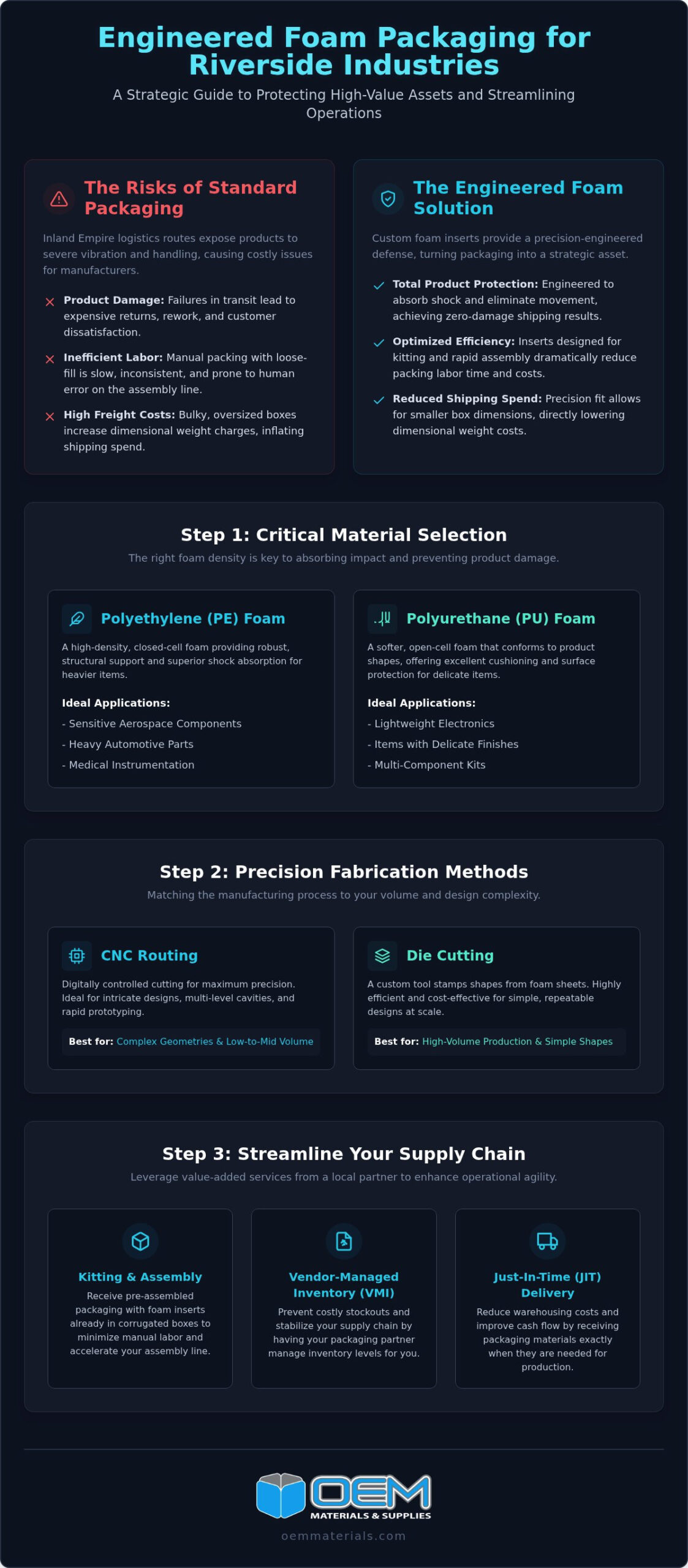
Procurement professionals in the Inland Empire must look beyond the initial price per unit. A reliable supplier should provide a unified solution by manufacturing both the foam and the corrugated boxes. This integration ensures that tolerances between the outer container and the inner cushioning are exact. When sourcing custom foam inserts riverside, always request technical data sheets that specify foam density and compression set values. These metrics are the only objective way to verify that a material will perform as promised under load. You must also verify that your partner can scale from initial prototypes to high-volume production without losing dimensional precision.
Local Logistics and Lead Times
Proximity is a functional advantage in Southern California. Sourcing from a local supplier reduces lead times and minimizes the high freight costs associated with shipping bulky foam over long distances. High-volume manufacturers in the Riverside area benefit from Just-In-Time (JIT) delivery. This allows your team to manage warehouse space more effectively by receiving packaging only when it’s needed for the assembly line. Local sourcing also reduces the carbon footprint of your supply chain, which is increasingly important for compliance with California environmental initiatives. A local partner can respond to sudden shifts in production schedules much faster than an out-of-state vendor.
Technical Support and Design Expertise
Technical depth is what separates a vendor from a partner. You should collaborate with custom packaging design experts who use 3D modeling to visualize the entire kit before fabrication begins. This visualization prevents costly errors in cavity placement and material selection. A professional supplier will test designs against ISTA standards for drop and vibration, ensuring the packaging meets rigorous industrial requirements. This data-driven approach eliminates the over-packaging that inflates costs or the under-packaging that leads to product damage. Using 3D modeling also allows for rapid adjustments to the design before any physical tooling is created, saving both time and budget.
To ensure your next production run meets these technical standards, request a quote and prototype by providing your product dimensions, weight, and annual usage requirements.
Partnering with OEM Materials for Riverside Foam Solutions
Reliability in the industrial supply chain is built on consistent performance and technical support. OEM Materials & Supplies operates as an extension of your engineering and procurement teams, providing comprehensive foam engineering and fabrication for the Southern California manufacturing sector. Our expertise in designing custom foam inserts riverside ensures that every component is matched to its outer container with mathematical precision. We don’t just act as a vendor; we provide a turnkey experience by integrating foam packaging directly with custom corrugated containers. This unified approach eliminates the risk of mismatched tolerances that often occur when sourcing materials from multiple suppliers.
Our team understands the specific pressures of the aerospace, medical, and electronics industries. We focus on solving real-world logistical problems, such as high labor costs and inventory shortages, through engineered solutions that are ready for immediate assembly line integration. By centralizing your packaging requirements with a local partner, you gain faster turnaround times and a more responsive support structure for your Riverside operations.
Vendor Managed Inventory (VMI) for Packaging
Managing inventory in a Riverside facility is a constant challenge, particularly given the competitive industrial real estate market in the Inland Empire. Our packaging VMI programs remove the administrative burden of tracking stock levels and placing manual orders. We monitor your usage and replenish supplies automatically, ensuring you never face a stockout of critical protective materials. This system optimizes your cash flow because you only pay for the packaging you actually use. By offloading inventory management to us, you can free up valuable floor space for manufacturing and core production activities.
Custom Kitting and Assembly Services
Manual packing processes are often the biggest bottleneck on the factory floor. To lower your operational overhead, we offer custom kitting and assembly services tailored to your specific workflow. Instead of receiving bulk components that require manual sorting, you receive complete packaging kits with foam inserts already placed in their respective boxes. This streamlines the pack-out process for complex medical or electronic devices, allowing your team to move products through the facility with greater speed. Standardized kitting also reduces the likelihood of packing errors, ensuring that every shipment meets your quality control standards. To facilitate an accurate recommendation for your project, please contact us with your product dimensions, weight, and annual usage requirements.
Optimizing Your Inland Empire Packaging Strategy
Engineering a successful shipping strategy requires more than just high-quality materials. It involves a technical understanding of G-force protection and a logistical plan that accounts for the specific stresses of the Inland Empire. By selecting the correct density and fabrication method for your custom foam inserts riverside, you protect your bottom line from the hidden costs of product damage and inefficient labor. Each design choice should be data-driven and matched to the physical requirements of your hardware.
OEM Materials & Supplies provides the technical expertise required to support the aerospace, medical, and electronics sectors with comprehensive design-to-delivery packaging solutions. Our local Southern California support and VMI programs ensure your facility remains lean and organized. We invite you to contact OEM Materials & Supplies for a custom foam quote to see how an engineered approach can stabilize your supply chain. Please provide your product dimensions, weight, and annual usage requirements so our engineers can develop a recommendation tailored to your specific application. We look forward to helping you achieve zero-damage shipping results.
Frequently Asked Questions
What is the best foam for heavy industrial parts in Riverside?
Polyethylene (PE) foam is the industry standard for securing heavy or sharp-edged industrial components. Its closed-cell structure provides superior load-bearing capacity and prevents the bottoming out effect during impact. This material is also resistant to chemicals and moisture, making it ideal for automotive parts that might have residual oils. When engineering custom foam inserts riverside, we recommend higher density PE for heavy machinery to ensure long-term durability throughout the Inland Empire logistics corridor.
Can I get custom foam inserts for low-volume production runs?
Yes, low-volume production is highly feasible through CNC routing. This fabrication method uses computer-controlled bits to carve shapes directly from foam blocks, eliminating the need for expensive steel rule dies or tooling investments. It’s an ideal choice for specialized machinery manufacturers or during the prototyping phase of a project. CNC routing allows for high precision and repeatable accuracy without the high upfront costs typically associated with large-scale industrial manufacturing runs.
How do custom foam inserts help reduce shipping costs?
Custom inserts reduce shipping costs by optimizing the internal footprint of your packaging. When an insert is engineered to the exact dimensions of your product, it allows for the use of smaller corrugated boxes. This reduction in volume lowers the dimensional weight charged by freight carriers. Additionally, the precise fit eliminates the need for excessive loose-fill materials, which reduces both material waste and the overall weight of the shipment.
What information is needed to get an accurate quote for custom foam?
To provide an accurate technical recommendation and quote, we require specific data points. Please provide the physical dimensions and weight of your product, along with its estimated annual usage. Information regarding the product’s fragility and any specific environmental requirements, such as cleanroom or ESD standards, is also essential. This data allows our design team to select the appropriate foam density and fabrication method to meet your specific protection and budgetary goals.
Are there anti-static foam options for electronics packaging?
Anti-static foam, also known as ESD foam, is a mandatory requirement for Riverside electronics manufacturers. These specialty materials are treated to dissipate static charges that could otherwise damage sensitive circuit boards or sensors during transit. We offer both anti-static polyurethane and polyethylene options, often identified by their distinct pink or black coloring. These foams provide the necessary cushioning while maintaining a safe electrical environment for high-value electronic components.
How long does the design and prototyping process take for custom inserts?
The design and prototyping process is streamlined to support rapid production cycles. Once we receive your product dimensions and CAD files, our engineering team creates a 3D model to visualize the fit. Rapid prototyping then allows us to produce a physical sample for testing before you commit to a full production run. This methodical approach ensures that the final custom foam inserts riverside meet all technical specifications while minimizing delays in your manufacturing schedule.
Do you provide the corrugated boxes along with the foam inserts?
We provide a comprehensive turnkey solution that includes both the custom foam inserts and the corrugated boxes. Sourcing these components from a single partner ensures that the tolerances between the foam and the outer container are perfectly matched. This integration prevents internal movement during transit and simplifies your procurement process. We can also provide pre-assembled kits, where the foam is already placed inside the boxes, to streamline your assembly line operations.
What are the benefits of sourcing foam from a local Riverside supplier?
Sourcing from a local Riverside supplier significantly reduces lead times and freight expenses on bulky shipments. Proximity allows for value-added services like Just-In-Time delivery and Vendor Managed Inventory, which help you optimize warehouse space. Being local also means our technical team can provide faster on-site support and rapid prototyping. This local presence strengthens your supply chain by providing a responsive partner that understands the logistical demands of the Southern California region.