
A single shipment of damaged aerospace components or medical devices can cost more in lost contracts and replacement fees than an entire year of packaging supplies. You likely recognize that standard off-the-shelf solutions rarely provide the precision required for high-value industrial goods. In the busy manufacturing hubs of Southern California, logistics managers often struggle with inconsistent lead times and excessive warehouse clutter caused by bulky, inefficient materials. Finding reliable custom foam packaging in Los Angeles is about more than just buying a cushion; it’s about integrating an engineered solution into your supply chain.
This guide provides the technical specifications and material insights needed to achieve zero-damage shipping while reducing your total pack times. We’ll examine how to select the right polyethylene or polyurethane densities, navigate the 2026 SB 54 plastic reduction mandates, and leverage just-in-time delivery to optimize your local production lines. By focusing on precision design and local logistics, you can transform your packaging from a cost center into a strategic operational advantage.
Key Takeaways
- Identify the mechanical differences between Polyethylene and Polyurethane to match cushioning density with your product’s specific load-bearing requirements.
- Utilize CAD-driven prototyping and CNC routing to ensure precision fitment for complex aerospace and medical components, eliminating the risks of manual cutting errors.
- Strengthen your supply chain by sourcing custom foam packaging los angeles from local partners who provide Vendor-Managed Inventory to prevent production line shutdowns.
- Lower operational overhead by integrating kitting and assembly services, which reduces the labor hours required for complex multi-part packaging.
- Prepare for 2026 California packaging mandates by selecting engineered foam materials that meet new plastic reduction targets without compromising product safety.
The Role of Custom Foam Packaging in Industrial Manufacturing
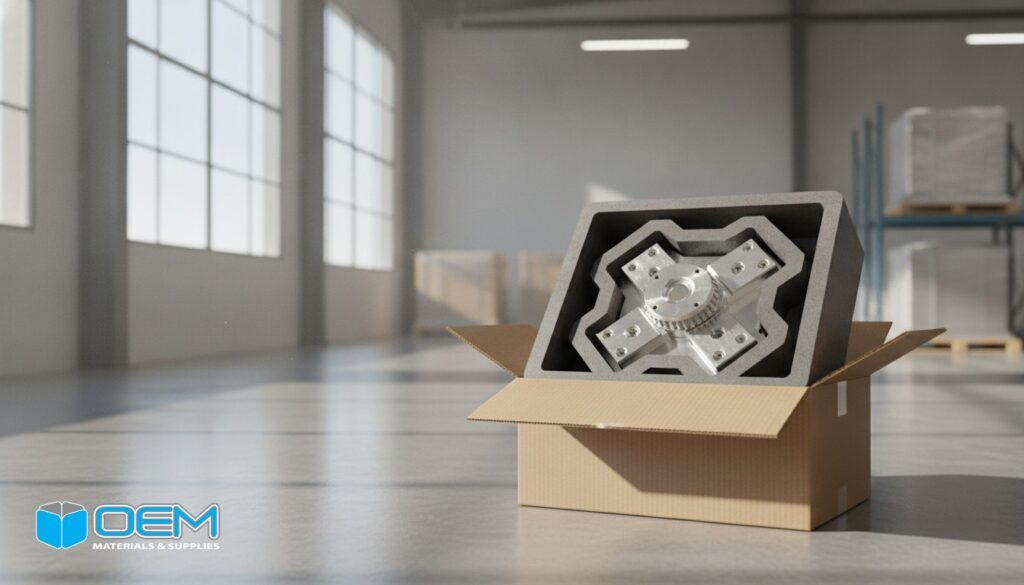
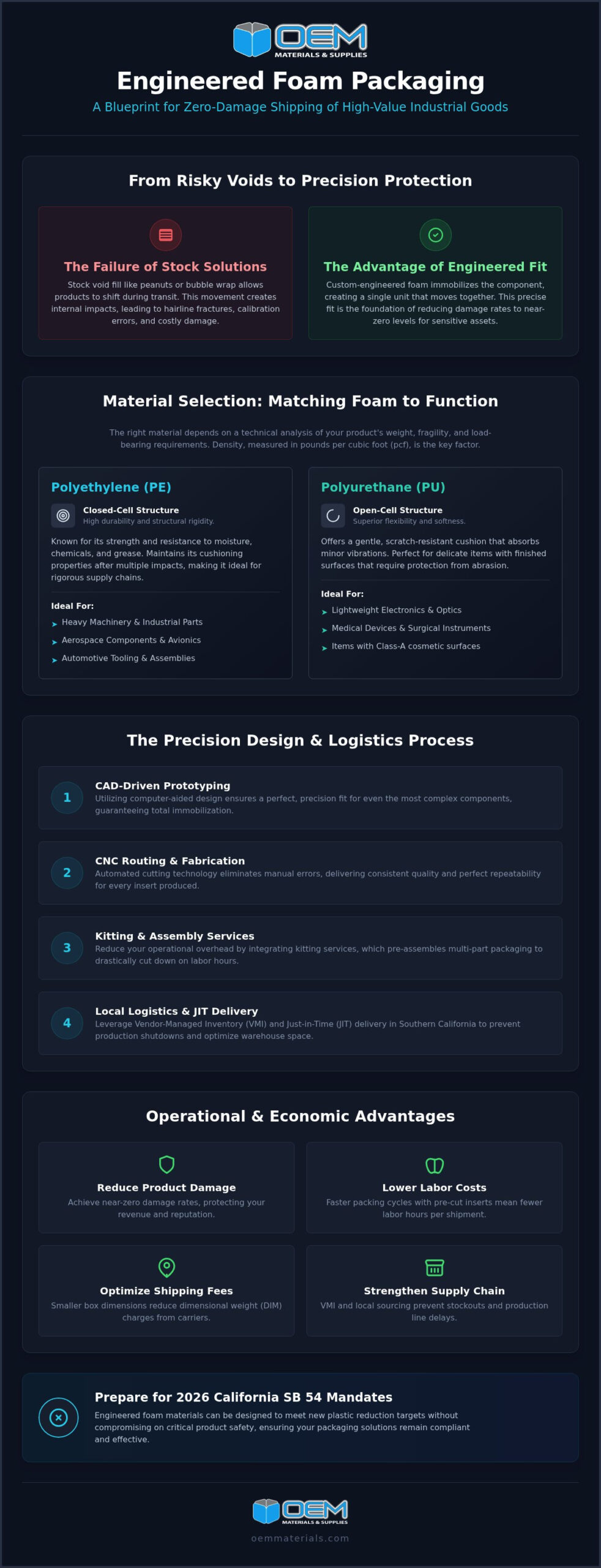
Stock packaging often fails because it assumes a “one size fits all” approach to protection. For industrial components with high mass or complex geometries, stock void fill like bubble wrap or packing peanuts allows for shifting during transit. This shifting creates internal impact forces that can lead to hairline fractures or calibration errors. Custom-engineered foam provides a precise fit that immobilizes the product, ensuring that the package and the product move as a single unit. This integration is the foundation of reducing damage rates to near-zero levels.
Selecting the right Package cushioning materials depends on the fragility and weight of the item. In the Southern California manufacturing corridor, choosing custom foam packaging los angeles allows engineers to work directly with designers to match foam density to the specific G-force rating of their product. Beyond protection, these custom inserts transform the packing station. Instead of workers spending minutes wrapping items in multiple layers of film, they simply drop the component into a pre-cut cavity. This speeds up the kitting process and ensures every box is packed with consistent quality regardless of the operator’s experience level.
Protecting Sensitive Assets in Aerospace and Medical Sectors
Aerospace components often face extreme vibration and multi-axis shock during international shipping or drayage from the Ports of Los Angeles and Long Beach. Custom polyethylene inserts provide the structural rigidity needed to support heavy turbine parts or sensitive avionics. In the medical sector, precision is mandatory. Packaging for surgical instruments or diagnostic equipment must account for both cleanliness and a secure fit to prevent abrasion against the device surface. Custom foam ensures these high-stakes assets arrive within the exact tolerances required by end-users.
Economic Benefits of Engineered Packaging Solutions
While custom solutions may have a higher initial design cost, the long-term operational savings are substantial. Optimized foam packaging designs allow for smaller box dimensions, which directly lowers dimensional weight (DIM) charges from carriers. When you reduce the overall footprint of the shipper, you also maximize pallet density and warehouse space usage. The reduction in product returns and insurance claims provides a predictable boost to the bottom line. Manufacturers often find that the labor savings from faster packing cycles alone justify the transition from stock materials to custom-engineered inserts. These results depend on specific variables like product dimensions and material density, but the efficiency gains are consistent across high-volume production lines.
Material Selection: Polyethylene vs. Polyurethane
Selecting the right material for custom foam packaging los angeles involves more than just picking a soft surface. It requires a technical analysis of foam density, which is measured in pounds per cubic foot (pcf). Density directly dictates load-bearing capacity; higher density foams provide the compressive strength needed to support heavy components without bottoming out during transit. Conversely, lower density foams offer the deceleration needed to protect lightweight, fragile items from shock. Engineers must balance these physical properties against the fragility of the product to ensure the packaging doesn’t fail under the stresses of the supply chain.
Polyethylene (PE) for Heavy Industrial Loads
Polyethylene is a closed-cell foam known for its high durability and structural rigidity. Because the cells are sealed, PE is naturally resistant to moisture, chemicals, and grease. This makes it the standard choice for heavy machinery, automotive parts, and aerospace tooling that may be stored in non-climate-controlled environments. Materials like Ethafoam and Stratocell are frequently used because they maintain their physical properties even after multiple impacts. This reliability is vital within Southern California’s goods movement system, where packages undergo frequent handling at regional distribution centers and ports.
Polyurethane (PU) for Fragile Instrumentation
Polyurethane is an open-cell foam that offers superior flexibility and a soft touch. It’s often used for lightweight electronics, medical optics, and items with finished surfaces that are prone to scratching. Unlike PE, PU provides a gentle cushion that absorbs minor vibrations. However, its open-cell structure acts like a sponge. It can absorb moisture and degrade if it’s exposed to outdoor environments or high-humidity storage for extended periods. For these reasons, PU is best suited for secondary packaging or cleanroom applications where moisture isn’t a primary concern.
Specialty applications often require advanced formulations. Anti-static (ESD) foams are treated to dissipate electrical charges, protecting sensitive circuit boards from static discharge. Cross-linked polyethylene (XLPE) offers a finer cell structure and even greater chemical resistance, making it ideal for medical devices or Class A surface protection. Choosing the wrong material can lead to product failure or unnecessary material costs. If you need help determining the right density for your specific dimensions and weights, you can speak with an engineer to review your requirements. We focus on matching the material to the exact G-force tolerances of your equipment to prevent over-packaging or under-protection.
The Custom Design and Prototyping Process
The engineering of industrial packaging begins with a comprehensive technical assessment. We evaluate the center of gravity, surface sensitivity, and the specific fragility rating (G-factor) of your component. For procurement professionals and engineers sourcing custom foam packaging los angeles, this initial phase is essential to prevent over-engineering, which increases material waste, or under-protecting, which leads to costly transit damage. We focus on the physical realities of your product rather than just its dimensions.
After defining these parameters, our designers create CAD templates. This digital modeling allows for the creation of precise cavities that account for every connector and protrusion on a medical device or aerospace assembly. Digital design ensures that the final physical insert provides maximum surface contact to distribute weight evenly while maintaining necessary clearances for delicate parts. This level of precision is what separates an engineered solution from a generic cushion.
From CAD Design to Physical Insert
Converting a digital design into a physical component involves choosing between die-cutting and CNC routing. Die-cutting provides high-speed production for large volumes with consistent shapes. CNC routing is preferred for complex, three-dimensional geometries or when rapid prototyping is required without the lead time of custom tooling. These inserts are designed to fit perfectly within custom corrugated boxes, creating a unified protective system. This integration ensures that the outer container and the internal foam work in tandem to dissipate energy from external shocks during transit.
Validating the Packaging Design
Validation is the most critical step before moving to high-volume production. We use physical prototypes to conduct drop tests that simulate the rigors of the Southern California logistics network. A frequent issue in industrial applications is “bottoming out,” where the foam density is too low to stop the product’s momentum before it impacts the box wall. By testing different foam densities during the prototype phase, we can optimize the design for the specific weight of the product. In complex kitting scenarios, we often use additional cushioning materials to protect smaller accessories within the same master shipper. This iterative testing phase eliminates guesswork and ensures that your high-value assets are protected by a validated, engineered solution.
Optimizing the SoCal Supply Chain with Local Logistics
Local logistics are the backbone of a resilient Southern California manufacturing operation. When sourcing custom foam packaging los angeles, the physical distance between your production line and your supplier’s warehouse directly impacts your operational agility. Bulky foam inserts are expensive to transport over long distances because you’re essentially paying to ship air. By partnering with a local supplier, you eliminate high freight costs and the risk of transcontinental shipping delays. This proximity allows for a more integrated relationship where packaging becomes a seamless extension of your assembly line rather than a logistical hurdle.
Implementing VMI for Packaging Supplies
For high-volume manufacturers, inventory management is a constant balancing act between avoiding stockouts and minimizing warehouse clutter. Our Vendor-Managed Inventory (VMI) programs solve this by shifting the burden of stock monitoring to the supplier. We use real-time tracking and established replenishment protocols to ensure you never run out of critical foam inserts or corrugated boxes. This system eliminates the need for large safety stocks. It frees up valuable square footage on your warehouse floor for revenue-generating production equipment and reduces the administrative burden on your procurement team.
Local Service Areas: Los Angeles to San Diego
The Southern California industrial landscape consists of specialized clusters that require high levels of responsiveness. Aerospace hubs in El Segundo and Long Beach often require rapid prototyping and immediate delivery to meet tight maintenance or launch schedules. Similarly, medical device manufacturers in Irvine and San Diego rely on precise, cleanroom-ready packaging delivered on a Just-In-Time (JIT) basis. Our local delivery network covers these areas, as well as the manufacturing centers in Riverside and Orange County. This regional focus allows us to offer next-day delivery on established stock items, providing a level of reliability that national vendors can’t match.
Beyond simple delivery, we help reduce operational overhead by offering kitting and assembly services. We can pre-assemble foam inserts into custom boxes and include other necessary components like stretch film or edge protectors before they reach your facility. This reduces the number of touches required by your warehouse staff and streamlines the entire packing process. If you’re looking to optimize your local logistics and reduce packaging-related labor, contact us for a supply chain consultation. We’ll review your current usage and delivery requirements to build a program that supports your lean manufacturing goals.
Selecting a Custom Foam Packaging Partner in Los Angeles
Choosing a vendor for custom foam packaging los angeles requires a distinction between a simple material distributor and a dedicated solutions partner. A distributor fulfills orders based on your existing specifications but rarely offers the engineering support needed to optimize a design. A solutions partner evaluates the entire lifecycle of your product. This includes the mechanical stresses of transit and the physical constraints of your assembly line. Technical expertise is the difference between a package that simply fits and one that is engineered to survive a six-foot drop onto concrete.
Operational efficiency is often tied to the breadth of your supplier’s catalog. Managing multiple vendors for pallets, crates, and foam inserts creates administrative friction and increases the risk of mismatched components. Partnering with a supplier that provides a comprehensive range of industrial packaging allows for better integration. When your foam inserts are designed alongside the outer crate and the pallet footprint, you ensure maximum structural integrity and dimensional efficiency. Transparency regarding material sourcing and realistic lead times is the final pillar of a reliable partnership, particularly as global raw material prices fluctuate.
Questions to Ask Your Packaging Supplier
- Do you offer in-house CAD design and rapid prototyping to validate fit and function before production?
- Can you manage my inventory levels through a VMI program to prevent production shutdowns?
- What is your specific experience with custom foam packaging for high-value aerospace or medical components?
- Do you provide kitting and assembly services to reduce my internal labor costs?
The OEM Materials & Supplies Advantage
OEM Materials & Supplies combines technical engineering with deep Southern California logistical expertise. We don’t just sell foam; we design protective systems that secure your most sensitive assets. Our full-service approach covers everything from custom packaging design to final delivery at your facility in Orange County, Los Angeles, or San Diego. We base our recommendations on factual product specifications and the rigorous demands of industrial supply chains. By positioning ourselves as a seasoned industry partner, we focus on providing the stability and precision required by the manufacturing and distribution sectors.
Securing Your Supply Chain with Engineered Protection
Precision-engineered foam is a critical component of your product’s success rather than a secondary consideration. Selecting the correct material density ensures that high-value assets in the aerospace, medical, and automotive sectors arrive intact. Local logistical integration further reduces your total operational costs by streamlining the assembly process. By transitioning to custom foam packaging los angeles, you gain access to rapid prototyping and vendor-managed inventory programs that eliminate stockouts while minimizing warehouse waste. These solutions provide the stability needed to maintain a competitive edge in the Southern California industrial market.
To optimize your packing cycles and protect your bottom line, contact OEM Materials & Supplies today for a custom foam packaging consultation and quote. Our team provides expert CAD design and reliable delivery support across Orange County, San Diego, and the Inland Empire. We’re ready to help you build a more resilient and efficient supply chain through technical expertise and dependable service.
Frequently Asked Questions
What information is needed to get a custom foam packaging quote?
To provide an accurate quote for custom foam packaging in Los Angeles, we require your product’s exact dimensions, total weight, and fragility rating. It’s also helpful to know your expected annual usage and the type of outer container, such as corrugated boxes or wood crates. Providing a CAD file or a physical sample allows our engineers to design a precise fit that balances material costs with maximum protection for your specific industrial application.
How do I choose between polyethylene and polyurethane foam for my product?
Selection depends primarily on your product’s weight and surface sensitivity. Polyethylene is a closed-cell foam ideal for heavy industrial components and automotive parts due to its high load-bearing capacity and moisture resistance. Polyurethane is an open-cell, softer foam better suited for lightweight electronics or fragile medical devices that require gentle cushioning. We analyze these variables during the design phase to ensure the material density prevents bottoming out while maintaining a compact footprint.
Can custom foam inserts be used with standard corrugated boxes?
Yes, custom foam inserts are frequently designed to fit within standard corrugated boxes to provide an immediate protective upgrade. However, pairing these inserts with custom-sized boxes often yields better results by reducing the overall dimensional weight of the shipment. This integration minimizes void space, which lowers shipping costs and prevents the internal movement that causes damage. We can design inserts for your existing stock or provide a unified box and foam solution.
What is the typical lead time for a custom foam prototype in Los Angeles?
Lead times for custom prototypes vary based on design complexity, but we prioritize rapid prototyping to support Southern California’s fast-paced manufacturing sectors. Simple designs can often be turned around quickly using CNC routing, which eliminates the need for expensive die tooling during the testing phase. Once you approve the prototype and validate the fit through drop testing, we move into production. Please contact us to discuss current timelines for your specific project requirements.
How does anti-static (ESD) foam protect sensitive electronics?
Anti-static foam is chemically treated to prevent the buildup of static electricity, which can permanently damage sensitive circuit boards and electronic instrumentation. This specialized foam dissipates electrical charges across its surface rather than allowing them to arc through your product. It’s an essential requirement for electronics manufacturers in the Inland Empire and Orange County who must meet strict ESD safety standards during the shipping and handling of high-value microchips and complex electronic assemblies.
Is it possible to integrate foam inserts into a larger kitting and assembly service?
We offer comprehensive kitting and assembly services that integrate custom foam inserts with other packaging components before they reach your facility. This process involves pre-assembling the foam into boxes and adding accessories like edge protectors or stretch film. By outsourcing these tasks, you reduce internal labor costs and streamline your production line. This is a practical solution for medical device and aerospace companies looking to optimize their packing cycles and improve warehouse throughput.
Do you provide on-site inventory management for large manufacturing facilities?
Yes, our Vendor-Managed Inventory (VMI) programs are designed to provide on-site support for large manufacturing facilities throughout Southern California. We monitor your packaging stock levels in real-time and trigger automatic replenishment to prevent stockouts of critical foam inserts or corrugated supplies. This service eliminates the need for large safety stocks on your floor, freeing up valuable warehouse space and allowing your procurement team to focus on higher-priority manufacturing and distribution requirements.
What are the minimum order quantities for custom die-cut foam inserts?
We accommodate a wide range of production scales, from initial rapid prototypes to high-volume industrial programs. While die-cutting is most cost-effective for larger runs due to the initial tooling investment, we use CNC routing for shorter runs and complex geometries to avoid those upfront costs. The best fabrication method depends on your annual usage and specific product dimensions. We’ll review these variables with you to determine the most economical production path for your project.