
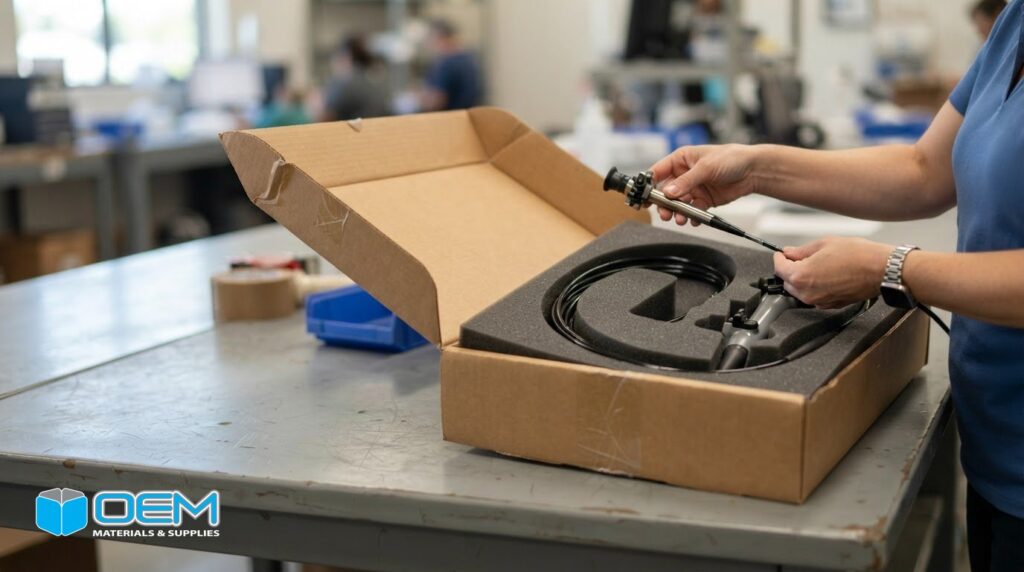
The lowest-cost foam choice can become an expensive one if a device shifts or arrives damaged. The cost of custom tooling for medical device foam packaging depends on the insert’s design, material, fabrication method, and production requirements; pricing is provided after a quote request. Tooling decisions should account for how the device needs to fit and stay protected, not just the shape of the cutout.
Foam can provide a close-fitting cushion for medical instruments and components, while corrugated packaging and other cushioning materials may suit different protection and handling needs. Closed-cell foam is useful when moisture resistance, resilience, and a clean surface matter, but the material must still suit the product and packaging conditions.
This article compares custom foam with other packaging approaches, explains what affects tooling costs, and reviews common medical device applications. It also covers closed-cell foam, fabrication options, and the biocompatibility and material considerations involved in choosing medical device foam packaging.
Key Takeaways
- Tooling needs depend on the insert’s geometry, material, fabrication method, and production requirements, so define the device’s fit and protection needs first.
- Case inserts, liners, and edge protectors support different packaging functions; matching the format to the device and shipping conditions helps control movement and impact.
- Compare foam with other packaging by considering cushioning, handling, cleanliness, and how the finished package will be used.
- Assess sterilization compatibility as part of material selection, alongside the product’s packaging and processing requirements.
- Biocompatibility for medical foam is assessed against the ISO 10993 protocol, according to the International Organization for Standardization.
How much does custom foam tooling cost for medical device inserts?
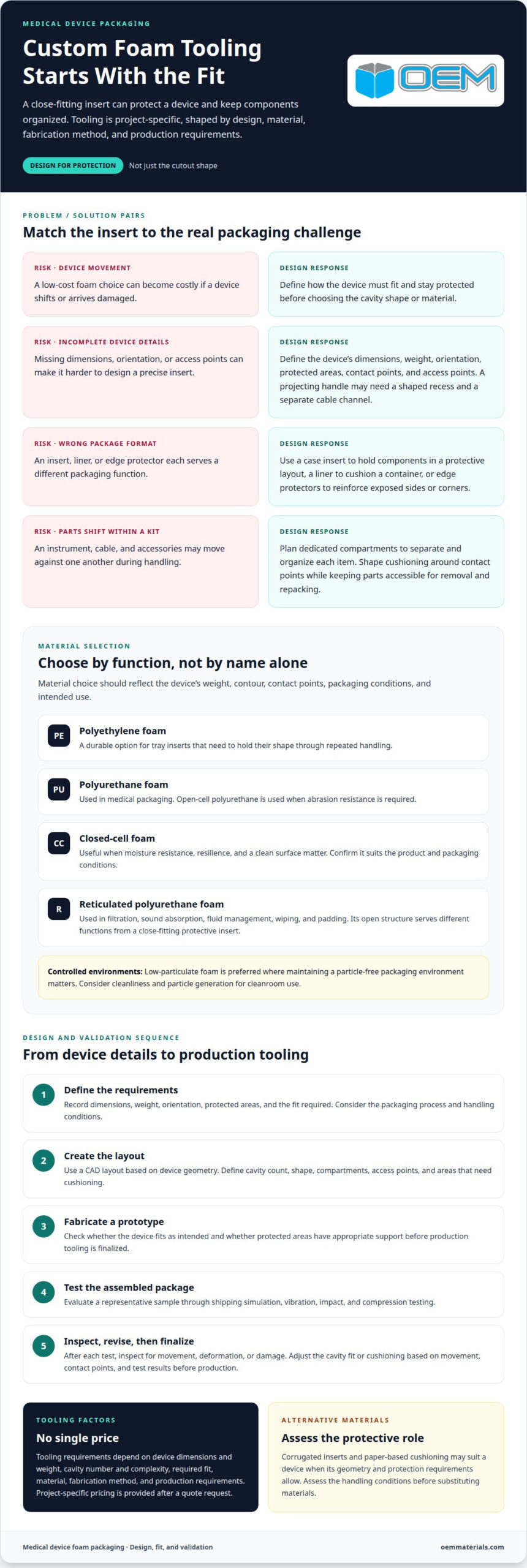
Custom foam tooling has no single price. Design, material, fabrication method, and production requirements all affect the work. Pricing depends on the device’s dimensions and weight, the number and complexity of cavities, and the fit required. The cost is specific to each project and provided after a quote request.
A CAD/CAM-designed insert starts with the device’s geometry and the areas that need cushioning. For example, an instrument with a projecting handle may need a shaped recess and a separate channel for its cable. Accurate dimensions, orientation, and access points help define the design before fabrication. A prototype can reveal fit issues before production tooling is finalized.
Packaging format also shapes the design. A case insert holds components in a protective layout, while a liner cushions the inside of a container. Edge protectors reinforce exposed sides or corners. A kit containing an instrument, cable, and accessories may need dedicated compartments to keep parts separated and organized during handling.
Polyethylene (PE) foam is a durable option for tray inserts that need to hold their shape through repeated handling. Material selection should reflect the device’s weight, contour, and contact points. A sensitive instrument with delicate protrusions needs a different cavity profile than a compact, robust component. Foam Packaging designs can be tailored around these requirements; see the foam packaging options for context.
What sustainable or recyclable alternatives are available? Corrugated inserts and paper-based cushioning may be suitable when the device’s geometry and protection requirements allow. Choose the packaging format to match the product and handling conditions, rather than substituting materials without assessing their protective role.
How is packaging tested for shipping, vibration, shock, and compression? Evaluate a representative packaged sample through shipping simulation, vibration, impact, and compression testing. After each test, inspect the device and insert for movement, deformation, or damage. Adjust the cavity fit or cushioning as needed.
What are the steps for designing and validating custom inserts? Define the device’s dimensions, weight, orientation, and protected areas. Create a CAD layout, fabricate a prototype, then assess fit and test the assembled package. Revise the design based on movement, contact points, and test results before production.
Tooling is most useful when a defined cavity layout improves protection or packing consistency. For a simple product that already fits standard packaging, a custom insert may add design work without addressing a clear handling problem. Base the choice on device geometry, cushioning needs, and the packaging process.
Medical device packaging foam applications
Foam packaging supports medical devices and instruments during transport and handling. The application determines the material, fit, and cushioning needed.
Medical and Laboratory Uses
In medical and laboratory settings, shaped foam can separate instruments, components, and pharmaceutical products in one package. A tray might hold a handheld instrument in one recess and its accessories in neighboring compartments. Die-cutting and computer numerical control machining can form recesses, channels, and compartments around the items’ contours. Consider contact points, handling steps, and intended package use when planning the layout.
Foam Selection for Medical Applications
Choose foam according to the medical product’s function and use. Polyurethane foam is used in medical packaging, while polyethylene offers another option for sensitive devices. Consider whether the application needs abrasion resistance, a particular surface, or shaped cushioning. For a device with delicate projections, design the layout to support those areas without obstructing removal.
Open-cell polyurethane foam is used in medical packaging when abrasion resistance is required. Reticulated polyurethane foam is used in filtration, sound absorption, fluid management, wiping, and padding products. Its open structure suits different functions from those of a close-fitting protective insert. Match the foam’s intended role to the item and packaging process rather than choosing by material name alone.
For a set of instruments, custom foam can create separate spaces that help keep components organized. It can also be tailored to package different products together, such as a device and its accessories. The layout should distinguish each part and cushion contact points, making removal and repacking more controlled during routine handling.
Cleanroom environments require attention to material cleanliness and particle generation. Low-particulate foam is preferred where maintaining a particle-free packaging environment matters. Reticulated polyurethane foam is also described as easy to clean and impervious to microbial organisms. Assess the intended use and environment together, especially when the package will be opened or handled in controlled areas.
Foam inserts can pair with rigid outer shells, combining cushioning with structural support. For example, a fitted insert can hold an instrument in position while the shell provides a firm enclosure. Custom medical device foam packaging can also combine foam with other packaging formats to suit how products move through manufacturing, storage, and distribution.
How Does Custom Foam Compare to Other Packaging?
Custom foam holds a device in a shaped cavity and cushions it during transport. Bags and corrugated boxes serve different purposes: a bag encloses an item, while a box provides an outer structure. The right combination depends on the device, handling path, and cleanliness requirements.
Potential foam risks include particles from abrasion, material emissions, and electrostatic discharge that can affect sensitive electronic components. Low-sloughing material can help reduce particle concerns, while suitable electrostatic-control material can address discharge risk. Assess material compatibility and handling conditions for the specific device.
A fitted foam insert can limit movement around a surgical instrument, particularly when its contours or projecting parts need support. A bag may protect against surface contact or dust, but cannot hold each component in a fixed position on its own. Corrugated packaging can form the outer container, with foam cushioning inside when additional impact protection is needed.
Compare packaging by the job it does at each stage. A bag can enclose a component, a foam insert can separate it from accessories, and a corrugated box can support distribution handling. Foam can also be combined with rigid outer shells for cushioning and structural support. This layered approach helps when no single material meets every packaging need.
Sterilization compatibility is another selection factor. Consider ethylene oxide (EO), gamma, autoclave, and electron beam (E-beam) methods when choosing foam materials. Assess the intended process alongside the foam’s function, the device, and the packaging configuration. Evaluate compatibility for the actual material and process rather than assuming it from the foam category.
Cleanroom packaging also requires attention to particle generation. Low-particulate foam is preferred where maintaining a clean, particle-free packaging area matters. Consider how the insert is cut, handled, and opened, since these steps affect contact with the package and device. Foam that suits shipping may not suit cleanroom handling unless both needs are assessed.
For a practical comparison, list the device’s protection needs, then assess each material against them. Consider impact cushioning, position retention, surface protection, and fit with the transport process. Include handling stresses, cleanliness, and any sterilization method. These criteria help show when custom foam adds useful precision and when a bag-and-box configuration better suits the application.
Test the assembled package as a system. Place the device in its intended bag, insert, or corrugated box, then assess fit and movement during the planned handling process. Record contact points and visible abrasion. These observations can guide design revisions and help determine whether the packaging protects the product without introducing avoidable material concerns.
Biocompatibility and regulatory considerations
Material selection and documentation affect how medical packaging supports a device’s quality system. Review the foam formulation, intended contact, and packaging use together.
Packaging Standards and Compliance
Standards and regulatory controls address different parts of a packaging program. The International Organization for Standardization identifies ISO 13485 as a standard for documenting packaging performance within a quality management system. Use that framework to connect material records, design decisions, and packaging performance documentation. For a diagnostic device, keep records tied to the actual components and package configuration.
The FDA’s Quality System Regulations final rule became effective on February 2, 2026. Packaging teams should account for the applicable quality system when documenting design controls, material decisions, and package changes. A change in foam formulation or cavity geometry can affect the finished configuration. Record the rationale, review path, and validation evidence in the quality documentation used for the device.
Consider packaging standards alongside the product’s intended use and supply chain. A package for a critical device component may have different contact and handling conditions from packaging for a non-contact accessory. Identify where the foam sits, whether it touches the device, and how the package moves through manufacturing and distribution. These details help focus the regulatory review.
Biocompatibility Considerations
Biocompatibility for medical foam is assessed against the ISO 10993 protocol, according to the International Organization for Standardization. The assessment relates to the material’s intended use and contact with the medical product. Identify the foam formulation and the device contact conditions before evaluating suitability. A material’s use in packaging alone does not establish suitability for every medical application.
An FDA Master File listing for a foam formulation does not, by itself, establish that the foam is medical grade. Additional biocompatibility testing is used to determine whether foam is appropriate for medical applications. Treat these points separately: a file listing provides formulation information, while assessment addresses intended use and material interaction.
For a practical review, document the foam identity, its position in the package, and the device surfaces it may touch. Include the package’s intended handling and relevant processing steps in the assessment. If the design changes, compare the new formulation or configuration with existing documentation. This helps maintain clear traceability across packaging components and revisions.
Chemical profiling can be one consideration in a broader review of medical-device packaging materials. Use the standard’s role as part of a broader materials review, not as a substitute for assessing the specific foam and application. Connecting the chemical profile, intended contact, and package design gives engineering and quality teams a defined basis for evaluation.
Closed-cell foam for medical device packaging
Closed-cell polyethylene foam is lightweight, resilient, and used to package sensitive instruments and devices. Its structure resists moisture and chemicals, making it suitable when humidity or incidental liquid exposure is a concern. Material choice still depends on the device’s contours, weight, and handling conditions. A protective insert should support the device rather than rely on foam type alone.
For a delicate diagnostic instrument, a close-fitting insert can limit movement and cushion contact points during transport. Foam can be cut or fabricated to match the item’s dimensions and contours, helping keep components positioned in the package. When laying out each cavity, consider protrusions, connector locations, and removal direction, since these details affect how the device sits and comes out.
Density is one design consideration, but evaluate it alongside the foam’s thickness, shape, and cushioning function. A heavier component may need a different support profile from a lightweight instrument. The package should also account for loading and removal. Testing a representative insert can show whether contact points stay supported and the device shifts during handling.
Closed-cell polyethylene can provide a clean surface and low moisture absorption, qualities considered for medical packaging. Foam can also be engineered to resist moisture and help protect packaged items from humidity or accidental liquid exposure. These properties do not replace decisions about biocompatibility, cleanliness, or sterilization compatibility. Assess the material for its specific packaging use and processing conditions.
For temperature-sensitive medical devices or pharmaceuticals, some foam materials provide thermal insulation that can help maintain a specified temperature range during shipping or storage. For businesses developing health formulations with contract specialists like Harmony Pharma Lab, pairing resilient packaging with temperature-conscious distribution helps preserve product efficacy. Foam is one part of the packaging system, so assess the complete configuration and shipping conditions. Insulation alone does not prove that a shipment will stay within the required range.
Closed-cell XLPE foam can be formed into components, packaging, and products through compression molding. This method can support defined shapes when a package needs repeatable cavities or structural features. For custom packaging, compare molded forms with cut inserts based on geometry, production needs, and handling. Choose the process that supports device fit without unnecessary design complexity.
The practical takeaway is to match closed-cell foam to the specific protection need: moisture resistance, resilient cushioning, a clean surface, or insulation. Confirm the package’s fit and performance using the intended device and configuration. To discuss an insert design, request a quote for custom foam packaging with the device dimensions, weight, and shipping conditions.
OEM Materials & Supplies: Corrugated Boxes
OEM Materials & Supplies provides corrugated boxes, foam packaging, and packaging kits for medical device shipments. These options suit applications that need interior cushioning alongside an outer box for handling and distribution. The box contains the packaged product, while a fitted foam insert can help position components inside. A packaging kit can bring the required elements together for a repeatable packing process.
For a useful recommendation, provide the device’s dimensions, weight, configuration, and shipping conditions. These details help match the box and cushioning to the packaging task. Contact OEM Materials & Supplies to discuss corrugated boxes or foam packaging for your application.
Move From Material Choice to a Defined Package
Turn packaging requirements into a clear design brief. Record the device configuration, critical contact areas, packing sequence, shipping conditions, and applicable quality documentation needs. This gives engineering, quality, and purchasing teams a shared basis for reviewing a proposed package and assessing production changes.
For medical device foam packaging, a useful brief connects material choice to how the device is packed, transported, and handled after arrival. Include product dimensions, weight, annual usage, and relevant test or processing requirements. These details guide a focused discussion about the package configuration and the next design step.
OEM Materials & Supplies offers Corrugated Boxes, Foam Packaging, and Packaging Kits for industrial packaging needs. Contact OEM Materials & Supplies to discuss your packaging requirements and move your project toward a practical, well-defined solution.
Frequently Asked Questions
What Are the Costs Involved?
Costs depend on project scope, and each design is quoted individually. To define the scope, provide the intended package configuration, order quantities, and any existing drawings or samples. If the package may change during product development, describe expected revisions. This information helps distinguish initial design and tooling work from recurring packaging requirements without relying on a generic cost estimate.
What foam materials are commonly used for medical device packaging?
Common material options include polyethylene, polyurethane, and cross-linked polyethylene foam. Open-cell and reticulated polyurethane are also used for specific packaging functions. Material names alone do not establish suitability for a particular device. Review the product’s intended use, packaging environment, and processing needs, then compare candidate materials with those requirements. Clearly identify the selected formulation in material specifications for purchasing and quality records.
How do you choose foam packaging for a specific medical device?
Start by observing how operators pack and unpack the device. Note the required orientation, grip points, access sequence, and any parts that must stay visible or accessible. Then document fit and handling acceptance criteria before reviewing a design. A packaging review with engineering, quality, and operations can reveal practical issues a drawing alone may miss, such as difficult removal or inconsistent placement.
What are the requirements for sterile barrier systems and protective medical device packaging?
A sterile barrier system maintains the intended sterile condition, while protective packaging helps prevent damage to the device and barrier during handling and distribution. Define these functions separately in the packaging plan. Specify which package layer performs each role, how the product is loaded, and what evidence shows the package performs as intended. A cushioning insert should not be treated as the sterile barrier on its own.
Which ISO and FDA regulations apply to medical device packaging in the United States?
Applicable requirements depend on the device, the packaging’s role, and the manufacturer’s quality system. Packaging that serves as a sterile barrier raises different considerations from a protective insert outside that barrier. Regulatory and quality teams should identify the requirements for the specific product, then align design records, supplier documentation, and change controls. Keep a clear record of why each packaging component was selected.
How much does custom medical device foam packaging cost in the United States?
There is no single price for every U.S. project; a quote reflects the specific packaging scope. For an initial cost review, describe the required package format, planned order quantities, and whether the design is new or established. Include drawings or representative samples when available. This lets the estimate address actual project requirements rather than rely on a broad industry average.
How do medical-grade foam packaging materials compare for cushioning, cleanliness, and chemical compatibility?
Compare candidate materials with documented requirements for the device and packaging environment. Define acceptable cushioning, surface cleanliness, and chemical exposure for the application before choosing a material. For example, a component exposed to cleaning agents during manufacturing may need a different review from one kept enclosed throughout the process. Record the criteria and selection rationale so purchasing and quality teams use the same specification.
How can medical device foam packaging be sterilized, and which materials are compatible with common sterilization methods?
Compatibility depends on the selected foam formulation and sterilization process. Use material-specific compatibility evidence, then evaluate the packaged configuration after exposure for changes that could affect the device or package function. Review the result against the product’s processing requirements and quality documentation. Do not assume foam suitable for one process will perform the same way under another process or in a different package design.