
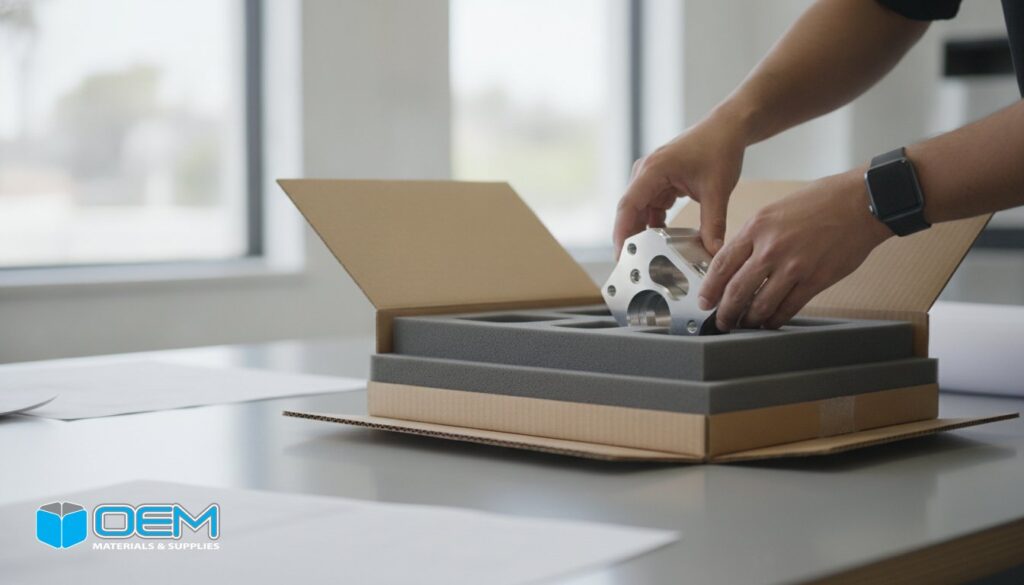
A single design flaw in your packaging can cost more than the product it’s meant to protect. For industrial manufacturers, custom packaging prototype development is not just a creative step; it’s a critical engineering phase that ensures your supply chain remains resilient. You likely know the frustration of receiving reports of product damage during shipping or seeing labor costs climb due to overly complex assembly. Inefficient material usage and long lead times for custom designs can stall your operations and eat into your margins.
Professional packaging prototyping provides the technical validation you need before committing to high-volume production. This process validates structural protection, reduces material waste, and streamlines the transition from initial design to the assembly line. In this guide, we explore how physical testing and engineered materials like custom foam and corrugated solutions prevent logistical failures. We’ll examine how manufacturers across Orange County, Los Angeles, and San Diego use these prototypes to optimize for durability and cost efficiency while meeting the rigorous standards of the aerospace, automotive, and medical device sectors.
Key Takeaways
- Identify why physical validation is essential for aerospace and medical sectors to prevent structural failures during transit.
- Use custom packaging prototype development to bridge the gap between digital CAD designs and production-ready physical solutions.
- Select specific corrugated grades and foam cushioning based on documented weight and protection requirements to minimize material waste.
- Test prototypes for logistical compatibility with pallets and crates to ensure efficient assembly and shipping.
- Transition to high-volume manufacturing with vendor-managed inventory to maintain reliable stock levels and reduce lead times.
The Role of Custom Packaging Prototypes in Industrial Manufacturing
A packaging prototype is a physical, functional sample designed to replicate the exact performance of a final production unit. In industrial manufacturing, custom packaging prototype development serves as a technical checkpoint rather than a visual exercise. While retail brands might prioritize shelf appeal and brand colors, industrial sectors like aerospace, medical devices, and automotive electronics focus on structural integrity and logistical reliability. These sectors deal with high-value, sensitive components where a single failure in transit leads to significant financial loss and project delays.
There’s a distinct difference between a visual mock-up and a functional industrial prototype. Visual mock-ups are often made from non-production materials to show size and shape. In contrast, a functional industrial prototype uses the actual specified materials, such as specific grades of corrugated boxes or foam packaging. This allows engineers to verify that the design can withstand the rigors of the supply chain before high-volume production begins.
Validating Structural Integrity for Sensitive Components
Physical samples are the only way to conduct accurate drop testing and vibration analysis. For manufacturers in Los Angeles, Orange County, and San Diego, ensuring that a custom foam insert holds a medical instrument with tight tolerances is vital. These prototypes allow for testing protection against environmental factors or electrostatic discharge (ESD), which is critical for sensitive electronics. By creating a physical sample, you can confirm that die-cut corrugated components fit perfectly with foam blocks to prevent internal movement during shipping.
Reducing Long-Term Costs through Physical Testing
Prototyping identifies over-packaging. Using more material than necessary increases both unit costs and shipping weights. By refining the design during the prototype phase, you can reduce unnecessary material expenses without compromising protection. Additionally, testing the assembly process helps lower labor requirements. If a box is difficult to fold or a foam insert is hard to seat, it’s better to fix those issues at the prototype stage than during a high-speed production run. Successful custom packaging prototype development prevents the high cost of shipping damage claims and ensures your operations remain efficient.
The Prototype Development Process: From CAD to Physical Sample
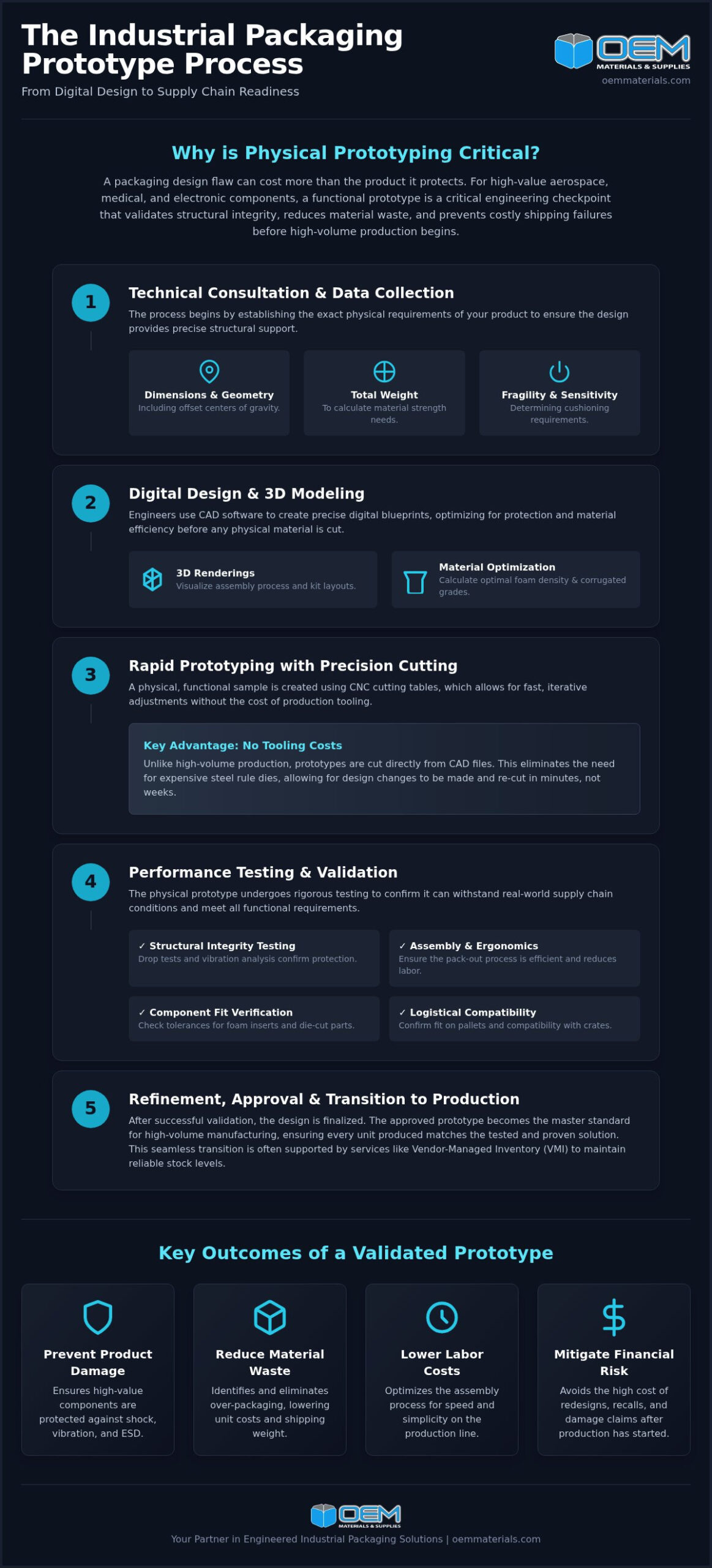
The workflow for custom packaging prototype development begins with a technical consultation to establish the physical requirements of your product. We collect data on dimensions, total weight, and fragility ratings. This step is critical because industrial components often have offset centers of gravity or protruding parts that require specialized support. Without these specifics, a design may look correct on screen but fail to provide adequate structural bracing in a real-world shipping environment.
Digital Design and 3D Modeling
Accurate measurements are the foundation of effective custom packaging design. Our engineers use digital CAD software to create precise blueprints for both corrugated outer shells and internal foam cushioning. 3D renderings allow operations managers to visualize how complex kits will be assembled on the production line before any material is cut. This phase also involves using software to calculate the optimal density for foam inserts. We aim to achieve the maximum level of protection using the minimum amount of material, ensuring the design is both safe and cost-efficient.
Rapid Prototyping with Precision Cutting Tables
Once the digital design is finalized, we move to physical sampling using CNC precision cutting tables. This technology is a significant advantage for industrial manufacturers because it eliminates the need for expensive steel rule dies during the initial testing phase. If a physical sample reveals a need for a tighter tolerance or a different fold pattern, we make immediate adjustments in the CAD file and cut a new version in minutes. This speed allows for iterative testing that ensures the final product is perfect.
Precision cutting tables also enable the production of short runs. These small batches are ideal for field testing or pilot programs where you need to send 10 to 20 units through your actual supply chain to monitor performance. If you are preparing for a new product launch in Orange County or the Inland Empire, you can request a technical consultation to begin your CAD modeling and sampling process.
After the physical sample is produced, it undergoes a rigorous review for fit and functional performance. We check how the product interfaces with the cushioning and how the entire unit fits into secondary packaging like crates or pallets. This hands-on evaluation identifies potential assembly bottlenecks that a digital model might miss, such as a flap that is difficult for a warehouse worker to close or a foam piece that requires too much force to seat. Addressing these issues now prevents costly delays during high-volume production runs.
Material Selection and Performance Testing during Prototyping
During custom packaging prototype development, material selection is a technical decision based on the Fragility Factor and weight of your product. The prototype stage allows our engineers to verify that the chosen substrates can handle the specific stresses of your supply chain. We test for compatibility with industrial chemicals and ensure materials meet cleanroom standards for medical and aerospace clients in Orange County and San Diego. Integrating edge and corner protectors into the prototype design is often necessary to prevent crushing when units are stacked in high-density warehouse environments.
Engineering Custom Foam Inserts for Impact Protection
Choosing the right material for foam packaging depends on the product’s sensitivity and total mass. Polyethylene is a closed-cell foam ideal for heavy machinery because it offers high load-bearing support and resists moisture. In contrast, polyurethane is an open-cell, softer foam better suited for light electronics that require delicate cushioning against vibration. Determining the correct foam density is vital to ensure that the part doesn’t bottom out during an impact. Foam density is a critical factor in shock absorption for industrial logistics.
Physical prototypes allow us to test these foam inserts in real-world scenarios. We examine how the foam reacts to repeated impacts, which is common in long-haul trucking or air freight. If a specific density fails to return to its original shape after compression, we adjust the material specification in the design file before moving to production. This iterative testing ensures that high-value components remain suspended and protected throughout the shipping cycle.
Selecting Corrugated Grades for Load-Bearing Requirements
The choice between single-wall and double-wall corrugated boxes significantly impacts the structural integrity of the container. Double-wall construction is frequently required for industrial OEMs shipping heavy parts that demand superior stacking strength. Flute size also plays a major role; larger flutes provide better vertical compression strength, while smaller flutes offer improved puncture resistance and a smoother surface for labeling. We analyze these variables to ensure the container won’t buckle under the weight of a full pallet.
The prototype phase confirms that these corrugated selections meet international shipping standards for bursting strength and edge crush test (ECT) ratings. By validating these grades early, we help manufacturers avoid the high costs of shipping damage claims. We also evaluate how the corrugated material interacts with stretch film and tape to ensure a secure seal. This comprehensive approach to material testing during the prototype phase guarantees that the final packaging solution is optimized for both durability and material efficiency.
Evaluating Your Prototype for Supply Chain Readiness
A successful design must perform well beyond the testing lab. During custom packaging prototype development, we evaluate how the solution integrates into your existing warehouse and distribution workflows. A prototype that protects the product but doubles the assembly time is a liability. We analyze the physical sample to ensure it’s compatible with automated equipment, such as high-speed tapers and automated stretch film wrappers, which are common in large-scale Southern California manufacturing hubs. If the packaging isn’t ready for the floor, it isn’t ready for production.
Assessing Kitting and Assembly Efficiency
Prototypes reveal bottlenecks that digital models often miss. For industries like aerospace and medical devices that require complex assembly, we test how easily components can be placed into the packaging. We check for ergonomic handling to ensure warehouse staff can pack units quickly without repetitive strain or errors. By refining the design at this stage, we can often reduce the total number of packaging components. Simplifying your inventory makes management easier and lowers the risk of stockouts for critical packing materials.
Efficient kitting services rely on intuitive packaging design. If a kit requires multiple foam inserts and specific corrugated dividers, the prototype must prove these parts fit together without forcing or excessive taping. We look for ways to consolidate protection into fewer pieces, which directly lowers labor costs. If you need to streamline your assembly line, request a technical consultation to review your current packing workflow.
Fit-Testing for Palletization and Logistics
Logistical efficiency depends on how well individual units utilize space on pallets and inside crates. We optimize box dimensions during the prototype phase to maximize pallet density. Even a half-inch reduction in a box dimension can lead to significantly more units per pallet, lowering your overall shipping costs per item. We also test the stability of the entire load when it’s secured with industrial-grade stretch film to prevent shifting during transit.
Industrial packaging must survive multi-modal transportation, including truck, rail, and air freight. The prototype allows us to verify that the stack height doesn’t compromise the structural integrity of the bottom layers. We simulate the stresses of the Inland Empire’s distribution corridors and San Diego’s shipping ports to ensure your goods arrive intact. This final validation step confirms that your custom packaging prototype development has resulted in a solution that is truly supply-chain ready.
Transitioning from Prototype to High-Volume Production in Southern California
The transition from a single physical sample to a production run of thousands requires a shift from engineering validation to logistical execution. Once the custom packaging prototype development phase is complete, the finalized design is prepared for high-volume manufacturing. This involves creating the necessary tooling, such as steel rule dies for corrugated boxes and precision programming for foam inserts. For manufacturers in Orange County, Los Angeles, and San Diego, working with a local partner ensures the transition happens without the delays associated with overseas shipping or long-distance freight.
Scaling Production for Aerospace and Medical Sectors
Industrial OEMs in the aerospace and medical sectors operate under strict quality control standards. Moving to high-volume production means ensuring the ten-thousandth unit provides the same level of protection as the initial prototype. Local manufacturing support allows for faster quality audits and immediate adjustments if production variables change. By keeping production within Southern California, factories can significantly reduce lead times. This proximity allows operations managers to visit facilities for first-article inspections, ensuring that the final output matches the validated design exactly.
Integrated Logistics and Vendor-Managed Inventory
Successful production runs are only as effective as the logistics strategy supporting them. We use the data gathered during the custom packaging prototype development process to plan for JIT packaging needs. This ensures that packaging materials arrive exactly when they are needed on the assembly line. Coordinating these deliveries improves warehouse space efficiency and reduces the need for large on-site storage areas, which is a major advantage given the high cost of industrial real estate in the Inland Empire and Los Angeles County.
Implementing a vendor-managed inventory (VMI) program further optimizes the supply chain. VMI programs lower overhead costs and prevent the packaging shortages that can halt a production line. Having a single partner for design, production, and logistics eliminates communication gaps between multiple vendors. This integrated approach ensures your custom solutions are always in stock and ready for the next high-volume run, providing the stability and reliability that modern manufacturing demands.
Optimizing Your Production Cycle with Technical Prototyping
Efficient industrial operations depend on the successful transition from initial design to the assembly line. By prioritizing custom packaging prototype development, you ensure that your protective solutions are validated for structural integrity and logistical performance before high-volume production begins. This process identifies potential bottlenecks in assembly and reduces the risk of product damage during transit; this is essential for the aerospace, medical, and automotive sectors we serve across Southern California.
OEM Materials & Supplies provides the technical expertise needed to develop engineered foam inserts and custom corrugated boxes that meet rigorous industry standards. Our local presence in Orange County, Los Angeles, and San Diego allows us to offer rapid sampling and seamless transition support to high-volume manufacturing. We act as a dedicated partner to help you lower labor costs and optimize material usage through physical testing and expert design.
If you are ready to secure your supply chain and improve warehouse efficiency, contact OEM Materials & Supplies for a custom packaging prototype consultation. Please provide your product dimensions, weight, and estimated annual usage so our team can develop a precise recommendation for your specific manufacturing needs. We look forward to helping you streamline your next production run.
Frequently Asked Questions
What is the difference between a physical prototype and a digital rendering?
Digital renderings are 3D models used for visualization; physical prototypes are functional samples made from production-grade materials. Physical samples allow for drop testing and fit verification that digital files cannot simulate. For industrial OEMs, custom packaging prototype development is essential to confirm the structural integrity of foam and corrugated components before committing to high-volume manufacturing. It’s the only way to verify real-world performance and ensure protection for high-value goods.
How long does the custom packaging prototype development process usually take?
The timeline for custom packaging prototype development typically ranges from a few business days to two weeks depending on design complexity. Simple corrugated boxes are sampled quickly using CNC cutting tables; complex kits involving engineered foam inserts require more CAD modeling time. We prioritize speed to help manufacturers in Southern California maintain their production schedules. Specific turnaround times depend on the availability of technical data and your specific material requirements.
Can I test a prototype for structural strength before ordering a full production run?
You can and should test a prototype for structural strength before ordering production quantities. Physical samples allow your team to perform drop tests, vibration analysis, and stacking strength evaluations. This testing ensures the design protects sensitive components from the rigors of multi-modal transportation. Validating performance at the prototype stage prevents the high cost of shipping damage claims and ensures your packaging meets the rigorous international standards required by industrial OEMs.
What information do I need to provide to start the prototyping process?
To begin the prototyping process, we require accurate product dimensions, total weight, and fragility ratings. It’s also helpful to provide information on your shipping methods, annual usage, and any environmental challenges like cleanroom requirements. Providing 3D CAD files of your product allows our engineers to design tight-tolerance foam inserts and die-cut corrugated shells. This data ensures we provide maximum protection for your components while minimizing material waste and overall costs.
Is it possible to develop prototypes for specialized foam inserts?
We specialize in developing prototypes for engineered foam inserts using materials like polyethylene and polyurethane. Our CNC precision cutting tables allow us to create intricate shapes and multi-layered cushioning without the need for expensive tooling. This capability is critical for aerospace and medical device manufacturers who need exact tolerances for sensitive instruments. We test different foam densities during the prototype phase to find the optimal balance of impact protection and logistical cost.
How does prototyping help reduce my overall packaging and shipping costs?
Prototyping reduces costs by identifying over-packaging and optimizing material usage. By refining the design, we can often reduce the number of components in a kit, which lowers material expenses and assembly labor. Additionally, prototypes help maximize pallet utilization, which reduces the total number of shipments required. While results depend on specific variables like product dimensions and shipping requirements, physical validation prevents the financial loss associated with damaged goods and inefficient warehouse logistics.
What happens if the prototype needs adjustments after the first sample?
If a prototype needs adjustments, we modify the digital CAD file and produce a new physical sample immediately. Our precision cutting tables allow for rapid iterations without the lead times or costs of traditional die-making. We work closely with your engineering team to refine fit and function until the design meets every technical requirement. This iterative process ensures that the final high-volume production run is optimized for both structural protection and assembly efficiency.
Do you offer prototyping services for Southern California manufacturers in Orange County?
We provide full prototyping and design services for manufacturers throughout Southern California, including Orange County, Los Angeles, and the Inland Empire. Our local facility allows for fast delivery of physical samples and easier coordination for first-article inspections. Proximity to major manufacturing hubs in San Diego and the surrounding counties means we provide hands-on support and just-in-time delivery for your high-volume production needs, keeping your supply chain resilient and responsive.