
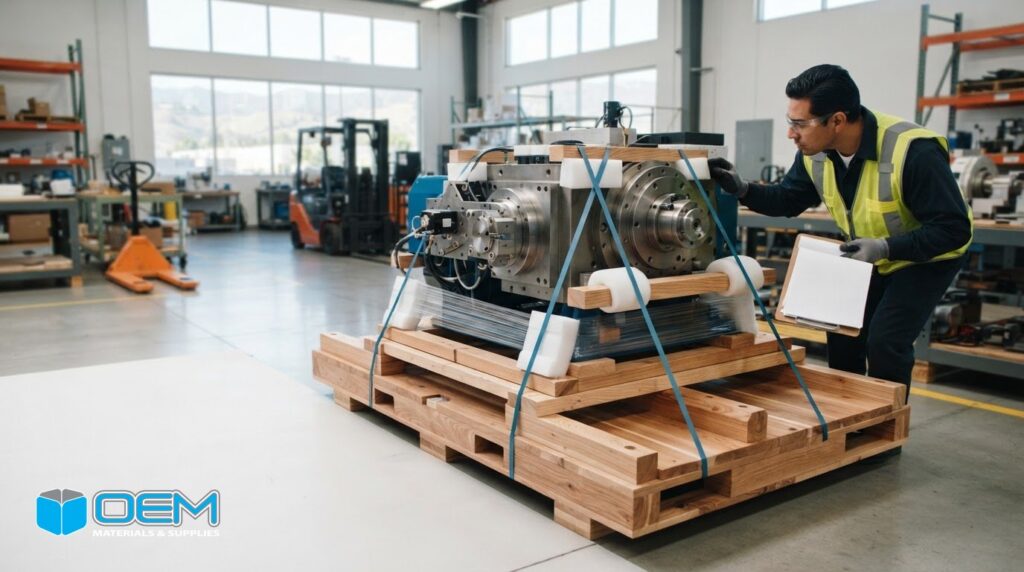
Weight alone doesn’t determine whether custom pallets for heavy machinery will work. The load path and handling sequence matter just as much. The pallet needs to account for the equipment’s footprint, weight distribution, and contact points, along with how the load will be lifted, restrained, and shipped. A base that fits the machine but conflicts with forklift access or transport restraints can create avoidable handling problems.
A good specification protects the equipment without adding unnecessary packaging or complicating operations. Before requesting a tailored recommendation, gather the equipment’s dimensions, weight, support points, handling methods, and shipping requirements. Then compare whether an open pallet is sufficient or whether cushioning, stretch film, or a crate may be appropriate. With those details, purchasing, engineering, and warehouse teams can discuss a fit-for-purpose design. Material use and potential savings depend on the machinery, packaging materials, and shipping requirements.
Key Takeaways
- Specify custom pallets for heavy machinery around the equipment’s footprint, weight distribution, support points, and handling plan.
- Prepare dimensions, actual shipping weight, center of gravity information, and contact-point locations for a useful design discussion.
- Compare an open pallet, added cushioning or restraint, and an enclosed crate against access, exposure, handling, and shipment needs.
- Include destination, handling requirements, prototype needs, and annual usage in your quote specification.
- Consider the pallet alongside cushioning, crates, and other packaging components so the full shipment plan fits the machinery and its route.
Why Heavy Machinery Needs a Pallet Designed Around Its Load
A machinery pallet is a load-supporting base designed for a specific product and handling plan. It transfers the equipment’s weight through its contact points to the pallet and provides access for the intended lifting method. Shape matters as much as equipment category: a machine with a compact base loads a platform differently from equipment with long rails or feet positioned far apart. For a general overview of heavy equipment, consider how much machinery can vary in size and configuration.
Specify a pallet based on how the load meets the base and how the base will be handled, not by total weight alone. Weight is essential, but it doesn’t show where the load rests, how it is distributed, or how the equipment will be picked up and moved. Those details help guide a fit-for-purpose design.
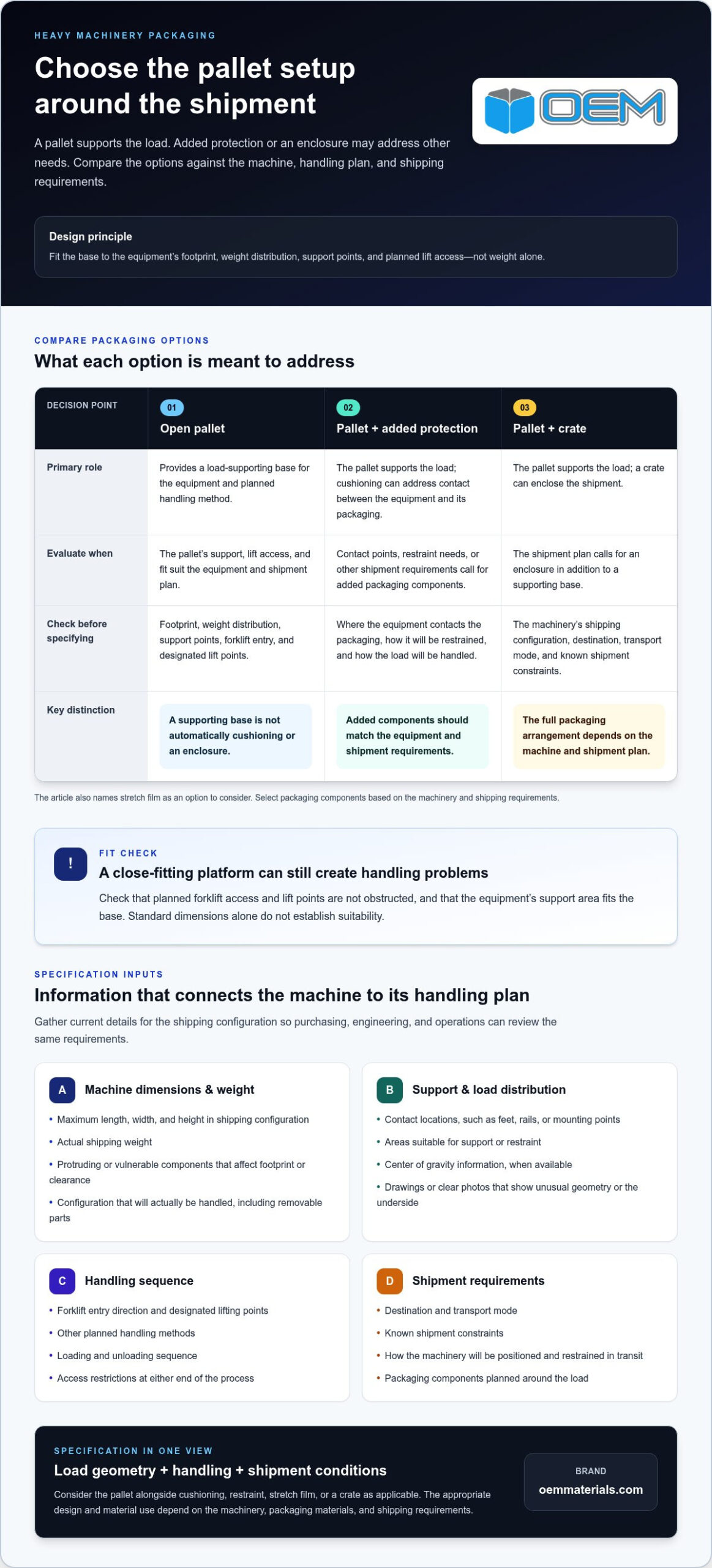
Custom pallets for heavy machinery provide support, but they are not automatically cushioning or an enclosure. Cushioning materials can address contact between the equipment and its packaging, while a crate can enclose a shipment. The right combination depends on the machine and shipment plan. OEM Materials & Supplies’ pallet options can be considered alongside the rest of the packaging requirements.
How machinery geometry changes pallet requirements
A distributed load rests across several areas of the base. A concentrated load places more of the equipment’s weight on a smaller area. For example, a machine supported by four feet loads a pallet differently from one resting along two long rails. Mounting points, uneven dimensions, and an offset center of gravity affect how forces travel through the base, especially when the load is lifted or moved.
The footprint also needs to work with lift access. A platform sized closely to the machine may still complicate handling if planned lift points are obstructed or the equipment extends beyond the available support area. Document the overall dimensions, support locations, and intended lift approach to give the design discussion a useful starting point.
When a standard platform may not fit the shipment
Oversized footprints, unusual shapes, and nonuniform contact points are reasons to evaluate pallet fit rather than assume a standard platform will suit the load. A machine may sit unevenly on a familiar pallet size, or its dimensions may affect how it can be positioned and accessed during handling. Standard dimensions alone don’t establish suitability.
Review the equipment in its shipping configuration, including any projections or components that affect its footprint. Then consider how the pallet will be lifted, restrained, and positioned for transit. This helps distinguish a platform that supports the machine from a broader packaging arrangement that may also need cushioning or an enclosure.
How to Specify Custom Pallets for Heavy Machinery
A useful pallet specification gives the design team more than a weight figure. It connects the machine’s dimensions and support locations to how the equipment will be lifted, loaded, and transported. Organize the information so purchasing, engineering, and operations can review the same shipment requirements.
- Document the machine. Record its maximum length, width, and height in the shipping configuration, along with its actual shipping weight. Note protruding or vulnerable components that affect the footprint or need clearance. If the machine has removable parts, identify the configuration that will ship so the pallet is planned around the load that will actually be handled.
- Map its support points. Mark where the equipment rests on the base, including feet, rails, or mounting points. Include contact-point locations and areas suitable for restraint. Center of gravity information helps describe how the load is distributed. Drawings or clear photographs can make unusual geometry easier to interpret, especially when dimensions alone don’t show the machine’s underside.
- Define the handling plan. Describe forklift entry, designated lifting points, and any other planned handling method. Explain the loading and unloading sequence, including access restrictions at either end. For example, if a forklift must approach from a particular side, note that constraint so pallet access can be considered alongside the equipment’s position.
- Describe shipment conditions. Provide the destination, transport mode, and known shipment constraints. Explain how the machinery will be positioned and restrained during transit, and note any packaging components planned around it. Pallet recommendations should reflect the complete shipment, not be inferred from weight alone.
What equipment and load information to gather
Use current measurements that reflect the shipping configuration, not just the machine’s nominal dimensions. Record contact locations and identify where the equipment can be safely supported or restrained. Include engineering drawings when available. Photographs can show projecting components, uneven undersides, or details that are difficult to capture in a measurement list. Clear source information reduces assumptions during specification.
How handling and shipping shape the specification
Handling details connect the pallet to the actual workflow. Identify where forks need to enter, how the load will be picked up, and what access is available during loading and unloading. Destination and transport mode add context. OEM Materials & Supplies considers these requirements through custom packaging design, with the pallet assessed alongside other packaging needs.
For a quote discussion, organize the dimensions, shipping weight, support-point locations, center of gravity information, handling method, destination, and annual usage. Include a drawing or photograph if it clarifies a constraint. The quote request form provides a way to share your machinery and shipment information.
Compare Pallet Design Options and Decide When More Protection Is Needed
The pallet supports the load and provides a handling base. Cushioning and enclosure address different packaging needs. Compare options against the machinery’s contact surfaces, exposure, lifting plan, and shipment conditions rather than assuming a more enclosed design is always better.
| Approach | Access and exposure | Support and handling considerations | Shipment fit |
|---|---|---|---|
| Open pallet | Equipment remains accessible and exposed. | Provides a base for support and planned lifting. Restraint needs depend on the shipment. | Consider when support and handling are the primary needs and exposure is acceptable. |
| Pallet with cushioning or restraint | Access may be partly limited by added components; the equipment is not fully enclosed. | Cushioning can address product-contact concerns when the application calls for it. Restraint can be considered as part of the load plan. | Evaluate when contact surfaces or load movement during handling and transit call for additional components. |
| Enclosed crate | Enclosure limits direct access and can reduce exposure to the surrounding environment. | The pallet or base supports the load, while the crate adds an enclosure. Coordinate both with handling and loading needs. | Consider when the shipment calls for enclosure or additional protection beyond an open base. |
Pallet, pallet with cushioning, or crate?
An open pallet may suit a machine that needs a stable base and straightforward lift access, with no additional product-contact or enclosure needs identified. If equipment surfaces need separation from packaging or contact concerns require attention, cushioning may be part of the design. Assess a crate when enclosure is needed. These approaches can work together: a crate can sit on a pallet, with cushioning selected for specific contact areas.
How material and shipment conditions affect the comparison
Material selection is project-specific, not a universal ranking. Consider how the pallet will be handled, whether it will be reused, how it will be stored, and the shipment’s requirements. The load and handling plan should guide the design. OEM Materials & Supplies offers plastic pallets, and its heavy-duty plastic pallet guidance can inform the material discussion.
For wood crate packaging, consider how the enclosure will fit around the machinery and coordinate with the supporting pallet. A crate can add packaging components and affect access, so account for the full assembly during loading and unloading. The appropriate design depends on the machine, handling sequence, and shipping conditions. Custom pallets for heavy machinery should be evaluated as part of the complete shipment, with protection added to address identified needs rather than by default.
Build a Quote-Ready Pallet Specification for Your Operation
A clear specification helps purchasing, engineering, and operations evaluate the same project requirements. For custom pallets for heavy machinery, organize the details around the equipment, shipment, and how often your operation will need the packaging. This provides a practical basis for discussing a recommendation that fits the workflow, not just a single pallet order.
A practical checklist for procurement and engineering
Gather the information below before requesting a quote. Drawings and photographs can clarify dimensions or features that are difficult to describe in writing. If a detail is unknown, identify it as an open item rather than substituting an estimate.
- Equipment: Overall length, width, and height in shipping configuration, plus actual shipping weight.
- Support and restraint: Contact-point locations, areas suitable for support or restraint, and components that need clearance.
- Handling: Forklift or other planned handling equipment, lift access, and loading or unloading constraints.
- Shipment: Destination, transport mode, route details that affect packaging, and known handling requirements.
- Workflow: Assembly or storage constraints, prototype needs, expected order frequency, and estimated annual usage.
These inputs help clarify whether the project involves a prototype, a short production run, or recurring orders. Each can shape planning differently. A prototype may help the team review fit and workflow before repeat purchasing, while recurring demand calls for attention to order frequency and supply coordination. Neither scenario implies a particular production schedule.
Plan for repeat orders and packaging workflow
For ongoing requirements, vendor-managed inventory may help coordinate packaging demand with the production schedule. Share expected usage patterns and changes in demand so the supply approach can reflect actual operations. Include other components only when the shipment calls for them, such as cushioning for product-contact needs or stretch film as part of load stabilization.
Evaluate stretch film as one part of load preparation, alongside the pallet and any restraint or cushioning required by the shipment. The appropriate packaging combination depends on how the machinery is prepared, handled, and shipped. Avoid adding components by default, and document the role each one needs to serve.
Cost-saving opportunities depend on the equipment’s dimensions, selected materials, and shipping requirements. A design that reduces packaging material in one application may not suit another load or route. Compare the complete packaging arrangement with the machinery’s handling needs and purchasing pattern before settling on a repeat specification.
Once the checklist is assembled, the pallet quote request form can include the equipment dimensions, weight, support details, shipment information, and annual usage. These details provide a practical starting point for discussing the pallet and related packaging components.
Work With OEM Materials & Supplies on a Machinery Pallet Solution
For manufacturers in Los Angeles County, Orange County, the Inland Empire, and San Diego County, pallet planning can involve more than the base beneath the equipment. OEM Materials & Supplies works with manufacturers on industrial packaging requirements, considering how a machinery pallet relates to cushioning, crates, and other components needed for a shipment. The goal is a coordinated packaging plan based on the equipment, handling process, and destination.
Coordinate pallet requirements with the full packaging plan
A pallet provides a supporting base and handling interface. Other components serve different purposes. Cushioning may be included where contact between packaging and equipment needs attention, while a crate can provide an enclosure when the shipment calls for one. Consider these elements together so they fit the machine and its preparation and handling steps. Pallet product information can help frame the base component within that broader discussion.
Packaging design support connects pallet requirements with the rest of the shipment plan. For recurring production needs, kitting or assembly may be relevant if packaging components need to be organized as part of the operation. Vendor-managed inventory can also support planning for repeat supply. Consider these options in light of the buyer’s workflow and operational needs.
Prepare a focused request for a quote
A complete project brief helps align procurement, engineering, and packaging discussions. Include the machine’s overall dimensions and shipping weight, along with contact-point locations and relevant center of gravity information. Add the planned handling method, destination, and known loading or unloading constraints. Drawings or photographs can clarify equipment details that are difficult to capture in writing.
Annual usage is useful context, too. It helps distinguish a one-time requirement from a recurring packaging need and supports a discussion about how the pallet fits into ongoing purchasing. If the shipment also needs cushioning, a crate, or other packaging components, identify those requirements so the pallet can be considered as part of the full arrangement.
OEM Materials & Supplies can discuss custom pallets for heavy machinery in relation to the equipment and its shipping workflow. Share the dimensions, weight, annual usage, handling requirements, destination, and available drawings or photographs when requesting a quote. Request a machinery pallet quote to start a project-specific discussion.
Move Your Machinery Packaging Plan Forward
Use the pallet specification as a working reference for engineering, warehouse, and procurement teams. Aligning those groups before ordering helps keep the equipment configuration, handling plan, and shipment requirements connected as the project moves into production. It also gives your team a basis for reviewing future changes, such as a revised machine footprint or a different shipping route, before they affect packaging decisions.
With the project details organized, you can discuss custom pallets for heavy machinery in the context of your operation and full packaging plan. Share the information you’ve gathered with OEM Materials & Supplies to begin a project-specific quote discussion.
Request a quote for your machinery pallet requirements with the machine dimensions, weight, support points, handling requirements, destination, and annual usage.
Frequently Asked Questions
How do I know if machinery needs a custom pallet?
Consider a custom pallet if the current setup requires recurring workarounds, such as repositioning the machine by hand or changing the packaging for different machine configurations. These issues can point to a mismatch between the pallet and the operation, even if the equipment fits on the platform. For custom pallets for heavy machinery, review how consistently the existing process works across units and note where operators need extra adjustments.
Can a pallet support heavy machinery without a crate?
Yes, if the shipment needs a supporting base but not an enclosure. The receiving process can help inform that choice: consider where the machinery will be staged after arrival, how soon it will be inspected, and whether it will remain packaged before installation. If the equipment needs to stay enclosed during storage or transit, include that requirement in the packaging plan rather than treating the pallet as the only component.
What information should I provide for a custom machinery pallet quote?
Along with project measurements and handling information, identify the exact machine model or configuration the quote should cover. Note whether the details apply to one unit or a family of machines, and identify drawings by revision if available. This keeps the discussion tied to the right configuration. If the product changes after the quote request, flag the revision so the packaging plan can be reviewed against the updated equipment.
Are custom pallets for heavy machinery made from wood or plastic?
OEM Materials & Supplies offers pallets, including plastic pallets. Consider how the pallet will fit the operation’s existing storage and return practices, especially if it will be reused. A pallet that works for a one-way shipment may not suit a return loop or a shared equipment pool. Include those operational details in the material discussion rather than selecting solely by the machinery’s weight.
How much do custom pallets for heavy machinery cost?
Pricing is project-specific, so a useful comparison requires the same scope for each option. Clarify whether the quote covers only the pallet or also cushioning, restraint, or an enclosure, and specify the machine configuration and expected order pattern. If comparing designs, keep those inputs consistent. Cost-saving opportunities depend on product dimensions, materials, and shipping requirements, so a general price range would not establish the cost of your project.
Can a custom pallet be designed for forklift handling?
Forklift handling can be included in the design discussion. Have the warehouse team review how the proposed load will move through its normal work area, including where it is picked up, staged, and set down. Their input can reveal workflow conflicts, such as a load that blocks access to a control or needs a different staging orientation. This operational review complements the equipment and shipment information used for specification.
When should I add cushioning or use a crate with a machinery pallet?
Consider how the shipment will be unpacked as well as how it will be prepared. If technicians need access to particular areas soon after delivery, packaging placement and removal steps may affect the choice of cushioning or enclosure. Note any inspection, setup, or installation sequence that begins at receipt. That context helps align packaging components with the receiving workflow, rather than treating added material as a default requirement.