
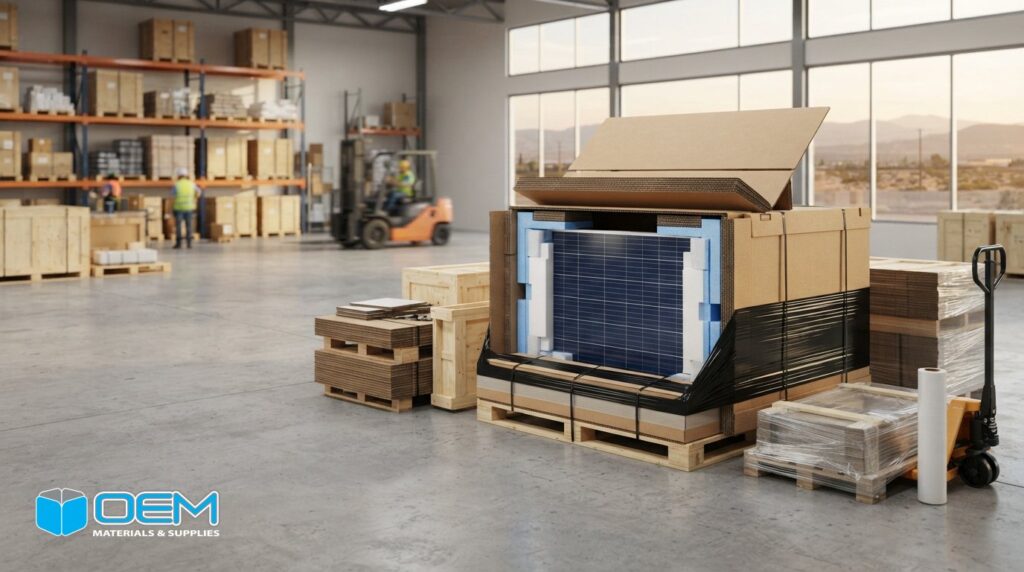
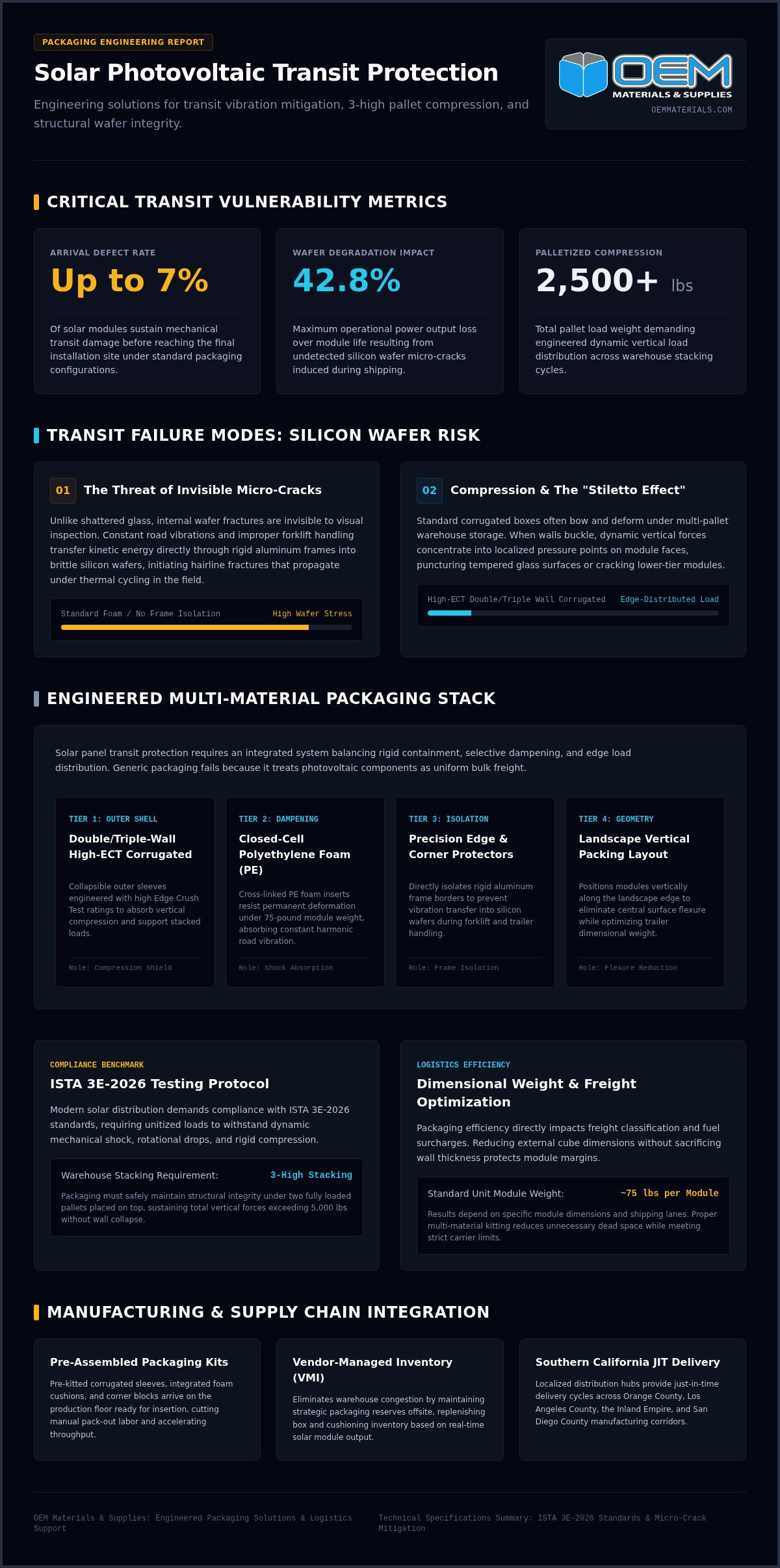
Industry audits reveal that up to 7% of solar panels sustain mechanical damage before arriving at an installation site. Even more critical is the fact that invisible micro-cracks can cause a power loss of up to 42.8% over the life of a module. For manufacturers in Orange County and across the Inland Empire, these statistics represent significant financial risks and logistical headaches. You already know that standard shipping methods often fail to protect sensitive silicon wafers from the rigors of long-haul transit. Selecting the right custom packaging for solar panels is not just about containment; it’s a precise engineering requirement to ensure product integrity from the factory floor to the final utility grid.
This guide provides a technical roadmap for selecting packaging solutions that achieve a zero-damage shipping record while reducing dimensional weight for lower freight costs. We will examine the latest ISTA 3E-2026 testing standards and the transition toward landscape vertical packing configurations. You’ll also learn how multi-material kitting and vendor-managed inventory (VMI) can streamline operations in your Los Angeles or San Diego facility. By focusing on structural dunnage and precision foam inserts, manufacturers can mitigate transit risks and protect their bottom line.
Key Takeaways
- Learn to identify and prevent invisible micro-cracks that degrade power output by utilizing engineered structural support and precision cushioning.
- Compare the durability and freight efficiency of corrugated, wood, and custom packaging for solar panels to find the best fit for your specific module dimensions.
- Discover how pre-assembled packaging kits and multi-material kitting reduce manual labor costs and accelerate production throughput.
- Optimize your supply chain and reduce storage constraints with local just-in-time delivery and vendor-managed inventory (VMI) services in Southern California.
Protecting Photovoltaic Integrity: The Role of Custom Packaging
Solar panels are unique among industrial products. They combine heavy, rigid aluminum frames with extremely fragile silicon cells and tempered glass. Standard shipping methods often treat these modules as durable bulk goods, but the reality is much more complex. Traditional corrugated boxes without internal engineering often fail to protect the delicate solar panel assembly from the shocks of long-haul transit. Effective custom packaging for solar panels must solve two conflicting problems simultaneously: providing rigid structural support while maintaining superior vibration damping.
The Threat of Micro-Cracks in Transit
Physical destruction is not always visible to the naked eye. While shattered glass is an immediate loss, micro-cracks within the silicon wafers are far more insidious. These fractures often occur during transit due to constant road vibration or improper handling by forklifts. According to industry research, these cracks can lead to power drops of up to 42.8% over the module’s operational life. The financial impact extends beyond the initial replacement cost. Return logistics, warranty claims, and damaged brand reputation can cripple a manufacturer’s margins. To prevent this, precision edge protectors are used to isolate the aluminum frames and prevent vibration from reaching the internal cells.
Load Stabilization and Vertical Compression
Large-format solar modules are heavy and bulky. A typical palletized load can exceed 2,500 pounds. Packaging must be engineered to withstand not just the weight of the panels it contains, but also the compression of stacked pallets in a warehouse. Updated ISTA 3E-2026 standards require packaging to survive 3-high stacking scenarios to ensure safety and stability. Standard boxes often collapse under these loads, leading to the “stiletto effect” where pressure points crack the bottom panels. Utilizing high-strength, double-wall or triple-wall corrugated materials ensures the load is distributed across the vertical edges rather than the panel surfaces. For manufacturers in the Inland Empire or Orange County, where warehouse space is at a premium, this stacking strength is vital for inventory management.
Custom designs also help optimize dimensional weight. By reducing the overall footprint of the packaging while increasing its strength, manufacturers can lower freight expenses. This balance of protection and efficiency is what separates a generic vendor from a true solutions partner. Results always depend on specific module dimensions and your chosen shipping lanes.
Material Selection for Solar Panel Protection
Selecting the right materials for solar transit requires balancing weight, cost, and structural performance. A successful strategy for custom packaging for solar panels relies on a multi-material approach that integrates the outer container, internal cushioning, and the pallet base into a single engineered unit. Unlike generic industrial goods, solar modules have specific pressure points and vibration sensitivities that demand high-performance materials. For manufacturers in Orange County and the Inland Empire, choosing the correct material blend is the first step toward achieving a zero-damage shipping record.
Custom Corrugated and Die-Cut Solutions
Double-wall and triple-wall corrugated boards are the industry standard for bulk shipments. These high-ECT (Edge Crush Test) materials provide the necessary vertical compression strength for three-high warehouse stacking. Precision die-cut designs allow for a tight fit, which is essential to prevent panels from shifting during sudden stops or turns. For high-volume production, custom corrugated boxes can be designed as collapsible sleeves that fit over a pallet, simplifying the unboxing process at the job site. This approach supports the complex solar photovoltaic manufacturing supply chain by protecting the module after final assembly.
Engineered Foam Packaging
Internal cushioning is where micro-crack prevention happens. Generic foam often crumbles or compresses permanently under the weight of a 75-pound module. We recommend custom foam packaging made from closed-cell polyethylene (PE). PE foam offers superior energy absorption and does not lose its shape under high static loads. Cross-linked PE is particularly effective for protecting tempered glass surfaces and sensitive wafer matrices. By specifying the correct foam density, engineers can create an air gap between panels, ensuring that vibration is absorbed by the dunnage rather than the silicon cells. This technical precision is vital when designing custom packaging for solar panels to withstand the rigors of long-distance freight.
Heavy-Duty Pallets and Crates
The foundation of every solar shipment is the pallet. Standard pallets often fail under the 2,700-pound load of 36 utility-scale modules. We specialize in heavy-duty industrial pallets and crates designed to withstand dynamic vehicle transit forces. While wood is the most common material for domestic transit, plastic pallets offer significant benefits for cleanroom environments and international shipping due to ISPM 15 compliance. For high-value prototypes or oversized panels, a custom wood crate provides the ultimate level of side-impact protection. To maintain load stabilization, we use high-performance stretch film with superior puncture resistance to prevent leaning. If you are unsure which material combination fits your current production line, you can request a packaging consultation to review your module specifications.
Engineering Efficiency: Custom Inserts vs. Bulk Shipping
Optimizing a production line requires more than just durable materials. It demands a logistical strategy that minimizes touches and maximizes throughput. While bulk shipping might seem cost-effective on a per-unit basis, the hidden labor costs of manual assembly often erase those savings. Custom packaging for solar panels provides a functional remedy by integrating multiple components into a single, ready-to-use system. This approach is particularly critical for high-volume manufacturers in Orange County and Los Angeles County who need to maintain fast cycle times and minimize warehouse bottlenecks.
Kitting and Assembly Services
Managing separate inventories for corrugated sleeves, foam inserts, and pallets creates unnecessary warehouse complexity. Pre-assembled packaging kits solve this by consolidating all required materials into a single SKU. When a kit arrives at the packing station, the operator doesn’t need to hunt for individual components or perform complex folding. This streamlined process directly reduces labor time per module. By partnering with a local supplier for kitting, manufacturers in the Inland Empire can free up floor space previously occupied by loose dunnage. These kits are often designed to facilitate landscape vertical packing, which is the industry’s preferred orientation for preventing frame deflection and lowering the center of gravity during transit.
Edge and Corner Protection
Solar modules are frequently secured with high-tension strapping to prevent shifting during transit. Without proper reinforcement, these straps can bite into the corrugated outer layer and damage the aluminum frames. Standard plastic corner caps often fail under the extreme dynamic loads found in LTL shipping. We recommend heavy-duty edge and corner protectors that run the full length of the pallet load. These components provide vertical stacking strength and distribute strap tension evenly across the entire unit load rather than concentrating it on a single point.
To validate the effectiveness of these designs, engineers reference ISTA transit testing procedures. These protocols simulate the exact vibration and impact scenarios panels face on a truck or rail car. Using custom-length protectors ensures that the panels stay immobile, which is the most effective way to prevent the cyclic vibration that leads to cell degradation. This level of technical precision transforms basic shipping supplies into an engineered protection system. Results depend on your specific pallet configuration and the weight of your modules, but the reduction in labor and damage claims is often measurable within the first few shipment cycles.
Key Specifications for Solar Packaging Procurement
Procuring the right custom packaging for solar panels requires a data-driven approach. A mismatch between panel specifications and packaging design leads to wasted material, increased freight costs, and inadequate protection. To ensure your shipping system is optimized for both safety and cost, procurement professionals must follow a structured specification process. Providing precise details during the design phase allows for rapid prototyping and ensures the final product meets the rigorous demands of the solar supply chain.
- Step 1: Define panel dimensions and weight with millimeter precision.
- Step 2: Identify the shipping lane and transportation mode, such as LTL, FTL, or ocean freight.
- Step 3: Determine stacking requirements for warehouse optimization.
- Step 4: Evaluate environmental exposure, including humidity levels at port locations.
- Step 5: Review annual usage to leverage volume-based pricing.
Determining Dimensional and Weight Constraints
Accurate measurements are the foundation of engineered packaging. When defining dimensions, engineers must measure the frame thickness, which often ranges from 30mm to 40mm for large-format utility modules. This ensures the custom foam packaging provides a snug fit without putting pressure on the tempered glass. You must also account for the weight of integrated cables and connectors, as these add to the total pallet weight. Factoring in the weight of the packaging itself is equally important. A heavy-duty wood crate offers superior protection but will increase your dimensional weight and freight expenses compared to a high-ECT corrugated sleeve.
Volume and Inventory Planning
Annual usage data is critical for accurate recommendations and pricing tiers. Solar manufacturers in Southern California often face storage space constraints for bulky packaging materials. By providing projected order volumes, you allow your supplier to implement a vendor-managed inventory (VMI) program. This service ensures you have a consistent supply of custom packaging for solar panels without tying up your warehouse floor space in San Diego or Riverside. Identifying the frequency of your production runs helps prevent stockouts, which can lead to expensive production line shutdowns. Balancing inventory levels with just-in-time delivery is the most effective way to manage costs in a high-volume manufacturing environment.
Providing these details early in the process facilitates a more accurate and efficient consultation. To begin designing a solution tailored to your specific module dimensions and shipping requirements, you can submit your product specifications for a custom quote.
Strategic Packaging Supply for Southern California Solar OEMs
Supply chain stability is as critical as the engineering of the packaging itself. For manufacturers in Southern California, the logistical infrastructure supporting a production line must be agile and responsive. Securing custom packaging for solar panels from a local partner provides the necessary proximity to manage sudden shifts in demand or rapid design changes. This regional focus eliminates the high freight costs and long lead times associated with shipping bulky, empty packaging materials across state lines.
Vendor Managed Inventory (VMI)
Warehouse floor space in Orange County and Los Angeles is a premium asset. Storing high volumes of triple-wall corrugated sleeves, large foam inserts, and heavy-duty pallets on-site can lead to severe operational bottlenecks. Our packaging VMI services provide a functional remedy by shifting the burden of inventory management to the supplier. We monitor your usage patterns and maintain stock levels in our regional facilities, ensuring that your production line never faces a stockout. This system transforms packaging from a storage headache into a reliable, just-in-time resource. By freeing up square footage, manufacturers can expand their assembly lines or increase their finished goods inventory.
Local Support for San Diego and Riverside Manufacturers
The Southern California renewable energy corridor, stretching from San Diego to the Inland Empire, requires a specific level of logistical agility. Freight expenses for inbound packaging are a silent margin killer. By sourcing locally, OEMs in Riverside and San Diego significantly reduce these overhead costs. Proximity also facilitates on-site consultations where packaging engineers can review your specific production flow and identify opportunities for optimization. Whether it is adjusting the thickness of a foam corner protector or redesigning a corrugated sleeve for better stacking, having a partner within driving distance accelerates the design-to-delivery cycle.
Rapid prototyping is another vital benefit of a local partnership. When a manufacturer develops a new module with updated wafer technology or a different frame thickness, they cannot afford to wait weeks for a packaging sample. We provide quick-turn prototypes that allow for immediate testing against ISTA standards. This speed ensures that your new products reach the market faster while maintaining the highest standards of protection. By leveraging a local supply chain, Southern California solar OEMs can maintain a zero-damage shipping record while optimizing their internal warehouse efficiency. Results for cost reduction and lead time improvements depend on your specific production volume and module dimensions.
Optimizing Your Solar Supply Chain
Protecting photovoltaic modules requires more than a standard shipping box. It demands a high-performance system that balances structural rigidity with precision vibration damping. By integrating multi-material kitting and specialized edge protection, manufacturers can achieve a zero-damage shipping record while significantly reducing manual assembly time. Transitioning to custom packaging for solar panels is a strategic investment that pays dividends through lower warranty claims and optimized freight efficiency.
OEM Materials & Supplies delivers technical expertise and engineered solutions to manufacturers across Orange County, Los Angeles, San Diego, and Riverside. Our comprehensive VMI and JIT services ensure your production line never stalls due to packaging shortages. Whether you’re scaling utility-scale module production or developing new aerospace prototypes, we provide the industrial reliability your operation requires. We invite you to contact OEM Materials & Supplies for a custom solar packaging quote. Please be ready to provide your module dimensions, pallet weights, and annual usage so our engineers can develop a prototype tailored to your specific logistical requirements. We look forward to securing your next shipment.
Frequently Asked Questions
What is the best material for packaging solar panels?
The most effective solution utilizes a multi-material system. This includes high-ECT triple-wall corrugated sleeves for vertical compression and closed-cell polyethylene foam for internal cushioning. These components are secured to heavy-duty wood or plastic pallets. This combination provides the rigid structural support needed for stacking in warehouse environments while protecting the fragile silicon wafers from transit shocks. Results for protection levels vary based on specific module weight and frame thickness.
How do custom foam inserts prevent micro-cracks in solar cells?
Custom foam inserts prevent micro-cracks by isolating the aluminum frame from external impacts and vibration. We utilize precision die-cut polyethylene foam to create a protective air gap between panel surfaces. This prevents the pressure points on the glass that transfer stress to the silicon cells. By absorbing cyclic road vibration during transit, these engineered inserts ensure that the modules arrive with their full power-generating capacity intact, preventing invisible damage before installation.
Can custom packaging reduce my shipping costs?
Engineered packaging reduces costs by optimizing dimensional weight and eliminating product damage. Custom-fit designs remove unnecessary bulk, allowing for higher pallet density and lower freight rates. Reducing the rate of micro-cracks and glass breakage also lowers the financial burden of return logistics and warranty claims. Actual savings depend on variables like shipment volume, panel dimensions, and the chosen transportation mode, such as LTL or ocean freight, rather than just material costs.
What information do I need to provide for a custom packaging quote?
To provide an accurate quote for custom packaging for solar panels, we need several technical data points. Please provide the length, width, and frame thickness of each module, along with the individual panel weight. We also require your projected annual usage and desired pallet configuration. Identifying your primary shipping lanes and warehouse stacking requirements allows our engineers to calculate the necessary ECT ratings and foam densities for your specific application.
Do you offer just-in-time delivery for solar panel manufacturers in Los Angeles?
We offer comprehensive just-in-time (JIT) delivery for manufacturers throughout Los Angeles, Orange County, and the Inland Empire. This service is designed to synchronize packaging arrivals with your daily production schedules. By receiving corrugated boxes and foam dunnage exactly when needed, you avoid the logistical bottleneck of storing bulky materials on your factory floor. This local agility is essential for maintaining high-volume throughput in the competitive Southern California solar corridor.
How does vendor-managed inventory work for packaging supplies?
Vendor-managed inventory (VMI) shifts the responsibility of stock monitoring to our team. We track your usage rates and replenish your packaging supplies automatically from our regional hubs. This ensures that your facility in San Diego or Riverside always has the necessary kits available for the production line. VMI lowers your overhead costs by reducing the capital tied up in unused inventory and freeing up valuable warehouse square footage for other operational needs.
Are your pallets and crates compliant with international shipping regulations?
Yes, our industrial pallets and wood crates meet all ISPM 15 heat treatment requirements for international shipping. Each unit is marked with the appropriate IPPC stamp to verify compliance with global pest control regulations. For manufacturers shipping into cleanroom environments or across borders, we also provide plastic pallets that are exempt from these treatments. These solutions prevent customs delays and ensure your photovoltaic modules reach global installation sites safely and on schedule.
Can you design packaging for oversized or non-standard solar modules?
We specialize in rapid prototyping for oversized or unique photovoltaic modules. Our engineering team designs custom packaging for solar panels used in utility-scale farms and specialized electronics applications. We analyze the center of gravity and frame deflection points to ensure non-standard modules remain stable during transit. If you are developing a new wafer technology or a large-format commercial panel, we can fabricate a protective system that meets rigorous ISTA testing standards.