
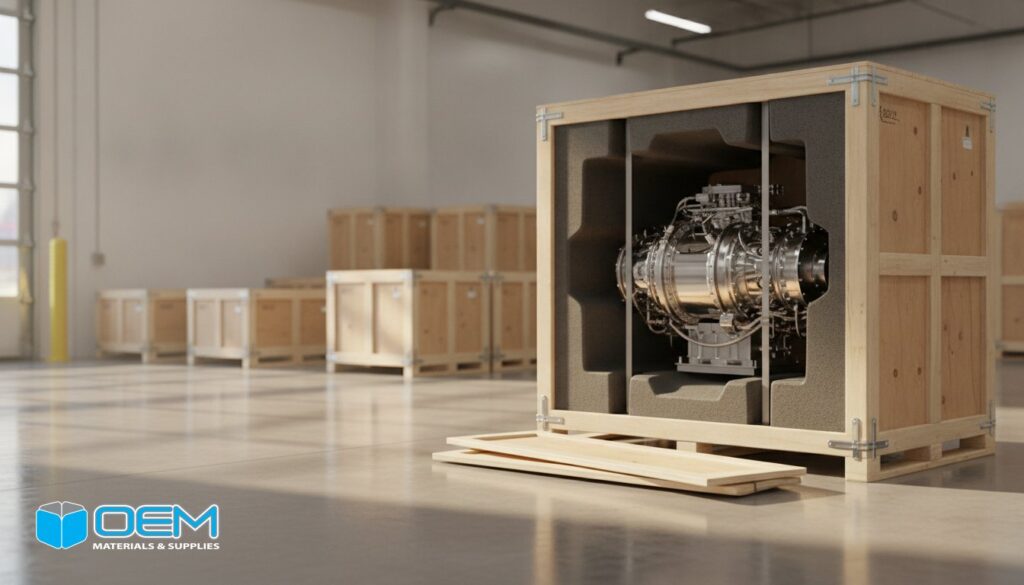
A single instance of transit damage to a high-value medical device or aerospace component often costs more than an entire year of packaging spend. For Riverside manufacturers, the stakes are high as global biosecurity enforcement reaches a zero tolerance level for non-compliant wood packaging. You understand that a sturdy box is not enough when shipping sensitive industrial assets. A minor engineering flaw or an incorrectly formatted IPPC mark can lead to rejected international shipments and significant logistical delays.
Securing reliable custom wood shipping crates in Riverside that operations can depend on requires a partner who understands both technical protection and regulatory precision. We will demonstrate how engineered wood crates protect your high-value assets and streamline logistics for local manufacturers. This guide covers the latest 2026 ISPM-15 heat treatment standards, including the mandatory hyphenated US-1234 marking format, and explains how optimized crate designs can reduce your total cost of ownership by maximizing warehouse efficiency. By the end of this article, you will know how to select crating solutions that ensure zero-damage shipments and full regulatory compliance for export.
Key Takeaways
- Learn how custom wood shipping crates riverside manufacturers utilize protect sensitive industrial machinery from the physical stresses of long haul transit.
- Understand the latest ISPM-15 heat treatment standards and why specific material selection is critical for avoiding international shipping delays and fines.
- Identify the optimal crate design for your application by comparing the benefits of fully enclosed boxes, open-slat skeleton crates, and reusable knock-down styles.
- Discover how to integrate engineered foam inserts with rigid wood exteriors to achieve zero-damage shipments for fragile electronics or medical devices.
- Explore how local vendor-managed inventory (VMI) services and Southern California proximity can reduce your warehouse footprint and optimize total packaging costs.
Strategic Importance of Custom Wood Shipping Crates for Riverside Manufacturers
Riverside is a central pillar of the Southern California industrial landscape. The Inland Empire region currently supports over 4,000 warehouses and a manufacturing sector that employs more than 92,200 people. This high-density logistics environment creates unique stresses on cargo. Standard pallets often lack the lateral stability required for heavy machinery or the protective barriers needed for sensitive medical electronics. By integrating the custom wood shipping crates riverside manufacturers require, companies can mitigate the risks associated with the frequent loading, unloading, and cross-docking common in the regional distribution network. These enclosures provide the rigid structural support necessary to navigate a complex supply chain without compromising the internal asset.
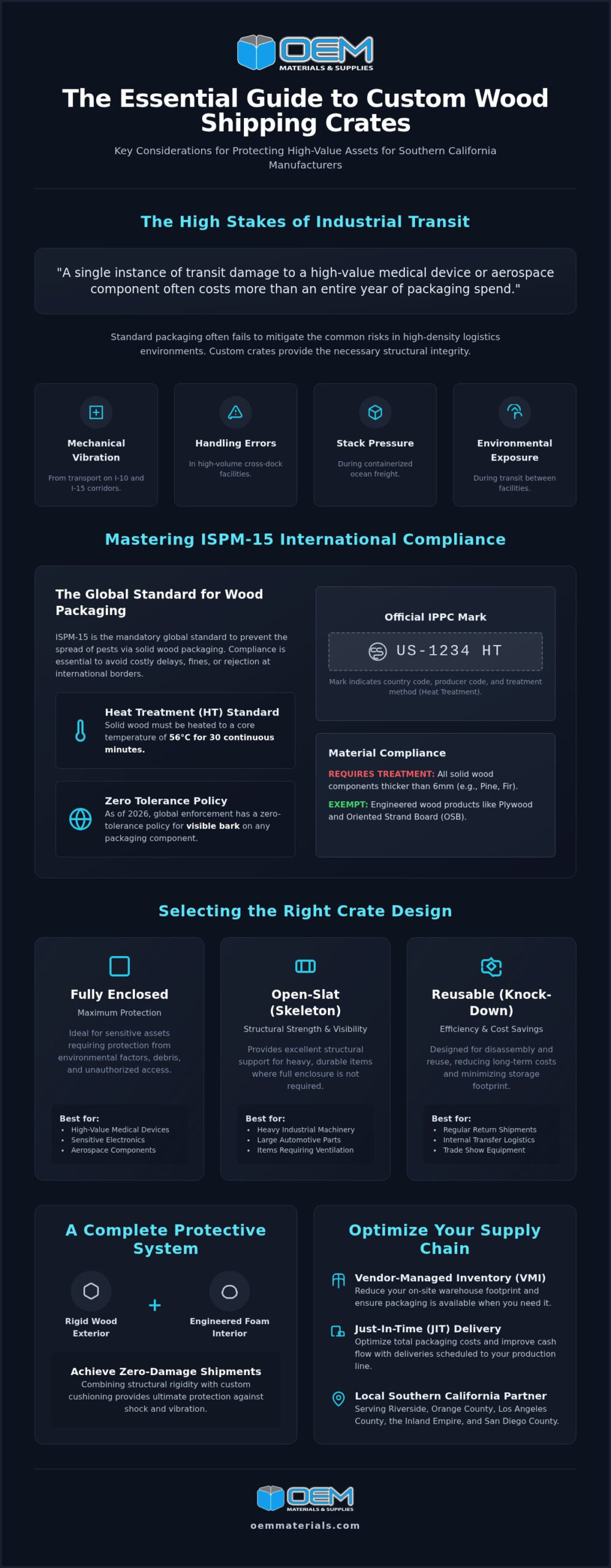
- Mechanical vibration during truck transport on the I-10 and I-15 corridors.
- Forklift handling errors in high-volume cross-dock facilities.
- Stack pressure and shifting in containerized ocean freight.
- Environmental exposure during transition between climate-controlled facilities.
Protecting High-Value Industrial Assets
Precision components face extreme mechanical shocks during flatbed or ocean transport. Industrial equipment engineered in Riverside often requires specific structural support to prevent internal calibration shifts or surface abrasions. Unlike generic packaging, custom enclosures are built to handle the exact weight distribution of the asset. These rigid shells resist crushing and provide a stable mounting point for internal cushioning materials. They also serve as a critical physical barrier, protecting against debris, moisture, and unauthorized access during multi-modal transit. For aerospace and medical sectors, this level of protection isn’t optional; it’s a fundamental requirement for quality control.
The Economic Impact of Transit Damage
The financial consequences of a damaged shipment extend far beyond the cost of the wood. Manufacturers must account for the expense of replacement parts, labor for repairs, and the high cost of expedited shipping to meet original deadlines. These incidents often lead to increased insurance premiums and long administrative cycles for claims processing. Reliability in the supply chain is directly tied to the structural integrity of the shipping container. Adhering to international standards like ISPM-15 Compliance is equally important, as non-compliant wood can lead to immediate shipment rejection at the border. Crate integrity is the foundational requirement for maintaining a predictable and resilient supply chain. Proper crating is an investment in predictable delivery and maintained brand reputation.
Engineering Standards: ISPM-15 Compliance and Material Selection
Engineering standards dictate the success of international logistics. For a Riverside facility to maintain compliance, understanding the technical requirements of wood packaging is mandatory. ISPM-15 is the primary global standard, requiring solid wood thicker than 6mm to be heat-treated to a core temperature of 56°C for at least 30 continuous minutes. While engineered wood products like plywood and OSB are exempt, solid lumber must bear the official IPPC mark to pass through customs in over 180 countries. Selecting the right materials ensures that your assets remain secure while avoiding the legal risks associated with non-compliant packaging.
Material selection is a balance of weight, durability, and cost. Southern Yellow Pine provides excellent structural strength for heavy loads, while plywood offers a high strength-to-weight ratio and natural resistance to splitting. Selecting the right material depends on the fragility of the asset and the specific shipping route. Proper moisture control is also vital; kiln-dried lumber prevents mold growth and reduces the risk of structural warping during long ocean voyages. This technical precision is what separates a basic box from high-quality custom wood shipping crates riverside manufacturers rely on for global distribution.
Understanding Heat-Treated Lumber Requirements
Pest elimination through heat treatment is a legal requirement for international trade. As of 2026, global enforcement has become significantly stricter, with a zero-tolerance policy for visible bark on any packaging material. U.S. Customs now strictly requires a hyphen to separate the country code and facility code in the IPPC mark, such as “US-1234”. Failure to use heat-stamped marks or following incorrect formatting can lead to immediate shipment rejection, resulting in costly drayage fees and port delays. You should verify that your supplier provides fully compliant, heat-treated materials that meet these evolving standards to prevent logistics bottlenecks.
Structural Integrity and Load-Bearing Calculations
Engineering for heavy machinery requires precise load-bearing calculations. For assets exceeding 5000 pounds, the base skid design must be engineered to distribute weight evenly across the floor of a container or flatbed. This prevents structural failure during crane lifts or forklift maneuvers. Integrating the core principles of Protective Packaging: Foam and Load Stabilization ensures that the crate can withstand vertical compression and lateral shifting. High-quality custom wooden crates are designed for stackability, allowing you to maximize warehouse and container space without risking damage to the lower units.
If your current packaging design lacks the structural data to support your heaviest assets, you can request a technical consultation to review your specific load-bearing requirements.
Selecting the Right Crate Design for Your Application
Selecting the optimal design for custom wood shipping crates riverside manufacturers require involves more than just measuring external dimensions. You must evaluate the shipping method, the fragility of the internal asset, and whether the container will be reused in a returnable program. A well-engineered design prevents mechanical failure and optimizes freight costs by avoiding unnecessary material weight. Industrial buyers in Southern California often choose between several structural configurations based on their specific logistics requirements.
Open Slat vs. Fully Enclosed Wooden Boxes
Open-slat skeleton crates provide a cost-effective solution for durable industrial components that don’t require protection from dust or moisture. These designs allow for easy visual inspection by customs officials and facilitate airflow, which is critical for certain mechanical parts that might be prone to condensation. In contrast, fully enclosed wooden boxes offer maximum security for sensitive electronics and medical laboratory equipment. These solid-wall containers shield the contents from environmental debris and potential theft. For specific manufacturing needs, a hybrid approach often works best. You might use a heavy-duty solid base to support a machine’s weight while utilizing a skeleton top to reduce material costs and overall shipment weight.
Heavy-Duty Crating for Machinery and Aerospace
Aerospace components and industrial machinery often present challenges like oversized dimensions and irregular centers of gravity. Engineering for these assets requires internal blocking and bracing to prevent shifting during high-G force transit. Without precise internal stabilization, even the strongest external shell can’t prevent damage. We offer specialized custom wooden crates that incorporate reinforced corners and heavy-duty skids designed for crane lifting and forklift handling. These designs ensure that the center of gravity remains stable even when the crate is tilted during loading onto ocean vessels or flatbed trucks.
For returnable shipping programs, knock-down crates offer a significant logistical advantage. These designs can be disassembled and flat-packed for the return leg, reducing the total cost of ownership across multiple shipments. Customization options like heavy-duty recessed latches, spring-loaded handles, and steel-reinforced corners allow these containers to withstand the rigors of repeated use in the automotive and medical sectors. When you specify a design, consider how the hardware will impact the packing time and the ease of access for the end user at the destination facility.
Integrating Protective Packaging: Foam and Load Stabilization
The structural integrity of custom wood shipping crates riverside manufacturers rely on is only the first line of defense. While the wood shell provides compression strength and puncture resistance, the internal environment requires precision engineering to neutralize mechanical shocks. Effective load stabilization depends on the synergy between the rigid exterior and engineered internal components. For high-value industrial assets, this often includes a combination of custom foam, moisture barriers, and mechanical blocking. A rigid crate without internal stabilization simply transfers every road vibration and handling shock directly to your product.
Selecting the correct foam density is critical for meeting specific G-force tolerances. Fragile medical devices often require softer, open-cell foams to absorb low-energy vibrations, while heavy aerospace components need high-density polyethylene to support significant weight without bottoming out. We also integrate edge protectors and specialized cushioning materials to prevent internal abrasion during long-haul transit. For international ocean freight, we incorporate moisture barrier bags and desiccants to protect sensitive surfaces from the corrosive effects of salt air and humidity. These elements work together to ensure that the asset arrives in factory-new condition regardless of the shipping duration.
Custom Foam Inserts for Sensitive Electronics
Sensitive electronics require a precision fit that only custom-fabricated foam can provide. Manufacturers often choose between polyethylene for its durability and moisture resistance or polyurethane for its superior cushioning properties. Utilizing custom foam packaging ensures that every component is nested securely, eliminating the risk of movement within the crate. These pre-engineered foam inserts also reduce warehouse labor costs by standardizing the packing process, allowing your team to secure complex assemblies in a fraction of the time required for loose-fill methods. This standardization minimizes human error and guarantees a consistent level of protection for every shipment.
Blocking, Bracing, and Internal Stabilization
Heavy machinery requires more than just cushioning; it needs mechanical stabilization. We use technical blocking and bracing techniques to secure heavy components directly to the crate base, preventing lateral shifting during sudden stops or crane maneuvers. This process often involves the use of specialized cushioning materials to protect finished surfaces from scratches caused by the wood bracing itself. By combining mechanical fasteners with protective barriers, we ensure the asset remains stationary regardless of the transport orientation. This dual-layered approach protects both the structural alignment and the aesthetic finish of your industrial equipment.
If you are shipping equipment with complex geometries or sensitive calibration, you can contact our engineering team for a prototype design that includes custom-cut foam and stabilization hardware.
Optimizing Your Supply Chain with a Riverside Packaging Partner
Riverside manufacturers operate within one of the nation’s most active industrial corridors. With the Inland Empire supporting over 4,000 warehouses and serving as a top tier exporter in the U.S., local logistics efficiency is a competitive necessity. Leveraging a local partner for custom wood shipping crates riverside operations allows for significantly faster lead times compared to out-of-state vendors. Proximity reduces drayage costs and allows for on-site engineering consultations that ensure the packaging design evolves alongside your product development. This local presence is especially critical as Southern California ports face anticipated congestion, making reliable, just-in-time delivery a safeguard against production line bottlenecks.
Collaborating with local engineers for prototype design and rapid testing allows your team to identify potential failure points before they impact your bottom line. We work directly with your operations managers to conduct fit tests and load-bearing trials, ensuring that the crate design is optimized for your specific handling equipment. This proactive approach prevents the costly delays associated with shipping containers that don’t fit standard forklift apertures or exceed the weight limits of regional drayage carriers.
Vendor-Managed Inventory (VMI) for Shipping Crates
Bulky wooden crates consume significant floor space, often leading to warehouse inefficiencies. Our Vendor-Managed Inventory (VMI) program solves this by shifting the burden of stock management to the supplier. We monitor your usage patterns and maintain a safety stock of your specific crate designs, delivering them only when they are needed on the assembly floor. This approach eliminates the risk of stockouts for critical shipping materials while freeing up valuable square footage for actual manufacturing. By automating the replenishment process, your procurement team can focus on high-level supply chain strategy rather than tracking individual crate counts.
Streamlining Procurement for Inland Empire OEMs
Managing multiple vendors for corrugated boxes, custom foam, and wood crates creates administrative friction and increases the likelihood of component mismatch. Working with a single-source solutions partner ensures that every element of the packaging system is engineered to work together. This integration is a core theme in our guide on Choosing a Wholesale Industrial Packaging Supplier for Southern California Manufacturers. When one partner handles the entire kit, from the rigid outer crate to the internal cushioning, the risk of transit damage drops significantly. This streamlined model also simplifies the accounting process, as all packaging assets are captured under a single procurement umbrella.
Efficiency in the supply chain depends on accurate data and responsive design. If you are looking to reduce your total cost of ownership or need to develop a prototype for a new industrial asset, you can contact a specialist for a custom quote. Be prepared to provide product dimensions, weight, and annual usage to facilitate a precise recommendation that aligns with your Riverside logistics requirements.
Securing Your Industrial Assets for Global Distribution
Effective industrial packaging is a strategic asset that safeguards your equipment and your company’s bottom line. By prioritizing ISPM-15 compliance and precision load stabilization, you eliminate the risks of rejected shipments and costly transit damage. Integrating engineered foam interiors with rigid wood exteriors ensures that even the most sensitive medical or aerospace components arrive in factory-new condition.
Riverside manufacturers can further optimize operations by leveraging local expertise and managed inventory services. Transitioning to a Vendor-Managed Inventory (VMI) model for your custom wood shipping crates riverside requirements reduces warehouse congestion and prevents production delays. We bring specialized engineering capabilities to sectors including electronics, automotive, and medical devices across the Inland Empire and greater Southern California.
If you’re ready to improve your logistics reliability and reduce total cost of ownership, we can help. Please Request a Quote for Custom Wood Shipping Crates to begin a technical consultation. We look forward to supporting your next shipment with reliable, high-performance packaging solutions.
Frequently Asked Questions
What is the difference between a wood crate and a wood box?
A wood crate is defined by its open or skeleton structure, allowing for easy inspection and ventilation. In contrast, a wood box is a fully enclosed container that provides a complete physical barrier against dust, debris, and theft. Selecting the right design depends on the fragility of your asset and the shipping environment. For many industrial applications, a hybrid design featuring a solid base and skeleton top provides the necessary balance of strength and cost efficiency.
How do I know if my wood crates need to be heat treated for export?
Any solid wood packaging material thicker than 6mm requires heat treatment if it’s crossing international borders. This is a mandatory requirement under ISPM-15 standards to eliminate wood-boring pests. Heat-treated crates must be kiln-dried and bear the official IPPC mark, which now requires a hyphen between the country and facility code (e.g., US-1234). Using compliant custom wood shipping crates riverside suppliers provide is essential to avoid shipment rejection and costly drayage fees at foreign ports.
Can custom wood crates be reused for multiple shipments?
Custom wood crates can be engineered for multiple uses through the integration of heavy-duty hardware and reinforced corners. Knock-down designs are particularly effective for returnable shipping programs because they can be flat-packed for the return leg, reducing freight costs. While the initial investment for a reusable crate is higher than a single-use container, the total cost of ownership often decreases significantly over several shipping cycles depending on your specific logistics loop and material durability.
What information is needed to get an accurate quote for custom crating?
To provide an accurate quote, we require specific data regarding the asset and its transit route. You should provide the exact dimensions and weight of the product along with its center of gravity if it’s irregular. Information about the shipping method, such as ocean freight or flatbed truck, helps determine structural requirements. Additionally, specifying your annual usage and any sensitivity to moisture or G-forces allows our engineers to recommend the most cost-effective materials and internal cushioning.
Are custom foam inserts necessary for all wood crates?
Custom foam inserts aren’t mandatory for every application but are highly recommended for sensitive industrial assets. While the wood exterior provides structural integrity, foam is necessary to neutralize mechanical shocks and vibrations that occur during transit. For durable machinery, simple blocking and bracing may suffice. However, for precision aerospace components or medical electronics, engineered foam inserts are critical to ensuring the product arrives in factory-new condition without internal calibration shifts or surface damage.
What industries in Riverside typically require custom wood crating?
Riverside and the broader Inland Empire support a diverse manufacturing base that relies on specialized packaging. Key sectors include aerospace, medical device manufacturing, electronics, and automotive components. These industries often produce high-value, heavy, or sensitive equipment that standard pallets cannot safely support. Local manufacturers utilize custom wood shipping crates riverside services to navigate the regional distribution network and ensure their products meet rigorous international export standards while minimizing the risk of transit damage.
How does a Vendor-Managed Inventory program work for large wood crates?
A Vendor-Managed Inventory (VMI) program for crates involves the supplier taking responsibility for monitoring and replenishing your stock levels. Instead of storing bulky crates on your production floor, we maintain a safety stock at our facility and deliver them just-in-time as your assembly schedule requires. This model reduces your warehouse footprint and eliminates the administrative burden of tracking inventory. It ensures you always have the necessary shipping materials without tying up capital in excess floor stock.
What is the typical lead time for a custom engineered wood crate?
Lead times for custom engineered wood crates vary based on the complexity of the design and the volume of the order. Simple designs can often be prototyped and produced quickly, while complex crates with custom foam inserts and specialized hardware may take longer. Our Riverside proximity allows us to offer faster delivery cycles to Southern California manufacturers than out-of-state vendors. We prioritize responsive service to help you avoid production bottlenecks and meet tight shipping deadlines for critical industrial projects.