
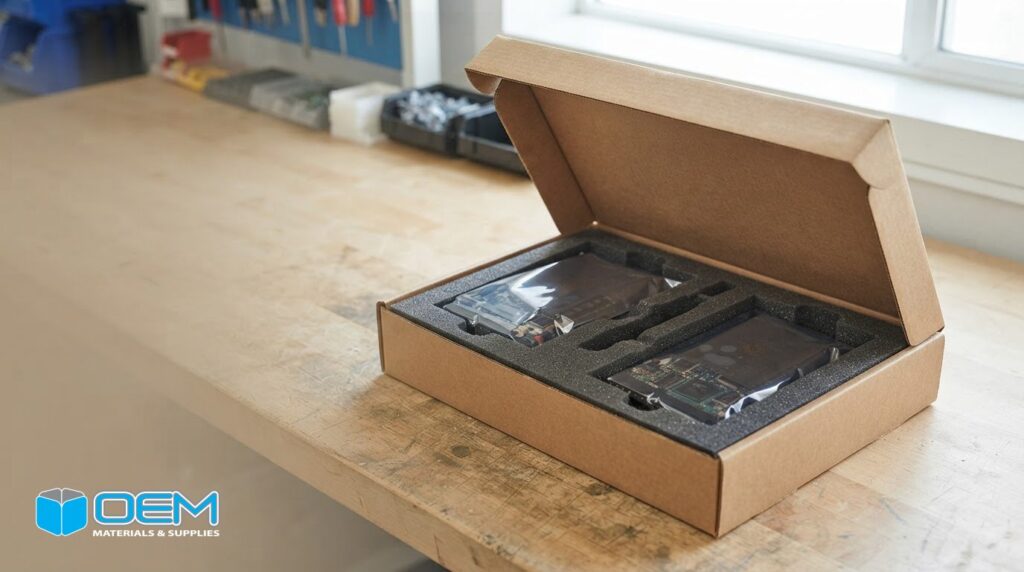
Electronics packaging works when the protection matches the product and its shipping conditions. Chula Vista electronics packaging solutions can combine corrugated boxes, foam, and cushioning materials to limit movement and help protect components during handling and transit. The right approach depends on product shape, fragility, and how the shipment will be stored and moved.
Choosing packaging isn’t just a matter of selecting a box. Fit, protective materials, palletization, stretch film, and crate requirements all affect how a shipment is prepared. This guide explains how those decisions fit together for Chula Vista electronics packaging solutions, what to consider when planning a package, and how OEM Materials & Supplies’ packaging products can support the process. It also covers how design choices relate to labor, material use, and supply-chain needs, so you can define the project before requesting a recommendation.
Key Takeaways
- Match corrugated boxes and foam protection to the electronics’ shape, handling needs, and shipping conditions.
- Account for static sensitivity and impact exposure when selecting protective packaging for electronic components.
- Evaluate packaging costs through product dimensions, material choices, packing labor, and shipping requirements.
- Use custom packaging design to improve product fit and make packing steps more consistent.
- Plan how stretch film, pallets, crates, and tape work together to secure shipments for storage and transit.
Corrugated boxes and foam protective packaging
Electronics packaging combines an outer container, often a corrugated box, with internal cushioning to manage movement and impact. Product weight, shape, sensitive surfaces, and shipping conditions guide the design.
Corrugated Box Protection
A corrugated box forms an outer layer around equipment, components, or accessories. For example, a box holding a circuit assembly should leave room for cushioning without letting the product shift. Review the packed product’s dimensions, weight, and closure method together. A poor fit can leave gaps or put pressure on delicate parts.
Foam Protection for High-Value Electronics
Foam can cradle a high-value device and separate it from the box walls. A shaped cavity can hold a control unit in position, while cutouts can keep cables or accessories from contacting its surface. The foam’s layout should match the product’s contact points and handling needs. Foam packaging can be considered alongside the outer box for a coordinated fit.
Protective Packaging Features
Assess the complete package, not just its material. Check whether the product stays centered, openings expose vulnerable edges, and the package can be closed consistently. For a display with a protruding connector, the interior should prevent that feature from bearing the package’s load. Custom packaging should also support repeatable packing steps.
Turnaround time and minimum order size depend on the design, materials, and production quantity. For a useful comparison, define the package configuration and order volume first, then review the quoted schedule and quantity terms.
Lithium battery shipments from Chula Vista depend on battery type, configuration, and transport mode. Identify whether batteries ship installed in equipment, packed with equipment, or separately, then follow the requirements for that shipment.
Electronics packaging should meet the quality requirements set for the product and its destination. Put required certifications, inspection steps, and packaging acceptance criteria in the purchasing specification before production begins.
Chula Vista businesses can work with industrial packaging suppliers serving San Diego County. Compare relevant packaging capabilities, the proposed design, turnaround terms, and minimum order requirements for the specific electronics shipment.
For recyclable packaging near Chula Vista, assess corrugated material and how the complete package can be separated after use. Chula Vista Municipal Code section 8.25.050 makes recycling mandatory, so packaging choices should account for local recycling practices.
Key risks include product movement, impact damage, exposed connectors, and packaging that complicates assembly or unpacking. Test the packed configuration with the actual product and packing sequence, and include any custom crate needs in the design review.
California law says businesses generating four cubic yards or more of commercial solid waste per week and multifamily dwellings with five or more units shall arrange recycling when services are offered and reasonably available.
Anti-static and impact-resistant packaging for electronics
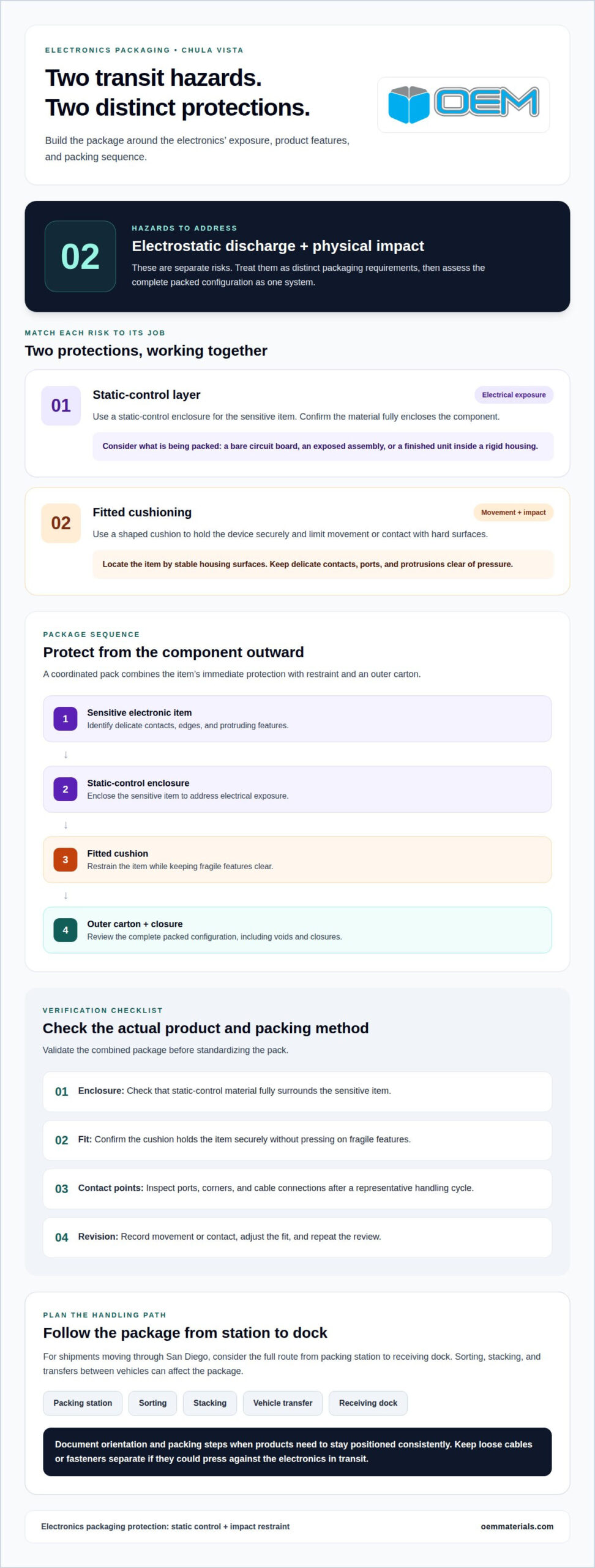
Electronic assemblies can face two separate hazards in transit: electrostatic discharge and physical impact. A circuit board may need static-control protection, while its connectors and soldered components also need cushioning. Treat these as distinct packaging requirements. A static-control layer addresses electrical exposure; a fitted protective structure helps limit movement and contact with hard surfaces.
Start by identifying which items are sensitive and how they will be packed. A bare circuit board, for example, has different handling needs from a finished control unit inside a rigid housing. Specify whether the item is assembled, exposed, or enclosed, and note any delicate contacts or protrusions. This product profile informs material selection and the package’s internal layout.
Next, map the packing sequence. The component should enter its protective layer without sliding across an unprotected work surface or contacting unrelated materials. Placing a board in a static-control enclosure and then securing it in a fitted cushion shows how electrical and impact protection can work together. Keep accessories separate if loose cables or fasteners could press against the electronics in transit.
Impact protection depends on restraint as well as cushioning. If a device shifts inside its carton, repeated movement can stress edges, ports, and internal connections. A shaped insert can locate a unit by its stable housing surfaces while keeping sensitive controls and connectors clear. Review the complete packed configuration, including voids, closures, and handling at each transfer point.
For shipments moving through San Diego, consider the full route from packing station to receiving dock. A parcel may be sorted, stacked, or transferred between vehicles, and each handling stage can affect the package. Document the orientation and packing steps for products that must stay positioned consistently. This gives warehouse teams a repeatable method and helps identify where an item could shift or contact another object.
Validate packaging with the actual product and intended packing method. Check that static-control materials fully enclose the sensitive item, then confirm the cushion holds it securely without pressing on fragile features. For a control module, inspect its ports, corners, and cable connections after a representative handling cycle. Record any movement or contact, revise the fit, and repeat the review before standardizing the pack.
Static-control and impact-resistant packaging address different failure modes, so one material rarely solves every concern. Define the electronics’ exposure, packing sequence, and transit handling first. Then assess the combined package as a system, from the product’s immediate protective layer through its cushioning and outer container.
Cost-efficient packaging
Packaging cost depends on more than the material used for a shipment. Product dimensions, protective materials, packing labor, shipping requirements, and damage exposure all shape the total. A smaller carton may reduce material use, for example, but only if the product remains protected and the package suits its shipping method.
Start with the product and shipment profile. Record the item’s dimensions, weight, fragile features, order pattern, and destination type. Then review the packing sequence at the workstation. A package that requires repeated trimming or extra void fill can use more labor and materials even when its unit material cost appears low.
Right-size the package without removing necessary protection. For a compact electronic assembly, compare its current carton with a closer-fitting design that still accommodates cushioning and closure. Evaluate unused space and whether the product can move during handling. Reducing excess space can simplify packing, but the right dimensions depend on the product and shipping conditions.
Review material combinations as a system. A fitted foam insert inside a corrugated box may reduce the need for loose cushioning and make placement more consistent. For a product shipped with cables or accessories, a packaging kit can organize components and reduce separate packing decisions. The right configuration depends on dimensions, materials, and shipping requirements, not just one material.
Standardize the packing method across shifts. Document the material sequence, product orientation, and closure method for each package configuration. A workstation guide, for example, can show where an insert sits and how accessories are arranged. Consistent steps help reduce variation and make unnecessary handling or material use easier to identify.
Inventory also affects packaging efficiency. Too many material types can take up storage space and complicate replenishment, while too few options may force poor-fitting substitutions. Review usage patterns alongside packaging specifications. A stable supply of selected materials helps teams follow the intended method instead of improvising with whatever is nearby.
Sustainability decisions should account for the complete package and its end-of-use handling. Assess whether components can be separated, reused, or recycled through the applicable local system. For example, a corrugated outer box and removable insert can make separation clearer. Reducing material is useful only when the package still protects the product.
Compare alternatives using the same product and shipping scenario. Track material consumption, packing steps, storage demands, and damage outcomes for each configuration. These measures show where changes may improve efficiency without shifting costs into rework or product replacement. A practical packaging cost review weighs these operational factors together.
Custom electronics packaging
For Chula Vista electronics packaging solutions, start with the product’s geometry and handling needs. Record its overall dimensions, weight, orientation, and any surfaces that cannot bear pressure. Note unusual features such as heat sinks, recessed controls, or mounting brackets. These details help define an interior that locates the product without interfering with handling.
Next, identify how the item moves through production and fulfillment. A component transferred between assembly stations may need different packaging from a finished unit prepared for outbound shipping. Consider where operators grip the product, how it enters the package, and how the receiving team removes it. A design that supports these transitions can reduce awkward handling in routine work.
Review product variations before finalizing a design. If related models share a housing but differ in connector placement, one interior layout may not suit every version. Map the differences and determine which features affect the fit. This review can help prevent mix-ups when production teams handle similar electronics on the same line.
Use a sample package to evaluate the design before adopting it across an operation. Confirm that the product fits as intended, operators can place it without forcing components, and removal does not require gripping a vulnerable area. Gather feedback from the people who pack and receive the item. Their observations can reveal practical constraints that drawings alone may miss.
Custom design must also fit the available workspace. Check the package’s outer dimensions against storage locations, picking areas, and the route to the shipping station. A carton that fits the product but blocks access to a workstation, for example, can disrupt packing. Include package orientation and handling sequence in the review.
Consider what information the package must communicate internally. A clearly defined product orientation can help operators position the item consistently, while a documented configuration can guide purchasing and production teams during replenishment. Keep the specification tied to the intended product version and packing process, especially when revisions change the shape or attachment points.
After the sample review, record the approved design and the conditions it supports. Include product version, package components, placement orientation, and any handling limitations. This gives engineering, purchasing, and operations a shared reference for evaluating future changes. A structured custom packaging design process helps connect product requirements with day-to-day workflow.
Review the packaging whenever the product or packing sequence changes. Recheck whether the established arrangement still protects sensitive areas and works for the people handling it. Keep unresolved questions visible to the teams responsible for packing, receiving, and replenishment, so a change is not treated as approved before its effect on the package is considered. This gives later adjustments a clear place in the process without assuming an earlier design will suit every revision.
For additional context, industry resources on custom packaging solutions highlight best practices for modern supply chains. Teams can use the approved package specification as a shared reference when discussing a proposed adjustment, then confirm that the change still suits the product version and work process in question. Clear communication about what has changed can help keep expectations aligned across the people involved.
Stretch film, pallets, export crates, and tapes
Unitizing electronics for freight takes more than placing cartons on a pallet. The load must stay aligned through handling, staging, and transit. Start by identifying the shipment footprint, carton arrangement, and equipment used to move the pallet. That information helps determine how to secure the load without pressing on exposed products or packaging edges.
Stretch film can hold grouped cartons together and help limit shifting during handling. Apply it in consistent passes around the load, keeping tension controlled. Too little restraint can let cartons move; excessive tension can distort lightweight boxes. A wrapped pallet should remain stable when moved with warehouse equipment, and film should not be used to compensate for a poorly arranged load.
Pallet selection affects storage and handling. A plastic pallet may suit operations that need a reusable load base, while product dimensions and carton pattern determine how the shipment fits. Keep cartons within the pallet footprint and distribute weight evenly. Before moving the load, confirm that the stack is aligned and wrapping does not block safe access for pallet-handling equipment.
Crates provide a rigid outer structure for shipments that need more substantial containment. Consider crate dimensions, internal restraint, and how the equipment will be loaded and removed. A heavy electronics assembly, for example, should be supported at stable structural points, not by a connector or control surface. The crate should protect the product while allowing practical access at receiving.
Packaging tape closes cartons and can reinforce selected seams, but it should not replace sound carton construction or a stable pallet load. Choose a closure pattern suited to the contents and packing process. At the pallet level, use stretch film to unitize the load; use tape for carton closure or a defined package seam.
Keep the sequence clear for warehouse teams: arrange cartons, inspect the stack, secure the load, then check stability before staging. If the shipment includes a crate, plan its placement and handling route alongside the pallet configuration. These steps help avoid rework, such as cutting away film to correct a shifting carton or unpacking a crate because the equipment is inaccessible.
Match each material to its job. Protective crates contain the product, pallets support the unit load, stretch film helps stabilize grouped cartons, and tape closes packages. Review the complete shipment configuration rather than selecting materials separately. The right combination depends on the equipment, assembly, handling method, and shipping conditions.
For a recommendation based on your shipment, request a packaging quote with the product dimensions, weight, pallet layout, and shipping requirements.
OEM Materials & Supplies
OEM Materials & Supplies provides electronics packaging materials tailored to the product and shipment. Custom corrugated boxes, foam protective packaging, and assembled packaging kits can support protective packing, while mailing tubes and cores serve compatible shipping needs.
For an electronics shipment from Chula Vista, product dimensions, weight, fragile features, and transit conditions are a practical starting point for discussing packaging options. Share those details, along with how the product is packed and shipped, to focus the conversation on your operation’s requirements.
Contact OEM Materials & Supplies to discuss your electronics packaging needs.
Set Up Your Next Packaging Review
Use your next packaging review to align product protection with how your team packs, stores, and ships electronics. A clear specification helps purchasing and operations evaluate options against the same requirements, rather than treating each material as a separate decision. For Chula Vista electronics packaging solutions, start with the product dimensions, weight, packing sequence, and shipping conditions that shape the design.
OEM Materials & Supplies can help you assess packaging options for your operation. Share product details and the challenges you want to address, such as movement in transit, difficult packing steps, or excess material use. This gives the discussion a practical starting point and helps focus the next decision.
Request a packaging quote from OEM Materials & Supplies to start planning a packaging approach that fits your electronics and workflow.
Frequently Asked Questions
What electronics packaging services are available near Chula Vista?
Electronics packaging options include custom corrugated boxes, foam protective packaging, cushioning materials, and assembled packaging kits. OEM Materials & Supplies serves manufacturers in San Diego and throughout Southern California, including Orange County, Los Angeles, and Riverside. A manufacturer shipping electronic subassemblies, for example, can coordinate an outer container with interior packaging suited to its products. The appropriate combination depends on the items and shipping requirements.
What are the prices for electronics packaging services in Chula Vista?
Pricing depends on the project and is provided after a quote request. Relevant factors include product dimensions, packaging materials, order quantities, and shipping requirements. A package for one component may require different materials and design work than a kit containing several parts. Product details and expected usage help define the requirements for a quote. No standard price applies to every electronics packaging project.
Do Chula Vista packaging providers offer custom boxes, foam inserts, or protective cushioning?
Yes. OEM Materials & Supplies provides corrugated boxes, foam protective packaging, cushioning materials, and custom packaging solutions. For a product shipped with matched components, an assembled packaging kit can organize the items and support a consistent packing sequence. The design can account for product geometry and how the shipment is prepared. Share the items’ dimensions and packing method to guide the packaging recommendation.
What packaging materials protect electronics from shock, moisture, and static?
Foam and cushioning materials help protect products from physical impact, while anti-static and ESD foam options address static-control needs. Weather-resistant corrugated boxes are available for shipments where exposure conditions matter. These materials address different risks, so the combination should reflect the product and shipping environment. A static-sensitive component, for example, may need ESD foam inside a suitable outer box, with cushioning selected for its handling needs.
How do local electronics packaging providers compare on turnaround time and minimum order size?
Turnaround time and minimum order size depend on the design, materials, and production quantity. Define the package configuration and order volume, then review the quoted schedule and quantity terms.