
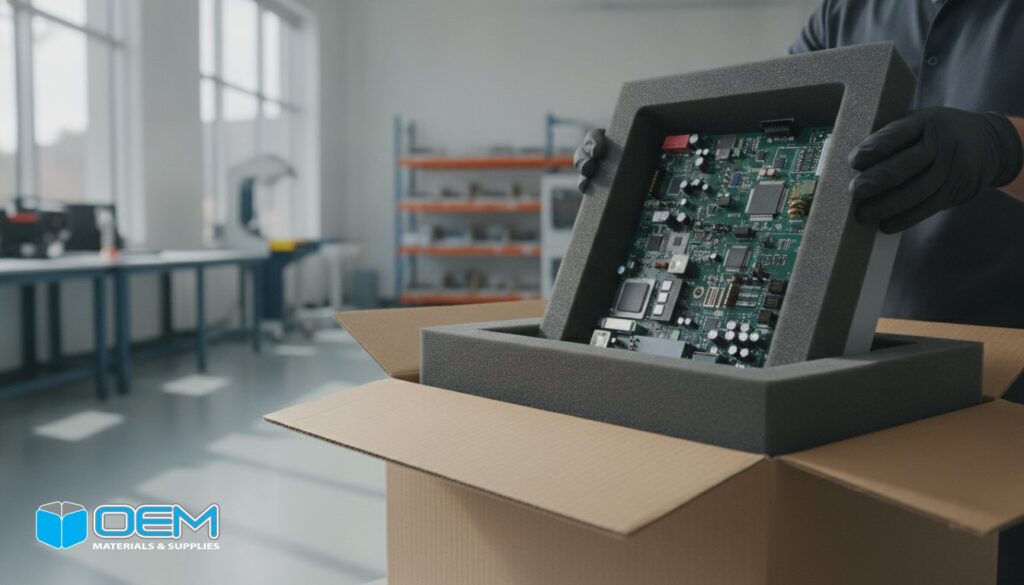
A single micro-crack in a circuit board or a silent electrostatic discharge during transit can turn a five-figure piece of equipment into scrap metal before it reaches the end user. For manufacturers across Los Angeles and Orange County, implementing secure packaging for high-value electronics is no longer optional; it is a critical operational requirement. You likely recognize that standard, off the shelf boxes rarely provide the precision fit or the technical protection required for sensitive hardware. Relying on inconsistent materials often leads to high replacement costs, shipping delays, and frustrated customers who expect perfection.
This guide demonstrates how to achieve a zero-damage shipping record by treating packaging as a technical system rather than an afterthought. You will learn how engineered foam inserts, custom corrugated solutions, and specialized ESD protection work together to mitigate physical and electrical risks. We also examine how local kitting and assembly services in Southern California can simplify your operations, reduce labor overhead, and ensure your products arrive in perfect condition every time. By moving from commodity supplies to an engineered approach, you can stabilize your supply chain and protect your bottom line.
Key Takeaways
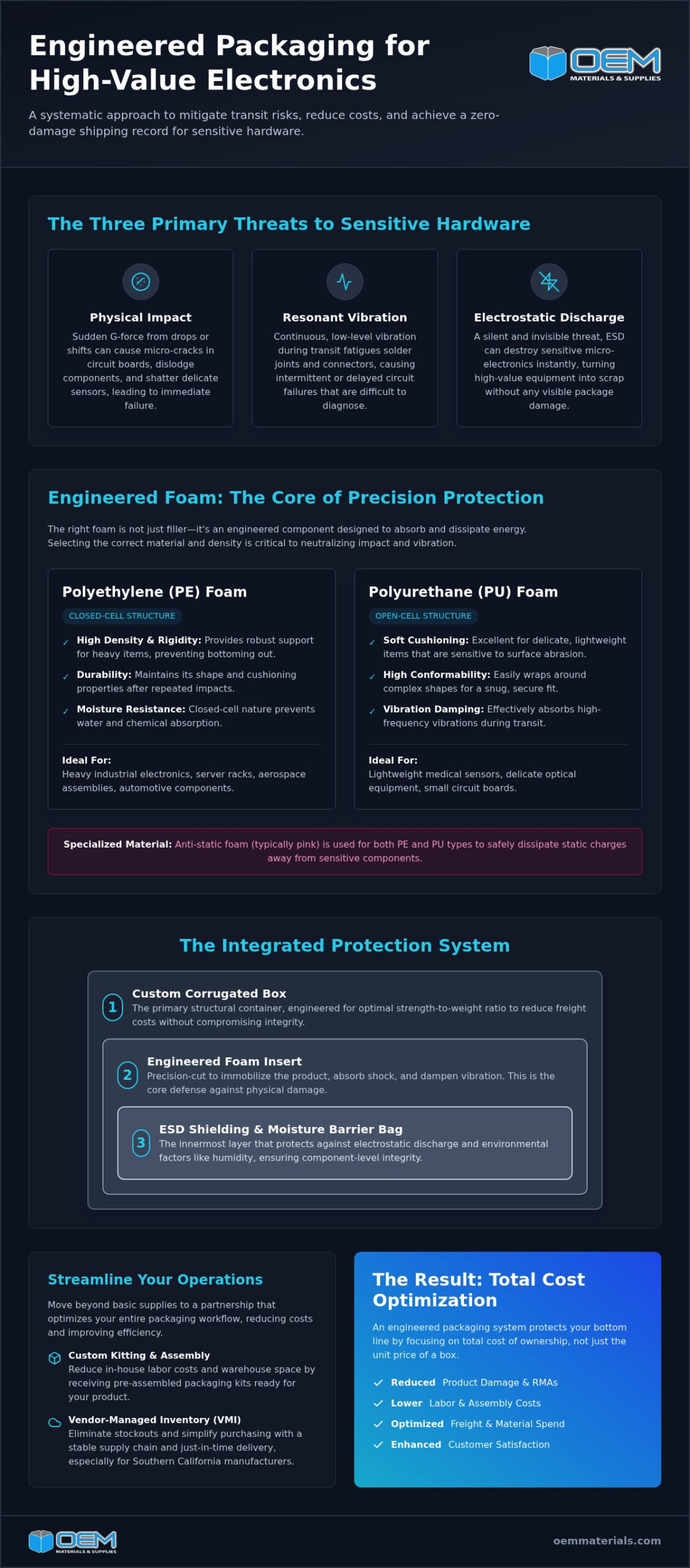
- Learn to identify and mitigate the three primary threats to sensitive hardware, including physical impact, vibration, and electrostatic discharge.
- Understand the technical performance differences between polyethylene and polyurethane foam to select the correct cushioning for your specific product requirements.
- Discover how an integrated system of ESD shielding and moisture barrier bags provides secure packaging for high-value electronics during complex logistics cycles.
- Identify strategies to reduce warehouse labor costs and material waste by implementing custom kitting and vendor-managed inventory programs.
- Explore the operational benefits of partnering with a local Southern California supplier for rapid prototyping and just-in-time delivery.
Assessing the Risks to Sensitive Electronics in the Supply Chain
Shipping high-value hardware requires more than a sturdy container. In the electronics sector, failure often happens at the microscopic level, where visual inspections can’t detect the damage. You must account for physical impact, resonant vibration, and electrostatic discharge (ESD) to maintain product integrity throughout the logistics cycle. While a standard corrugated box provides basic containment, it lacks the structural engineering to neutralize these specific forces. Modern Electronic packaging standards in 2026 emphasize a system-based approach where every layer of the container serves a specific protective function. Hidden damage, such as micro-fractures in silicon or weakened solder points, often stays undetected until the end user powers on the device. This leads to costly RMAs and damaged brand reputations for manufacturers in Orange County and across Southern California.
Secure packaging for high-value electronics isn’t just about preventing a crushed box; it’s about managing energy transfer. When a pallet shifts in a trailer or a package is dropped during last-mile delivery, the resulting shock can shatter delicate sensors. Regulatory requirements for medical and aerospace components have become more stringent, demanding documented proof that packaging can withstand standardized drop tests and vibration profiles. Failure to meet these standards doesn’t just risk the product; it risks compliance and contract eligibility.
Physical Impact and Vibration Hazards
Electronics are sensitive to specific G-force thresholds. If a package exceeds its rated deceleration during a drop, internal components can dislodge or crack. Resonant vibration is equally dangerous during long-haul trucking or air freight. When the frequency of the transport vehicle matches the natural frequency of the component, the energy transfer is amplified significantly. Constant low-level vibration during transit causes mechanical fatigue in solder joints, eventually leading to intermittent circuit failure. Engineers must use custom foam packaging designed with the correct density to dampen these specific frequencies before they reach the hardware.
The Cost of Improper Material Selection
True costs extend far beyond the unit price of a container. You should calculate the total cost of ownership by including freight expenses, labor for assembly, and the probability of transit damage. Many manufacturers over-package their goods to avoid damage, but this adds unnecessary weight and volume. For air freight departing from Los Angeles or San Diego, every extra pound increases shipping costs. The goal is to find the precise point where structural integrity meets weight efficiency. Using high-performance custom corrugated boxes allows you to reduce material volume without compromising safety. Secure packaging for high-value electronics requires this technical balance to remain competitive in high-volume production environments.
Engineering Custom Foam Inserts for Precision Protection
Internal cushioning is the primary defense against the transit risks discussed in the previous section. Engineered foam is more than just a filler material; it’s a precision-cut component designed to absorb specific energy levels before they reach the hardware. When designing secure packaging for high-value electronics, selecting the correct foam density is critical. Density determines how much a material will compress under load and, more importantly, how quickly it will decelerate the product during a drop. If the foam is too soft, the product will bottom out against the outer box. If it is too rigid, the shock will pass directly through to the internal circuits.
Material Selection for Fragile Components
Polyethylene (PE) foam is a closed-cell material that provides rigid support for heavy industrial electronics, such as aerospace assemblies or server racks. It’s durable, resistant to moisture, and maintains its shape under repeated impacts. In contrast, Polyurethane (PU) foam is an open-cell material used for lightweight, highly sensitive items like medical sensors that require soft cushioning. For electronic components, we often utilize anti-static foam, which is typically color-coded pink to indicate it has been treated with chemical additives to prevent static buildup. Using these engineered materials is the most reliable way to achieve secure packaging for high-value electronics that must survive multi-stop logistics routes. You can find these specialized options in our custom foam packaging inventory.
Custom Prototyping and Testing
Generic inserts often fail because they don’t account for the unique center of gravity or the most fragile points of a device. Custom die-cutting ensures an exact fit, eliminating internal movement that leads to surface abrasion or lead damage. Before moving to high-volume production, we recommend validating the design through physical drop testing and compression analysis. This engineering phase allows you to see how the materials perform under stress before committing to a full production run. Investing in custom packaging design ensures that your shipping kits are optimized for both protection and material efficiency.
A well-engineered insert reduces the need for excessive outer layers, lowering your overall freight volume and reducing waste. For manufacturers in San Diego, Orange County, or the Inland Empire, working with a local partner allows for faster iterations during the design phase. You can request a quote for a custom prototype to see how engineered foam can improve your current shipping outcomes and protect your high-value assets.
Beyond the Box Integrating ESD and Environmental Shields
While engineered foam handles the kinetic energy of a drop, the internal environment of a package must address invisible threats like electrostatic discharge (ESD) and atmospheric moisture. Static discharge can destroy microchips or degrade circuit paths without leaving a visible mark, leading to latent failures that appear only after the product is in the field. Achieving secure packaging for high-value electronics involves a multi-layered defense strategy that includes conductive, dissipative, and anti-static materials. Each layer serves a distinct technical purpose, from preventing the generation of static to shielding the component from external electrical fields.
In the aerospace and medical sectors, environmental protection is equally critical. Sensitive sensors and control boards are prone to oxidation if exposed to high humidity during long-haul transit or warehouse storage. Integrating moisture barrier bags (MBB) with desiccant packs ensures that the internal micro-climate remains stable. For medical electronics, maintaining a sterile or cleanroom-compatible environment is often a regulatory requirement. Specialized coatings on the outer container can also provide a secondary barrier against moisture and grease, ensuring the structural integrity of the container is not compromised by the environment.
Electrostatic Discharge Protection Levels
Understanding the difference between anti-static pink poly and true static shielding bags is vital for procurement and engineering teams. Pink poly materials are treated to prevent the generation of static electricity, but they do not provide a barrier against external charges. For ungrounded components like standalone PCBs, you must use shielding bags that incorporate a metalized layer. A true static shielding bag utilizes a metalized layer to create a Faraday cage effect, which redirects external electrostatic charges around the surface of the package rather than through the sensitive components inside. Primary packaging should always be ESD-safe to ensure that the device remains protected even when removed from the secondary cushioning.
Corrugated Box Strength and Structural Integrity
The outer container provides the necessary framework to support the internal protective layers. Selecting the right Edge Crush Test (ECT) rating is vital for maintaining structural integrity during palletized transit, especially for heavy industrial electronics. While single-wall construction may suffice for lightweight items, double-wall corrugated boxes are often required for high-value loads to prevent box compression under the weight of stacked pallets. For manufacturers in the Inland Empire or Riverside, choosing the correct board grade ensures that your products can withstand the rigors of multi-stop logistics without the outer walls buckling. High-ECT containers provide the vertical strength needed to protect your investment from the bottom of the stack to the top. Secure packaging for high-value electronics requires this foundation of structural reliability to ensure all internal engineering remains effective.
Streamlining Electronics Logistics with Kitting and VMI
High-value electronics manufacturing requires precision not just in the product, but in the assembly process. Once you have engineered the ideal secure packaging for high-value electronics, the challenge shifts to the assembly line. Inefficient packing processes often lead to significant labor overhead and an increased risk of human error. By streamlining how materials reach the packing station, you can maintain the technical standards established during the design phase while improving throughput. Moving from individual component sourcing to an integrated logistical model allows your team to focus on manufacturing rather than material handling.
Packaging Kitting and Assembly Services
Standardizing components is essential when managing a diverse product line. Pre-assembled packaging kits arrive at your facility with the custom foam already inserted into the corrugated box, along with the necessary ESD shielding and labels. This eliminates the need for warehouse staff to source individual components from multiple pallets across the floor. These value-added kitting and assembly services reduce total packing time and ensure every unit is protected identically, regardless of the shift or the operator. If your operation handles high-volume production, integrating packaging VMI allows your team to maintain a lean workflow without sacrificing the quality of the internal cushioning.
Inventory Optimization for SoCal Manufacturers
Warehouse space in high-rent areas like Orange County, Los Angeles, and San Diego is a significant operational expense. Storing bulky corrugated boxes and foam inserts on-site ties up capital and reduces the square footage available for production equipment. Implementing JIT packaging strategies ensures that materials arrive exactly when they are needed for a specific production run. Vendor Managed Inventory (VMI) further optimizes this by allowing your supplier to monitor stock levels and automatically replenish items before a shortage occurs. This proactive approach prevents costly stockouts of critical materials like ESD-safe bags or high-ECT containers during peak production cycles in the Inland Empire or Riverside.
Custom labeling and printing on the outer shipping containers further improve supply chain visibility from the moment the package leaves your dock. Clear, durable markings for fragile warnings, ESD symbols, and tracking barcodes ensure that specialized logistics providers handle the cargo with appropriate care. This level of organization reduces the likelihood of mishandling during the final stages of delivery. To see how kitting can reduce your labor costs and improve your bottom line, contact us for a logistical consultation and provide your current assembly requirements for a technical review.
Custom Packaging Solutions for Southern California Electronics Manufacturers
Southern California remains a primary hub for global electronics innovation, from the aerospace corridors of San Diego to the industrial manufacturing centers in Los Angeles. For businesses in these regions, the proximity of a packaging partner is a critical factor in maintaining a lean supply chain. Secure packaging for high-value electronics requires more than just a technical design; it requires a logistical framework that can adapt to changing production schedules. Relying on a local supplier in the Inland Empire or Riverside allows you to bypass the long lead times and high freight costs associated with out-of-state vendors. This geographic advantage ensures that your materials are available for just-in-time delivery, keeping your warehouse floor clear and your production lines moving.
Direct access to engineering expertise is particularly valuable for aerospace and medical startups in San Diego. These sectors often require rapid prototyping to validate new hardware designs before moving to high-volume production. When you work with a local partner, you can iterate on designs quickly, conducting on-site testing and adjustments in days rather than weeks. This hands-on approach ensures that the final packaging system is perfectly calibrated to the dimensions and fragility of your specific components. As production scales up, having a partner capable of transitioning from prototypes to high-volume manufacturing in Los Angeles or Orange County provides the stability needed for long-term growth.
Regional Expertise and Fast Turnaround
Fast turnaround is a requirement for the modern tech sector. On-site consultations allow our team to walk your warehouse floor and identify bottlenecks in your current packing process. We understand the unique regulatory and environmental requirements of Southern California manufacturers, including the need for cleanroom-compatible materials and specialized ESD protection. By reducing the physical distance between the manufacturer and the supplier, we eliminate the communication gaps that often lead to incorrect specifications or delayed shipments. This local presence allows for immediate response times when production demands suddenly spike.
Comprehensive Industrial Supply Access
Managing multiple vendors for different packaging components creates unnecessary administrative burden. We provide a single point of contact for all your industrial needs, from custom foam packaging to standard shipping supplies. Integrating edge protectors and high-performance stretch film into your palletized shipments ensures that your cargo remains secure during the heavy-duty transit cycles common in Southern California logistics. Sourcing your pallets, wood crates, and corrugated boxes from one reliable vendor simplifies your procurement process and ensures material compatibility across your entire shipping kit. This comprehensive approach provides the most reliable foundation for secure packaging for high-value electronics, ensuring every layer of protection is optimized for performance and cost-efficiency.
Optimizing Your Electronics Supply Chain for 2026
Transitioning from basic containers to an engineered system is the most effective way to eliminate transit damage and static discharge. You have seen how custom foam inserts and structural corrugated solutions provide the precise deceleration needed for fragile hardware. By integrating ESD shielding and moisture barriers, you address the invisible threats that lead to latent failures and costly RMAs. These technical layers work together to ensure your sensitive components reach their destination in factory condition.
As a full-service industrial supplier for Southern California, OEM Materials & Supplies specializes in custom engineering for the aerospace, medical, and electronics sectors. Our localized VMI and JIT delivery programs help manufacturers in Orange County, San Diego, and Los Angeles maintain lean operations without risking stockouts. Implementing secure packaging for high-value electronics is a strategic investment in your brand’s reputation and long-term bottom line.
To start improving your logistics efficiency, please provide your product dimensions, weight, and annual usage. Contact OEM Materials & Supplies for a Custom Packaging Quote to begin your technical review and prototype design. We look forward to helping you achieve a zero-damage shipping record.
Frequently Asked Questions
What is the best foam for packaging sensitive electronics?
Polyethylene and polyurethane are the primary choices for high-performance cushioning. Polyethylene provides the rigid support needed for heavy aerospace or industrial hardware; whereas polyurethane offers soft cushioning for lightweight, fragile components. For electronics, these materials are often treated with antistatic agents to prevent static buildup. Selecting the correct density ensures secure packaging for high-value electronics by managing the deceleration of the product during a drop or impact.
How does ESD packaging protect high-value components?
ESD packaging utilizes conductive and dissipative materials to prevent electrostatic discharge from reaching internal circuits. Shielding bags create a Faraday cage effect, which redirects external electrical charges around the package surface rather than through the device. This protection is vital for ungrounded components that are sensitive to even minor voltage spikes. Without these layers, silent electrical damage can occur during transit through the Los Angeles or San Diego logistics corridors.
What is the difference between custom foam inserts and standard bubble wrap?
Standard bubble wrap is a generic cushioning material that provides inconsistent protection for industrial items. Custom foam inserts are engineered for the specific dimensions and weight of your hardware. Foam is precision-cut to provide an exact fit, which eliminates internal movement and surface abrasion. This technical approach allows for predictable G-force management, while bubble wrap often fails under the weight of heavy electronics or during repetitive vibration cycles.
Can custom corrugated boxes be designed for heavy industrial electronics?
Yes, custom corrugated boxes are frequently designed for heavy industrial loads using double-wall or triple-wall construction. These containers are engineered to support the weight of heavy server racks or medical equipment without buckling. When combined with high-performance edge protectors and stretch film, these boxes maintain their structural integrity throughout the Southern California supply chain. We design these solutions to meet specific stacking and transport requirements for our industrial partners.
How does Vendor Managed Inventory reduce packaging costs?
Vendor Managed Inventory (VMI) reduces costs by shifting the responsibility of stock monitoring to the supplier. This program eliminates the administrative labor of manual ordering and prevents production delays caused by material shortages. For facilities in high-rent areas like Orange County, VMI saves valuable warehouse space by delivering supplies just-in-time. It ensures you have the correct amount of secure packaging for high-value electronics without tying up excessive capital in inventory.
What are the shipping requirements for medical electronics?
Medical electronics must meet strict requirements for shock protection and often require atmospheric controls. Moisture barrier bags and desiccants are used to prevent oxidation of sensitive contacts during long-haul transit. Packaging must also be compatible with cleanroom standards to maintain sterility when required. Our engineering team in Southern California designs these systems to ensure compliance with medical industry standards while protecting the device from physical impact during the logistics cycle.
Why is ECT rating important for electronics shipping containers?
The Edge Crush Test (ECT) rating measures the vertical compression strength of a corrugated container. This is critical for electronics because pallets are often stacked high in trailers or warehouses. A box with an insufficient ECT rating will collapse under the weight of the load, compromising the internal cushioning and damaging the product. We recommend specific ECT ratings based on your stacking height and the weight of your industrial components.
How can I reduce product damage during long-distance freight?
Reducing damage during long-distance freight requires an integrated packaging system. You should use custom foam inserts to dampen resonant vibration and high-ECT corrugated boxes to withstand stacking pressure. Adding edge protectors and high-quality stretch film stabilizes the pallet, preventing the shifting that leads to impact damage. Working with a local Southern California partner for rapid prototyping allows you to test these systems before committing to high-volume production runs.