
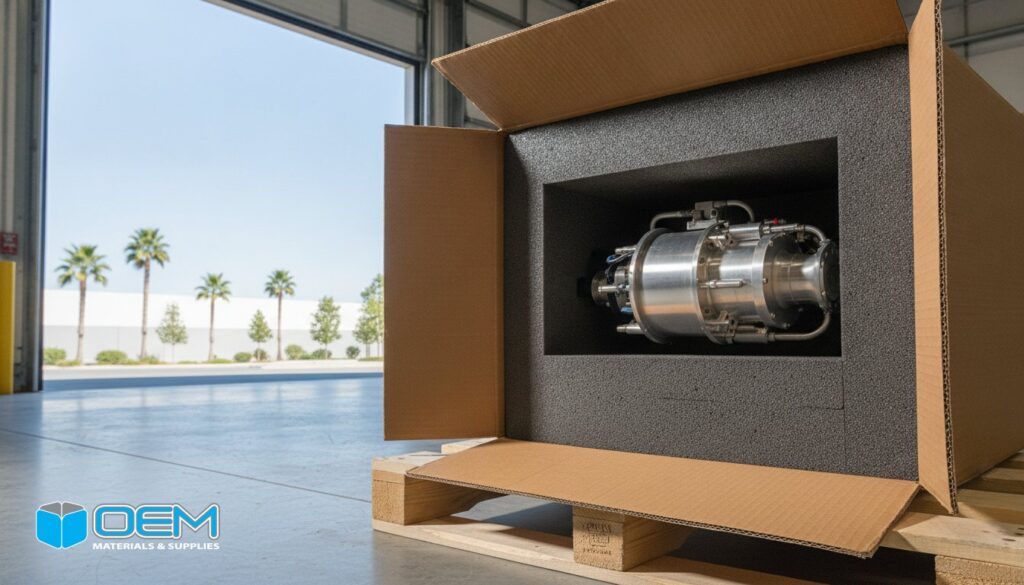
Shipping a precision aerospace component in a standard box with loose fill isn’t just a risk; it’s a calculated gamble that often ends with a rejected shipment and a strained client relationship. You already know that standard packaging fails to protect sensitive equipment during the rigors of the Los Angeles and Orange County logistics networks. Between rising carrier surcharges and the strict requirements of SB 54, the margin for error in your supply chain has never been thinner. Using engineered foam-lined shipping boxes is no longer a luxury for specialized manufacturers; it’s a logistical necessity for maintaining operational efficiency.
This guide explains how to select and engineer foam-lined shipping boxes to eliminate product damage and optimize your industrial supply chain. We will examine how to match material densities to specific product fragilities, methods for reducing dimensional weight fees, and how integrated designs can slash your packing labor costs. By the end, you’ll have a clear roadmap for implementing a repeatable, professional packaging solution that ensures compliance with sensitive equipment shipping standards and protects your bottom line.
Key Takeaways
- Distinguish between Polyurethane (PU) and Polyethylene (PE) foam to ensure your packaging provides the correct compression and shock absorption for your specific part weight.
- Engineer foam-lined shipping boxes using G-factor fragility scales to eliminate product damage without over-packaging or incurring excessive dimensional weight fees.
- Compare the efficiency of stock convoluted mailers for low-profile items against custom-engineered foam inserts designed for high-value OEM components.
- Leverage local Southern California manufacturing and kitting services to reduce lead times and streamline the packing process for aerospace and medical electronics.
- Understand how integrated foam packaging reduces labor costs and simplifies inventory management through vendor-managed inventory (VMI) programs.
Understanding Foam-Lined Shipping Boxes for Industrial Applications
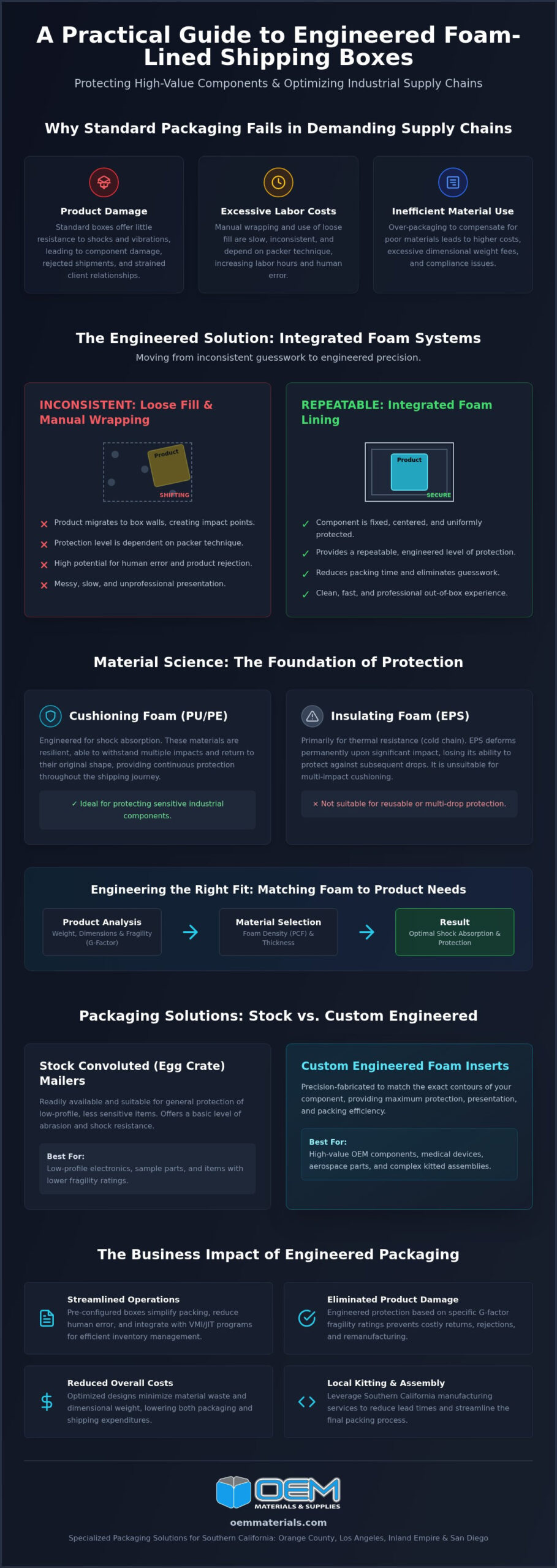
Foam-lined shipping boxes are more than just corrugated containers with padding; they are integrated packaging systems engineered to protect high-value industrial components. These systems combine a structural outer shell with internal foam packaging to provide a secure environment for sensitive goods. Unlike manual wrapping methods that rely on warehouse staff to apply layers of bubble or foam wrap, integrated lining arrives ready for immediate use. This pre-configured setup significantly reduces labor costs by streamlining the packing process and eliminating the variability of manual applications.
Industrial packaging serves three primary roles: shock absorption, vibration dampening, and abrasion prevention. During transit through regional hubs in Los Angeles or Orange County, packages experience multiple drops and constant mechanical vibration. An engineered lining absorbs these kinetic forces, preventing energy transfer to the internal component. By securing the item in a fixed position, these boxes also prevent surface scratches that occur when parts rub against rough corrugated surfaces.
The Difference Between Cushioning and Insulation
A common point of confusion in procurement is the distinction between thermal insulation and protective cushioning. Expanded polystyrene (EPS), often used for cold chain shipping, provides excellent thermal resistance but lacks the resilience needed for multi-impact protection. Once EPS is compressed during a drop, it remains deformed, losing its ability to protect against subsequent impacts. This makes it unsuitable for heavy industrial parts that may be handled multiple times throughout the supply chain.
In contrast, engineered materials like polyurethane (PU) and polyethylene (PE) are designed for Package cushioning because they can withstand multiple shocks and return to their original shape. Deceleration distance is the specific thickness of foam required to slow a product’s movement to a stop before it makes contact with the outer corrugated wall. Selecting the wrong material or thickness can lead to bottoming out, where the foam fully compresses and the product absorbs the final impact force.
When to Use Integrated Foam Lining vs. Loose Fill
Relying on loose fill, such as packing peanuts, often leads to inconsistent protection and high product rejection rates. Loose materials shift during transit, allowing heavy components to migrate toward the box walls where they are vulnerable to damage. Foam-lined shipping boxes provide a fixed, repeatable level of protection that doesn’t depend on the packer’s technique. This ensures the component remains in the center of the package, surrounded by a uniform protective buffer.
For manufacturers in the Inland Empire or San Diego County handling complex kitting, integrated foam lining reduces human error. Packers don’t have to guess how much wrap to use; they simply place the component into the designated foam cavity. This consistency ensures every shipment meets the same professional standard while maintaining compliance with strict aerospace or medical equipment shipping requirements. It’s a faster, cleaner, and more reliable method for high-volume distribution.
Material Science: Selecting the Right Foam Lining for Your Components
Selecting the correct material for foam-lined shipping boxes requires a precise balance between component weight and fragility. Engineers often refer to the “G-level” or fragility rating of a product, which defines the maximum acceleration it can withstand before damage occurs. Foam density, typically measured in pounds per cubic foot (PCF), determines how effectively the lining manages this energy. If the foam is too soft for the part’s weight, the product will bottom out during a drop; if it’s too firm, the shock is transmitted directly to the part through the foam itself.
Matching material properties to your specific application ensures that your packaging remains efficient and cost-effective. For manufacturers in Los Angeles and Orange County, choosing between open-cell and closed-cell structures is the first step in engineering a reliable transit solution. This choice impacts not only the level of protection but also the overall dimensional weight and shipping costs of the package.
Polyurethane Foam for Sensitive Electronics
Polyurethane (PU) is a versatile, open-cell material known for its softness and flexibility. It is the standard choice for protecting lightweight, highly sensitive items that require gentle cushioning. Convoluted “egg crate” PU foam is especially effective for operations handling varying product heights. The peaks and valleys of the convoluted surface allow a single box size to accommodate multiple SKUs, providing a snug fit without the need for custom molds for every part.
Because PU foam is non-abrasive, it is ideal for protecting finished surfaces, optical lenses, or delicate housings. For circuit boards, sensors, and other microelectronics, we utilize pink anti-static (ESD) PU foam. This specialty material prevents the buildup of static electricity, which can cause internal component failure even if the physical exterior of the part remains intact. If your assembly involves these sensitive components, you can speak with an engineer to determine the optimal foam density for your electronics.
Polyethylene Foam for Heavy Aerospace and Automotive Parts
Polyethylene (PE) is a dense, closed-cell foam engineered for high load-bearing capacity. It is the preferred material for heavy aerospace components, automotive machinery, and industrial tools. Unlike open-cell foams, PE resists moisture absorption and chemical degradation. This durability is critical for parts that may be exposed to industrial lubricants or varying humidity levels during long-distance transport or storage in Southern California warehouses.
Custom die-cut PE inserts are engineered to fit complex geometries, ensuring that even heavy, sharp-edged components remain completely immobilized. This precision prevents the part from shifting and piercing the corrugated outer shell. PE foam provides superior vibration dampening for heavy assemblies, protecting internal calibration and mechanical alignment during transit. By utilizing foam packaging tailored to these high-mass items, manufacturers can significantly reduce the risk of structural failure during shipping.
Comparing Convoluted Foam Mailers and Custom Foam-Lined Containers
Choosing between stock mailers and custom-engineered foam-lined shipping boxes is a decision driven by product geometry, weight, and the total cost of the fulfillment cycle. While stock solutions offer immediate availability for standardized parts, custom containers address the unique structural requirements of high-value OEM components. The primary distinction lies in how the internal cushioning interacts with the product to prevent migration and absorb kinetic energy during transit through the Southern California logistics network.
Stock availability is often the priority for rapid fulfillment of low-profile items. However, procurement professionals must weigh the convenience of off-the-shelf mailers against the long-term efficiency of a custom-designed kit. A custom solution often reduces the overall dimensional weight of the package, which can lead to significant savings on carrier fees for high-volume shippers in Los Angeles and Orange County. Furthermore, integrated designs eliminate the need for secondary materials like bubble wrap or tape, streamlining the packing process and reducing warehouse waste.
Stock Convoluted Foam Shippers
While specialized industrial components require these custom foam solutions, many businesses also need a reliable source for standard high-quality packaging and moving supplies; to explore a comprehensive range of professional materials, visit Phoenix Supplies UK.
Stock convoluted shippers provide a functional and cost-effective solution for small medical devices, handheld electronics, and lightweight replacement parts. These containers utilize “egg crate” polyurethane foam on the top and bottom lids to create a secure environment. The compression mechanism is simple: when the box is closed, the interlocking foam peaks press against the item, immobilizing it without the need for additional void fill. This design is excellent for rapid packing because it requires no specialized training or assembly.
Despite their versatility, convoluted mailers have specific limitations regarding weight distribution. Because the foam is typically a lower-density polyurethane, it lacks the load-bearing capacity required for heavy industrial components. If a heavy part is placed in a standard convoluted shipper, the foam peaks may fully compress or “bottom out” during a drop. This failure allows the shock to transfer directly to the product, rendering the packaging ineffective for heavy-duty aerospace or automotive applications.
Engineered Custom Foam-Lined Boxes
For high-fragility OEM components or complex machinery, engineered custom solutions are the industry standard. These systems go beyond simple top-and-bottom padding to include full perimeter lining or precision die-cut cavities. The custom packaging design process allows engineers to match the exact footprint of a part to the internal cushioning. This ensures that even irregularly shaped items remain completely stationary, regardless of the orientation of the box during shipping.
One major advantage of custom engineering is the ability to utilize multiple foam densities within a single container. For instance, a heavy metal base might be supported by high-density polyethylene, while more delicate upper sensors are protected by soft polyurethane. This hybrid approach optimizes protection while keeping the overall package size as small as possible. Manufacturers in San Diego and the Inland Empire often find that these bespoke inserts significantly reduce product rejection rates, protecting both the bottom line and the brand’s reputation for reliability.
Best Practices for Shipping Sensitive Electronics and Aerospace Parts
Protecting aerospace components and microelectronics requires a data-driven approach to packaging design. The first step is assessing the fragility of the component using the Fragility Scale, commonly known as the G-factor. This metric represents the maximum acceleration a part can withstand before mechanical or electrical failure occurs. For example, a flight control computer might have a G-factor of 15 to 25, while a ruggedized industrial sensor might handle 50 or more. Understanding this limit is essential for engineering foam-lined shipping boxes that provide adequate deceleration during a drop.
Calculating the required foam thickness is the only way to prevent bottoming out. This failure occurs when the cushioning material compresses completely, allowing the product to strike the outer corrugated wall and absorb the full impact force. The thickness must be proportional to the anticipated drop height and the weight of the part. In Southern California’s high-volume logistics hubs, where packages are frequently handled by automated sorting equipment, designing for a 36-inch drop height is a standard precaution for sensitive equipment.
Proper box closure is equally critical for heavy foam-lined shipments. We recommend using reinforced water-activated tape or heavy-duty pressure-sensitive tape to ensure the structural integrity of the container. Standard office tape often fails under the weight of dense foam and heavy metal components. Additionally, engineers must consider environmental factors like humidity and temperature. If parts are stored in non-climate-controlled warehouses in the Inland Empire or Orange County for extended periods, certain foams may degrade or lose their resiliency, compromising the protection level.
Protecting Against Electrostatic Discharge (ESD)
Standard polymeric foams can generate significant static charges through friction during transit. For microchips and sensors, even a small discharge can cause catastrophic internal damage that isn’t visible to the naked eye. Electronics manufacturers should always utilize pink anti-static foam lining. This material is treated with an antistatic agent to prevent triboelectric charging. For a complete protection system, we recommend combining these specialty liners with custom corrugated boxes that feature conductive or dissipative coatings.
Vibration Dampening in Aerospace Logistics
Aerospace logistics often involve long-distance air or sea freight, exposing components to sustained high-frequency vibrations. These vibrations can loosen fasteners or damage delicate solder joints over time. A snug fit is essential; any internal movement within the box allows the part to gain momentum, increasing the risk of impact damage. For oversized aerospace assemblies that exceed standard box dimensions, custom crates can be foam-lined to provide the same level of precision cushioning as smaller containers.
If you’re shipping high-value components and need to verify your current protection levels, you can request a packaging consultation to review your specific G-factor requirements and foam density needs.
Custom Foam-Lined Packaging Solutions in Southern California
Local manufacturers in San Diego, Los Angeles, and Orange County face unique logistical pressures, from high warehouse costs to strict regulatory compliance. Partnering with a Southern California supplier for foam-lined shipping boxes provides a significant strategic advantage. Proximity allows for faster design iterations, reduced transit costs, and a more responsive supply chain. OEM Materials & Supplies integrates foam lining into complete assembly and kitting services, delivering ready-to-use packaging systems that eliminate the need for secondary handling on your production floor.
Before moving to high-volume production, our prototyping and testing services validate that the engineered design meets your specific protection requirements. We create physical samples that allow your engineering team to verify fit and function. This step is essential for high-value aerospace and medical components where the cost of a single damaged part far exceeds the investment in precision packaging. Validating the design early prevents costly field failures and ensures the packaging performs as expected under real-world transit conditions, protecting your brand reputation and your bottom line.
Streamlining Supply Chains with VMI and JIT
Managing inventory for bulky packaging materials can strain warehouse capacity and complicate audits. By utilizing packaging VMI, you ensure that your foam-lined shipping boxes are always in stock without tying up excessive floor space or capital. We monitor your usage patterns and replenish stock automatically, allowing your procurement team to focus on core manufacturing operations rather than tracking box counts or managing multiple vendor lead times.
For facilities in Riverside and the Inland Empire, just-in-time packaging protocols offer a functional remedy for inventory congestion. Receiving pre-assembled, foam-lined containers exactly when they are needed for the production run slashes labor costs and reduces the footprint required for packaging storage. Your team no longer needs to spend hours folding boxes or inserting foam pads; they simply pull the integrated unit from the pallet and begin packing. This level of operational efficiency is a hallmark of a mature, optimized industrial supply chain that values both speed and precision.
Requesting a Quote for Custom Foam-Lined Boxes
To provide an accurate recommendation and cost analysis, our engineers require specific data points regarding your application. Having this information ready during the initial consultation ensures a faster turnaround for prototypes and quotes. Please be prepared to provide the following:
- Product Dimensions: Accurate length, width, and height of the component.
- Weight: The total mass of the item to determine the necessary foam density.
- Fragility (G-Factor): The maximum shock level the part can withstand before failure.
- Annual Usage: Estimated quantity to optimize manufacturing runs and inventory levels.
The prototype process is the most reliable way to test custom foam inserts against your specific performance standards. Once the design is finalized, we can move rapidly into production to meet your delivery schedules. Request a custom quote for foam-lined shipping boxes today to speak with an industrial packaging specialist about protecting your high-value components.
Optimize Your Supply Chain with Engineered Protection
Transitioning from standard containers to engineered cushioning systems represents a fundamental shift from reactive damage control to proactive supply chain optimization. By integrating material science with precise G-factor calculations, your operation can achieve the repeatable protection standards required by modern aerospace and medical electronics sectors. This approach doesn’t just protect the product; it safeguards your fulfillment schedule and reduces the total cost of ownership by eliminating the waste associated with over-packaging and product rejections.
OEM Materials & Supplies serves as a technical consultant for manufacturers across San Diego, Los Angeles, and Orange County. We provide the localized support and specialized engineering expertise needed to solve complex logistical challenges. Through integrated VMI and kitting services, we ensure your facility remains efficient and your inventory stays lean, allowing you to scale production without the burden of managing bulky packaging stocks.
Take the next step in securing your high-value components. Request a Quote for Custom Foam-Lined Shipping Boxes today. By sharing your product dimensions, weight, and annual usage, you allow our team to develop a high-performance packaging system tailored to your specific industrial requirements. We look forward to engineering a solution that protects your bottom line.
Frequently Asked Questions
What is the difference between polyurethane and polyethylene foam for shipping?
Polyurethane (PU) is a soft, open-cell foam designed for lightweight, fragile items requiring gentle cushioning. Polyethylene (PE) is a dense, closed-cell material used for heavy or sharp industrial parts that need high load-bearing support. While PU absorbs energy through compression and air displacement, PE provides structural rigidity and resists moisture. Engineers select the material based on the product weight and the required G-factor protection level for the transit environment.
Can I get anti-static foam-lined boxes for electronic components?
Yes, we provide specialized pink anti-static (ESD) foam lining designed to protect microchips, sensors, and circuit boards from triboelectric charging. Standard foams can generate static through friction during transit, leading to catastrophic internal component failure. Using ESD-safe foam-lined shipping boxes ensures that your electronic assemblies are protected from both physical impact and electrostatic discharge. This is a standard requirement for our partners in the medical and aerospace sectors.
How do I determine the right foam thickness for my product?
Foam thickness is determined by calculating the deceleration distance required to stop your product before it strikes the outer corrugated wall. This calculation depends on the product weight, its fragility (G-factor), and the anticipated drop height of the shipping environment. For most industrial applications in Southern California hubs, a thickness that prevents “bottoming out” during a 36-inch drop is the baseline. Our engineering team uses these variables to specify the exact foam depth needed.
Are foam-lined shipping boxes reusable for multiple shipments?
Reusability depends on the foam type and the intensity of the initial transit cycle. Polyethylene (PE) foam is highly resilient and maintains its structural integrity over multiple uses, making it ideal for closed-loop supply chains or internal transfers. Polyurethane (PU) is also durable but can degrade faster if exposed to repeated heavy compression. If your operation involves returning containers for refurbishment, we recommend engineered PE inserts to maximize the lifespan of the packaging system.
Do you provide custom die-cut foam inserts for specific product shapes?
We specialize in die-cut foam inserts that are precision-engineered to match the exact geometry of your components. This ensures a “snug fit” that completely immobilizes the part, preventing internal movement that leads to surface abrasion or mechanical damage. Custom inserts are particularly effective for complex aerospace assemblies or medical devices with irregular footprints. These integrated designs arrive pre-assembled within the box to reduce your warehouse labor and packing time.
What information do I need to provide for a custom foam packaging quote?
To generate an accurate quote and technical recommendation, we require the product dimensions, total weight, and estimated annual usage. If known, providing the G-factor or fragility rating of the component allows our engineers to select the optimal foam density more quickly. We also consider your shipping method and any specific environmental requirements, such as ESD protection or moisture resistance. This data ensures the final design balances protection with dimensional weight efficiency.
Do you offer foam-lined boxes for manufacturers in Orange County and San Diego?
We provide local support and delivery to manufacturers throughout Orange County, San Diego County, and the Inland Empire. Having a Southern California supplier reduces lead times and allows for face-to-face consultations on complex packaging designs. Our regional presence supports just-in-time delivery and vendor-managed inventory (VMI) programs, ensuring your production lines stay moving without the burden of storing large volumes of bulky packaging materials on-site.
Can foam-lined boxes help reduce my shipping insurance claims?
Implementing engineered foam-lined shipping boxes directly reduces product rejection rates by providing a repeatable, validated level of protection. Many carriers and insurance providers look favorably on packaging that meets ISTA or ASTM testing standards, as it demonstrates a proactive approach to risk mitigation. By eliminating the variability of manual wrapping and preventing “bottoming out,” you significantly lower the frequency of damage claims and the associated administrative costs of processing them.