
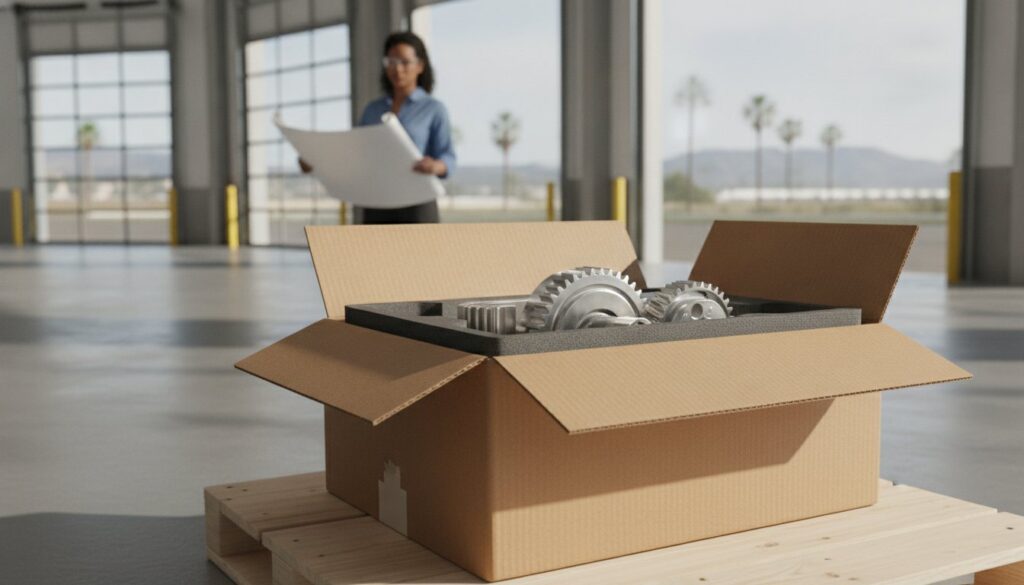
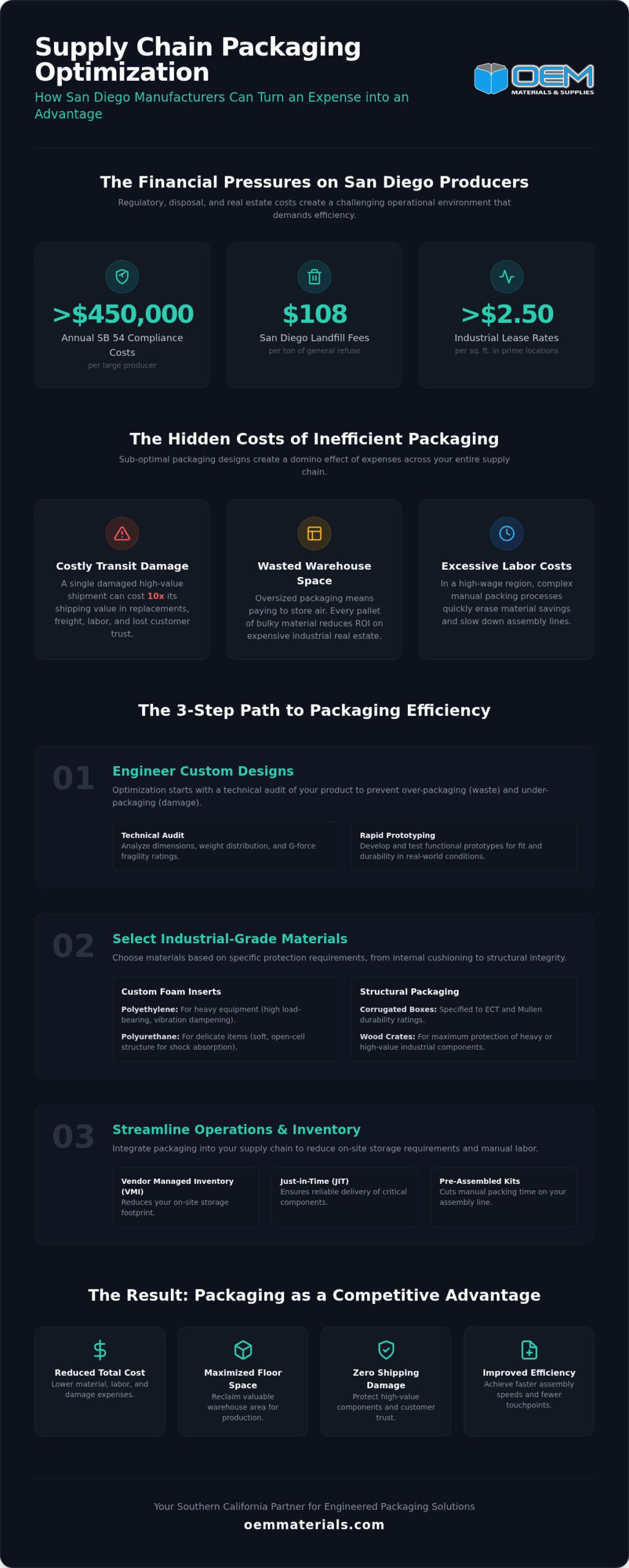
Large producers in California are currently facing average annual compliance costs exceeding $450,000 following the final regulations of SB 54 that went into effect on May 1, 2026. When you combine these regulatory hurdles with San Diego commercial landfill fees reaching $108 per ton for general refuse, the financial pressure on local manufacturers is undeniable. You’re likely already dealing with high warehouse lease rates and the frustration of product damage during long-haul transit. It’s a logistical bottleneck that demands more than just a different box; it requires a strategic shift in how you handle materials.
Implementing a robust strategy for supply chain packaging optimization in San Diego is the most effective way to protect your margins and your products. This guide provides a comprehensive look at how engineered packaging and logistics optimization can lower your total cost of ownership while reclaiming valuable warehouse floor space. We’ll examine the roles of custom foam packaging, pre-assembled kitting, and vendor managed inventory in streamlining your assembly line and achieving zero shipping damage. By focusing on precision and durability, you can transform your packaging from a overhead expense into a competitive advantage.
Key Takeaways
- Learn how optimizing packaging dimensions can help your business reclaim floor space and offset high San Diego industrial lease rates.
- Discover the technical process for supply chain packaging optimization in San Diego through product audits and rapid prototyping.
- Understand how to select corrugated materials and wood crates based on industrial durability standards like ECT and Mullen ratings.
- Identify strategies to reduce on-site storage requirements and manual labor through Vendor Managed Inventory and pre-assembled packaging kits.
- Explore the benefits of partnering with a local Southern California supplier to ensure faster lead times and more reliable logistics for critical components.
The Financial Impact of Packaging Inefficiency in San Diego
Supply chain packaging optimization in San Diego isn’t merely a search for a cheaper box. It’s a rigorous engineering discipline focused on reducing the total cost of ownership across your entire distribution network. Many manufacturers mistakenly view packaging as a static commodity expense, but inefficient designs create a cascade of hidden costs. These include excessive labor, wasted warehouse volume, and the high price of landfill disposal for non-compliant materials. By adhering to packaging and labeling fundamentals, your facility can ensure that every shipment is as compact and protected as possible, directly impacting your bottom line.
In Southern California, the labor-to-material ratio is a critical metric. High regional wages mean that a complex, manual packing process can quickly eclipse any savings found in material procurement. If your team spends several minutes folding multi-piece corrugated boxes or hand-wrapping components, you’re losing money on every unit. Streamlining these operations through custom packaging design allows for faster assembly line speeds and fewer touchpoints, which is essential for maintaining a competitive edge.
San Diego Industrial Real Estate and Storage Costs
Industrial lease rates in hubs like Otay Mesa and Carlsbad have reached historic highs, often exceeding $2.50 per square foot for premium warehouse space. When your packaging is oversized, you’re essentially paying to store air. Storing high volumes of obsolete or bulky inventory is a financial drain that limits your operational flexibility. Every pallet of unused packaging material reduces your liquidity and prevents you from stocking revenue-generating finished goods. Optimization ensures that your packaging inventory matches your actual production needs. Efficient packaging volume is the primary driver of storage ROI in high-cost real estate markets.
Transit Damage and the Cost of Replacement
Shipping high-value aerospace or medical components from San Diego to national customers involves significant transit risks. Standard, off-the-shelf boxes often fail in high-vibration industrial environments, leading to catastrophic product damage. The cost of a single damaged shipment isn’t just the price of the material; it includes the freight for the return, the labor for inspection, the cost of the replacement part, and the potential loss of customer trust. For a complex medical device, these cumulative costs can be ten times the original shipping value. Using engineered solutions like custom foam inserts or heavy-duty wood crates provides the durability required to reach the destination intact, eliminating the cycle of damage claims and replacements.
Step 1: Engineering Custom Packaging Designs for Protection
Effective supply chain packaging optimization in San Diego begins with a technical audit of the physical product. Engineers must analyze precise dimensions, weight distribution, and G-force fragility ratings to determine the required level of protection. Without this data, you risk either over-packaging, which inflates material costs, or under-packaging, which leads to transit damage. A thorough audit ensures that every element of the package serves a functional purpose, from the structural integrity of the outer shell to the dampening properties of the internal cushioning.
Once the audit is complete, developing rapid prototypes allows for real-world testing of fit and durability. This iterative process ensures the final design meets the specific stresses of your Southern California distribution cycle. If you’re shipping sensitive electronics or aerospace components, these prototypes are essential for verifying that internal parts remain secure during high-vibration transit. You can submit your product dimensions and weight to start this engineering process and receive a functional prototype for testing.
The Role of Custom Foam Inserts in Protection
Custom foam packaging serves as the primary defense against internal movement and shock. We utilize polyethylene foam for heavier industrial equipment because of its high load-bearing capacity and excellent vibration dampening. For delicate items like medical sensors or glass components, polyurethane foam provides a softer, open-cell structure that absorbs impact energy more effectively. Using engineered foam often allows for a smaller outer box because the interior material is specifically designed to handle the heavy lifting of protection, reducing the need for bulky void-fill materials.
Right-Sizing to Combat Dimensional Weight Charges
Carriers calculate shipping costs based on either actual weight or dimensional weight (DIM), whichever is greater. If your corrugated boxes contain excessive empty space, you’re paying a premium for shipping air. Engineering the smallest possible footprint reduces these volume-based charges and directly lowers your shipping overhead. This approach aligns with Sustainable Materials Management (SMM) principles by minimizing raw material waste and maximizing pallet density. When you right-size your packaging, you fit more units on a single truckload, which improves logistics efficiency across your entire San Diego and Inland Empire routes.
Finally, integrating kitting services into your packaging design can drastically simplify the final assembly process. By receiving pre-assembled packaging kits that include the box, custom foam inserts, and labels in one unit, your warehouse team can pack products in seconds rather than minutes. This reduces the labor costs discussed in the previous section and ensures consistency in every shipment, regardless of the operator’s experience level.
Step 2: Selecting Materials Based on Industrial Durability
Choosing the right materials is the structural foundation of supply chain packaging optimization in San Diego. While engineering design determines the shape and fit, the material specifications dictate whether a package survives the rigors of the Southern California logistics environment. Selecting materials based on specific industrial durability standards ensures that high-value components remain protected without adding unnecessary weight or cost. It’s about finding the precise balance between material performance and operational efficiency.
Corrugated Strength Ratings for Heavy Loads
When specifying industrial corrugated boxes, you must choose between Edge Crush Test (ECT) and Mullen ratings. ECT measures the stacking strength of the board, which is critical for warehouse efficiency and pallet density. In contrast, the Mullen test measures the force required to puncture the box wall; it’s the better choice for heavy, irregular parts that might shift during transit. For industrial equipment weighing several hundred pounds, we often recommend double-wall or triple-wall corrugated board to provide the necessary vertical compression strength. This technical selection process aligns with broader initiatives like the Supply Chain Optimization and Intelligence Network, which emphasizes the need for data-driven decisions to strengthen domestic manufacturing.
For exceptionally heavy or oversized products, corrugated materials might reach their physical limits. In these cases, transitioning to custom wood crates provides the superior structural rigidity required for global shipping. Crates offer maximum protection against side-impacts and are essential for aerospace or automotive assemblies that cannot tolerate any flexion during handling. The jump from corrugated to wood is a strategic decision based on the specific weight and fragility of your components.
Stabilizing Palletized Shipments for Long-Haul Transit
Load containment is just as important as the box itself. High-performance stretch film is the primary tool for securing a palletized load, but selecting the wrong gauge can lead to catastrophic failure. Thinner, high-performance films often provide better puncture resistance and higher force-to-load than traditional 80-gauge films. This allows you to use less material while achieving a tighter, more secure wrap that prevents shifting during long-haul transit.
To prevent the film from tearing and to distribute the pressure of banding straps, we integrate heavy-duty edge and corner protectors. These components stabilize the pallet and prevent the top layers of corrugated boxes from collapsing under the tension of the wrap. By reinforcing the vertical corners of a pallet, you can stack loads higher in the warehouse and on the truck. This maximizes your freight efficiency and reduces the total cost per unit shipped. Accuracy in material selection turns a standard shipping container into a high-performance asset for your San Diego facility.
Step 3: Streamlining Operations with VMI and JIT Programs
Effective supply chain packaging optimization in San Diego requires a shift from reactive procurement to proactive inventory management. Many manufacturers struggle with the “bullwhip effect,” where small fluctuations in demand lead to massive swings in packaging inventory. This often results in either critical stockouts of corrugated boxes or an overstock of bulky materials that consume expensive warehouse floor space. By integrating your packaging supply directly into your production schedule, you can eliminate these inefficiencies and ensure a steady flow of materials.
Implementing Vendor Managed Inventory (VMI)
Transitioning to packaging VMI services allows your supply partner to take full responsibility for monitoring your stock levels. We track your usage rates and replenishment needs in real-time, which prevents production downtime caused by missing supplies. This model provides significant financial benefits; you typically only pay for the materials as they are consumed, which preserves your working capital. By utilizing just-in-time delivery, you can reclaim significant warehouse floor space, a vital advantage given the rising industrial lease rates in San Diego County and the Inland Empire.
Kitting and Assembly: Reducing Warehouse Labor
Manual packaging assembly is a common but often overlooked labor drain. If your warehouse team spends hours folding boxes, cutting cushioning, and kitting components, they are being diverted from their core manufacturing tasks. Packaging kits solve this problem by delivering a complete, pre-assembled unit that is ready for immediate product insertion. This streamlined approach reduces the number of “touches” required for each shipment, which directly lowers your labor-to-material ratio.
Managing multiple SKUs for boxes, foam, tape, and labels complicates procurement and increases the risk of inventory shortages. When you switch to pre-assembled packaging kits, your procurement team only tracks a single item. This simplicity reduces administrative overhead and ensures that all necessary components arrive at the assembly line simultaneously. Because we utilize local Southern California delivery routes, we can offer rapid replenishment that national vendors cannot match. This local presence allows for more frequent, smaller deliveries that support a lean manufacturing model and reduce your reliance on safety stock.
To see how a managed inventory program can fit your specific production volume, request a consultation for a VMI audit today.
Choosing a Supply Chain Packaging Partner in San Diego
Selecting a partner for supply chain packaging optimization in San Diego requires a shift in perspective. You aren’t just looking for a vendor to fulfill a purchase order; you’re seeking a technical consultant capable of analyzing your entire distribution cycle. A qualified partner should demonstrate deep expertise in custom engineering and design, ensuring that every corrugated box or wood crate is purpose-built for the specific fragility and dimensions of your components. This technical depth is what separates a strategic partner from a basic commodity reseller.
The breadth of a supplier’s product offering is equally critical. To truly optimize your operations, your partner must provide a comprehensive range of materials, including custom foam packaging, stretch film, and edge protectors. Consolidating these requirements under one roof reduces administrative overhead and ensures that all components of your packaging kit are compatible and arrive simultaneously. A single point of contact for your entire packaging inventory simplifies procurement and allows for more cohesive cost-savings analysis.
Local Expertise and Logistics Advantage
A local San Diego presence provides a distinct logistics advantage that national suppliers cannot replicate. Proximity to your facility in hubs like Otay Mesa, Carlsbad, or Escondido translates directly to reduced lead times and lower shipping costs. Local partners can perform on-site consultations and physical inventory audits, allowing them to identify inefficiencies that might be missed in a remote assessment. This hands-on approach is essential for maintaining the reliability of your just-in-time delivery schedules. Our local delivery fleet ensures that your assembly line never stops due to a lack of critical packaging supplies.
Getting Started with a Packaging Quote
Moving from an inefficient, reactive model to an optimized system begins with a data-driven audit. To provide an accurate recommendation, we require specific data points including your product dimensions, weight, and projected annual usage. This information allows our engineers to develop rapid prototypes that you can test in your actual shipping environment. Once a prototype is validated for both protection and dimensional efficiency, we can transition quickly to a full production run or integrate the item into a vendor managed inventory program.
Optimization is an ongoing process that adapts to your changing manufacturing needs. By prioritizing supply chain packaging optimization in San Diego, you can uncover opportunities to reduce material waste, lower freight costs, and reclaim valuable floor space in your facility. To begin your assessment, request a custom packaging quote for your San Diego facility and provide your product specifications for a technical review.
Protecting Your Margins Through Strategic Packaging
Achieving effective supply chain packaging optimization in San Diego requires a partner that understands the specific requirements of the aerospace, medical, and electronics sectors. Transitioning from reactive procurement to a strategic model protects your bottom line against rising industrial costs. By focusing on custom engineering and material durability, you ensure every shipment reaches its destination intact while minimizing dimensional weight charges. These technical adjustments, combined with streamlined logistics like kitting and VMI, transform your packaging from an overhead expense into a driver of operational efficiency.
OEM Materials & Supplies provides the technical expertise and local delivery network needed to support manufacturers across San Diego, Los Angeles, and Orange County. Whether you need rapid prototyping or a comprehensive warehouse audit, we have the resources to stabilize your supply chain. To begin your analysis, please Request a Packaging Optimization Quote and provide your product dimensions, weight, and annual usage for a professional review. We’re ready to help you reclaim your floor space and eliminate shipping damage.
Frequently Asked Questions
What is the difference between stock and custom packaging optimization?
Stock packaging utilizes standard sizes that often lead to excessive void fill and higher shipping costs. Custom packaging optimization involves engineering a container specifically for your product’s dimensions and fragility. This approach reduces dimensional weight charges and material waste while providing a higher level of protection for sensitive industrial components. It ensures every square inch of the package serves a functional purpose in the supply chain.
How much can a San Diego manufacturer save by implementing VMI?
Total savings from Vendor Managed Inventory depend on variables like your annual usage and current warehouse lease rates. By reclaiming floor space and preventing production downtime caused by stockouts, manufacturers often see a significant reduction in total operational costs. VMI also improves cash flow by allowing you to pay for materials only as they are consumed on your assembly line, which is essential for supply chain packaging optimization in San Diego.
What industries in Southern California benefit most from custom foam inserts?
The aerospace, medical device, and electronics sectors in Southern California benefit most from engineered foam. These industries ship high-value, fragile components that require precise vibration dampening and shock absorption. Using custom foam inserts ensures that sensitive instruments remain secure during long-haul transit. This level of protection is a critical component of supply chain packaging optimization in San Diego for high-tech manufacturers and OEMs.
How does right-sizing packaging affect shipping costs with major carriers?
Right-sizing reduces the exterior volume of your box, which directly lowers dimensional weight charges. Most major carriers bill based on the amount of space a package occupies rather than its actual weight. By eliminating empty space, you can fit more units on a single pallet and reduce your overall freight spend. This strategy maximizes truckload efficiency and lowers the cost per unit shipped across your distribution network.
Can packaging optimization help reduce my company’s carbon footprint?
Optimization reduces material waste and improves transport efficiency, which directly lowers your environmental impact. Using less corrugated board and foam cushioning decreases the raw materials required for each shipment. Additionally, fitting more products into a single truckload reduces the number of trips needed. This lowers fuel consumption and helps your company comply with California’s evolving environmental regulations, such as the plastic reduction mandates in SB 54.
What information do I need to provide for a custom packaging design quote?
To receive an accurate quote, you should provide the exact dimensions, weight, and fragility of your product. It’s also helpful to share your annual usage estimates and current shipping methods. This data allows engineers to select the appropriate material grades and design prototypes. The goal is to balance protection with cost efficiency for your specific manufacturing and distribution requirements.
How does kitting improve assembly line efficiency in manufacturing?
Kitting improves efficiency by delivering pre-assembled packaging components as a single unit. Instead of warehouse staff spending time folding boxes and inserting foam manually, they receive a ready to pack kit. This reduces the number of touches per shipment and speeds up the assembly line. It allows your team to focus on core production tasks rather than the logistics of manual packaging assembly.
Is it better to use wood crates or corrugated boxes for heavy industrial machinery?
Wood crates are generally better for heavy industrial machinery that requires maximum structural rigidity and side-impact protection. However, triple-wall corrugated boxes can often handle heavy loads while offering a lighter shipping weight. The choice depends on the specific weight distribution of the machine and the transit environment. You should also consider whether the shipment involves international transit where heat-treated wood is required.