
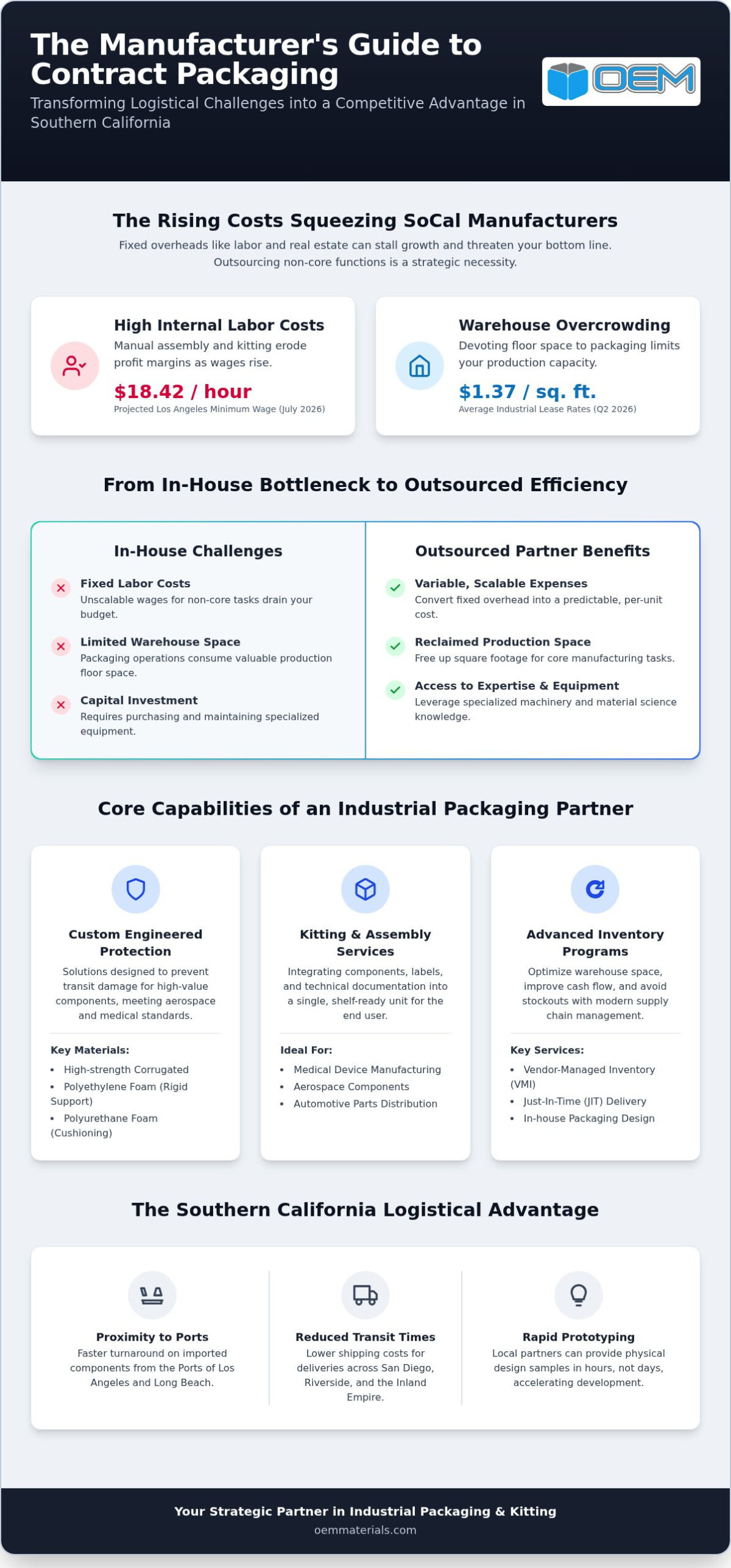
With the Los Angeles minimum wage reaching $18.42 per hour in July 2026 and industrial lease rates averaging $1.37 per square foot, maintaining an in-house kitting and assembly line is no longer just a logistical challenge; it is a direct threat to your bottom line. Many manufacturers find that high internal labor costs and warehouse overcrowding are stalling their growth. If you are managing complex supply chains in Southern California, finding a reliable partner for contract packaging los angeles is a strategic necessity rather than a simple outsourcing decision.
We understand that your priority is protecting high-value components while maintaining a lean operation. This guide will teach you how to evaluate and select industrial contract packaging partners in Southern California to reduce your total cost of ownership and improve overall efficiency. We will cover the benefits of scalable assembly services, professional protective packaging that meets rigorous aerospace or medical standards, and how localized fulfillment helps you avoid inventory stockouts. By the end of this article, you will have a clear framework for choosing a partner that functions as a dependable extension of your manufacturing floor.
Key Takeaways
- Strategic contract packaging los angeles helps Southern California manufacturers reduce overhead by converting fixed labor costs into scalable, variable expenses.
- Custom engineered foam and high-strength corrugated materials are essential for protecting sensitive industrial equipment and meeting aerospace or medical quality standards.
- Vendor Managed Inventory (VMI) and Just-In-Time (JIT) delivery models optimize warehouse space and improve cash flow by minimizing on-site packaging stock.
- Selecting a partner with in-house design capabilities ensures your packaging remains functional and cost-effective as production scales from prototypes to high-volume runs.
Evaluating Contract Packaging and Fulfillment Services in Los Angeles
Industrial contract packaging is the strategic outsourcing of component assembly and protective kitting to a specialized partner. For manufacturers, this process moves beyond simple boxing. It involves integrating custom foam packaging, labels, and technical documentation into a single unit ready for the end user. While a general definition might explain What is a contract packager? by focusing on consumer goods, industrial kitting requires a higher level of technical oversight. This service is designed for sectors where precision and protection are mandatory, such as medical device manufacturing or automotive parts distribution.
Identifying the Need for Outsourced Fulfillment
Internal labor is often the highest cost center for local manufacturers. With the Los Angeles minimum wage reaching $18.42 in July 2026, manual assembly and kitting can quickly erode profit margins. Manufacturers must evaluate the hidden costs of in-house packaging, which include the time spent on inventory management, material handling, and the maintenance of specialized equipment. Results in cost reduction depend on specific variables like product dimensions and annual usage, but the shift from fixed to variable labor is a primary driver for many operations.
Warehouse space is another critical factor. The Los Angeles industrial market saw a 6.0% vacancy rate in Q2 2026. Devoting floor space to kitting operations instead of production can limit your growth capacity. Outsourcing to a partner for contract packaging los angeles allows you to reclaim that square footage for core manufacturing tasks. It also eliminates the need to invest in capital equipment for custom foam cutting or corrugated box assembly.
Regional Logistical Advantages in Southern California
Operating within the Southern California corridor provides distinct logistical benefits. Proximity to the ports of Los Angeles and Long Beach allows for faster turnaround on imported components. Local fulfillment also significantly reduces transit times and shipping costs for deliveries to facilities in San Diego, Riverside, and the Inland Empire. Fast-paced delivery schedules are easier to maintain when the assembly point is within a two-hour drive of your primary distribution hub.
A local partner facilitates rapid prototyping and custom packaging design. When an aerospace engineer needs a revision to a protective foam insert, a local supplier can provide a physical sample in hours rather than days. This proximity supports just-in-time delivery models, ensuring that packaging supplies arrive exactly when needed to keep the production line moving without overcrowding your warehouse.
Technical Requirements for Industrial Contract Packaging
Industrial packaging is an engineering discipline that prioritizes product integrity over aesthetic appeal. Unlike retail co-packing, industrial kitting must withstand the physical stresses of long-haul freight, stacking pressures, and environmental fluctuations. When manufacturers seek contract packaging los angeles, they are looking for technical solutions that prevent transit damage and eliminate the high costs of product returns. Effective protection requires a deep understanding of material science, specifically how different cushioning agents interact with outer containers to neutralize vibration and impact.
Custom Engineered Protection: Foam and Corrugated Integration
The most effective industrial solutions rely on the synergy between foam inserts and custom corrugated boxes. Protection begins with material selection. Polyethylene foam is a closed-cell material that provides rigid support and high load-bearing capacity for heavy components. Polyurethane foam is an open-cell alternative that offers superior cushioning for delicate electronics or polished surfaces. These materials are often die-cut or CNC-routed to create precise cavities that lock a product into place, preventing internal movement during transit.
Corrugated box strength is equally critical. For heavy industrial loads, we evaluate the Edge Crush Test (ECT) ratings to ensure the outer shell won’t collapse under the weight of stacked pallets. The prototyping process involves creating physical samples that undergo fit-testing with your actual components. This methodical approach ensures that every packaging kit is optimized for its specific weight and fragility. If you are unsure which material density fits your application, you can request a technical consultation to review your product specifications.
Specialized Packaging for Medical and Aerospace Sectors
Aerospace and medical device manufacturers face the most stringent packaging requirements in the industry. Aerospace components often require Electrostatic Discharge (ESD) packaging to protect sensitive circuitry from static electricity. These specialized materials are integrated into the kitting process to meet rigorous defense and aviation standards. For medical devices, kitting services must focus on maintaining a clean environment and ensuring that all materials are compatible with sterile processing protocols.
Oversized industrial machinery requires a different scale of protection. In these cases, contract packaging los angeles providers must utilize heavy-duty crates and reinforced pallets. These systems are designed to distribute weight evenly and provide secure anchor points for blocking and bracing. By matching the packaging design to the specific logistical path of the product, manufacturers can significantly reduce the total cost of ownership through lower insurance claims and improved customer satisfaction.
Optimizing Supply Chain Efficiency with VMI and JIT Programs
Efficient manufacturing requires more than just high-quality components; it demands a streamlined flow of materials that supports continuous production. In the industrial sector, the logistical management of packaging is often as critical as the design itself. High-performing contract packaging los angeles partners do not just supply boxes. They integrate directly into your supply chain through advanced inventory management models. By aligning packaging delivery with actual production needs, manufacturers can eliminate the bottlenecks caused by material shortages or warehouse congestion.
The foundation of this integration is a robust communication loop between the manufacturer and the packaging provider. This involves sharing real-time production schedules and usage rates, allowing the partner to anticipate demand fluctuations. This proactive approach stabilizes the supply chain, ensuring that protective materials are always available without requiring constant oversight from your procurement team. It shifts the focus from reactive ordering to strategic resource planning.
Vendor Managed Inventory (VMI) vs Traditional Procurement
Traditional procurement models often lead to two expensive extremes: stockouts that halt production or excessive safety stock that ties up capital. Manual purchase orders and periodic inventory counts are prone to human error and administrative delays. Transitioning to VMI services shifts the burden of inventory tracking to the supplier. Under this model, the packaging partner monitors stock levels at your facility and triggers replenishment cycles automatically based on pre-set minimum and maximum thresholds.
This shift reduces administrative overhead and improves operational cash flow. Instead of paying for months of inventory upfront, you maintain only what is necessary for immediate production. Automated usage tracking provides a level of accuracy that manual systems cannot match, providing a reliable buffer against the supply chain volatility often seen in the aerospace and automotive sectors.
Implementing Just In Time (JIT) Delivery Models
Lean manufacturing principles rely on the ability to receive materials exactly when they are needed on the assembly line. Implementing JIT packaging is particularly beneficial for manufacturers in Los Angeles, Orange County, and the Inland Empire where industrial floor space is at a premium. Bulky materials like custom foam inserts and corrugated sheets take up significant square footage. JIT delivery allows you to reclaim this space for revenue-generating production equipment.
Reliable JIT execution requires a local contract packaging los angeles partner. The proximity allows for rapid response times that a distant supplier cannot provide. When production schedules accelerate, a local partner can adjust delivery windows within hours, ensuring the assembly line never waits for packaging. This geographic advantage is essential for maintaining the high-velocity throughput required in modern Southern California distribution hubs.
Selecting a Fulfillment Partner: Key Performance Indicators for Manufacturers
Choosing a partner for contract packaging los angeles is an engineering decision that directly impacts your operational throughput. Reliability is the primary metric. For a manufacturer, a fulfillment partner must act as a seamless extension of the production line. This requires evaluating specific Key Performance Indicators (KPIs) that move beyond simple labor costs. You need to assess technical engineering capabilities, reporting transparency, and the ability to maintain quality at scale.
Transparent reporting is essential for maintaining a lean supply chain. Your partner should provide real-time data on inventory levels and assembly progress. This visibility allows your procurement team to make informed decisions and prevents the “black hole” effect often associated with outsourced kitting. When communication is data-driven, you can identify potential bottlenecks before they disrupt your distribution schedule.
Prototyping and Scalability Requirements
The speed of custom packaging design is a critical KPI for OEMs in Southern California. Your partner must be able to produce physical samples and prototypes rapidly to keep pace with R&D cycles. Scalability is equally important. A provider might handle short-run prototypes effectively but struggle when production volume spikes. You should verify their capacity to manage seasonal surges or sudden increases in demand without compromising lead times.
A versatile partner maintains a deep inventory of stock supplies to supplement custom components. This includes essentials like stretch film, packaging tape, and mailing tubes. Access to these materials ensures that even if a custom component is delayed, the assembly process doesn’t grind to a halt. If you are ready to evaluate a partner based on your specific volume requirements, you can request a technical consultation and quote.
Quality Control and Regulatory Compliance Standards
Quality control in industrial kitting is not optional. For the aerospace and medical sectors, assembly accuracy must be absolute. Evaluate a partner’s track record for kitting precision and their familiarity with industry-specific transit safety benchmarks. This includes the strategic use of edge protectors and cushioning to ensure that heavy industrial loads remain secure during multi-modal transport.
Secondary services add significant value to the partnership. A partner that provides labeling, stretch wrapping, and palletizing reduces the number of touchpoints in your supply chain. These services should be integrated into a single quality management system. When your contract packager handles the final palletization, they assume responsibility for the unit’s integrity until it reaches the distribution hub. This accountability is the foundation of a long-term solutions partnership.
Custom Kitting and Assembly Solutions for Southern California OEMs
Developing a turnkey kitting program requires a methodical approach that aligns with your specific production cycle. Unlike general co-packing, industrial kitting for Southern California OEMs involves the precise assembly of mechanical or electronic components into highly protective environments. The process begins with a technical review of your bill of materials and a design phase where we integrate your components with custom corrugated and foam packaging. By consolidating material sourcing and assembly labor with a single partner for contract packaging los angeles, you eliminate the logistical friction of managing multiple vendors and disparate lead times.
Streamlining Assembly with Custom Packaging Kits
Complex kitting often involves more than just placing items in a container. For example, an aerospace sub-assembly kit might require ESD-safe cushioning, multiple hardware packets, and technical manuals, all organized within a specific sequence for the end user. Our assembly services integrate these components into a cohesive unit that is ready for immediate distribution. Once the internal assembly is complete, we utilize high-performance stretch film and heavy-duty pallets to ensure final load stabilization and transit safety.
Receiving ship-ready kits provides significant labor savings for your operations. Your team no longer spends hours on manual packing or searching for missing components. Instead, you receive a finished product that has been quality-checked and palletized according to your specific shipping requirements. This efficiency is particularly valuable for manufacturers in Orange County and the Inland Empire who need to maintain high throughput with limited on-site personnel. The reduction in touchpoints naturally lowers the risk of human error and product damage.
Requesting a Quote: Essential Data for Accurate Estimates
Providing detailed data is the first step toward an optimized kitting program. To provide an accurate estimate for large-scale fulfillment, we require specific information regarding your product and logistics. This includes the physical dimensions and weight of each component, as well as your projected annual usage. Understanding the fragility level and any specific transit hazards is also vital for engineering the correct level of protection. Results in cost reduction depend on these specific variables, as they dictate the material density and assembly time required.
A detailed packaging analysis helps identify areas where material reduction or assembly improvements can lower your total cost of ownership. When you request a quote, please include your current shipping methods, such as LTL or parcel, as these variables dictate the necessary strength of the corrugated materials. Our goal is to provide a solution that balances material costs with the technical requirements of your industry. This ensures your products arrive intact while maintaining the speed and reliability your supply chain demands.
Optimizing Your Southern California Supply Chain
Transitioning to a professional partner for contract packaging los angeles allows manufacturers to reclaim valuable floor space and stabilize rising labor costs. We have explored how technical kitting and engineered protection reduce the total cost of ownership while meeting the rigorous quality standards of the aerospace and medical sectors. By integrating VMI and JIT programs from a local facility, you ensure that your production line remains lean and responsive to shifting market demands.
OEM Materials & Supplies operates as a dedicated solutions partner with a local Southern California presence designed for rapid prototyping and high-volume assembly. Our specialized engineering team understands the complexities of industrial logistics, from custom foam design to final load stabilization. Please request a quote for contract packaging and fulfillment by providing your product dimensions, weight, and annual usage. We look forward to helping you streamline your logistics and protect your high-value components for long-term success.
Frequently Asked Questions
What is the difference between co-packing and contract packaging for manufacturers?
Industrial contract packaging focuses on technical kitting and assembly rather than retail consumer goods. While co-packing often deals with primary packaging for food or supplements, contract packaging los angeles involves secondary and tertiary protection for the manufacturing sector. This includes integrating engineered foam inserts and high-strength corrugated boxes to protect sensitive components. It is a logistical partnership designed to move mechanical or electronic parts safely through the industrial supply chain.
How does a contract packaging partner in Los Angeles help reduce shipping costs?
A local partner reduces transit costs by minimizing the distance between the assembly point and Southern California distribution hubs. Facilities in Los Angeles, Orange County, and the Inland Empire benefit from reduced freight charges and faster turnaround times. Additionally, technical design services help right-size your packaging. This eliminates empty space in containers, which directly lowers shipping rates and reduces the volume of materials like stretch film and edge protectors required for stabilization.
What industries benefit most from industrial kitting and assembly services?
High-precision sectors such as aerospace, medical device manufacturing, and electronics benefit most from these services. These industries require specialized kitting that meets rigorous safety and sterile environment standards. Automotive manufacturers also utilize assembly services to manage complex parts distribution. By outsourcing the kitting of technical components, these sectors can focus internal resources on core production while ensuring that every unit is protected by custom-engineered materials during transit.
Can a contract packager help with custom foam and corrugated design?
Full-service contract packagers provide expert design for custom foam and corrugated solutions. This involves engineering specific cushioning densities, such as polyethylene or polyurethane, to neutralize vibration and impact. The process includes rapid prototyping and die-cutting to create precise cavities for your products. This integration ensures that the outer corrugated box and the internal foam work together to prevent movement and damage during long-haul transit or multi-modal shipping environments.
What is the typical lead time for a custom kitting project in Southern California?
Lead times for custom kitting projects depend on the complexity of the assembly and the availability of specialized materials. For manufacturers in Southern California, local proximity often allows for faster prototyping cycles compared to out-of-state vendors. Once a design is approved and materials are sourced, production schedules are scaled to meet your specific throughput requirements. We recommend discussing your annual usage and delivery windows early in the planning phase to ensure consistent supply.
How do VMI and JIT programs integrate with contract fulfillment?
VMI and JIT programs allow the packaging partner to manage inventory levels and deliver kits exactly when they are needed on the production line. Under a Vendor Managed Inventory model, the supplier monitors stock and triggers replenishment automatically. Just-In-Time delivery ensures that bulky items like corrugated boxes and wood crates don’t occupy valuable warehouse space. This integration reduces overhead and prevents production delays caused by material shortages or warehouse overcrowding.
What information is needed to get an accurate quote for contract packaging?
To provide an accurate quote, we require the physical dimensions, weight, and fragility levels of your products. You should also specify your projected annual usage and the shipping environment the kits will encounter. Details regarding secondary services, such as labeling, palletizing, or the use of plastic pallets, are also necessary. This data allows our engineering team to conduct a detailed packaging analysis and recommend the most cost-effective materials and assembly methods for your application.
Are there minimum order quantities for industrial kitting services?
Industrial kitting services are designed to scale according to the needs of the manufacturer. While some providers focus only on high-volume production, OEM Materials & Supplies supports a wide range of project sizes, from rapid prototyping and short runs to full-scale fulfillment programs. The feasibility of a project often depends on the complexity of the assembly and the material requirements. We evaluate each program individually to ensure the solution aligns with your operational goals.