
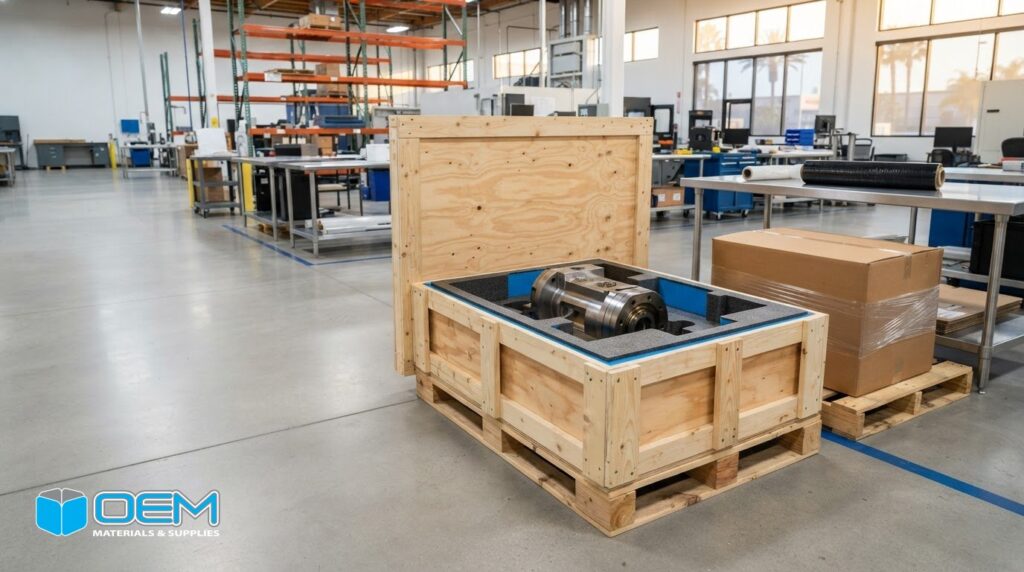
A crate can be built to fit a product and still leave important protection needs unaddressed. For buyers searching “industrial crating company orange county,” the decision should account for more than the crate itself. Product requirements, handling conditions, and complementary materials all contribute to a packaging plan.
Dimensions and weight are a useful starting point, but internal cushioning, corrugated packaging, and supply consistency also affect how well a packaging plan supports production and distribution. This guide explains what to prepare for a quote and how to compare wood crates, foam, corrugated boxes, and cushioning for your application.
You’ll also learn how to assess packaging design support and plan for needs ranging from prototypes to ongoing production. OEM Materials & Supplies serves manufacturers in Orange County and across Southern California. The goal is a clear, coordinated specification that fits your product and operating requirements.
Key Takeaways
- Give an industrial crating company in Orange County clear product dimensions, weight, handling conditions, shipment context, and anticipated annual usage.
- Specify the product and its protective packaging together so the crate, internal cushioning, and handling requirements work as a coordinated plan.
- Compare wood crates, corrugated boxes, and combinations with foam or cushioning based on the product, protection needs, and project scale.
- Use a defined sourcing process to move from a packaging brief to design discussions, prototype needs, and production planning.
- Align packaging design and complementary materials with your supply plan, from short-run projects to ongoing production programs.
What Orange County manufacturers should expect from an industrial crating company
Industrial crating is protective packaging designed around a product, piece of equipment, or industrial shipment. A crate provides an outer structure suited to the item and its planned handling. Start the design brief with the product and its journey, not simply a request for a crate of a certain size. General background on types of crates can help clarify the range of uses, but each project’s requirements depend on its product and distribution conditions.
Product value and fragility help define the protection requirements. Dimensions, weight, and shape affect how the product fits within its packaging and how it can be handled. A large, irregularly shaped component may need a different approach than a compact, robust part. Consider the crate alongside any foam or cushioning intended to protect the product inside it.
For manufacturers in Orange County, packaging is often part of a broader production plan. Aerospace, automotive, medical device, electronics, and other manufacturing operations may need packaging for a prototype, a short run, or a continuing program. OEM Materials & Supplies serves manufacturers in Orange County and across Southern California, including Los Angeles, Riverside, and San Diego.
What information shapes an industrial crate requirement?
A useful project brief separates confirmed requirements from assumptions. Record the product’s dimensions and weight, describe fragile areas or irregular shapes, and note how the item can be supported without putting pressure on sensitive features. Identify handling points, such as where the product is lifted or moved, along with the planned shipment route and known transit or storage conditions.
Also flag details that are still undecided. For example, the route may be established while the storage duration is not. Marking that uncertainty helps focus the packaging discussion on decisions that need to be made instead of treating estimates as fixed specifications. It also gives purchasing and engineering teams a consistent basis for comparing proposals.
How does an industrial packaging supplier differ from a crating service?
Packaging supply can include the crate and related protective materials, with design support to align them to the product and project requirements. Packing a product and arranging freight are separate activities from specifying packaging materials. Define the requested scope early so purchasing and operations teams can compare proposals on the same basis and assign each task clearly.
For example, a buyer may need a wood crate designed alongside internal foam or cushioning, while their own team coordinates packing and freight. OEM’s wood crates can be considered with complementary packaging as part of a project-specific plan. State whether the request includes packaging materials, design input, prototypes, or production supply. A clear scope gives the project a practical starting point.
How to evaluate an industrial crate for your product and handling needs
A crate specification should connect the product’s physical details to the way it will be loaded, moved, stored, and shipped. Start with confirmed information, then identify assumptions that could change the packaging plan. This gives engineers, operations teams, and purchasing managers a shared basis for reviewing options. For Orange County buyers comparing an industrial crating company, a consistent brief makes proposals easier to evaluate against actual project requirements.
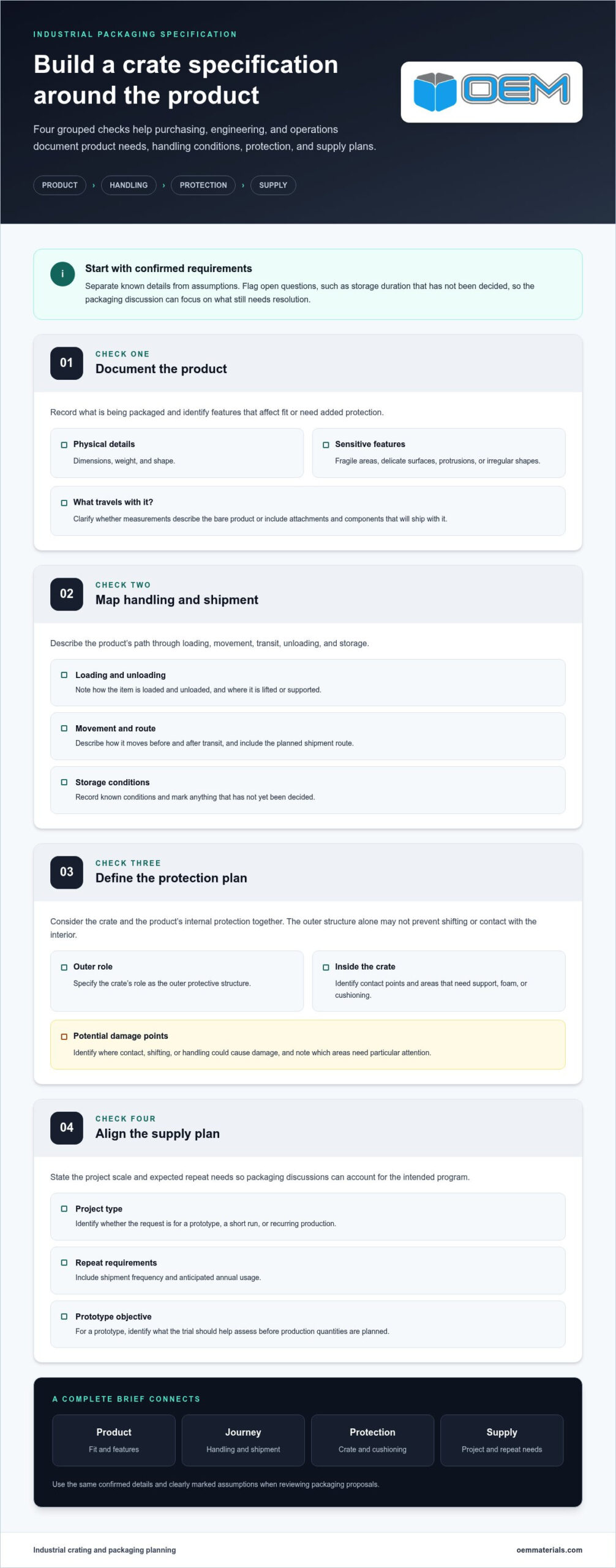
Use this sequence to build the specification:
- Document the product. Record dimensions, weight, shape, fragile areas, and features that need added protection. Note whether measurements describe the bare product or include attachments and components that will travel with it.
- Map handling. Describe how the item is loaded and unloaded, where it is lifted or supported, and how it moves before and after transit. Include known storage conditions and the planned shipment route.
- Define protection. Identify areas where contact, shifting, or handling could cause damage. Consider the crate’s outer protective role alongside any foam or cushioning needed inside.
- Align supply needs. State whether the request is for a prototype, a short run, or recurring production. Include shipment frequency and anticipated annual usage to inform planning for repeat orders.
Which product and shipment details should buyers document?
Be precise about what the dimensions represent. Product measurements alone may not show the space needed for internal protective materials, while finished-package measurements should account for the complete configuration. Provide the product’s weight and shape, and identify delicate surfaces, protrusions, or other areas that need particular attention.
Then map the handling path from the production area through loading, transit, unloading, and storage. Separate confirmed facts, such as a known lifting point, from assumptions, such as a storage condition that has yet to be decided. For repeat shipments, note anticipated usage and frequency. For a prototype, identify what the trial should help assess before planning production quantities.
How should internal protection and crate construction be considered?
The crate provides the outer protective structure, but it does not automatically prevent the product from moving or contacting the interior. Identify where the product may touch the packaging and which areas need support or cushioning. Foam or other cushioning materials can be considered with the crate to address those interior protection needs. The suitable design depends on the product and its handling conditions, not a universal specification.
When you’re ready to discuss crate and protective packaging requirements, submit a packaging quote request to OEM Materials & Supplies. Include product dimensions, weight, handling details, project stage, and anticipated annual usage to give the discussion a practical starting point.
Crates, corrugated boxes, and cushioning: compare the packaging options
These formats address different parts of a packaging problem. A crate can provide an outer structure, corrugated packaging can enclose or organize products, and foam or other cushioning can help manage contact and movement inside a package. They can work together rather than compete as one-for-one substitutes. The right combination depends on the product, handling conditions, protection requirements, and project scale.
| Option | May suit | Evaluate |
|---|---|---|
| Wood crate | Equipment or products whose size, weight, shape, or handling needs call for a crate format. | Product dimensions and weight, loading and unloading, and shipment conditions. |
| Corrugated box | Products that can be packaged in a box format suited to their size and protection needs. | Product fit, required protection, handling, and whether the package is part of a repeat program. |
| Crate with foam or cushioning | Products needing an outer crate along with interior protection at contact points or areas where movement is a concern. | Product surfaces, shape, areas needing support, and how the package will be handled. |
Use the comparison as a starting point, not a universal specification. A format that fits one product may not suit another, even within the same manufacturing operation. Evaluate industrial wood crates alongside complementary packaging against the project brief.
When might a wood crate be a better fit than a corrugated box?
Consider product size, weight, shape, and planned handling. Equipment with an irregular profile or a shipment that calls for a crate format may need a different approach from a product suited to a corrugated box. Neither format is automatically the better choice. Match the packaging to the item and shipment requirements, then consider how the selected format fits the project’s production scale. OEM Materials & Supplies offers wood crate packaging as part of its packaging solutions.
How can foam and cushioning support a crate packaging plan?
The crate addresses the outer packaging structure. Interior protection addresses how the product sits within it. Foam packaging can be designed for a project-specific fit around product features, while other cushioning materials may suit different contact points and protection needs. Avoid assuming every product needs the same interior treatment. Identify sensitive areas and how the item may shift, then evaluate the crate and internal materials together. OEM’s custom foam packaging and cushioning materials can be considered alongside a crate.
Packaging choices can also change with project stage. A prototype may help assess a proposed configuration before planning a short run or high-volume program. Any cost comparison should account for the product’s dimensions, materials, and shipping requirements. No packaging format guarantees savings across all applications.
A practical sourcing process for industrial crating in Orange County
A structured sourcing process helps purchasing, engineering, and operations teams move from a product need to a packaging plan that fits the project stage. Start with a clear brief, discuss the packaging design, decide whether a prototype is needed, then plan for production supply. This keeps the conversation focused on project requirements rather than assumptions about what a crate or service includes.
When evaluating an industrial crating company in Orange County, make sure quote inputs clarify both the product and the supply scope. Include:
- Product dimensions, weight, shape, and any drawings available for review.
- Known handling requirements, including loading, unloading, movement, and storage.
- Shipment context, such as the route and any confirmed transit or storage conditions.
- Related packaging materials under consideration, such as foam or cushioning.
- Project stage, expected volumes, shipment frequency, and anticipated annual usage.
OEM Materials & Supplies works with manufacturers in Orange County and across Southern California on packaging needs from prototypes and short runs through high-volume programs. A well-prepared request helps frame design and supply discussions around confirmed information, while clearly identifying unresolved requirements.
How should a buyer prepare a crate packaging brief?
Gather product drawings or measured dimensions, weight, and details about how the item is handled. Describe the project stage and expected volumes, and note whether the crate will be considered alongside corrugated packaging, foam, or other cushioning. State shipment and performance requirements as facts. Don’t assume export or regulatory specifications apply unless they are part of the project requirements.
Separate confirmed details from estimates. If annual usage is still being forecast, label it as an estimate rather than a committed quantity. That distinction supports a more useful discussion about prototype needs and production planning.
How do prototypes and recurring production needs affect sourcing?
A prototype or short run centers the discussion on the specific packaging configuration and what needs evaluation before a broader rollout. A high-volume program adds ongoing supply planning to the design conversation. For recurring requirements, vendor-managed inventory (VMI) can support inventory coordination with production needs. Buyers comparing suppliers for a wider packaging program can also review what a wholesale industrial packaging supplier can support.
Share the brief early, especially when crate design and related materials need to be considered together. This helps define the prototype path and how the packaging plan may carry into production without treating a preliminary estimate as a final specification.
To begin a project discussion, request a packaging quote with dimensions, weight, handling details, shipment context, project stage, and anticipated annual usage. Clear inputs focus the conversation on the requirements that shape the proposed packaging and supply plan.
How OEM Materials supports industrial crating and packaging programs
A crate project often affects more than the outer package. Product protection, related materials, prototype decisions, and ongoing supply all need to fit the manufacturer’s operating plan. OEM Materials & Supplies provides wood crates and complementary packaging, including corrugated boxes, foam packaging, and cushioning materials. Its packaging solutions support manufacturers from prototype projects and short runs through high-volume production programs.
For manufacturers evaluating an industrial crating company in Orange County, a useful packaging partner considers the crate alongside the wider packaging requirement. A product may need a crate and internal cushioning, while a production program may also rely on corrugated packaging or coordinated packaging kits. Reviewing those needs together helps teams define a scope around the product and workflow rather than treating each material as an isolated purchase.
What packaging support can OEM bring to a crate project?
Packaging design connects product details to the materials under consideration. OEM supports projects from prototypes and short runs through high-volume production programs. A prototype provides an opportunity to review a proposed packaging configuration before production planning advances. The crate, foam, corrugated components, and cushioning can be considered as parts of one packaging plan, with the specific configuration shaped by project requirements.
For a new or changing application, share available product information and the project stage during the design discussion. OEM’s custom packaging design supports a project-focused review of how crate packaging and complementary materials may fit together. Kitting and assembly services can also support packaging program requirements where relevant.
How can local manufacturers plan for ongoing packaging supply?
Once a packaging configuration is established, the supply plan should reflect how materials connect to production and inventory needs. Vendor-managed inventory (VMI) can support inventory coordination for recurring programs where inconsistent material availability or unclear replenishment planning can disrupt operations. The right approach depends on the manufacturer’s usage patterns and supply requirements.
OEM serves manufacturers in Orange County, Los Angeles, Riverside, and San Diego. This regional coverage supports businesses coordinating packaging needs across Southern California, from initial project discussions through ongoing programs. OEM’s packaging and logistics supplies include crates, corrugated boxes, foam packaging, and other protective materials.
To request a quote, contact OEM Materials & Supplies with the product dimensions, weight, anticipated annual usage, project stage, and known handling requirements. Include related packaging materials and recurring supply needs. These details provide a practical basis for discussing a crate and packaging plan aligned with your operation.
Put your packaging specification to work
A crate decision is more useful when it becomes a shared reference for engineering, procurement, and operations, not a one-time purchasing note. Keep the approved product configuration, handling assumptions, and packaging scope connected as the project moves from evaluation into production. If the product or route changes, revisit the packaging brief before repeating the order. This helps teams identify mismatches early and keep quote comparisons tied to the same requirements.
For manufacturers comparing industrial crating companies in Orange County, the next step is to turn project details into a defined packaging request. OEM Materials & Supplies can discuss a project-specific approach that considers the crate alongside broader protective packaging and supply needs. A clear brief gives the team a useful starting point.
Request a quote for your industrial crating project and include the product dimensions, weight, handling requirements, project stage, and anticipated annual usage. OEM Materials & Supplies serves manufacturers in Orange County and across Southern California, including Los Angeles, Riverside, and San Diego.
Frequently Asked Questions
How much does an industrial shipping crate cost?
Crate pricing depends on the project, so a useful estimate needs application details rather than a generic per-crate figure. Share the product’s dimensions and weight, required materials and protective components, handling and shipment needs, and expected order volume. For a more meaningful comparison, keep the requested configuration and quantities consistent across quotes. An industry average won’t account for the specific requirements that shape your project’s packaging.
Can a wooden shipping crate be reused?
A wooden crate may be reusable if its condition and construction remain suitable for the next shipment. Before reuse, inspect for damage or changes that could affect how it supports and protects the product. Then compare the crate’s condition with the next item’s dimensions, protective packaging, and handling plan. A crate that worked for one shipment shouldn’t automatically be assumed suitable for a different product or route.
Can a crate be made for irregularly shaped equipment?
Irregularly shaped equipment can be considered for project-specific packaging. Include a drawing or clear description of protrusions, offset sections, and areas that need protection. Also note where the item can be supported or handled, since those details help inform how it fits within the packaging. A broad length, width, and height measurement may not communicate the full shape, so provide multiple views when available.
Should equipment be cushioned inside a shipping crate?
It depends on the equipment and how it may move or make contact during handling. For example, a protruding component or sensitive surface may need different consideration from a robust, flat area. Identify those features and describe the handling conditions before selecting internal protection. Foam and other cushioning materials can be considered with the crate, but product details should guide the choice rather than a default material or assumed performance level.
What details should I provide when requesting an industrial crating quote?
Provide dimensions, weight, shape, handling requirements, shipment context, and anticipated annual usage. Note whether the request is for a prototype, short run, or recurring production, and include any related packaging materials in scope. For Orange County buyers evaluating an industrial crating company, these details establish a consistent basis for discussing the project. If product drawings or existing packaging information are available, include them as useful references.
Does OEM Materials serve industrial customers in Orange County?
Yes. Its industrial packaging offering includes wood crates and related protective packaging for projects at different production stages. To start a project-specific discussion, share the product dimensions, weight, handling needs, and anticipated usage in a quote request. That gives the team useful context for reviewing the packaging requirement.