
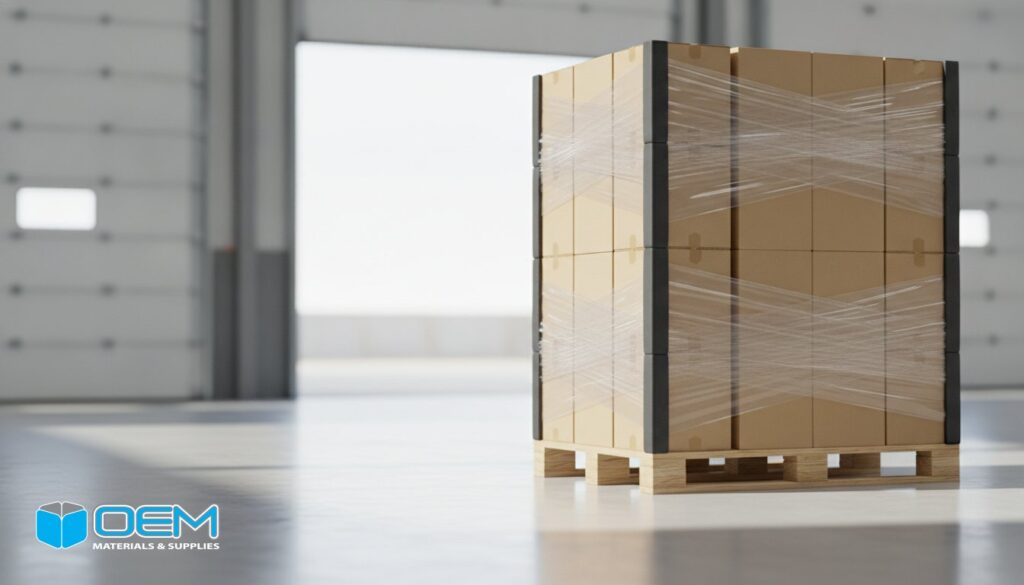
Every pallet that leaves your dock is a test of your containment strategy. If you rely solely on stretch film to keep a load from shifting during transit, you are likely overspending on material while still risking product damage. High-tension strapping often leads to crushed carton corners, creating waste before the shipment even reaches the truck. Proper use of edge protectors for pallet stabilization solves these structural issues by distributing pressure and unifying the load into a rigid, transportable column.
You understand that maintaining load integrity is critical for meeting the strict requirements of sectors like aerospace and medical device manufacturing. When a pallet leans or walks during a long-haul trip, it results in rejected shipments and increased labor costs for restacking. You need a solution that ensures zero-damage arrivals without relying on excessive layers of plastic film or redundant packaging materials.
This guide provides the technical context you need to select the right caliper and material for your specific application. You will learn how to integrate these components into your existing workflow to reduce material waste and optimize your shipping operations. We cover everything from standard sizing to custom lengths designed for non-standard pallet heights common in Southern California manufacturing hubs.
Key Takeaways
- Learn how edge protectors serve as structural reinforcements that transform individual cartons into a unified, rigid column for safer transit.
- Understand technical specifications like caliper thickness to select the right edge protectors for pallet stabilization based on your load weight and strapping tension.
- Discover how strategic placement of corner guards allows for higher containment force with less stretch film, reducing both material waste and costs.
- Identify specialized application techniques for the aerospace and medical sectors to maintain product integrity and meet rigorous shipping standards.
- Explore how local Southern California logistics solutions like VMI and JIT delivery can optimize your warehouse space and prevent inventory shortages.
The Role of Edge Protectors in Pallet Stabilization
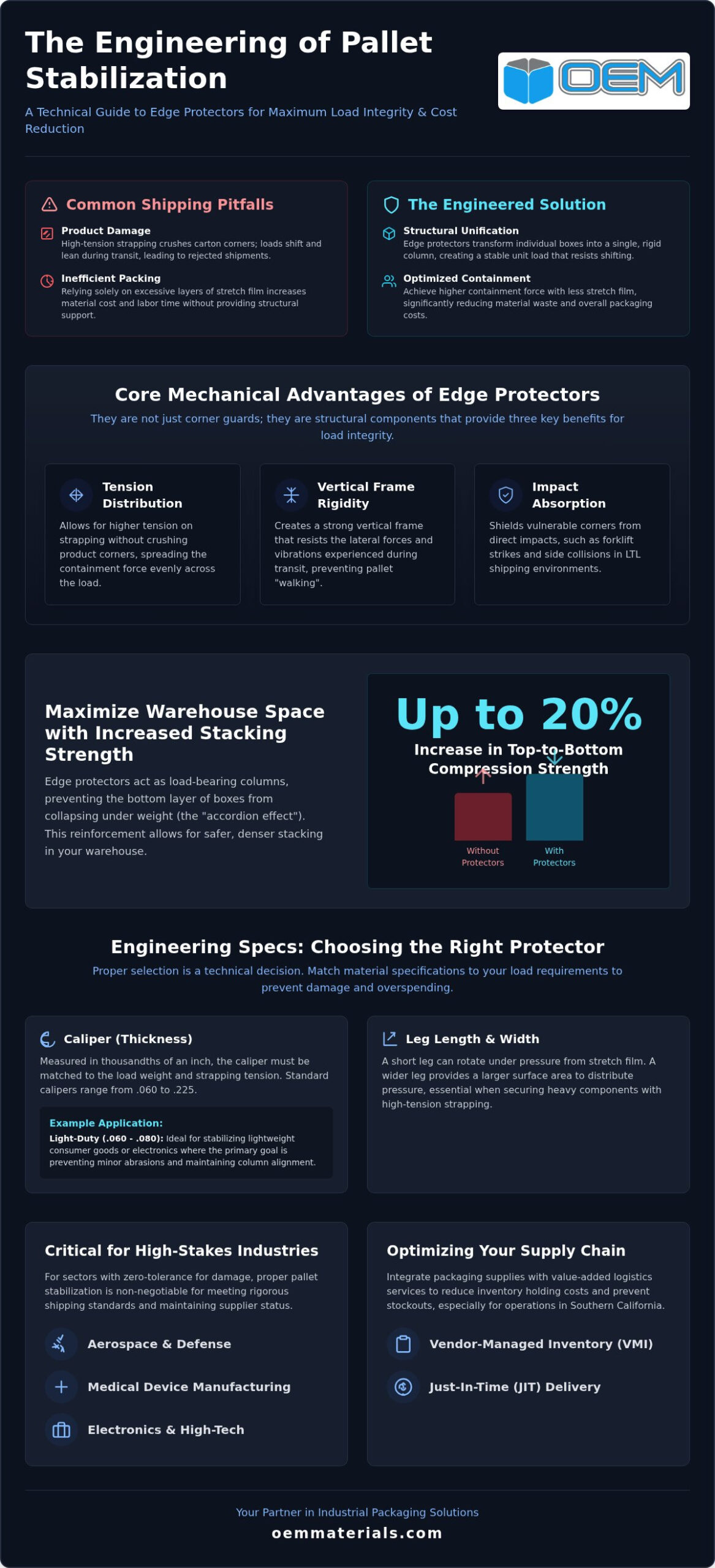
Edge protectors for pallet stabilization act as the structural skeleton of a unit load. While many warehouse managers view them as simple corner guards, their primary function in industrial logistics is to transform individual corrugated boxes into a unified, rigid column. This unitization is essential for maintaining the structural foundation of a unit load during the high-stress environment of long-haul trucking. Without this reinforcement, pallets are susceptible to “walking” or leaning, where the top layers shift out of alignment with the base.
The application of edge protectors provides three distinct mechanical advantages:
- Strapping Tension Distribution: They allow for higher tension on plastic or steel strapping without crushing the underlying product.
- Vertical Frame Rigidity: They create a vertical frame that resists lateral forces during transit.
- Impact Absorption: They shield vulnerable corners from forklift strikes and side-impact collisions.
From an economic perspective, this stabilization reduces the frequency of damage claims and can lead to lower insurance premiums by demonstrating a commitment to rigorous shipping standards. Better containment also means fewer rejected shipments, which is critical for maintaining supplier status in high-stakes industries like aerospace or medical manufacturing.
Load Containment vs. Surface Protection
It is vital to distinguish between materials designed for surface protection and those engineered for load containment. Light-duty foam guards are excellent for preventing scratches on finished surfaces but lack the structural integrity required for stabilization. In contrast, heavy-duty V-boards are structural components. In modern LTL shipping environments, where pallets are frequently moved and subjected to constant vibration, surface protection alone is insufficient. You need the rigidity of a structural board to ensure the load remains unitized from the point of origin to the final destination.
Increasing Vertical Stacking Strength
Edge protectors serve as load-bearing support columns when pallets are double-stacked in a warehouse or trailer. By reinforcing the vertical corners of a pallet, they prevent the “accordion effect,” where the bottom layer of corrugated boxes collapses under the weight of the layers above. This is a common point of failure in high-volume distribution centers. Using edge protectors for pallet stabilization can increase top-to-bottom compression strength by up to 20 percent. This added strength allows for safer high-density stacking, effectively maximizing your vertical warehouse footprint in high-cost regions like Orange County and Los Angeles County.
Engineering Specs: Material Selection and Caliper Thickness
Selecting the right edge protectors for pallet stabilization requires a technical understanding of caliper, which is the measurement of the material’s thickness in thousandths of an inch. A common mistake in procurement is treating all corner guards as interchangeable commodities. In reality, the caliper and material density must be engineered to withstand the specific compressive forces of your strapping and the weight of the load. Load containment principles dictate that the stabilization components must be rigid enough to maintain the load’s integrity without deforming under tension.
Beyond thickness, you must match the leg length and width to the dimensions of your shipping container or corrugated boxes. If the leg is too short, the protector may rotate under the pressure of the stretch film or strapping. A wider leg provides a larger surface area to distribute pressure, which is essential when securing heavy components that require high-tension steel or polyester strapping.
Selecting the Correct Caliper for Your Load
Industry standard calipers typically range from .060 to .225. Matching the thickness to the application prevents both product damage and material overspending. Consider these three primary categories for industrial use:
- Light-Duty (.060 to .080): These are ideal for stabilizing lightweight consumer goods or electronics where the primary goal is preventing minor abrasions during handling.
- Medium-Duty (.120 to .160): This range serves as the industrial baseline for most manufacturing sectors in Orange County and San Diego County. It provides sufficient rigidity for standard palletized loads.
- Heavy-Duty (.225 and above): Reserved for aerospace, automotive, and heavy machinery shipments. These calipers are necessary when using high-tension strapping that would otherwise crush thinner boards.
V-Board vs. Plastic Protectors
Most industrial applications utilize recycled paperboard, often referred to as V-board. It is cost-effective, sustainable, and provides excellent friction to stay in place during the wrapping process. However, environmental factors may dictate a shift in material. Plastic edge protectors are the standard for medical device manufacturers requiring cleanroom compliance, as they don’t produce dust or fibers. They are also the preferred choice for outdoor storage or shipments traveling through high-humidity climates where paperboard might soften. If you are unsure which material fits your transit profile, you can request a technical consultation to review your specific shipping requirements.
Durability also varies by material density. High-density paperboard can often be reused in closed-loop supply chains, whereas plastic provides the ultimate longevity for long-term warehousing. Choosing the right material ensures that your containment strategy remains effective from the assembly line in the Inland Empire to the final delivery point.
Strategic Application for Maximum Load Containment
Maximizing the effectiveness of edge protectors for pallet stabilization depends on precise placement and proper alignment. A frequent operational error is using protectors that do not span the full height of the load. If the protector is too short, the top layers lack the necessary vertical support, which often results in the load shifting during transit. For optimal stability, the protector should match the exact height of the stacked unit, ensuring that containment forces are applied uniformly from the base pallet to the top layer.
During the wrapping process, securing these components requires coordination. In manual packing stations, warehouse personnel must hold the protectors in place until the first two revolutions of stretch film for pallet wrapping can lock them into position. Automated wrapping systems often utilize specialized dispensers to integrate these protectors without slowing down the line. For internal stabilization, placing corner guards inside the boxes themselves prevents heavy items from shifting and puncturing the outer walls of your packaging.
Strapping and Tie-Down Integration
High-tension strapping is essential for heavy industrial loads, but it often cuts into the corners of custom corrugated boxes. Applying edge protectors allows your team to reach the tension levels required to meet OSHA secure storage requirements. These regulations mandate that materials stored in tiers must be stable and secure against sliding or collapse. The protector acts as a structural bridge, spreading the strap’s concentrated force across a wider surface area to prevent product deformation or carton failure.
Horizontal vs. Vertical Edge Protection
Vertical protectors are the baseline for corner impact and stacking strength. However, horizontal protectors are equally critical for stabilizing the top layer of a unit load. Horizontal application prevents “strap-burn” and keeps top cartons from splaying outward under pressure. For high-value equipment or sensitive electronics, combining both vertical and horizontal pieces creates a “picture frame” stabilization strategy. This 360-degree reinforcement ensures the load remains square and rigid throughout the vibration cycles of long-haul trucking, providing the highest level of security for critical shipments.
Industry-Specific Edge Protection Requirements
Industrial supply chains are not uniform. Each sector faces distinct mechanical stresses that require specialized configurations of edge protectors for pallet stabilization. For example, the aerospace and automotive industries often ship heavy, irregularly shaped metal components. These parts create uneven weight distribution and high point-loading on pallet corners. Using high-caliper V-boards ensures that the tension from steel strapping doesn’t collapse the primary packaging or the pallet itself.
In the medical device sector, maintaining sterile packaging integrity is the top priority. Even minor box crushing can lead to expensive product rejections. Here, edge protectors serve as a rigid barrier against side-impact damage during high-volume sorting. For electronics manufacturers, stabilization is often paired with custom foam inserts. This combination provides a dual-layer defense; the foam absorbs internal shock while the edge protectors maintain the external structural box frame.
Food and beverage distribution involves cold chain logistics where moisture is a constant threat. Standard paperboard can soften in refrigerated trailers, leading to load failure. We provide moisture-resistant coatings that allow edge protectors to maintain their stiffness in humid environments, ensuring that top-heavy beverage pallets remain upright during transit.
Logistics in Southern California Hubs
Southern California serves as a primary gateway for international trade. Manufacturers in San Diego County must meet rigorous export standards for cross-border transit, where loads are subjected to multiple handling cycles. Similarly, shipments moving through the Los Angeles and Long Beach port corridors face extreme vibration and frequent stop-and-go stresses. In high-volume distribution centers across Riverside and the Inland Empire, pallet stability is essential for automated storage and retrieval systems that require perfect load squareness to operate without interruption.
Custom Sizing for OEM Production Lines
Stock sizes often lead to material waste or insufficient protection for specialized industrial equipment. If a pallet height is non-standard, using a stock protector that is too long requires manual cutting on the warehouse floor; this increases labor time and safety risks. We offer custom-cut lengths that fit your specific production requirements perfectly. This is particularly beneficial for oversized wood crates or unique machinery skids where standard 48-inch boards are inadequate. If your operation requires a specialized stabilization profile, you can request a custom prototype to test in your specific shipping environment.
Optimizing Inventory with OEM Materials & Supplies
Managing the inventory of edge protectors for pallet stabilization presents a specific logistical challenge due to the physical bulk of the material. Storing large quantities of V-board can consume valuable floor space that is better utilized for production. OEM Materials & Supplies solves this through Vendor Managed Inventory (VMI), where we monitor your stock levels and replenish supplies automatically. This service ensures that your packaging line never stops due to a shortage of critical stabilization components.
For high-volume manufacturing centers in Orange County, Los Angeles County, and the Inland Empire, we offer just-in-time (JIT) delivery. This model allows you to maintain a minimal warehouse footprint while relying on our local distribution network for rapid fulfillment. By consolidating your orders for edge protectors with other protective packaging, such as stretch film or custom corrugated boxes, you can significantly lower freight costs and simplify your procurement process. Our team provides consultative design services to help you identify the lowest-cost material and caliper that still meets your rigorous safety and transit specifications.
Cost Reduction Strategies
Analyzing the total cost of ownership is essential for any industrial packaging strategy. While a higher-caliper edge protector may have a higher unit price, the reduction in product damage claims and rejected shipments often results in a net gain. Using a rigid edge protector also allows for higher containment force with fewer revolutions of stretch film, which reduces overall material consumption. VMI programs eliminate the risk of stockouts during peak production by maintaining a buffer of ready-to-ship inventory based on your historical usage patterns. These efficiencies help stabilize your packaging budget even when shipping volumes fluctuate.
Next Steps for Facility Managers
If your facility is experiencing load shifting or corner damage, the first step is a comprehensive pallet stability audit. Our specialists can visit your site in San Diego County or the surrounding areas to evaluate your current wrapping and strapping techniques. We can then provide custom prototypes for new product launches or oversized equipment to ensure your stabilization strategy is optimized before the first shipment leaves the dock. To receive a quote tailored to your operation, please contact OEM Materials & Supplies with your typical load dimensions, pallet weights, and estimated annual usage. This data allows us to recommend the precise caliper and material density required to protect your bottom line.
Securing Your Supply Chain Integrity
Effective palletization is a matter of precision engineering rather than guesswork. By selecting the correct material density and caliper thickness, you transform vulnerable loads into rigid, shippable units. Implementing edge protectors for pallet stabilization doesn’t just prevent crushed corners; it allows for higher containment force with less material waste. This technical approach is essential for meeting the rigorous standards of the aerospace and medical device industries where packaging failure is not an option.
OEM Materials & Supplies has served specialized manufacturers across Orange County, Los Angeles, and San Diego since inception. We combine local SoCal inventory for rapid delivery with full-service design and engineering support to solve your most complex logistical challenges. Our team is ready to help you conduct a stability audit or design custom prototypes tailored to your specific load dimensions and transit risks.
Contact OEM Materials & Supplies for a Custom Edge Protection Quote today to optimize your shipping operations. We look forward to partnering with you to achieve zero-damage arrivals and a more efficient supply chain.
Frequently Asked Questions
What is the difference between V-board and corner protectors?
V-board refers to rigid, heavy-duty paperboard folded into a V-shape to provide structural reinforcement along the entire vertical edge of a load. The term corner protector is more general and can include smaller plastic pieces used primarily to prevent strap-burn or light-duty foam guards for surface protection. For industrial palletizing, V-boards are the standard choice when you need to increase stacking strength and maintain a rigid vertical column.
How do I determine the right length of edge protector for my pallet?
You should select a length that matches the full vertical height of your palletized load. If the protector is shorter than the stack, the top layers will lack the necessary containment force and may shift during transit. Conversely, using lengths that exceed the load height interferes with double-stacking and creates safety hazards. For non-standard heights, we provide custom-cut lengths to eliminate manual trimming on your warehouse floor.
Can edge protectors be reused in a closed-loop supply chain?
Edge protectors for pallet stabilization can be reused in closed-loop supply chains if the material maintains its structural integrity. High-caliper boards (.160 and above) are durable enough for multiple trips between local Southern California facilities. You must inspect the boards for softening or corner crushing before each use. Once the board loses its rigid V-shape, it no longer provides the mechanical advantage required for load containment.
Are cardboard edge protectors recyclable?
Most cardboard edge protectors are fully recyclable and made from high-density recycled paperboard. They can be processed alongside standard corrugated waste in your facility’s recycling stream. This makes them a more sustainable choice compared to plastic alternatives for general manufacturing. By using paper-based stabilization, you reduce the environmental footprint of your packaging while maintaining the rigidity needed for heavy industrial components moving through the Inland Empire.
How many edge protectors do I need for a standard 48×40 pallet?
A standard configuration requires four vertical edge protectors, one for each corner of the pallet. If you’re shipping high-value or unstable goods, you may require four additional horizontal pieces to create a picture frame around the top layer. This eight-piece setup provides maximum resistance against lateral shifting and prevents strapping from damaging the top cartons. The specific count depends on your load’s weight and stability requirements.
What happens if I use a caliper that is too thin for my load?
Using a caliper that is too thin for your load weight results in structural failure when strapping tension is applied. The protector will buckle or fold, allowing the strap to cut into your cartons and causing the load to lose its unitized shape. This often leads to pallet lean during long-haul trucking. It’s essential to match the caliper to the tension of your strapping to ensure the board remains rigid throughout the trip.
Do edge protectors help with international shipping compliance?
Edge protectors help you comply with federal cargo securement rules, such as 49 CFR Part 393, by ensuring load stability. These regulations require cargo to be secured against sliding or falling. By reinforcing corners, you prevent the load shifting that leads to DOT violations. They also assist in meeting the 2026 ISTA 3E standards for unitized loads, which are critical for international manufacturers in San Diego County who must prove their packaging can withstand transit stresses.
Can edge protectors be customized with company branding or handling instructions?
Custom printing is available for edge protectors to include company branding, handling instructions, or safety warnings. This is particularly useful for identifying specific product lines in a crowded warehouse or providing clear Do Not Double Stack instructions to carriers. Customization helps maintain brand professionality and ensures that logistics personnel follow your specific handling requirements. We can integrate these custom designs into your kitting or VMI program for simplified inventory management.