
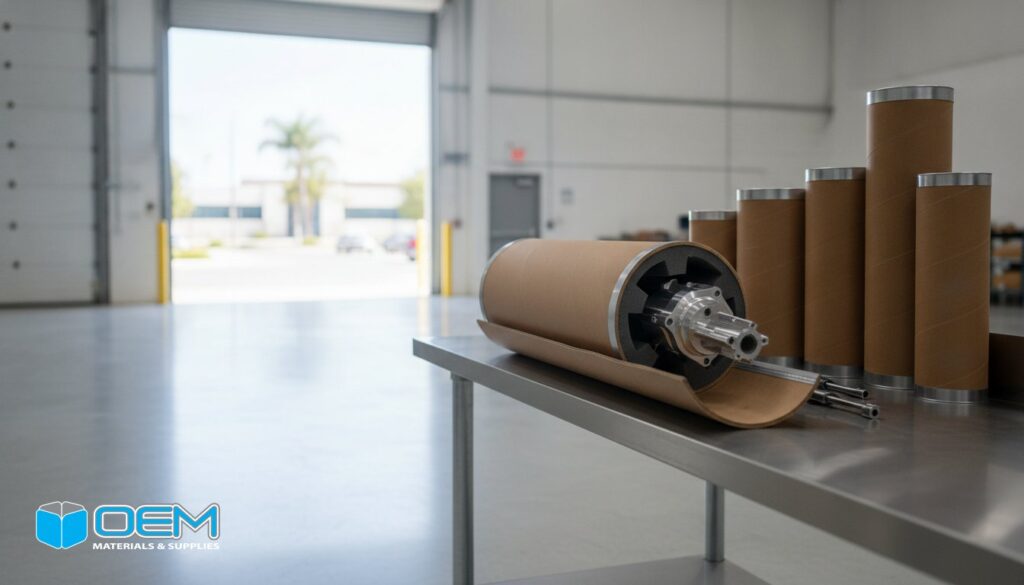
A standard shipping cylinder is often the only thing standing between a precision-machined component and a total loss during transit. For many manufacturers, the assumption that any cardboard tube will suffice leads to crushed walls and compromised internal parts. When shipping heavy or high-value items, you need mailing tubes for industrial parts in Orange County that are engineered as protective shells rather than simple containers. Reliability in your packaging is just as critical as the tolerances of the parts inside.
We recognize that inconsistent supply chains and rising shipping costs for oversized items create constant pressure on your operations. This guide provides the technical specifications needed to select heavy-duty mailing tubes that protect your assets and streamline your Southern California distribution. You’ll learn how to identify the correct wall thickness for industrial loads, choose closures that reduce pack-out labor, and find a local partner for just-in-time delivery. This information will help you move away from generic solutions and toward a strategy that eliminates transit damage while improving your operational efficiency.
Key Takeaways
- Learn how to evaluate wall thickness and ply count to ensure spiral-wound tubes provide the necessary hoop strength for heavy industrial loads.
- Discover the logistical advantages of sourcing mailing tubes for industrial parts in Orange County to enable just-in-time delivery and reduce local lead times.
- Compare round, square, and triangular tube profiles to optimize warehouse space and prevent movement on automated conveyor systems.
- Identify how to integrate custom foam inserts and moisture barriers to secure high-precision instruments within a complete packaging kit.
- Understand how local vendor-managed inventory programs can stabilize your supply of heavy-duty tubes and eliminate costly inventory shortages.
Beyond Posters: The Role of Mailing Tubes for Industrial Parts
Most people associate cardboard cylinders with blueprints or promotional posters. In the manufacturing sector, however, these items serve a much more critical purpose. Industrial applications require significantly higher structural integrity than standard retail options. When sourcing mailing tubes for industrial parts orange county manufacturers often prioritize wall thickness and ply count over aesthetics. These aren’t just simple containers; they’re engineered shells designed to handle metal extrusions, plastic rods, and heavy-duty shafts. They provide a space-efficient alternative to long, rectangular corrugated boxes, which often contain wasted volume and have structural weak points at the corners.
The transition to industrial-grade mailing tubes and cores allows operations to optimize their floor space and shipping density. Because these tubes are spiral-wound, they offer superior hoop strength, which is the ability to resist external pressure from all sides. This makes them ideal for stacking in a warehouse or on a pallet without the risk of the bottom layer collapsing under the weight of the inventory above.
Protecting High-Value Aerospace and Medical Components
High-precision instruments used in the medical and aerospace sectors require absolute protection against bending or warping. A cylindrical shape is structurally superior for this task because it distributes external pressure more evenly than a flat-sided box. This inherent strength is a primary benefit of heavy-duty shipping and mailing tubes. In Southern California’s competitive aerospace hubs, maintaining the straightness of a shaft or the calibration of a long-form instrument is vital. By utilizing custom lengths, you ensure a snug fit that minimizes internal movement. This prevents the part from sliding back and forth, which can damage delicate threads or polished surfaces during the vibrations of transit.
Tubes as a Replacement for Heavy Wooden Crates
For many long-form parts that aren’t inherently fragile, wooden crates can be an expensive and heavy overkill. Heavy-duty mailing tubes offer a lightweight alternative that maintains structural rigidity while slashing dimensional weight. This directly impacts your bottom line by reducing air and ground freight costs. Shipping a lightweight tube is almost always more cost-effective than a heavy wood box. Beyond the shipping fees, your warehouse team benefits from easier handling. Tubes are simpler to maneuver than bulky crates, which often require forklifts or multiple people to move safely. When you pair these tubes with custom foam packaging end caps, you get a high level of security with a fraction of the material mass. This shift reduces pack-out labor and material waste simultaneously.
Technical Specifications for Industrial-Grade Mailing Tubes
Industrial-grade tubes are defined by structural variables that ensure they survive the rigors of LTL shipping and automated sorting. When procurement teams evaluate mailing tubes for industrial parts orange county operations require, the focus shifts from simple dimensions to ply count and wall thickness. These specifications must align with recognized packaging and labeling standards to ensure consistent performance across the supply chain. Selecting the wrong grade often results in crushed walls, which can lead to part deformation or total loss during transit.
The primary material used in these tubes is high-strength paperboard, but the performance comes from the layering process. Standard kraft liners are the workhorse of the industry, providing cost-effective durability. For applications requiring a cleaner aesthetic or high-contrast labeling, bleached white liners are available. The final choice depends on the weight of the part and the specific shipping method used.
Understanding Wall Thickness and Crush Resistance
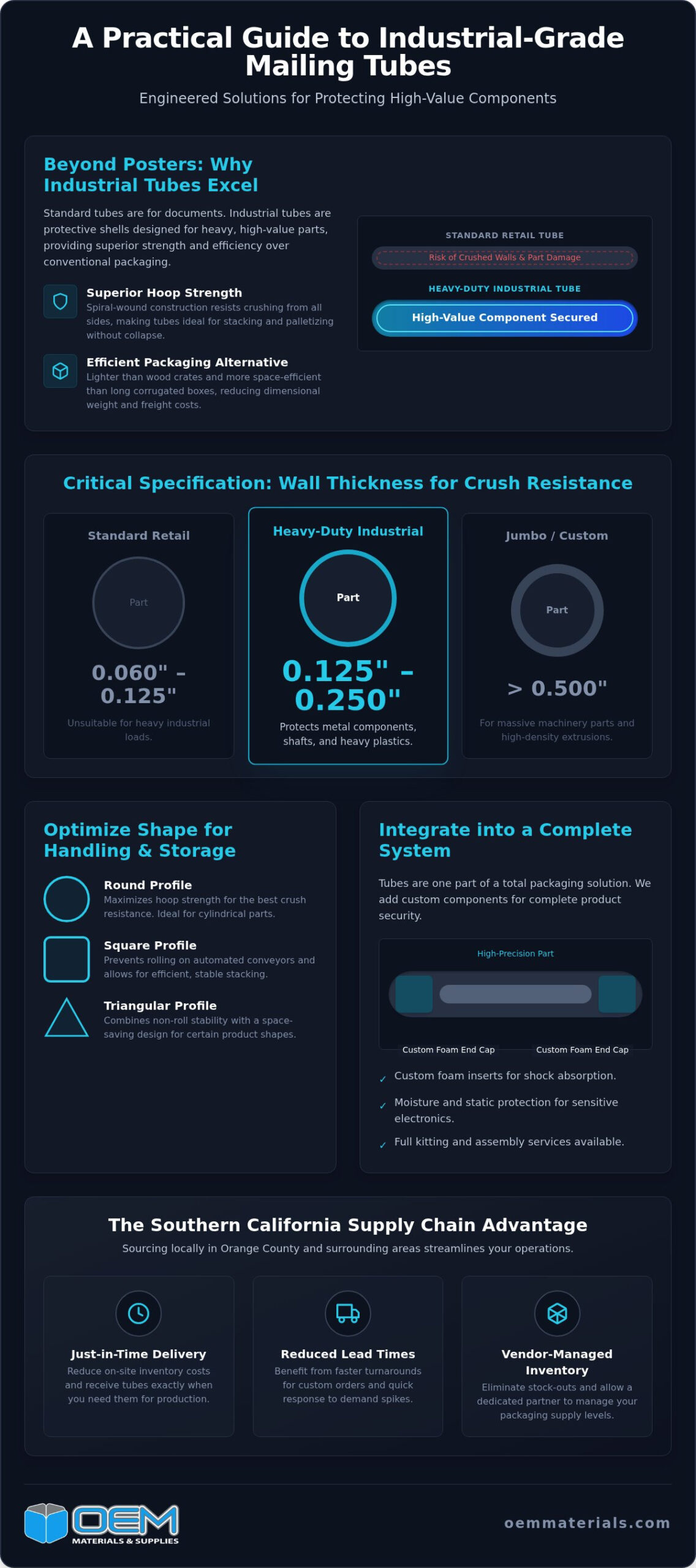
Wall thickness is the most reliable indicator of a tube’s crush resistance. While standard retail tubes often use walls ranging from 0.060 to 0.125 inches, these are generally unsuitable for industrial loads. Heavy-duty industrial tubes require a thickness between 0.125 and 0.250 inches to protect metal components or heavy plastics. For massive machinery parts or high-density extrusions, jumbo tubes can exceed 0.500 inches in thickness. This density ensures the tube maintains its shape even when stacked under multiple layers of heavy freight in a warehouse or trailer.
Spiral-Wound vs. Convolute Construction
The method of construction determines how the tube handles different types of stress. Spiral winding involves wrapping ribbons of paper at an angle around a mandrel. It’s the industry standard for continuous high-speed production and provides excellent hoop strength. This helps the tube resist collapsing when squeezed from the sides. Convolute tubes are wound straight across, offering higher vertical strength for specific stacking needs where the tube must stand on its end. The adhesive bond between these plies creates the final monolithic structure. If the bond is weak, the plies can delaminate under pressure, compromising the entire package. If you are unsure which construction style fits your application, you can consult with a specialist to review your specific part weight and dimensions.
Properly specified mailing tubes and cores act as a rigid exoskeleton for your products. By matching the wall thickness to the part’s weight, you eliminate the guesswork that leads to shipping damage. This technical approach to packaging is a key component of a reliable Southern California supply chain.
Selecting the Right Shape and Closure for Industrial Security
Choosing the geometry of your packaging is a functional decision that impacts warehouse safety and shipping costs. While round tubes are the default choice, they aren’t always the most efficient for every supply chain. When sourcing mailing tubes for industrial parts orange county facilities must account for how these containers interact with automated sorting systems and pallet configurations. A tube that fails to stay stationary during transit can lead to logistical delays or internal damage.
Round vs. Square vs. Triangular Tubes
Round tubes provide the highest strength-to-weight ratio for heavy rods and shafts. Their cylindrical design allows them to withstand significant external pressure without buckling. However, their tendency to roll on flat surfaces can be a liability on conveyor belts or in the back of a delivery truck. If your facility uses high-speed automated sorting, the rolling motion of round tubes can cause misfeeds or safety hazards.
Square and triangular tubes solve this problem by remaining stationary. These shapes are easier to stack on plastic pallets and don’t require specialized dunnage to prevent shifting. Many square and triangular options are constructed from heavy-duty corrugated materials and can be shipped flat to your facility. This reduces incoming freight costs and saves valuable floor space before the tubes are assembled for use. Triangular tubes, in particular, provide exceptional corner protection and resist side-impact crushing better than square alternatives.
Industrial Closure Options: Caps and Seals
The closure method is often the weakest link in a shipping tube. For industrial parts, the closure must withstand the inertia of the product during sudden stops in transit. Standard plastic end caps are versatile but may require additional securing. For heavy parts, we recommend fastening these caps with heavy-duty staples or tape to prevent the component from punching through the end of the tube.
- Crimped Ends: Also known as snap-seals, these tubes have ends that fold inward to create a secure lock. They eliminate the need for separate caps and reduce pack-out labor, making them an efficient choice for high-volume production lines.
- Wooden or Metal Plugs: For extremely heavy or sharp parts, such as threaded steel rods, wooden or metal end plugs provide the ultimate barrier. These are typically fastened through the tube wall with screws or staples to create a rigid, impenetrable seal.
For operations handling variable lengths, telescopic tubes offer a flexible solution. These consist of two tubes that slide together, allowing you to adjust the length to fit the part exactly. This eliminates the need for custom ordering multiple sizes and reduces the amount of cushioning materials needed to fill internal voids. Selecting the right combination of shape and closure ensures that your mailing tubes for industrial parts orange county shipments arrive intact while keeping labor overhead under control.
Sourcing Mailing Tubes for Orange County Manufacturing Hubs
Proximity is a competitive advantage. For manufacturers in Irvine, Anaheim, and Huntington Beach, sourcing mailing tubes for industrial parts orange county locally eliminates the logistical friction inherent in national supply chains. Long-distance shipping for cylindrical packaging is often cost-prohibitive. Because tubes are essentially hollow shells, they occupy significant volume while weighing very little, leading to high dimensional weight charges if shipped via air or long-haul ground freight. Local sourcing bypasses these excessive costs while providing faster response times for urgent production runs.
Working with a local partner also allows for on-site consultations to refine custom packaging design. When dealing with complex or sensitive parts, an engineer can visit your facility in person to measure tolerances and suggest specific wall thicknesses. This level of technical support is rarely available from national commodity vendors who operate primarily through online catalogs. We find that these face-to-face reviews often identify opportunities to reduce material waste and improve pack-out speed.
Vendor Managed Inventory (VMI) for Packaging Supplies
Inventory management is a constant challenge for high-volume manufacturing sectors. Stock-outs of critical shipping supplies can halt an entire production line, leading to missed deadlines and strained client relationships. Local firms can utilize packaging VMI programs to automate their replenishment cycles. This system eliminates stock-outs of critical shipping tubes with automated replenishment based on your actual usage data. This approach reduces your warehouse footprint because you only store what is needed for the immediate production cycle, freeing up floor space for manufacturing equipment or finished goods.
Just-In-Time (JIT) Delivery in Southern California
Operating in Santa Ana or Costa Mesa requires a lean approach to logistics. Coordinate tube delivery with production cycles to maintain a lean operation. Just-In-Time (JIT) delivery ensures that your mailing tubes and cores arrive exactly when the production cycle demands them. This minimizes the risk of damage to empty tubes, which can easily be crushed if stored in crowded, high-traffic warehouses for extended periods. By integrating JIT packaging into your workflow, you improve cash flow by reducing the capital tied up in sitting inventory. It turns packaging from a storage burden into a precise, scheduled component of your assembly line. If you are looking to optimize your local supply chain, you can request a quote for custom delivery schedules tailored to your facility’s needs.
Integrating Mailing Tubes into a Complete Packaging Strategy
Industrial mailing tubes are most effective when they are part of a unified packaging protocol. For companies utilizing mailing tubes for industrial parts orange county, the goal is to create a secure environment that accounts for vibration, moisture, and impact. Relying on the tube wall alone is often insufficient for high-precision components that are susceptible to surface abrasion or corrosion. Integrating secondary materials like poly bags or protective sleeves inside the tube provides a necessary barrier against moisture and dust. This is particularly vital for ferrous metal parts that may rust during long-term storage or transit through varying climates.
A holistic strategy also considers the final stages of the supply chain. Once a part is tubed, it often requires further stabilization on a pallet. Using stretch film and edge protectors ensures that these cylindrical containers don’t shift or sustain impact damage during forklift handling. By viewing the mailing tube as one layer in a multi-stage protective system, you build a more resilient supply chain.
Custom Foam Inserts for Internal Stabilization
Precision-cut foam is the ideal partner for cylindrical packaging. While the tube provides the structural shell, custom foam packaging ensures the part remains centered and stationary. Foam end caps prevent heavy parts from sliding and impacting the closures, which is a common failure point for heavy industrial loads. For long, polished metal rods, center-support foam rings prevent the part from touching the inner walls of the tube, preserving the surface finish. You can find more details on material selection in our guide to foam inserts to ensure you choose the right density for your specific part weight.
Kitting and Assembly Services
Many Southern California manufacturers are moving away from managing individual packaging components. Instead, they opt for comprehensive packaging kits that arrive ready for the assembly line. By utilizing kitting and assembly services, you receive tubes that are already pre-labeled and pre-stuffed with the necessary protective cushioning. This significantly reduces on-site labor costs and eliminates the logistical headache of managing multiple vendors for tubes, foam, and tape. Outsourcing the assembly of complex protective kits allows your warehouse team to focus on production while ensuring every part is packed to a consistent, repeatable standard.
Partnering with a full-service supplier like OEM Materials & Supplies allows for unified sourcing across your entire packaging category. Whether you need corrugated boxes for secondary containment or specialized mailing tubes and cores, having a single point of contact simplifies your procurement process. This integrated strategy ensures that every component works together to protect your high-value industrial parts. Request a quote for custom mailing tubes and cores today to begin optimizing your packaging workflow.
Optimizing Your Long-Form Industrial Shipping Strategy
Implementing a technical strategy for long-form shipping ensures that structural integrity is never left to chance. By prioritizing correct wall thickness and profile geometry, you create a dependable barrier against transit damage. Utilizing mailing tubes for industrial parts orange county from a local source further strengthens your operation by reducing dimensional weight costs and lead times. This approach moves beyond commodity purchasing and treats packaging as a critical engineering component of your production line.
OEM Materials & Supplies offers the engineering expertise needed to design custom wall thicknesses and lengths for the most demanding sectors. Our integrated VMI and JIT programs provide the stability your supply chain requires without the burden of excessive on-site inventory. We invite you to request a quote for industrial mailing tubes to optimize your packaging workflow. By sharing your part dimensions and usage requirements, you allow us to develop a prototype that balances protection with cost efficiency. Let’s build a more reliable distribution model together.
Frequently Asked Questions
What is the maximum weight a heavy-duty mailing tube can hold?
The weight capacity of a heavy-duty mailing tube is determined by its diameter, length, and wall thickness. For most industrial applications, tubes with a 0.250 inch wall can securely hold parts weighing between 50 and 100 pounds. Extremely heavy components may require jumbo tubes with walls exceeding 0.500 inches. It’s essential to match the tube’s structural capacity to the density of the part to prevent the cylinder from buckling under its own load during transit.
Do I need to staple the plastic end caps for industrial parts?
You should staple or tape plastic end caps when shipping heavy industrial components. While these caps provide a friction fit, the inertia of a heavy part during shipping can cause the cap to pop out or the part to punch through the end. For high-value shipments, securing the cap with heavy-duty staples through the tube wall provides a mechanical lock. This simple step significantly reduces the risk of product loss or damage during rough handling in the supply chain.
Can mailing tubes be customized with company branding or part numbers?
Industrial mailing tubes can be customized with high-contrast printing for company branding or specific part numbers. This customization helps warehouse teams identify contents quickly and improves the professional presentation of your shipments. Many manufacturers use this feature to include handling instructions or barcodes directly on the exterior. Because we offer custom design and prototyping, we can ensure that the labeling meets your specific operational requirements while maintaining the structural integrity of the spiral-wound paperboard.
Are square mailing tubes stronger than round ones for stacking?
Square mailing tubes are generally superior for vertical stacking because they provide flat surfaces that prevent shifting. While round tubes offer the highest hoop strength to resist side-impact crushing, they are prone to rolling, which can destabilize a pallet. Square or triangular profiles allow for denser palletization and don’t require specialized dunnage to keep them in place. This makes them a practical choice for manufacturers looking to maximize warehouse space and improve safety on automated conveyor systems.
How do I choose the correct wall thickness for a 50-pound metal rod?
For a 50-pound metal rod, a wall thickness of at least 0.250 inches is recommended. This thickness provides the necessary crush resistance to protect the rod’s finish and prevent the tube from bending. When sourcing mailing tubes for industrial parts orange county, engineers often specify heavy-duty plies to ensure the container acts as a rigid exoskeleton. Combining this thickness with custom foam end caps will further stabilize the rod and prevent internal movement that could compromise the tube ends.
What are the benefits of using a local Orange County packaging supplier?
Sourcing from a local Orange County supplier provides several logistical advantages, including faster lead times and reduced shipping costs. Proximity to hubs in Irvine and Anaheim allows for just-in-time delivery, which helps mid-sized manufacturers improve cash flow by reducing on-site inventory. Additionally, local partners can provide on-site consultations to troubleshoot packaging failures and refine designs. This level of service is difficult to achieve with national vendors who lack a physical presence in Southern California.
Are industrial mailing tubes recyclable after use?
Most industrial mailing tubes are fully recyclable because they are constructed from layers of paperboard and water-based adhesives. They can be processed through standard corrugated recycling streams once the plastic end caps or metal plugs are removed. This makes them a more sustainable alternative to some plastic-based packaging options. For firms with strict environmental mandates, using paper-based cylinders supports corporate waste reduction goals while providing the structural durability required for heavy-duty aerospace and automotive components.
Can I use mailing tubes for international sea freight?
Mailing tubes are suitable for international sea freight provided they are treated for moisture resistance. High humidity in shipping containers can soften standard paperboard, leading to structural failure. To prevent this, we recommend using moisture-resistant liners or sealing the tube inside a poly bag. Using mailing tubes for industrial parts orange county that are destined for export requires careful consideration of the entire transit environment. Adding desiccants and high-strength adhesive bonds ensures the tubes remain rigid throughout the journey.