
A single collapsed core can scrap thousands of dollars in high-performance fabric and halt an entire production shift before it even begins. While many manufacturing facilities in Southern California, from Orange County to the Inland Empire, view the core as a simple commodity, it is actually a precision-engineered component that dictates the success of your winding and logistics operations. If you have dealt with material waste from core failure or inconsistent winding tension, you understand that the wrong specification is an expensive mistake.
We agree that reliability in your supply chain is non-negotiable for maintaining high-volume production. This technical resource provides the specifications and selection criteria necessary to optimize winding efficiency and protect fabric integrity using industrial cores for textiles. We will examine how crush resistance ratings and precise dimensional accuracy prevent inventory shortages and lower your total cost of ownership through better logistics and automated machinery compatibility. By understanding these technical requirements, you can ensure zero downtime and maintain the high standards required for aerospace, medical, and automotive textile applications.
Key Takeaways
- Learn how to align crush resistance ratings with winding tension to prevent core collapse and material waste.
- Compare the structural benefits of spiral wound and convolute tubes to choose the optimal industrial cores for textiles for your production line.
- Understand the impact of dimensional accuracy on automated spinning equipment to ensure consistent tension and zero downtime.
- Identify specialized core specifications for various materials, including high-performance aerospace fabrics and delicate medical yarns.
- Evaluate the logistical benefits of local Southern California sourcing to reduce lead times and total cost of ownership.
The Critical Role of Industrial Cores in Modern Textile Manufacturing
The industrial core serves as the structural foundation for every roll of fabric or yarn produced. In Modern Textile Manufacturing, these components are essential to the mechanical success of the production line. High-speed winding operations exert immense pressure that can cause inferior industrial cores for textiles to oval or collapse. When a core loses its structural integrity, the result is immediate machine downtime and compromised product quality.
Consistency in core dimensions is a strict requirement for automated textile machinery to function without error. Modern sensors and mandrels are calibrated to precise tolerances. A core that deviates in diameter or wall thickness can trigger automated stops or cause the winding arm to misalign. This level of precision is vital for manufacturers in Southern California who rely on high-throughput facilities to meet tight delivery schedules. We’ve seen that even a minor variation in core density can lead to catastrophic failure during the final stages of a high-tension wind.
Supporting High-Speed Winding Operations
Rotational speed in a textile mill creates centrifugal forces that test every layer of a core’s construction. Core balance is critical to prevent machine vibration at high RPMs. If a core is even slightly out of round, the resulting vibration can damage expensive winding mandrels and cause uneven yarn distribution. Core stiffness directly dictates the ability to maintain uniform tension across the fabric width. Without sufficient rigidity, the center of the core flexes under the weight of the material, leading to loose winding and inconsistent roll density that’s difficult to correct in downstream processes.
Preventing Material Deformation and Waste
Selecting the wrong core leads to edge damage, wrinkles, and significant material waste during the unwinding process. A weak core allows the inner layers of fabric to crease or fold as the cumulative tension of the outer layers compresses the tube. This deformation often ruins the first several yards of a roll, creating a direct financial loss for the mill. Utilizing high-quality mailing tubes and cores prevents these issues by providing a stable base that resists compression throughout the entire winding cycle.
Beyond the winding process, cores must maintain the roll’s shape during vertical or horizontal storage. Inferior products often develop flat spots when stacked, which makes them impossible to load onto automated feed systems later. Common core failure points include:
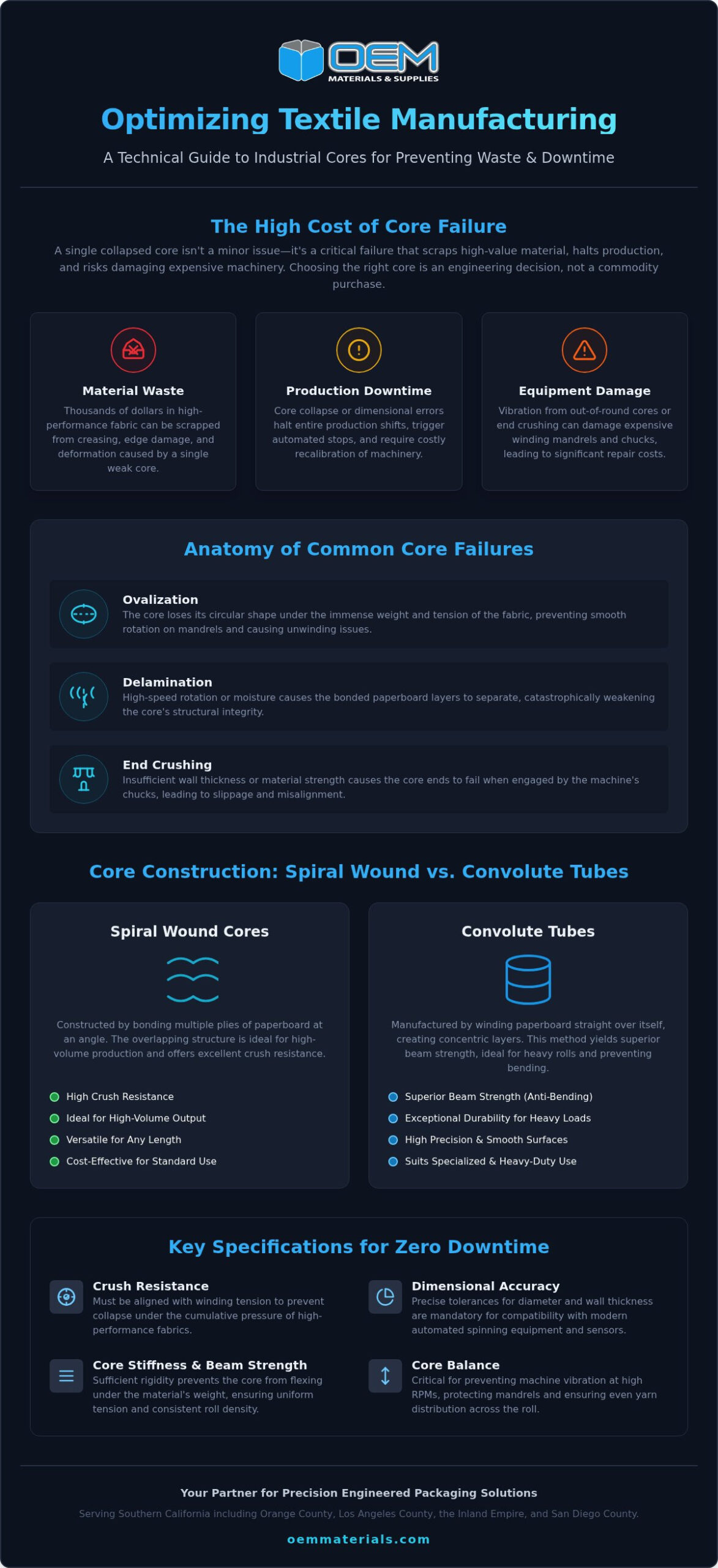
- Ovalization: The core loses its circular profile under the weight of the fabric, preventing smooth rotation.
- Delamination: High-speed rotation or moisture causes the paperboard layers to separate, weakening the structure.
- End Crushing: The core ends fail when engaged by the machine’s chucks or mandrels, often due to insufficient wall thickness.
By prioritizing technical specifications over commodity pricing, operations managers can eliminate these frequent causes of material waste and machine failure. It’s about ensuring that the foundation of your product is as engineered as the textile itself.
Comparing Core Construction: Spiral Wound vs. Convolute Tubes
The mechanical performance of a core is determined by its construction method. Manufacturers primarily utilize two styles: spiral wound and convolute. While both provide the necessary surface for winding, they respond differently to vertical pressure and horizontal bending. Choosing the right industrial cores for textiles requires a balance of crush resistance and beam strength. We’ve found that high-quality mailing tubes and cores must be matched to the specific density and width of the textile being wound to avoid structural failure.
Spiral Wound Cores for High-Volume Production
Spiral wound cores are the industry standard for high-volume textile production. Their continuous manufacturing process allows for virtually any length requirement, making them highly versatile for standard yarn and thread carriers. These cores are built by bonding multiple plies of paperboard at an angle. This overlapping structure creates high crush resistance, which is essential for withstanding the inward pressure of tightly wound synthetic fibers. Because the process is automated and continuous, spiral cores offer significant cost-efficiency for large-scale operations in sectors like apparel and medical hosiery.
Convolute Tubes and Beam Strength Advantages
Convolute tubes are manufactured differently. Instead of multiple angled plies, a single sheet of paperboard is wrapped parallel to the core axis. This construction significantly increases beam strength, or the resistance to bowing in the center. This is critical for extra-wide fabric rolls like carpets or industrial geotextiles where the weight of the material could cause a standard spiral core to sag. However, convolute tubes have limitations regarding inner diameter flexibility. They’re typically produced in specific sizes based on fixed mandrel dimensions, which may require specialized winding equipment.
Modern manufacturing allows for custom wall thicknesses in both styles to meet specific load requirements. Engineers must evaluate the Technical Specifications and Quality Standards associated with their specific machinery and material weight to ensure operator safety and product integrity. For instance, high-tension winding of industrial non-wovens may require a heavy-wall spiral core to prevent ovalization. Conversely, a wide-width upholstery fabric might necessitate a convolute tube to ensure the roll remains straight during transit across Southern California or long-haul shipping.
If you’re unsure which construction fits your specific winding equipment, our team can help you request a quote for a custom core prototype based on your roll dimensions, material weight, and annual usage.
Technical Specifications and Quality Standards for Textile Cores
Precision defines the difference between a seamless production run and a costly mechanical failure. When evaluating industrial cores for textiles, engineers must look beyond simple dimensions to the underlying physical properties that ensure performance under load. A core that meets basic size requirements but lacks specific technical tolerances will eventually fail under the cumulative tension of high-density winding.
Crush Resistance and Dimensional Accuracy
Crush resistance is measured in pounds per linear inch (PLI). This value must exceed the maximum winding tension by a safe margin to prevent ovalization or total collapse. Testing methods include radial crush, which measures side-to-side pressure, and axial compression for end-to-end strength. For high-performance textile carriers, a tolerance of 0.25mm is the industry benchmark. This level of accuracy ensures that cores fit perfectly onto automated mandrels without vibrating at high RPMs. Wall thickness correlates directly to weight capacity. Increasing the ply count is a functional remedy for rolls exceeding standard weight limits.
Surface Finishes and Yarn Retention
Surface texture determines how well the first layer of yarn or fabric grips the core during startup. Smooth cores often cause slippage, leading to uneven tension and wasted material. We provide mailing tubes and cores with plush or embossed surfaces to provide necessary friction. These finishes are essential for Specialized Fabric Applications where delicate synthetics or high-tenacity yarns are used. Custom grooves or notches can also be integrated to secure the tail end of the material, allowing for a faster transition between rolls. For medical or high-purity textile applications, contaminate-free requirements are strictly enforced to ensure no paper dust or adhesive residue transfers to the product.
Moisture Content and Environmental Stability
Moisture content in paperboard cores must be strictly controlled, typically between 5% and 8%. If levels are too high, the core may warp or shrink as it dries in a warehouse, leading to dimensional inaccuracies. This is especially important for Southern California manufacturers in areas like the Inland Empire or San Diego County where humidity levels can fluctuate between the factory floor and storage. Consistent moisture levels prevent delamination and ensure the core remains rigid throughout its entire lifecycle. We manage these variables through rigorous quality control to ensure your inventory is always production-ready.
By adhering to these technical standards, operations managers can reduce total cost of ownership by eliminating core-related machine downtime. It’s not just about the tube; it’s about the engineering that keeps your production line moving.
Selecting Cores for Specialized Fabric Applications
Selecting the right industrial cores for textiles requires a deep understanding of the specific material being wound. A core suitable for delicate silk thread will fail immediately if loaded with a heavy-duty geotextile. Conversely, over-engineering a core for lightweight applications adds unnecessary cost and logistics friction. We categorize core selection based on rotational speed, material weight, and environmental exposure. It’s about matching the structural foundation to the material’s physical demands.
Cores for Yarn Spinning and Synthetic Fibers
High-speed spinning frames operate at extreme RPMs. This creates significant centrifugal force that can quickly expose flaws in a core’s balance. Bobbins and cones used in these frames must have exceptional rotational stability. Even a microscopic imbalance causes machine vibration, leading to yarn breakage and inconsistent thread quality. For synthetic thread manufacturers, we recommend precision-ground mailing tubes and cores that feature smooth, snag-free surfaces. These finishes ensure that the first layers of high-tenacity yarn don’t catch or fray during the high-speed startup phase. Maintaining a consistent inner diameter is critical for ensuring the core seats properly on the spinning mandrel every time.
Heavy-Duty Tubes for Carpets and Geotextiles
Industrial fabrics and non-wovens present a different set of challenges. These materials require heavy-duty cores that can withstand high-tension winding without collapsing. Geotextiles and construction fabrics often demand large inner diameters to accommodate the heavy industrial mandrels found in wide-width mills. When a roll exceeds 500 pounds, wall thickness becomes the primary engineering concern. We calculate the required ply count based on the cumulative weight and the width of the roll to prevent sagging. This prevents the “bowing” effect that ruins fabric integrity during storage. To reinforce core ends during long-haul transit from Southern California hubs in Orange County or the Inland Empire, we often suggest plastic or wood end plugs. These components prevent the core from crushing when handled by forklifts or automated warehouse systems.
Specialized fibers like carbon or aramid require even more stringent specifications. These materials are often used in aerospace or medical applications where chemical resistance and low outgassing are mandatory. Standard adhesives used in commodity cores may release vapors that contaminate sensitive fibers. Our engineering team designs cores using specific bonding agents that meet these rigorous cleanliness standards. This level of customization ensures that the packaging never compromises the high-value product it supports.
If you need a core engineered for a specific textile application, request a quote for a custom prototype today. Providing your roll dimensions, material weight, and annual usage allows us to develop a solution that optimizes your winding efficiency while protecting your product.
Optimizing Logistics with Local Southern California Core Suppliers
Logistics often dictate the total cost of ownership for industrial cores for textiles. Because cores are bulky and relatively light, shipping them long distances is inefficient and expensive. Sourcing from a local Southern California supplier significantly reduces lead times and transit costs. Local partners have a deeper understanding of the specific requirements of the Los Angeles, Orange County, and San Diego manufacturing hubs. This proximity allows for faster troubleshooting and more reliable delivery schedules, which are critical for high-volume textile mills. When your supplier is just a short drive from your facility, the risk of damage during long-haul transit is virtually eliminated.
Just-In-Time (JIT) delivery is another functional remedy for warehouse congestion. Bulky core inventory consumes valuable floor space that could be used for production. By coordinating deliveries with your production schedule, we ensure you have the necessary stock without the burden of excessive on-site storage. This approach is particularly beneficial for facilities in land-constrained areas like Orange County or the Inland Empire where every square foot of warehouse space must be optimized for maximum ROI. Evaluating a wholesale industrial packaging supplier on their logistics capabilities and technical compliance, not just unit price, is essential for manufacturers navigating rising real estate costs and new SB 54 reporting requirements across the region.
Vendor Managed Inventory (VMI) for High-Usage Facilities
For facilities with high consumption rates, VMI services provide a hands-off solution for inventory replenishment. Under a VMI program, the supplier monitors and replenishes core stock automatically based on pre-set minimum and maximum levels. This eliminates the risk of machine downtime due to unexpected stockouts. Beyond stock reliability, VMI offers significant labor savings by outsourcing the administrative burden of inventory management and procurement. It also improves cash flow; capital is no longer tied up in sitting stock, as you only pay for what you use. This level of logistical support is essential for manufacturers in the aerospace and medical sectors who must maintain lean operations without sacrificing reliability.
Custom Core Design for Specialized Manufacturing
Working with a local partner facilitates better custom packaging design for unique winding equipment. If you’re developing a new textile product for the automotive or electronics sectors, you need a core that matches your specific tension and surface requirements. Our process includes rapid prototyping for new core dimensions or surface treatments, allowing you to test performance on your own machinery before committing to a full production run. This iterative approach ensures that the final core specification is perfectly aligned with your operational needs. It’s a level of service that commodity resellers simply cannot provide.
We encourage you to contact a specialist for a consultation based on your annual usage and material specifications. Providing data such as core dimensions, material weight, and winding speeds allows us to recommend a logistical and technical solution that lowers your total cost of ownership and protects your production schedule.
Optimizing Your Textile Production Foundation
Selecting the right industrial cores for textiles is more than a simple procurement task; it is a strategic step in protecting your material and ensuring total machine uptime. We have detailed how technical factors like crush resistance and surface texture directly influence winding efficiency. By choosing the correct construction style and prioritizing dimensional accuracy, you can eliminate the waste and production delays caused by inferior components.
OEM Materials & Supplies serves manufacturing hubs across Los Angeles, Orange County, Riverside, and San Diego with a focus on high-volume industrial production programs. Our custom VMI and JIT logistics solutions are designed to solve the common challenges of inventory shortages and warehouse congestion. We act as a seasoned industry partner to ensure your supply chain remains stable and cost-effective.
Ready to improve your operational reliability? Request a quote for custom industrial cores and tubes today. Please include your roll dimensions, material weight, and annual usage to help us provide an accurate technical recommendation. We are ready to help you secure your production line with precision-engineered solutions.
Frequently Asked Questions
What is the difference between spiral and convolute cores for textiles?
Spiral cores are manufactured by bonding multiple plies of paperboard at an angle, allowing for continuous lengths and high crush resistance. Convolute tubes wrap a single sheet parallel to the axis, providing superior beam strength that prevents sagging in wide rolls like carpets. Spiral cores are the industry standard for high-volume yarn carriers, while convolute styles are reserved for heavy, wide-width fabrics.
How does core diameter affect winding tension in fabric production?
Smaller core diameters increase the winding angle and torque, which puts greater physical stress on the tube’s structure. Larger diameters distribute the material weight over a broader surface area, reducing the risk of inner layer deformation. Engineers must balance the diameter with the machine’s mandrel size to ensure consistent tension from the first wrap to the last.
Are industrial textile cores recyclable or biodegradable?
Yes, paperboard industrial cores for textiles are generally 100% recyclable and biodegradable. They are manufactured using recycled fibers and water-based adhesives, making them easy to integrate into existing mill recycling programs. This helps manufacturers meet sustainability goals without compromising the structural integrity required for high-speed winding operations.
What are the most common causes of core failure during high-speed winding?
Core failure typically results from ovalization, delamination, or end crushing due to incorrect technical specifications. If the crush resistance rating is lower than the winding tension, the core will lose its circular profile and halt production. Moisture imbalance can also cause the paperboard layers to separate, leading to a total collapse under the weight of the fabric.
How do I determine the required wall thickness for heavy fabric rolls?
Wall thickness requirements are calculated based on the total roll weight, fabric width, and the inward pressure exerted during winding. For rolls exceeding 500 pounds, we typically recommend a heavy-wall core with an increased ply count to maintain beam strength. Proper thickness prevents the center of the roll from bowing, which is a primary cause of edge damage during storage.
Can custom surface finishes prevent yarn slippage on the core?
Specific surface treatments like plush or embossed finishes provide the necessary friction to grip the first layer of material. This is critical for high-speed startups where smooth cores often cause the yarn to slip, resulting in uneven rolls and material waste. Custom finishes ensure a secure “grab” that maintains tension throughout the entire winding cycle.
What are the standard tolerances for industrial textile core dimensions?
The benchmark for high-performance textile carriers is a tolerance of plus or minus 0.25mm for the inside diameter. This precision ensures the core seats correctly on automated mandrels and rotates without vibration at high RPMs. Deviating from these tolerances can lead to machine wear and inconsistent winding patterns that ruin fabric quality.
How does local sourcing in Southern California improve core quality?
Local sourcing across Orange County, LA, and San Diego eliminates the structural damage often caused by long-haul vibrations and humidity fluctuations. Proximity allows for rapid prototyping and regular quality audits that aren’t possible with distant vendors. Local partners can also implement VMI programs to ensure you always have production-ready inventory without consuming excess warehouse space.