
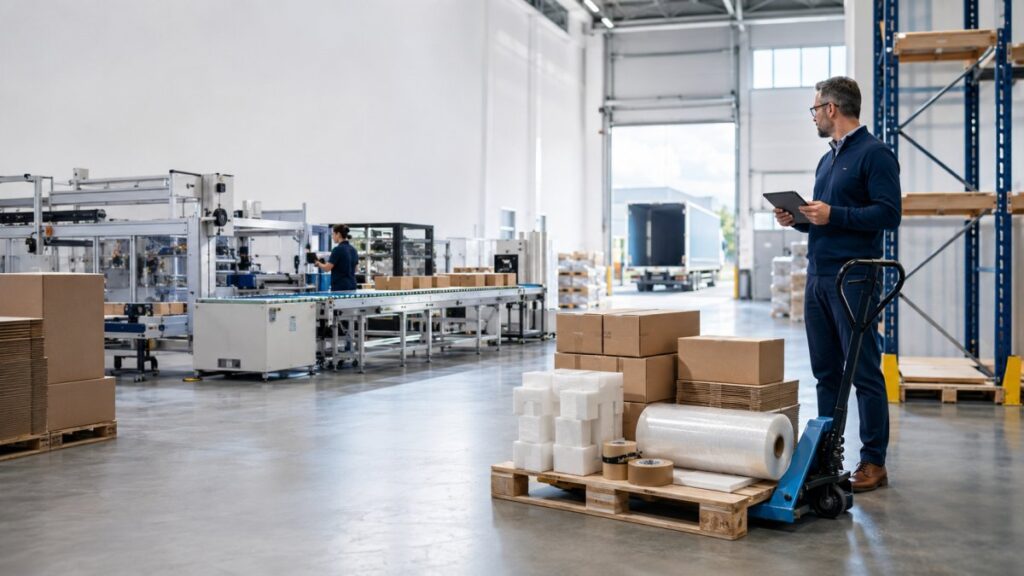
Every square foot of your manufacturing floor dedicated to storing empty corrugated boxes is a square foot that isn’t generating revenue. In high-demand regions like Orange County and Los Angeles, warehouse space is too valuable to be used as a storage locker for air and cardboard. You likely feel the strain of seeing capital tied up in months of supply just to avoid the risk of a stock-out. Transitioning to just-in-time packaging inventory programs solves this dilemma by synchronizing material arrival with your actual production schedule.
We understand that reliability is your primary concern; a missing box is just as disruptive as a missing component. This article explains how a strategic JIT partnership allows you to reclaim floor space and improve cash flow without sacrificing operational security. We will break down the mechanics of localized inventory management and how it helps manufacturers across Southern California maintain 100% packaging availability while running leaner than ever before.
Key Takeaways
- Understand the shift from traditional “just-in-case” safety stock to a demand-driven replenishment model that aligns with your actual production output.
- Identify how just-in-time packaging inventory programs reduce carrying costs and free up warehouse floor space for revenue-generating manufacturing.
- Learn the importance of setting precise minimum and maximum stock levels to ensure constant packaging availability without overstocking.
- Discover how standardizing packaging SKUs and utilizing kitting services can reduce assembly time and streamline line-side delivery.
- Evaluate the benefits of localized logistics and specialized support for high-compliance industries like aerospace and medical device manufacturing.
What is a Just-In-Time Packaging Inventory Program?
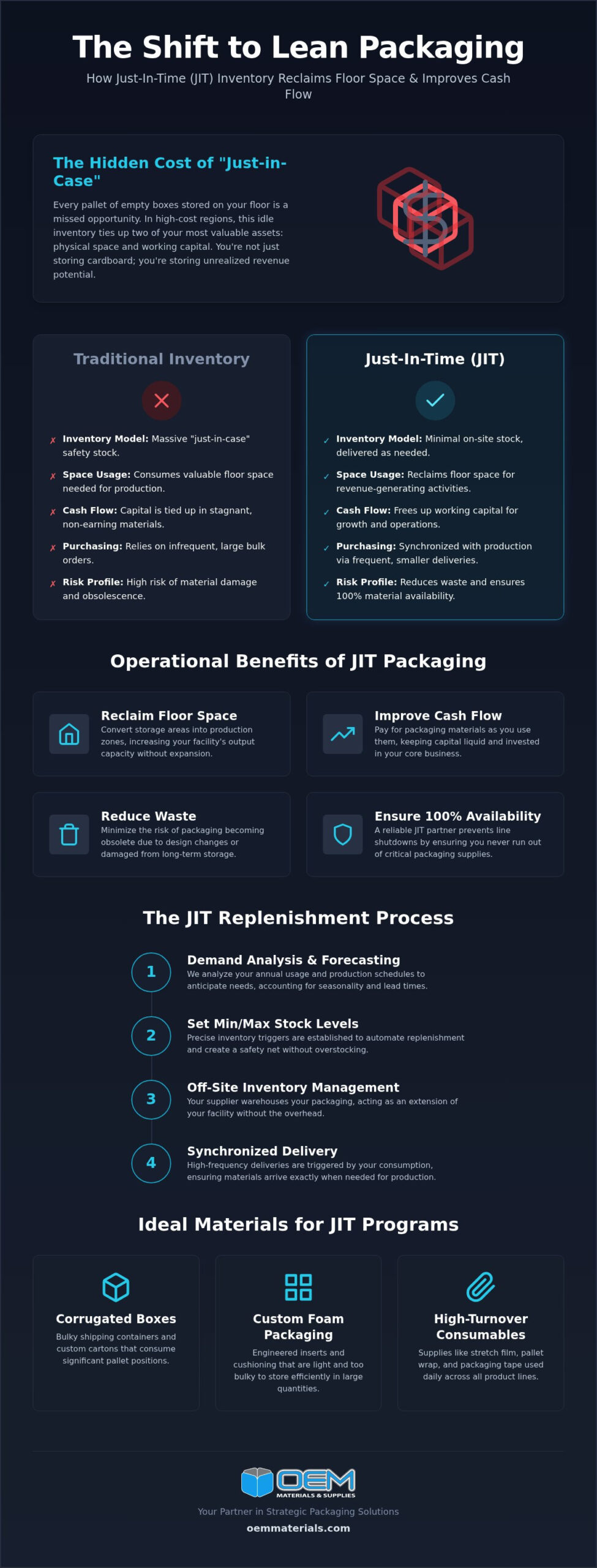
A just-in-time packaging inventory program is a lean manufacturing strategy where packaging materials are delivered to your facility only as they are needed for production. Instead of maintaining a “just-in-case” safety stock that occupies hundreds of square feet, you transition to a demand-driven model. This approach treats packaging as a fluid component of the assembly line rather than a static warehouse commodity. For industrial operations in Southern California, where real estate costs are high, this shift is often the difference between scaling production or being limited by storage capacity.
Packaging is the ideal candidate for just-in-time packaging inventory programs because of its high volume-to-value ratio. Finished products are often compact and high-value; conversely, empty packaging is bulky and relatively low-cost per unit. Storing six months of empty boxes means you are essentially paying to store air. By moving to a JIT model, you reclaim that floor space for revenue-generating machinery or additional assembly lines. The core objectives are clear: reduce waste, improve cash flow by keeping capital out of the warehouse, and ensure 100% material availability through precise coordination.
The Shift Toward Lean Packaging Management
Implementing JIT requires synchronizing your packaging deliveries with your actual production schedules. It replaces bulk quarterly orders with high-frequency deliveries tailored to your weekly or daily output. We help manufacturers identify specific trigger points for replenishment; these are predetermined inventory levels that signal a delivery before a shortage occurs. In areas like Orange County and San Diego, local proximity allows for a level of responsiveness that eliminates the need for massive on-site stockpiles. It’s about moving from a reactive purchasing habit to a proactive, data-driven replenishment cycle.
Common Packaging Materials Managed via JIT
While almost any supply can be managed this way, certain materials provide the fastest return on investment due to their physical footprint. High-turnover and custom-engineered items are the primary focus for most industrial programs:
- Corrugated boxes: Bulk shipping containers and custom-sized boxes that otherwise consume significant pallet positions.
- Custom foam packaging: Engineered inserts and protective cushioning that are often too light and bulky to store in large quantities efficiently.
- High-turnover consumables: Standard supplies like stretch film, pallet wrap, and packaging tape that are used daily across all product lines.
By focusing on these high-volume items, manufacturers can see immediate improvements in warehouse organization and operational efficiency. The goal is to keep only what you need for the immediate production window, relying on a dependable partner to manage the pipeline.
The Operational Mechanics of JIT Replenishment
Effective execution of just-in-time packaging inventory programs requires more than just a reliable truck; it demands a deep integration of data between the manufacturer and the supplier. This system functions through a continuous exchange of production forecasts and real-time inventory counts. By establishing clear minimum and maximum stock levels, we create a safety net that prevents line shutdowns while keeping on-site inventory at a bare minimum. When implementing just-in-time packaging inventory programs, the off-site warehousing managed by your supplier acts as an extension of your own facility, allowing for on-demand delivery without the overhead of physical storage.
Forecasting and Demand Planning
Reliable JIT programs begin with accurate demand planning. We analyze your annual usage data alongside weekly production targets to anticipate needs before they become urgent orders. This process must account for seasonal fluctuations and product lifecycle changes common in the electronics and medical device sectors. Lead-time requirements for custom die-cut components generally require ten to fifteen business days to allow for material sourcing and precision tooling setup. Planning for these specific timelines ensures that your high-precision foam packaging is always available when the product leaves the assembly line.
The Partnership Between Manufacturer and Supplier
A successful JIT relationship is built on accountability and proximity. Utilizing vendor-managed inventory (VMI) allows your supplier to take full responsibility for monitoring stock levels and automating the replenishment cycle. This removes the administrative burden from your purchasing team and reduces the risk of human error. Local supplier proximity is non-negotiable for rapid response times in Southern California. Whether your facility is in Los Angeles County, Orange County, the Inland Empire, or San Diego County, having a partner who can reach your dock in hours rather than days is the only way to manage sudden demand spikes or production shifts effectively.
Communication protocols are the final piece of the operational puzzle. We establish direct channels to handle unexpected changes in volume, ensuring that a surge in orders doesn’t result in a packaging bottleneck. If you’re struggling with inconsistent delivery schedules or frequent stock-outs, you can request a consultation to review your current inventory flow and identify optimization opportunities.
JIT vs. Traditional Inventory: A Cost-Benefit Analysis
Traditional inventory management often relies on bulk purchasing to secure the lowest possible price per unit. While this looks efficient on a purchase order, it creates hidden carrying costs that erode your bottom line. These expenses include warehouse insurance, property taxes on inventory, and the persistent risk of material obsolescence. If a customer changes a specification or a product design is updated, thousands of pre-printed corrugated boxes or custom foam inserts become worthless. Transitioning to just-in-time packaging inventory programs shifts the financial focus from unit price to total cost of ownership.
Cash flow is a critical factor in this analysis. Large-scale bulk orders tie up capital for months, whereas JIT allows you to pay for materials as they are delivered and consumed. This liquidity can be redirected toward research and development, new machinery, or workforce expansion. By aligning expenses with revenue-generating production, manufacturers achieve a more agile balance sheet that is less vulnerable to market shifts.
Quantifying the Savings in Southern California
In regions like Orange County and Los Angeles County, industrial real estate is a premium asset. High warehouse lease rates mean that storing air and cardboard is an expensive use of space. When you implement just-in-time packaging inventory programs, you can reclaim hundreds of square feet currently occupied by empty packaging. This spatial optimization allows you to expand production lines without increasing your facility footprint. Additionally, you reduce labor costs associated with double-handling pallets and performing manual cycle counts on massive stock levels. You can learn more about the variables that impact packaging cost savings to better estimate your potential ROI.
Addressing the Risks of Lean Inventory
A common concern regarding lean operations is the potential for a supply chain disruption to halt production. However, a professional JIT program does not eliminate safety stock; it strategically relocates it. We maintain a dedicated buffer stock at our local facilities in the Inland Empire and San Diego County to mitigate transit delays or material shortages. This local proximity ensures that even if an unexpected demand spike occurs, your facility receives the necessary supplies within hours. Balancing the cost of a potential line shutdown against the cost of excess inventory is a central part of our planning process. The goal is a resilient supply chain that supports lean manufacturing goals without introducing unnecessary risk.
Implementation Best Practices for Industrial Packaging
Successfully transitioning to just-in-time packaging inventory programs requires a disciplined approach to SKU management and logistics coordination. It’s not enough to simply reduce stock; you must also simplify the materials themselves to increase velocity. High SKU counts often lead to complexity that undermines lean goals. By standardizing your packaging components, you reduce the number of variables your team must track, which minimizes the risk of errors during replenishment. Implementing packaging kitting and assembly further streamlines this process by delivering pre-sorted components directly to the assembly line, removing the need for workers to search through disparate pallets for boxes, foam, and tape.
Visibility is the foundation of any JIT system. Utilizing barcode or RFID systems provides real-time data on stock movement, allowing both the manufacturer and the supplier to see exactly when inventory reaches its minimum threshold. This data should be supplemented with regular audits. Monthly or quarterly reviews of your usage patterns allow you to refine min-max levels, ensuring they reflect current production realities rather than outdated forecasts.
SKU Rationalization and Design Optimization
One of the most effective ways to optimize a JIT program is through SKU rationalization. Consolidating box sizes improves palletization and storage density, allowing more material to be moved in fewer trips. When you invest in custom foam packaging that is engineered to serve multiple product variations, you reduce the total number of unique parts in your system. This design approach simplifies assembly requirements and lowers labor costs per unit. It also makes your inventory more resilient; if one product line experiences a temporary dip, the packaging materials can often be diverted to another line without delay.
Logistics Coordination in Southern California
Operating just-in-time packaging inventory programs in Southern California presents unique geographical challenges. Navigating the heavy traffic of Los Angeles County and Orange County requires a supplier with a sophisticated understanding of local logistics and multiple regional distribution hubs. Reliable timing is critical; a truck stuck on the 405 or the 91 can halt a production line if the buffer stock is too lean. Shift-based delivery schedules support 24/7 manufacturing operations by timing arrivals to coincide with production intervals, preventing the bottlenecks often caused by high-volume daytime traffic. This level of coordination ensures that your materials are staged and ready precisely when the next shift begins.
If you need to reduce the complexity of your current inventory or want to explore how SKU consolidation can lower your overhead, contact our engineering team for a detailed packaging audit and custom design consultation.
Optimizing Your Supply Chain with OEM Materials JIT Programs
OEM Materials & Supplies provides comprehensive just-in-time packaging solutions tailored to the rigorous demands of Southern California manufacturers. By integrating custom packaging design, high-volume manufacturing, and localized logistics under one roof, we eliminate the friction often found when managing multiple vendors. Our expertise in high-compliance sectors, including medical devices and aerospace, ensures that every component meets strict industry standards for protection and cleanliness. We have a proven track record of reducing overhead for facilities in Riverside and San Diego by synchronizing material flow with specific assembly line requirements.
Implementing just-in-time packaging inventory programs is more than a logistics change; it’s a commitment to operational excellence. We act as a seasoned industry partner rather than a mere vendor, projecting a sense of dependability and high-level capability. Our regional presence allows us to offer the speed and precision that national commodity resellers cannot match, particularly when managing the logistical requirements of the Southern California supply chain.
The OEM Materials & Supplies Consultative Approach
Every successful program begins with a full audit of your current packaging usage and storage footprint. We don’t just supply boxes; we analyze how materials move through your facility to identify bottlenecks. Our engineering team develops prototypes for custom foam packaging and corrugated solutions, testing them against your specific product dimensions and shipping stressors. Once a program is active, we provide ongoing support and data-driven optimization. This ensures that your just-in-time packaging inventory programs evolve alongside your production volume, maintaining the ideal balance between lean operations and material security.
Local Support for Southern California Industry
Our strategic warehouse locations throughout the Inland Empire, Orange County, and Los Angeles County ensure rapid response and reliable delivery. We offer on-site stocking options and point-of-use delivery capabilities, where materials are staged exactly where your packing team needs them. This level of service transforms the supplier relationship from a commodity transaction into a strategic partnership. We understand that in a 24/7 manufacturing environment, dependability is the most valuable asset a partner can provide. Our local hubs allow us to respond to sudden demand spikes within hours, keeping your lines running without the need for massive on-site safety stock.
To begin optimizing your facility’s footprint and improving your operational efficiency, contact us for a consultation. Please provide your current product dimensions, weight, and annual usage to help our team develop an accurate recommendation for your operation. Request a quote today to see how a localized JIT program can improve your cash flow and reclaim your production space.
Strengthen Your Manufacturing Agility
Transitioning to just-in-time packaging inventory programs is a fundamental step toward achieving a truly lean manufacturing environment. By eliminating the burden of excessive safety stock, you reclaim valuable production space and improve your company’s cash flow. Localized logistics and data-driven forecasting allow Southern California manufacturers to maintain 100% material availability without the overhead of physical storage; this strategic shift ensures that your capital stays in your business rather than on your warehouse shelves.
We specialize in high-compliance sectors like aerospace and medical device manufacturing, offering full-service design, kitting, and VMI capabilities. Our strategic presence in Los Angeles, Orange County, San Diego, and Riverside provides the regional expertise necessary to navigate local supply chain challenges with precision. We are ready to help you optimize your inventory flow and reduce operational friction through a partnership built on reliability and technical expertise.
To begin your transition to a more efficient replenishment model, Request a JIT Packaging Consultation from OEM Materials. Please provide your product dimensions, weight, and annual usage so our engineering team can develop a recommendation tailored to your facility’s specific requirements. We look forward to helping you build a more resilient and profitable supply chain.
Frequently Asked Questions
What is the difference between JIT and VMI in packaging?
Just-in-time (JIT) focuses on the timing of deliveries to minimize on-hand stock, while Vendor Managed Inventory (VMI) shifts the responsibility of monitoring and replenishment to the supplier. In many just-in-time packaging inventory programs, we combine both strategies to automate the replenishment cycle. You provide the production forecast, and we take responsibility for ensuring the materials arrive exactly when the line needs them, removing the administrative burden from your purchasing team.
How does a JIT program affect the unit price of corrugated boxes?
While bulk purchasing might offer a lower price per unit on a single purchase order, it ignores the high cost of warehouse space in regions like Los Angeles or Orange County. JIT programs focus on reducing the total cost of ownership by eliminating carrying costs, insurance, and the risk of material damage during long-term storage. The savings from reclaimed floor space and reduced double-handling typically outweigh minor differences in the base unit price for corrugated boxes.
Can custom foam inserts be managed through a just-in-time program?
Yes, custom foam inserts are ideal candidates for a JIT model because of their high volume-to-value ratio. Storing large quantities of bulky, engineered foam is an inefficient use of pallet positions. We manufacture and hold your specific foam designs in our regional hubs, delivering them in smaller, manageable increments that align with your daily assembly needs. This ensures you have the protection required for sensitive electronics or medical devices without cluttering your facility.
What happens if our production demand suddenly doubles overnight?
Sudden demand spikes are managed through strategic buffer stock held at our local distribution centers in Riverside or San Diego. While your on-site inventory remains lean, we maintain a secondary reserve to act as a shock absorber for production surges. Our local proximity allows us to respond within hours to ensure your assembly line never stops due to a packaging shortage, even during unexpected volume increases.
Is there a minimum annual usage requirement for a JIT packaging program?
There isn’t a universal minimum, but these programs provide the most value to manufacturers with consistent, high-volume packaging requirements. We evaluate each operation based on SKU complexity and storage constraints. If your facility manages high volumes of a few specific SKUs, you’ll see a faster return on investment through reclaimed production space and improved cash flow compared to low-volume, highly varied operations.
How do local Southern California traffic patterns affect JIT delivery reliability?
We mitigate traffic delays on the 405, 91, or 5 freeways by utilizing multiple distribution hubs across Southern California. By staging inventory closer to your facility in the Inland Empire or Orange County, we reduce transit times and avoid peak congestion windows. We also coordinate shift-based deliveries to ensure materials arrive during off-peak hours, maintaining a reliable schedule regardless of regional traffic conditions.
What data does a manufacturer need to provide to start a JIT program?
To build an effective program, we require your current product dimensions, weights, and annual usage per SKU. We also need to understand your weekly production targets and any seasonal fluctuations in demand. This data allows our team to set accurate min-max levels and establish a delivery cadence that supports your specific manufacturing workflow without creating bottlenecks or stock-outs.
How does JIT packaging contribute to corporate sustainability goals?
JIT packaging reduces the environmental impact of your operations by optimizing transportation routes and reducing the need for large, climate-controlled warehouse spaces. Frequent deliveries from local hubs result in fewer “empty miles” compared to long-haul shipping. Additionally, lean inventory management reduces material waste by preventing the obsolescence of packaging materials when product designs or specifications are updated.