

A low packaging unit price can hide an expensive operating problem. Knowing how to measure packaging effectiveness means looking beyond the purchase order to see whether packaging protects products, supports efficient packing, and performs reliably through distribution.
Material costs are easy to track, but damage reports, packing labor, freight data, and inventory records often sit in separate systems. Without a consistent view, it is difficult to understand the full cost of a packaging choice or compare alternatives without risking production continuity.
This guide shows you how to build a practical scorecard using consistent measures for product protection, total operating cost, logistics, and supply reliability. You’ll learn which indicators can reveal damage and handling issues, how package dimensions and labor affect performance, and how to use operational evidence to evaluate alternatives. You’ll also find ways to test improvements, including packaging design and prototypes, while maintaining a dependable flow of materials.
Key Takeaways
- Learn how to measure packaging effectiveness with a scorecard that tracks protection, operating cost, logistics, labor, and supply reliability.
- Use consistent conditions and data sources to compare packaging options beyond their purchase price.
- Assign clear owners for packaging, quality, shipping, procurement, and inventory data to make reviews repeatable.
- Connect measured performance gaps to practical design or supply changes, such as custom corrugated boxes, foam packaging, or crates.
- Test improvements in a controlled way so packaging changes can be assessed without disrupting production or material availability.
What Does Packaging Effectiveness Mean for an Industrial Operation?
Packaging effectiveness is the ability of a packaging system to protect a product, support efficient handling, control operating demands, and remain available when production and shipping need it. The system includes more than the box or cushioning material. It also includes how the package is assembled, how it moves through the facility, and whether the required materials can be supplied consistently.
That balance matters for manufacturers in Orange County, Los Angeles, Riverside, and San Diego, as well as businesses shipping across the country. A package can be inexpensive to purchase but still require extra packing steps, take up unnecessary storage space, or leave a product vulnerable during transit. Assess packaging across its operational life rather than judging it by one purchase-order line. The broader functions of packaging and labeling help explain why protection, handling, and information all matter.
Packaging efficiency and effectiveness are related, but not identical
Efficiency focuses on the resources used to pack and ship a product. Effectiveness asks whether the packaging also meets protection and delivery requirements. Using fewer materials may improve efficiency, but it is not an improvement if product damage rises or workers need more time to secure each shipment.
Consider a fragile manufactured component packed in a low-cost box with minimal cushioning. Material expense may be low, yet the packer may need to add protective layers, or the component may arrive damaged. A better-fitting foam packaging solution may be worth evaluating if the current configuration does not adequately protect the component. The right choice depends on the product, materials, and shipping requirements.
Choose a useful baseline before setting improvement goals
Before deciding how to measure packaging effectiveness, define what you’re assessing. Keep the scope specific: identify the product family, current packaging configuration, facility, shipment type, and review period. A packaging setup used for local deliveries may not perform the same way on parcel or freight shipments, so avoid combining unlike conditions in one comparison.
Build the baseline from existing records before proposing a change. Capture the package components and packing method, then gather comparable shipment, damage, labor, and material records. If records cover different facilities or shipment types, keep those distinctions visible rather than blending them into one result.
Data gaps are useful findings, not reasons to guess. Note when labor time is estimated, damage reporting is incomplete, or material use is recorded only at a broader level. Keep assumptions alongside the baseline so later reviews compare like with like. This gives purchasing, operations, and quality teams a shared starting point for setting goals and assessing changes without mistaking missing data for improved performance.
Which Packaging Effectiveness Metrics Should You Measure?
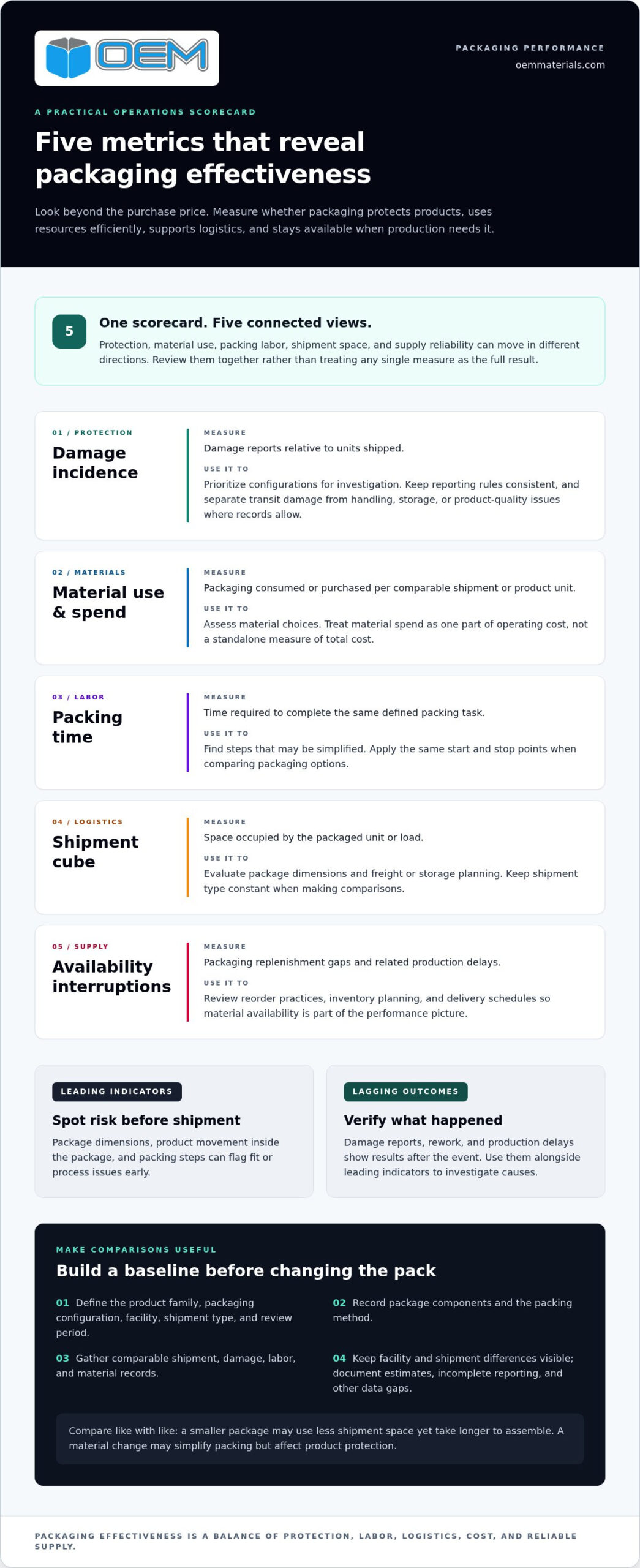
To decide how to measure packaging effectiveness, track measures that connect package design to results on the floor and in transit. A useful scorecard covers protection, cost, logistics, labor, and supply reliability. Each metric should answer a practical question: Is the product protected? Does packaging consume more material or time than needed? Can the required materials reach the line consistently?
Separate leading indicators from lagging outcomes. Package dimensions, product movement inside the package, and packing steps can signal risk or inefficiency before shipments go out. Damage reports, rework, and production delays show what has already happened. Used together, these measures help teams identify a likely cause and verify whether a change improved performance.
Protection and fit measures that reveal product risk
Track reported damage against units shipped, using the same reporting rules across configurations. Record package dimensions, protective materials, and whether the product shifts inside the package. These leading indicators can help identify poor fit or inconsistent packing; damage data shows whether products are arriving in acceptable condition. Where records allow, separate transit damage from handling, storage, and product-quality issues so packaging changes address the right cause.
For each KPI, use a consistent unit and connect the result to a decision:
- Damage incidence: Damage reports relative to units shipped. Use it to prioritize configurations for investigation, while checking that reporting methods are consistent.
- Material use and spend: Packaging consumed or purchased per comparable shipment or product unit. Use it to assess material choices, not as a standalone measure of total cost.
- Packing time: Time required for the same defined packing task. Use it to identify steps that may be simplified, and apply the same start and stop points when comparing options.
- Shipment cube: Space occupied by the packaged unit or load. Use it to evaluate package dimensions and freight or storage planning, with shipment type held constant.
- Availability interruptions: Packaging replenishment gaps and related production delays. Use them to review reorder practices, inventory planning, or delivery schedules.
Packaging effectiveness requires several measures because protection, labor, logistics, cost, and material availability can move in different directions. A smaller package, for example, may reduce shipment space yet take longer to assemble. A material change may simplify packing but affect product protection. Cost findings should reflect product dimensions, materials, shipping requirements, and operating conditions, rather than relying on a universal estimate.
Keep results tied to the configuration and conditions measured. If replenishment interruptions recur, evaluate inventory programs such as vendor-managed packaging inventory alongside material and labor measures. OEM Materials & Supplies supports manufacturers in Southern California, including Orange County, Los Angeles, Riverside, and San Diego, with packaging solutions and supply programs. For help assessing options against your operational requirements, share your packaging requirements with the team.
How Can You Compare Packaging Options Fairly?
A fair packaging comparison tests the current and proposed options under equivalent conditions. If the product mix, packing method, shipment route, or reporting rules change at the same time as the package, the results won’t show which factor drove the difference. Define the comparison unit first, such as one product, one shipment, or a consistent production volume, and use it for both configurations.
Set up a controlled packaging trial
Select a representative product and document its existing package, including components, dimensions, and packing steps. Record the proposed design with the same detail. For a box change, assess corrugated box design in the context of the product and distribution conditions it must serve, not as a material-only substitution.
Keep shipment conditions as consistent as practical. Use the same product family, shipment type, and handling process, and agree in advance on when labor time starts and stops and how damage will be recorded. Choose observation points that fit the operation, such as after packing, at dispatch, and after delivery. If an actual route or handling pattern varies, record the difference rather than treating the observations as directly equivalent.
Interpret results without letting one metric distort the decision
Compare protection and operational outcomes alongside material use and shipment space. A package that uses less material may require more labor, while product-specific cushioning, such as foam inserts, may change fit and packing steps. Consider all relevant results together; no single measure should decide the outcome.
| Metric | Unit or method | Data source | Interpretation |
|---|---|---|---|
| Damage | Reports per comparable shipment or product unit | Quality and shipping records | Shows observed protection outcomes |
| Material use | Packaging consumed per product or shipment | Purchase and packing records | Indicates material demand, not total system cost |
| Packing labor | Time per consistently defined packing task | Floor observation or labor records | Shows whether the configuration changes work effort |
| Shipment space | Package or load dimensions | Shipping records or measurements | Supports comparison of space requirements |
Keep observed results separate from assumptions. If a trial includes only a limited set of shipments, don’t present the outcome as proof of performance across every route or production condition. Note changes in product mix, volume, handling, or destination that may affect comparability. These details help teams interpret results without overstating what the trial shows.
Applying how to measure packaging effectiveness consistently means documenting both gains and trade-offs. Cost findings depend on product dimensions, materials, shipping requirements, and operating conditions. If you’re evaluating a packaging change, share the product dimensions, weight, and shipment requirements to support a project-specific discussion.
How Do You Build a Repeatable Packaging Measurement Process?
A repeatable process turns scattered packaging records into decisions teams can use. Start with a defined product family or packaging issue, then agree on what success means before collecting new results. For each metric, document its name, unit, data source, reporting period, and how exceptions will be handled. If teams define “damage” or “packing time” differently, comparisons can look precise without being reliable.
Consistent definitions make packaging comparisons more credible because they allow teams to evaluate results on the same terms. Assign ownership at the source of each measure. Packaging or engineering can maintain configuration details; quality can classify damage and defects; shipping can provide shipment and freight records; procurement can report material use and spend; and inventory can track stockouts, replenishment interruptions, and related production delays. One coordinator can compile the information, but each owner should confirm the accuracy of their data.
Create a practical packaging KPI dashboard
Keep the first dashboard focused. Include only measures tied to a specific operational decision, such as investigating damage, changing a packing step, or reviewing replenishment. For each KPI, show the baseline, current result, reporting period, and data completeness. Mark estimates and missing records clearly. Segment results by product family, facility, or shipment type when those differences could affect performance.
Build the process in a defined sequence:
- Set the scope. Identify the product family, packaging configuration, facility, shipment type, and review period.
- Define the measures. Agree on units, calculation methods, data sources, owners, and rules for unusual or incomplete records.
- Capture the baseline. Preserve the current configuration and its results before introducing a change.
- Update and validate. Gather each owner’s records for the agreed period, check for gaps, and note relevant operating changes.
- Review and decide. Compare results with the baseline, investigate exceptions, and document whether to continue monitoring or test an improvement.
Review results and decide when to test a change
Set a review cadence that matches how often reliable data becomes available and how quickly the decision must be made. A sudden change in damage reports or packing time deserves investigation before teams revise a material or specification. Check for shifts in product mix, handling, volume, or shipment conditions that could explain the result.
When evidence points to a specific design gap, packaging design and prototyping can help teams evaluate an improvement before broader adoption. OEM Materials & Supplies supports packaging programs from prototypes through high-volume production, with design options tailored to the application. Custom packaging design provides a practical way to test a targeted change while keeping the evaluation tied to defined measures.
For support structuring a packaging evaluation, discuss a packaging evaluation and share the product dimensions, weight, current packaging configuration, and relevant performance records.
How Can Packaging Design and Supply Support Improve Effectiveness?
Once the data points to a specific performance gap, match the response to its cause. A fit issue calls for a design review. Extra packing steps may indicate that the package or packing sequence needs adjustment. Replenishment interruptions call for a supply workflow review, not automatically a different box. This problem-to-response approach ties changes to operational evidence and makes their effect easier to assess.
Match the response to the measured packaging problem
Custom packaging design is useful when product fit, protection, or packing steps need evaluation. Corrugated boxes suit many shipping configurations, but dimensions and distribution requirements determine the right design. Foam packaging can be considered when product-specific cushioning is needed, while crates may be appropriate when shipping and protection needs call for a more robust package. Evaluate each option against the measured gap rather than selecting by default.
Supply problems need a different remedy. If packaging shortages repeatedly interrupt production, review replenishment timing, usage patterns, and inventory visibility. Vendor-managed inventory (VMI) can support packaging replenishment planning, while just-in-time delivery can align deliveries with operational needs. Kitting and assembly may also help when teams spend time gathering separate packaging components. The right approach depends on how materials are used and where delays occur. Potential cost effects also depend on product dimensions, materials, shipping requirements, and operating conditions.
- Fit or protection gap: Evaluate package dimensions, cushioning, and the product’s movement within the package.
- Excessive packing effort: Review the packing sequence and whether a packaging design change could simplify the work.
- Material shortages: Examine usage and replenishment patterns, then consider a VMI or just-in-time packaging delivery workflow.
Prepare useful information for a packaging consultation
A clear project brief connects operational evidence to a practical packaging response. Include product dimensions and weight, describe its fragility, and document the current packaging configuration. Add shipment routes, handling conditions, and any observed damage, rework, or packing-labor concerns. Note approximate annual usage and production or replenishment constraints, such as storage limits or recurring material interruptions.
These details help frame how to measure packaging effectiveness for the specific application and identify what a design or supply change should address. OEM Materials & Supplies supports manufacturers with packaging design, custom corrugated boxes, engineered foam packaging, crates, and supply services. Recommendations and potential cost benefits depend on the product and operating requirements.
To discuss a packaging option, request a packaging quote or consultation. Include product dimensions, weight, shipment needs, current packaging, and approximate annual usage so the project can be assessed in context.
Turn Packaging Data Into a Practical Next Step
A useful packaging evaluation doesn’t need to begin with a large-scale change. Start with one product family or recurring issue, identify the evidence your team can collect consistently, and use it to decide what deserves closer testing. That approach gives purchasing, engineering, quality, and operations a shared basis for action while keeping product and supply continuity in view.
Knowing how to measure packaging effectiveness is most valuable when the findings lead to a defined next step. If your records point to a fit, protection, labor, or replenishment concern, bring the relevant product and shipping details together before selecting a response. Include package and product dimensions, weight, shipment conditions, and estimated annual usage so the discussion reflects the actual application.
Request a packaging quote or consultation to discuss your evaluation and potential options. Include product dimensions, weight, shipment needs, current packaging, and approximate annual usage to help ground the discussion in your application.
Frequently Asked Questions
What is the difference between packaging effectiveness and packaging efficiency?
Effectiveness is whether packaging performs its required job; efficiency is how economically and easily the operation achieves that result. Set protection and delivery requirements as minimum acceptance conditions, then look for ways to reduce material or labor without compromising them. This order matters. A process may pack quickly, but speed alone doesn’t show that the package is appropriate for the product or distribution path.
How do you calculate packaging damage rate?
Divide the number of damaged units by the total units shipped in the same defined group, then multiply by 100. Decide whether the measure counts damaged packages or damaged products, since a single package may contain multiple units. Also set a rule for duplicate reports, such as a damage claim and a return referring to the same incident. Consistent counting makes the resulting rate more useful for quality review.
Which packaging KPIs should a manufacturer track first?
Choose KPIs based on the operational issue with the clearest evidence or consequence. If quality records show recurring product claims, start with a damage measure and the disposition of affected units. If packers report difficulty, observe the steps where delays or rework occur. Tie each KPI to a specific investigation instead of collecting measures simply because they are easy to retrieve.
How can I compare packaging costs when shipment volumes change?
Separate materials purchased from materials actually consumed during the comparison period. Purchases can rise because inventory is being replenished, even if packaging use per shipment remains steady. Track beginning inventory, receipts, and ending inventory alongside shipment volume to estimate consumption. Also compare the same product or packaging revision, since a shift in product mix can change usage independently of shipment volume.
How often should a company review packaging effectiveness metrics?
In addition to a regular review schedule, trigger a review after a meaningful operational change. Examples include a packaging specification revision, a new distribution route, a change in handling practices, or a material substitution. These events can make older results less representative of current conditions. Record what changed and when, so the team can distinguish a process shift from normal variation in its measurements.
Can packaging effectiveness be measured for a new package before full production?
Yes. Before production, use representative product samples to check fit, orientation, closure, and whether the package can be assembled as intended. Have the people who will pack the product perform the task and note any unclear steps or adjustments. A preproduction review can identify design questions early, while shipment evaluation can provide additional evidence before the packaging is adopted more broadly.
How should packaging effectiveness be measured across different product families?
Use shared definitions for data fields, but record a distinct package revision and acceptance criteria for each family. That allows teams to compare like products without treating the needs of a compact electronic part and a large fabricated component as interchangeable. When reporting company-wide results, retain the family-level detail so a strong result in one group doesn’t conceal a concern in another.