

What if the packaging that keeps production moving is also one of your least visible supply chain risks? A shortage can interrupt production, fulfillment, or scheduled shipments. Mitigating supply chain risks for packaging starts with identifying which materials and supplier dependencies could cause the greatest disruption, not simply adding more inventory.
Demand shifts make that balance difficult. Holding too much material can take up space and working capital, while a last-minute substitute may affect product protection, packing labor, or shipping efficiency. A practical risk plan accounts for these tradeoffs and connects packaging decisions to real operating requirements.
Use this checklist to assess vulnerable materials, compare inventory buffers and sourcing options, and review design changes that could improve flexibility. It also covers supplier coordination, including how vendor-managed inventory and just-in-time planning can fit into your approach. The goal is a set of clear next steps, accountable owners, and review triggers that keep packaging aligned with production and fulfillment needs.
Key Takeaways
- Map packaging materials, suppliers, and transportation dependencies to identify vulnerabilities that could disrupt production or shipments.
- Assess how substitutions may affect product protection, packing time, and pallet configuration before a shortage makes the decision urgent.
- Use the checklist for mitigating supply chain risks for packaging to compare sourcing, inventory, demand visibility, and design options.
- Assign an owner and next action to each risk, then set review triggers for demand shifts, supplier notices, and inventory exceptions.
- Coordinate packaging design and replenishment as part of a broader resilience plan, while maintaining internal controls.
Where Packaging Supply Chain Risks Start: Map Materials, Dependencies, and Impacts
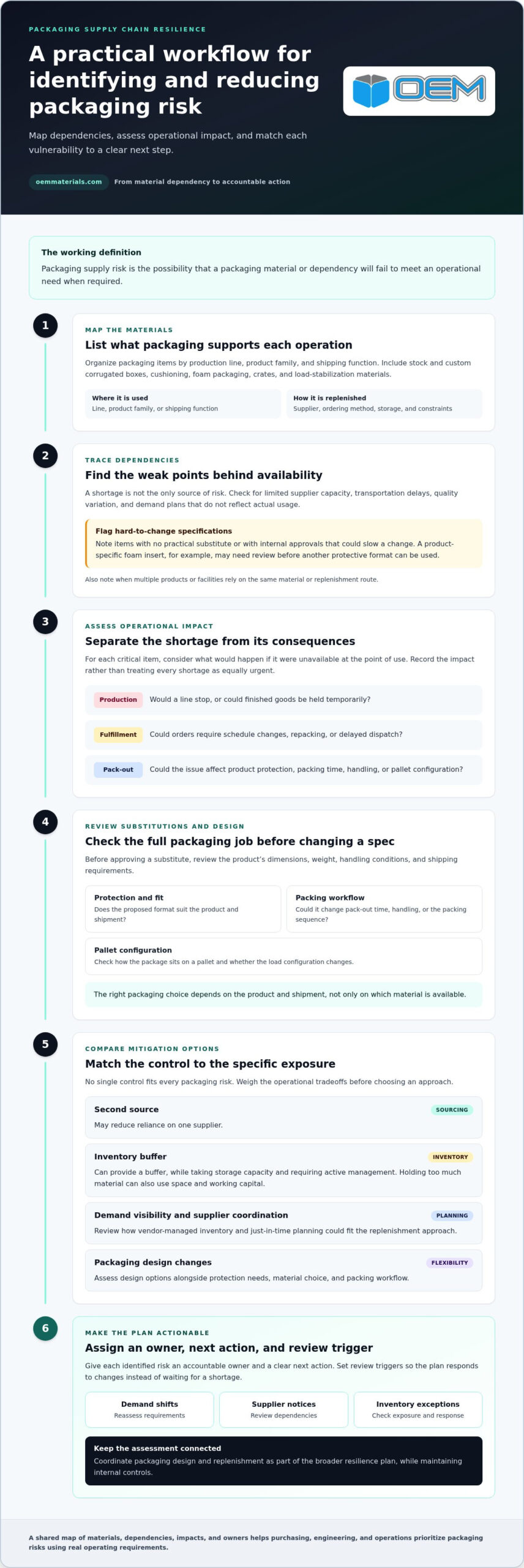
A missing corrugated box, foam insert, crate, or stretch film can hold up a production line or delay outbound shipments. Packaging risk is broader than a supplier running out of material. It can also stem from limited supplier capacity, transportation delays, quality variation, or demand plans that don’t reflect actual usage. A useful working definition is: Packaging supply risk is the possibility that a packaging material or dependency will fail to meet an operational need when required.
Effective supply chain risk management begins by identifying dependencies, assessing their consequences, and deciding how to address them. For packaging, trace each item from its use on the line through its replenishment path, then record what a disruption would affect.
Build a packaging dependency map
Start by listing packaging items by production line, product family, and shipping function. For each one, record where it is used, who supplies it, how it is ordered, where it is stored, and any known replenishment constraints. Include stock and custom corrugated boxes, cushioning, foam packaging, crates, and load-stabilization materials that support production or shipping.
Flag items with no practical substitute or with an internal approval process that could slow a change. For example, a foam insert designed around a product may need review before another protective format can be used. Documenting that dependency makes the exposure visible before inventory runs low. Packaging design can align protection, material choice, and packing workflow. Learn more about foam packaging options.
Rank risks by operational consequence
Not every shortage has the same effect. Assess whether an unavailable item would stop production, delay order fulfillment, reduce product protection, or add labor through a slower pack-out. A delayed packaging shipment may create a scheduling problem; an unsuitable substitute could also leave goods vulnerable to damage. Record these consequences separately so urgency reflects operational impact, not just purchase status.
For operations serving Orange County, Los Angeles, Riverside, and San Diego, note which sites rely on the same material or replenishment route. Shared dependencies can expose multiple facilities to one disruption. This map gives purchasing, engineering, and operations teams a common basis for prioritizing risks and deciding which mitigation options to assess next.
How Packaging Disruptions Affect Production, Product Protection, and Fulfillment
A packaging shortage can create a chain of operational effects, even if it doesn’t stop production outright. Without the specified box, insert, or crate, teams may need to hold finished goods, rearrange schedules, or repack orders before dispatch. Packaging continuity helps keep production moving and finished shipments ready for handling and delivery.
The impact can extend beyond the item that’s unavailable. If several product families use the same box or cushioning specification, a supply gap may affect multiple work areas at once. A missing load-stabilization material can complicate pallet preparation, while a substitute may require extra handling or a different packing sequence. Separate the availability problem from its possible consequences, such as added labor, quality concerns, and delivery delays.
Identify the operational consequences of a packaging shortage
Trace what would happen if each critical item were unavailable at the point of use. A team may be able to continue production and hold goods temporarily, or the missing packaging may prevent products from being packed for shipment. Identify where repacking, schedule changes, or delayed dispatch could occur, and note which other products share the affected material or specification. This helps teams plan around actual operating consequences instead of assuming every shortage has the same result.
Protect performance when specifications or demand change
Before approving a substitute, review the product’s dimensions, weight, handling conditions, and shipping requirements. Check fit and protection, but also consider pack-out time and how the package sits on a pallet. A replacement that accommodates the product may still change the packing workflow or load configuration.
Match the packaging approach to the protection need. Corrugated boxes may be paired with foam or other cushioning, while a crate may suit a different handling requirement. The right choice depends on the product and shipment, not just on what material is available. For industrial box sourcing context, see this guide to corrugated boxes.
For teams mitigating supply chain risks for packaging, specification changes deserve the same attention as supplier delays. The Society of Plastics Engineers discusses planning for disruption and building supply chain resilience in packaging. Apply that broader perspective alongside product-level checks: confirm that a proposed change supports protection, packing, and shipment requirements before it reaches the production floor.
Packaging Risk Mitigation Checklist: Compare Sourcing, Inventory, and Design Options
No single control fits every packaging risk. A second source may reduce reliance on one supplier, while added inventory can provide a buffer but take up storage capacity and require active management. Use the comparison below to weigh each option against the material’s specifications, usage pattern, and operational role. The aim of mitigating supply chain risks for packaging is to improve readiness without adding controls that create more complexity than they resolve.
Supplier diversification
Addresses: Dependence on one source or limited supplier capacity.
Tradeoff: An alternate source may require specification review, qualification, or purchasing coordination.
Review question: Can another source meet the material and quality requirements, and what approval steps would be needed?
Inventory buffers
Addresses: Replenishment delays or changes in consumption.
Tradeoff: Additional stock uses storage space and needs clear tracking to prevent excess or outdated inventory.
Review question: Do consumption patterns, storage limits, and replenishment visibility support holding more?
Demand visibility
Addresses: Reordering based on incomplete or outdated usage information.
Tradeoff: Better visibility depends on timely, consistent purchase-order, usage, and inventory records.
Review question: Do current reports show what is on hand, what is committed, and how quickly items are being used?
Design flexibility
Addresses: Too many packaging specifications or reliance on a single configuration.
Tradeoff: Simplifying or sharing components requires checking fit, protection, and packing workflow for each applicable product.
Review question: Can specifications be consolidated without compromising product or shipping requirements?
Supplier coordination
Addresses: Gaps between demand signals, replenishment, and material availability.
Tradeoff: Coordinated replenishment still depends on accurate usage information and defined internal ownership.
Review question: Who reviews inventory status, communicates changes, and acts on exceptions?
Compare sourcing and inventory controls
Evaluate a second source against the actual material, specification, and qualification requirements rather than assuming every item can be transferred easily. Set buffer decisions against consumption, available storage, and replenishment visibility. Vendor-managed inventory can support coordination, but internal teams remain responsible for accurate demand information and operational priorities. Learn how vendor-managed packaging inventory support can fit into a replenishment plan.
Compare packaging redesign and visibility improvements
Review whether compatible product lines can share packaging components or use fewer specifications. Validate protection and packing requirements before making a change. For visibility, compare new tracking tools with purchase-order, inventory, and usage reporting already in place. Improve the underlying information flow before adding technology that may not address the core gap.
Put the Packaging Risk Checklist into Practice with Owners and Review Triggers
A risk checklist becomes useful when it drives a decision. Turn the findings into a working register that records the packaging item, the risk, the operational consequence, the accountable owner, and the next action. Include review triggers so teams revisit assumptions when demand, supply, or specifications change. This makes mitigating supply chain risks for packaging an ongoing operating process, not a one-time assessment.
Use this sequence to put the register to work:
- Map exposure. Identify critical packaging items, where they’re used, and the supply or internal dependencies that could affect availability.
- Describe the consequence. Record what a shortage or unsuitable material could affect, such as production flow, product protection, packing labor, or shipment readiness.
- Assign ownership. Name a primary owner for each item and an internal escalation contact. Document who approves specification changes and replacement materials.
- Choose an action. Define a practical response, such as reviewing a substitute, adjusting replenishment, improving inventory records, or assessing design flexibility.
- Set triggers and review results. Reopen the item when demand changes, a supplier issues a notice, specifications change, or inventory falls outside the team’s established expectations. Record the decision and any follow-up.
Assign accountable owners and escalation paths
Procurement can maintain supplier and order details, while engineering reviews packaging specifications and operations or warehouse teams report usage and handling issues. Agree on who makes the final decision before a shortage forces a rushed substitution. Keep on-hand quantities, open orders, actual usage, and forecast assumptions in consistent records so teams work from the same information.
Review replenishment and delivery coordination
Match replenishment to actual demand patterns and operating requirements. Just-in-time support can coordinate packaging supply with planned use, but it depends on timely demand information and clear communication. Review just-in-time packaging support as one option within your broader inventory plan, alongside internal monitoring and escalation procedures.
Use each review to confirm whether the action reduced the identified exposure or created a new constraint. For support with packaging requirements and replenishment coordination, request a packaging consultation with product dimensions, weight, and annual usage.
Build Packaging Supply Resilience with Design and Supplier Coordination
Packaging resilience improves when design, material planning, and replenishment decisions work together. A packaging change can affect more than material availability: it may alter product fit, protection, packing steps, or shipment handling. Coordinating these decisions helps manufacturers address connected risks instead of treating each shortage as an isolated purchasing issue.
A supplier relationship can support that coordination, but it should remain one layer in the buyer’s risk plan. Internal teams still need accurate usage and inventory records, clear specification controls, and defined approval paths. OEM Materials & Supplies works with manufacturers on packaging design, vendor-managed inventory, and kitting or assembly to support packaging programs alongside those internal controls.
Connect packaging design to supply and operating needs
Design decisions should account for product dimensions and weight, protection needs, pack-out steps, and shipping requirements. A prototype can help evaluate a concept before a production program, while short runs and high-volume programs may involve different material planning and replenishment needs. Custom packaging design can help align the package with product protection and the packing workflow.
Once the design is established, procurement and operations can connect approved materials to expected demand and replenishment planning. Kitting or assembly may help coordinate packaging components used together, while vendor-managed inventory can support visibility and replenishment coordination. These approaches work best when internal owners continue to monitor usage, specifications, and exceptions.
Prepare useful information for a packaging consultation
Before reviewing a packaging program, gather product dimensions, weight, annual usage, and shipping requirements. Also identify the packaging items currently in use, recurring shortages, and constraints such as storage capacity, packing labor, or specification approvals. This information gives the team a practical basis for discussing design, materials, and replenishment needs.
For manufacturers in Los Angeles, Orange County, Riverside, and San Diego, coordinated planning can connect packaging requirements with production and distribution needs. To discuss a quote or consultation, share the product details and how it ships. Request a packaging quote or consultation.
Make Packaging Resilience Part of Your Operating Plan
Mitigating supply chain risks for packaging starts with knowing which materials and dependencies could disrupt production or shipments. Map each critical item to its operational impact, compare sourcing, inventory, and design options, then assign owners and review triggers so teams can act before a shortage becomes urgent.
Resilience also depends on coordination. Packaging design can align product protection with material choices and packing workflows across prototypes, short runs, and high-volume production programs. Vendor-managed inventory, just-in-time planning, kitting, and assembly can help coordinate replenishment and packaging components, while your internal teams retain ownership of demand information and approvals.
OEM Materials & Supplies supports manufacturers in Southern California, including Orange County, Los Angeles, Riverside, and San Diego, as well as customers across the United States. To discuss a packaging program, gather product dimensions, weight, annual usage, and shipping requirements, along with any recurring shortages or operating constraints. Request a packaging quote or consultation to discuss a practical next step for your supply process.
Frequently Asked Questions
What are the most common supply chain risks for packaging?
Common packaging supply risks include material shortages, supplier capacity constraints, transportation delays, quality variation, and inaccurate demand or inventory information. Internal approval steps can add exposure if a substitute requires engineering review before use. For manufacturers in Los Angeles, Orange County, San Diego, and Riverside, mapping each critical item to its supplier, replenishment path, and operational impact helps teams distinguish a manageable delay from a risk to production or shipment readiness.
How can manufacturers reduce the risk of packaging shortages?
Manufacturers can reduce shortage exposure by tracking critical packaging items, actual usage, on-hand inventory, open orders, and expected demand in consistent records. Set review triggers for supplier notices, changing production plans, and inventory exceptions. For each high-impact item, define an owner and a next action, such as checking an alternate specification or adjusting replenishment. The right response depends on the item’s operational role, storage limits, and how reliably demand can be forecast.
Should a company use multiple suppliers for packaging materials?
Using multiple suppliers can reduce reliance on a single source, but it isn’t practical for every packaging item. An alternate supplier must be able to meet the relevant specification, quality requirements, and production needs. Qualification and approval work may also add complexity. Assess each critical material individually: determine the operational consequence of a supply interruption, the feasibility of an alternate source, and the internal steps needed before that source can be used.
How does vendor-managed inventory help mitigate packaging supply risk?
Vendor-managed inventory (VMI) can coordinate replenishment by sharing responsibility for monitoring packaging stock and responding to usage information. It may help teams align supply with demand, but it depends on accurate records and clear communication about changes in production or packaging requirements. VMI doesn’t replace internal ownership: the manufacturer still needs to define priorities, track exceptions, and ensure the inventory plan reflects current operating needs.
Is just-in-time packaging supply a good way to prevent shortages?
Just-in-time packaging support can coordinate replenishment with planned usage, but it doesn’t prevent every shortage. Its usefulness depends on reliable demand information, communication, and alignment between replenishment and operating requirements. Review how the approach fits each material’s role, usage pattern, and exposure to supply delays. Some items may need additional inventory protection, while others may fit a closer replenishment cycle as part of a broader risk plan.
How often should packaging supply chain risks be reviewed?
Review packaging risks on a defined internal schedule and whenever a meaningful trigger occurs. Triggers can include a demand change, supplier notice, packaging specification revision, or inventory exception. There isn’t one review interval that fits every item. Critical materials with a direct effect on production or product protection may need closer attention than items with workable alternatives. Record the owner, decision, and next review point so follow-up doesn’t depend on memory.
How can packaging design reduce supply chain risk?
Packaging design can reduce exposure by aligning product protection, material selection, and packing workflow, while identifying opportunities to simplify specifications or share compatible components. Evaluate any change against product dimensions, weight, handling, and shipping requirements. A design that uses fewer distinct items may simplify planning, but it must still perform for the product and operation. Manufacturers can assess packaging needs for prototypes, short runs, or high-volume production programs.