
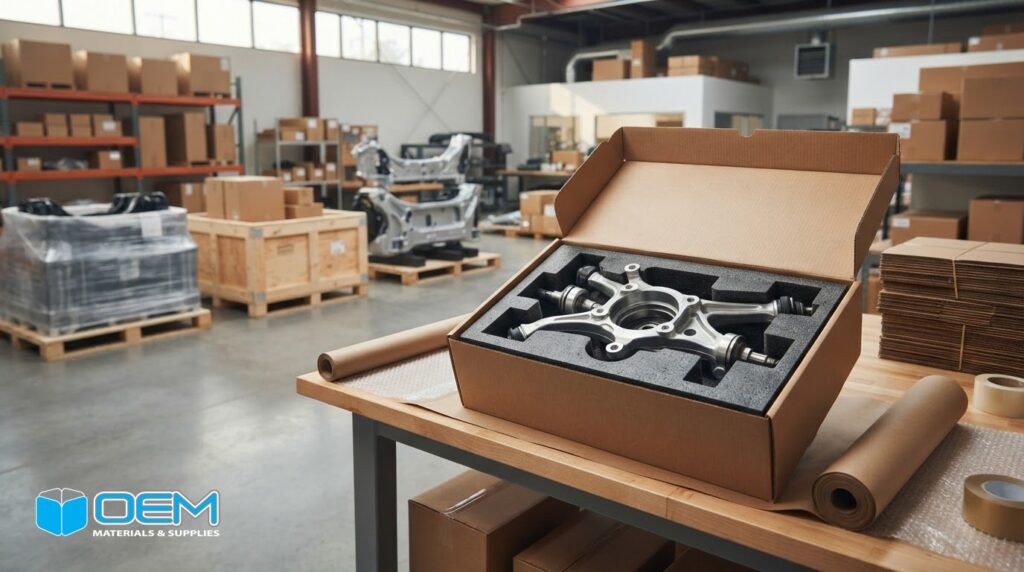
A package that fits an automotive part can still leave it vulnerable to scratches, shifting, or damage in transit. Effective Oceanside automotive parts packaging starts with the part’s geometry, surface sensitivity, and handling conditions, not a one-size-fits-all box.
Packaging also needs to work for the operation, not just the shipment. Excess material, extra packing steps, and difficult storage can slow fulfillment, while supply interruptions can put production schedules at risk. The right approach balances protection with packing efficiency and a dependable supply workflow.
This guide explains how to match automotive components with corrugated boxes, foam inserts, cushioning materials, and crates. It covers how shipment requirements and production processes shape the choice, and how packaging design and supply coordination can support operations in Oceanside and across Southern California. The goal is a solution that protects parts through handling and transit while fitting the way your team packs, stores, and replenishes materials.
Key Takeaways
- Document part dimensions, contact points, and handling conditions to develop a repeatable packaging concept.
- Compare corrugated boxes, foam, cushioning, and crates based on the component and shipment, not material alone.
- For Oceanside automotive parts packaging, account for receiving, storage, production cadence, and delivery coordination.
- Packaging design, kitting, assembly, and inventory programs can connect part protection with day-to-day supply needs.
Oceanside Automotive Parts Packaging Starts with the Part and Its Journey
Automotive parts packaging is a coordinated package designed around a component and the steps it passes through, from packing and internal movement to storage, carrier handling, and receiving. A machined housing, finished trim piece, and bag of fasteners have different protection needs. The package should account for the part and the conditions it will encounter.
Start packaging selection with the part, its movement, and its delivery conditions. This helps teams avoid two common mismatches: packaging that leaves a component exposed to contact or movement, and packaging that adds material or packing steps without addressing a real risk.
Which part characteristics should guide packaging design?
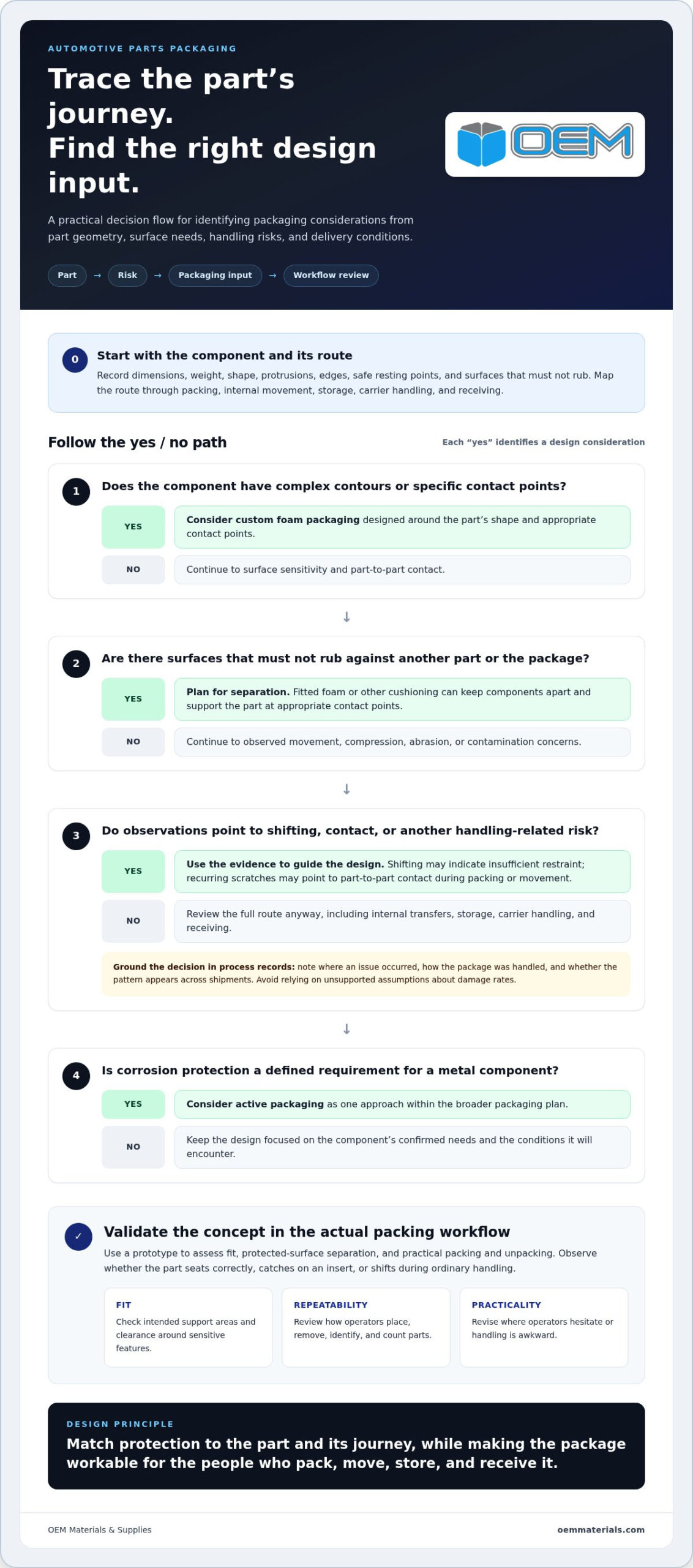
Start with dimensions, weight, shape, protrusions, and edges. Note where the part can safely rest and which surfaces must not rub against another component or the package. Surface sensitivity matters: a cosmetic finish may need separation from other parts, while a robust component may need support at specific contact points to limit shifting.
Then document how parts are packed: individually, in batches, or as assembled kits. Separate confirmed requirements, such as a specified orientation or protected surface, from assumptions that need engineering review. For parts with complex contours, custom foam packaging can be designed around their shape and contact points.
Where can automotive parts face packaging-related risks?
Map the route through packing, staging, warehouse movement, carrier handling, and receiving. Internal handling may involve repeated transfers between work areas; outbound shipments add storage and transport conditions. At each step, consider whether movement, compression, abrasion, or contamination is relevant to the part and process.
Use damage observations and process records to locate the problem. A recurring scratch may point to part-to-part contact during packing or movement. A shifted component may indicate insufficient restraint. Record where the issue occurred, how the package was handled, and whether the same pattern appears across shipments. This gives packaging design a practical starting point without relying on unsupported assumptions about damage rates.
Storage can introduce concerns that differ from transit. A component held before use may need protection from contact or exposure during warehouse storage, while a shipped part must also remain stable through outbound handling. For metal components where corrosion protection is a defined requirement, active packaging for automotive parts is one approach to consider as part of the broader packaging plan.
For Oceanside operations, include the actual receiving and delivery workflow in the assessment. The selected package should protect the component while fitting how employees pack, move, store, and identify it. This view of the part and its route creates a sound basis for comparing packaging formats.
Designing Automotive Packaging Around Protection, Fit, and Packing Work
Once the part and its route are understood, translate the requirements into a package operators can use consistently. Begin with measured dimensions, including protrusions and areas that need clearance. Mark support points, surfaces that should stay separated, and any orientation required for packing or removal. These details are design inputs, not just box dimensions.
Fit is functional. Too much open space can let a component shift; contact in the wrong place can cause abrasion or pressure on a sensitive feature. Internal separation and cushioning can help limit unwanted movement, but no package should be described as eliminating all risk. The design needs to reflect actual handling and shipment conditions.
How do fit and interior protection affect component handling?
Fitted foam or other cushioning can support a part at appropriate contact points and keep components from rubbing against each other. Cutouts should follow the part’s geometry, with clearance for protrusions and a loading orientation operators can repeat. Custom foam packaging can be useful when a component needs shaped interior support rather than loose fill or a generic divider.
Review how the part enters and leaves the package, too. An insert that holds securely but makes removal awkward may slow the line or lead to inconsistent handling. For a batch, separate cavities or cushioning layers can keep pieces apart and make the count visible during packing and receiving.
How should packaging design support repeatable packing?
A sound design works for the person packing the order as well as for the part. Confirm how operators place, remove, identify, and count components, and whether the package needs to hold an individual part, a batch, or a kit. Clear orientation and an intuitive loading sequence can reduce guesswork between shifts.
A prototype lets the team evaluate fit and workflow before moving into a production run. Use it to check whether the component seats correctly, protected surfaces stay separated, and packing and unpacking are practical. A design review can bring engineering, operations, and packaging requirements together before the format is finalized.
Keep the review grounded in observable outcomes. Note where an operator hesitates, where a component catches on an insert, or where the finished pack shifts during ordinary handling. Revise the design based on those findings. The aim is a repeatable concept that balances protection, access, and packing effort, not simply the most elaborate interior.
- Fit: Confirm the part rests on intended support areas and has clearance around sensitive features.
- Separation: Check that components do not contact one another where contact could mark or damage a surface.
- Workflow: Observe loading, removal, identification, and counting with the prototype.
For Oceanside automotive parts packaging, this review can align the container and interior with the actual production and fulfillment process. If you’re developing or revising a design, share the part dimensions, weight, and shipping requirements through the packaging quote request to start a practical review.
Comparing Corrugated Boxes, Foam, Cushioning, and Crates for Automotive Parts
Packaging formats serve different roles. Corrugated boxes commonly act as the outer container, while foam or other cushioning can help position and separate parts inside. Crates provide a rigid shipping structure to evaluate for applications with specific handling needs. The right configuration depends on the component, shipment pattern, and packing operation, not on material alone.
| Component or shipment need | Handling pattern | Format to evaluate | Operational trade-off |
|---|---|---|---|
| Small parts shipped individually or in batches | Frequent packing, staging, and carrier handling | Corrugated box with suitable internal separation | Can support familiar packing workflows; interior protection must match part contact and movement needs. |
| Part with a distinct shape or sensitive contact areas | Repeated loading and removal | Foam insert inside an outer container | Shaped support can organize placement; insert design should allow practical access and repeatable loading. |
| Parts that may shift or contact one another inside a box | Movement within the outer package | Cushioning materials or dividers | Can address separation and movement; the arrangement needs to suit the part and packing method. |
| Shipment requiring a rigid structure | Handling conditions call for a sturdier outer format | Crate, with interior protection as needed | Provides a different structural approach; storage, handling, and shipment requirements should guide its use. |
When can corrugated boxes support automotive parts shipments?
Corrugated boxes can be specified around the part and packing configuration, with custom dimensions or die-cut structures considered when they serve a clear purpose. Box size affects how parts fit and how packages are stored and handled. A compact configuration may reduce unused space, but interior protection and practical packing access still matter. Custom corrugated boxes can serve as outer containers for automotive shipments.
When might foam, cushioning, or crates fit the application?
Foam is worth evaluating when the component’s shape calls for fitted interior support. Cushioning can help manage movement or contact within an outer package, while a crate may suit shipment requirements that call for a rigid structure. These options can also be combined, such as an insert inside a corrugated box. Choose based on the part and handling workflow.
For Oceanside automotive parts packaging, compare formats using the same practical criteria: how the part is held, how operators pack it, how the shipment is handled, and how the package fits storage and fulfillment. This helps identify when a simple outer box is sufficient and when the interior or shipping structure needs more design attention.
Choosing an Automotive Packaging Program for Oceanside Operations
A packaging program connects part requirements with the materials available at the point of use. For an Oceanside operation, receiving schedules, warehouse space, production cadence, and delivery coordination all affect how a packaging plan performs. Use a structured review rather than selecting materials in isolation.
- Document requirements. Gather part dimensions and weight, surface considerations, shipment routes, and typical packing quantities. Note current packaging formats, observed damage, packing steps, storage limits, and expected usage patterns. Include known production changes that could affect demand.
- Review the workflow. Trace packaging from receipt and storage to the packing station and outbound shipment. Identify where materials are staged, how operators access them, and what happens when delivery timing or production schedules shift.
- Evaluate a design. Review a proposed package against the component, packing process, and shipment requirements. A prototype can help teams assess fit and handling before moving into a broader program.
- Plan supply. Set a replenishment approach around actual usage, storage capacity, and delivery coordination. Keep the plan adaptable to operational changes rather than relying on assumptions about fixed demand.
What information helps evaluate a packaging program?
Useful inputs include part dimensions, weight, sensitive surfaces, shipment destinations, and quantities packed per order. Add current packaging, recorded damage observations, labor steps, and storage constraints. Usage history and anticipated production changes help clarify replenishment needs. This information lets engineering, operations, and purchasing teams work from the same requirements instead of making separate assumptions.
How can packaging supply support production continuity?
Packaging replenishment should reflect how the operation uses and stores materials. Just-in-time delivery can align arrivals with operating requirements; just-in-time packaging services can support coordination around production needs. Vendor-managed inventory is another option for monitoring packaging supplies and coordinating replenishment. Both approaches depend on clear usage information and communication about changes in demand.
For Oceanside businesses receiving materials or shipping parts across San Diego County and Southern California, map delivery coordination to the operation’s schedule and storage capacity. Nearby service areas include San Diego, Riverside, Orange County, and Los Angeles County. A program should account for where packaging is received, where it is stored, and how it reaches the packing point without creating avoidable congestion.
Material use and cost outcomes depend on part dimensions, selected materials, shipment requirements, and the packing process. Review those variables together before changing a specification or replenishment plan. A design that suits the part but disrupts storage or packing may not serve the operation well.
To assess a packaging program for Oceanside automotive parts packaging, request a packaging quote with part dimensions, weight, usage patterns, shipment details, and current process constraints.
Working with OEM Materials & Supplies on Oceanside Automotive Parts Packaging
Automotive packaging decisions are connected. The outer container, interior protection, packing sequence, and material replenishment all affect how a part moves through production and fulfillment. OEM Materials & Supplies works with manufacturers on packaging design, material selection, and supply coordination, bringing these considerations into one practical plan. For Oceanside automotive parts packaging, the design can draw on corrugated boxes, foam inserts, cushioning materials, or crates according to the component and its handling requirements.
What can an integrated packaging approach address?
Start with the complete pack. A corrugated box or crate provides the outer structure, while a fitted foam insert or other cushioning can help position parts inside. Considering these elements together supports a consistent packing arrangement and helps teams assess whether the container suits the shipment and warehouse workflow.
For orders assembled from multiple components, kitting and assembly can prepare parts for a defined production or fulfillment process. The package and kit configuration can be considered together, so operators receive an organized set of components rather than handling each item as a separate packing task. The right arrangement depends on the parts, work sequence, and delivery requirements.
Packaging design also connects with supply planning. A selected format must be usable on the floor and available when needed. For projects that call for design development, custom packaging design support can address prototypes, short runs, and high-volume programs. If replenishment needs to align with production, packaging requirements can be planned alongside inventory coordination.
What should Oceanside buyers prepare for a quote discussion?
Useful project information helps shape a relevant packaging recommendation. Share part dimensions and weight, annual usage, shipping requirements, and the quantities typically packed together. Include the current packaging format and known damage concerns, such as repeated contact between components or movement inside the package.
Describe the packing steps and storage conditions as well. Note where materials are received, how they are stored, and how they reach the packing area. If production demand changes by season, order pattern, or program, include that context so packaging and replenishment planning reflect actual operating needs. Drawings or part images can help explain geometry and contact points when available, but the essential details are the requirements and workflow.
OEM Materials & Supplies supports packaging needs for automotive and manufacturing operations across Southern California, including San Diego County and the Oceanside area. To discuss a quote, prototype, or packaging consultation, request an automotive packaging quote with part dimensions, weight, annual usage, and shipping requirements.
Put Your Packaging Requirements Into Motion
Turn packaging priorities into a defined project brief. Decide what the program needs to improve, such as easier packing, clearer part separation, more practical storage, or steadier material replenishment. Bring together the people who handle the parts and packaging each day; their process knowledge can help shape a solution that works beyond the drawing board.
For Oceanside automotive parts packaging, a focused review gives engineering, purchasing, and operations a shared basis for evaluating the design and supply plan. OEM Materials & Supplies supports automotive and manufacturing programs from prototypes through short runs and high-volume production, with packaging design and coordination tailored to operational needs.
Start with the part details and the outcome your team wants to achieve. Request a quote for automotive parts packaging and take the next step toward a packaging program built around your operation.
Frequently Asked Questions
Can automotive parts packaging be designed for several part sizes or SKUs?
Yes, a program can cover multiple SKUs when they share compatible pack-out requirements. Clearly identify variants and specify which insert or packing instruction goes with each item to reduce selection errors at the station. A component family may use a common outer format while keeping distinct internal arrangements. Review SKU differences together so packaging stays clear to operators as the product mix changes.
How can packaging reduce scratches on finished automotive components?
Scratch risk can be reduced by controlling how finished surfaces are handled, not only by selecting an insert. Identify surfaces that shouldn’t be placed face down, prevent parts from sliding across work surfaces, and keep debris away from contact areas. Use a suitable separator where components could rub, then inspect a packed sample after normal handling. These steps target likely causes without promising scratch-free delivery.
Is corrugated packaging suitable for automotive parts?
Corrugated can be suitable when the package meets the part’s containment and distribution requirements. Review the closure, payload arrangement, storage conditions, and receiving site’s handling expectations as part of the decision. After shipments arrive, record package condition and note any mismatch between the packaging and receiving process. If a package is compromised, assess the full configuration rather than assuming the material category alone caused the issue.
What information should I provide for an automotive packaging quote?
Provide dimensions, weight, annual usage, and shipping requirements, organized by SKU rather than as a combined estimate. Add customer packaging instructions, pack-out identification needs, and a sample or drawing of the current package if available. Note which requirements are mandatory and which are preferences. This distinction helps focus the review on actual constraints and prevents an assumed feature from being treated as a fixed specification.
Can packaging supplies be coordinated with production schedules?
Yes. Replenishment planning can use scheduled demand and actual material consumption to coordinate supplies with production. Just-in-time delivery can be planned around operating requirements, while vendor-managed inventory can use shared usage and stock information to monitor supplies. Agree on how production changes, delayed receipts, or unusual demand will be communicated. These coordination methods support planning, but don’t guarantee uninterrupted supply or a specific savings outcome.
Do automotive parts shipments require a specific packaging test standard?
Not every shipment uses the same test requirement. Review the customer’s packaging specification, purchase documentation, and any product- or route-specific instructions. Record the applicable requirement, package revision, and approval status with the part record so production uses the intended configuration. If shipment conditions or customer instructions change, review whether the existing design remains suitable. Don’t apply a test requirement solely because it was used for another product.