
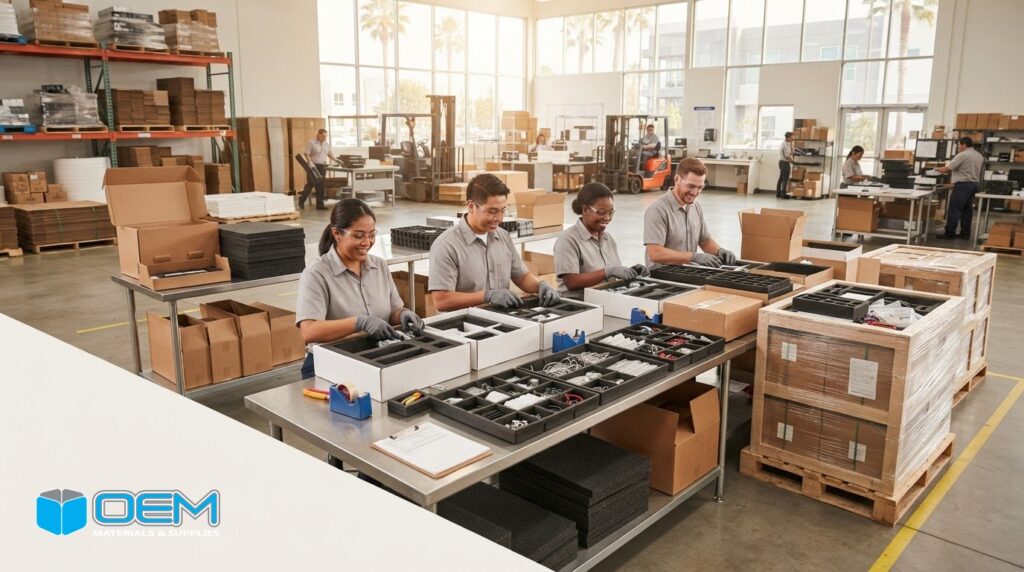
What if the labor slowing production is not on the line, but in sorting components, assembling kits, and repacking orders? For Orange County manufacturers, packaging kitting services can bring those tasks into a coordinated process. A partner can provide packaging kitting services Orange County manufacturers need while aligning assembly, protective materials, and replenishment with the way products move through the operation.
Manual handling takes time from production and warehouse teams. Inconsistent kit contents can cause problems downstream, while managing packaging through separate vendors adds coordination work. Outsourcing assembly alone may not solve these issues. Kitting, packaging, and material supply should fit both the product and the workflow.
This article explains how to define the scope of kitting and assembly, assess packaging consistency, and reduce avoidable handling and material complexity. It also covers how to compare outside support with in-house work, including the effect of ongoing demand and changing production volumes. OEM Materials & Supplies supports manufacturers in Orange County and across Southern California with kitting, assembly, packaging design, and coordinated packaging materials, connecting product protection with production and distribution workflows.
Key Takeaways
- Define each kit by its required components, packaging, and place in your production or distribution workflow.
- Coordinate assembly with corrugated boxes, cushioning, and other packaging materials to support product protection and consistent handling.
- Evaluate packaging kitting services Orange County manufacturers can use by comparing internal capacity, material coordination, process control, and changing volumes.
- Prepare product details, kit contents, packaging requirements, and expected demand to establish a clear project scope.
- Consider how kitting, assembly, packaging design, and vendor-managed inventory can support a more coordinated packaging supply chain.
What Packaging Kitting Services in Orange County Cover for Industrial Buyers
For industrial buyers, a kit is a defined group of products or components assembled for a particular production or shipment requirement. Product bundling describes the basic idea of combining items in one package. Industrial kitting adds operational requirements: accurate contents, appropriate protection, and a configuration that fits the next step in the workflow. Packaging kitting services Orange County manufacturers use can include assembling specified components with protective materials and packaging into a repeatable unit.
This is different from promotional kits, employee onboarding packages, or consumer subscription boxes, which are often organized around branding or the recipient experience. Industrial kits support production staging, component grouping, or recurring product shipments. Their contents and packaging need to match the product and the process they are intended to support.
Which industrial products and workflows can benefit from kitting?
Kitting can group related components with the packaging needed to protect or organize them. For example, a manufacturer may prepare a recurring set of parts with cushioning and a corrugated box, ready for a production stage or shipment preparation. A clearly defined kit list makes it easier to maintain the same configuration across repeat runs.
The right setup depends on the product, handling steps, and destination. OEM Materials & Supplies provides foam packaging as part of packaging solutions designed around product protection needs. Kitting and assembly can then be scoped to the specified components and packaging, with instructions matched to the work required.
How kitting differs from contract packaging and fulfillment
Kitting generally means grouping specified items into a prepared set. Contract packaging can cover a broader scope of assembly and packaging work, while fulfillment may include additional order handling or distribution activities. These terms can overlap, so define the work instead of relying on the label. A project scope should state who supplies the products and materials, what assembly and packaging steps are required, how items must be handled, and where completed kits are intended to go.
OEM Materials supports industrial kitting, assembly, and packaging as coordinated work. The scope is shaped by the product, kit configuration, packaging requirements, and delivery needs. Documenting these details aligns the assembly process with the workflow the kits need to support.
How Industrial Kitting Connects Packaging Materials, Assembly, and Replenishment
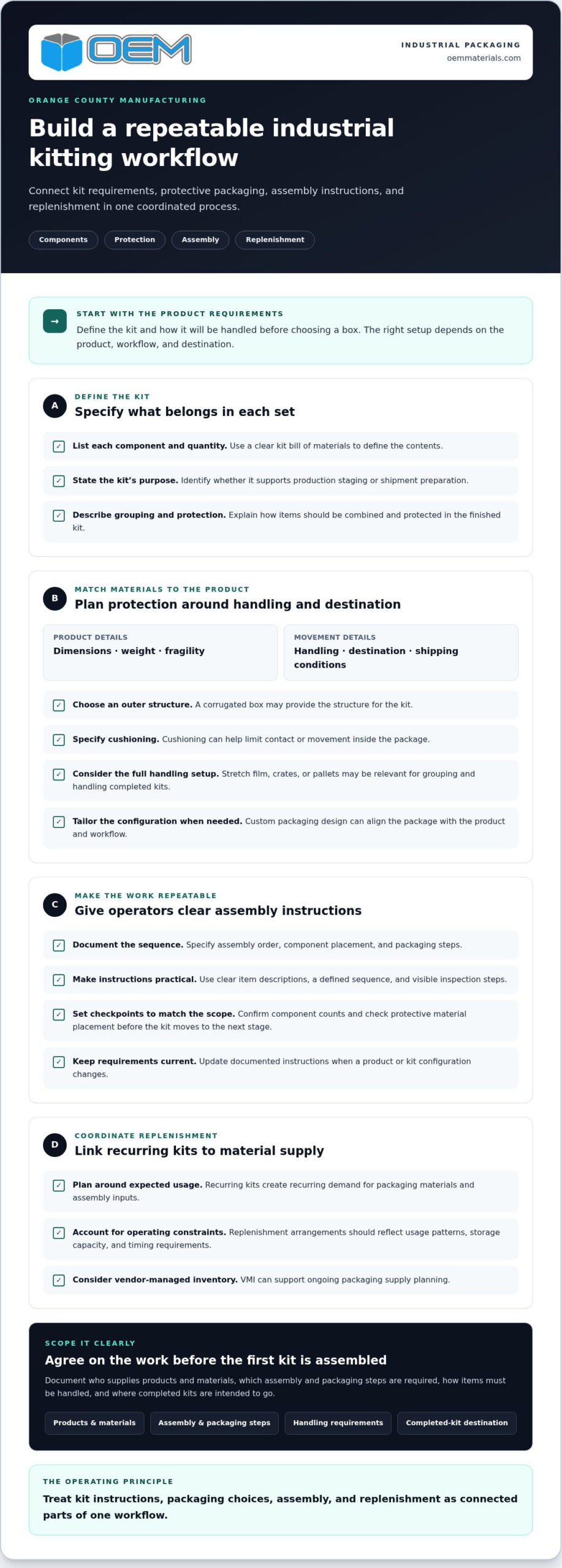
A reliable kitting workflow starts with product requirements, not a box choice. Define the kit bill of materials, including each component and quantity, then document how items should be grouped, assembled, and protected. Planning packaging materials alongside assembly helps ensure the finished kit suits its intended use, whether it is for production staging or shipment preparation.
Choose materials based on the product and how it will be handled. A corrugated box may provide the outer structure, while cushioning can help limit contact or movement. Stretch film, crates, or pallets may also be relevant when grouping and handling completed kits. The suitable combination depends on product dimensions, weight, fragility, and destination, not on a standard kit template.
Repeatability depends on usable work instructions. Specify assembly order, component placement, and packaging steps. Practical checkpoints, such as confirming component counts and checking that protective material is positioned as intended, help catch issues before a kit moves to the next stage. Set inspection steps to match the product and agreed scope.
What belongs in an industrial kit specification?
A useful specification identifies components and quantities, packaging materials, labels, assembly sequence, and handling requirements. Product dimensions and weight inform packaging selection. The destination and shipping conditions help determine how the kit should be protected and prepared. When the product needs a tailored configuration, custom packaging design can align the package with the product and workflow.
Keep the specification practical for operators. Clear item descriptions, a defined sequence, and visible inspection steps reduce ambiguity between runs. When a product or kit configuration changes, update the documented requirements so assembly and packaging stay aligned.
When replenishment programs complement kitting
Recurring kits create recurring demand for packaging materials and assembly inputs. Planning replenishment around expected usage helps operations coordinate material availability with production needs and avoid disconnected ordering. Vendor-managed inventory (VMI) can support ongoing supply planning. Replenishment arrangements should reflect usage patterns, storage capacity, and timing requirements. OEM Materials & Supplies offers vendor-managed inventory to support ongoing packaging supply needs.
For companies evaluating packaging kitting services Orange County, treating kit instructions, packaging choices, and replenishment as connected parts of one workflow gives the project a clearer operating basis. Any efficiency or cost impact depends on the product, materials, demand patterns, and shipping requirements.
How to Compare Kitting Support with In-House Assembly or General Fulfillment
The right model depends on more than labor availability. Consider how often kits are needed, how much handling they require, how demand changes, and whether your team can assemble them without pulling people from higher-priority production or warehouse work. Packaging kitting services Orange County manufacturers use should fit the operating workflow, not simply move tasks outside the facility.
| Factor | In-house assembly | Industrial packaging support | General fulfillment |
|---|---|---|---|
| Labor | Uses internal staff and competes with other assigned work. | Can shift specified assembly and packaging tasks to a partner. | Often centers on order handling rather than production-related assembly. |
| Material coordination | Your team coordinates packaging inputs and availability. | Assembly and packaging materials can be scoped together. | May focus on standard packing needs rather than product-specific packaging design. |
| Process control | Managed through internal instructions and inspection steps. | Can follow defined kit instructions and agreed inspection points. | Processes are generally organized around order preparation. |
| Volume variability | Staffing and capacity must adjust to changing demand. | Scope can be planned around recurring, seasonal, prototype, or changing runs. | May suit order-volume patterns without addressing manufacturing workflow. |
When does outsourced kitting make operational sense?
Outsourcing may be worth evaluating when repeatable assembly takes time away from production, receiving, or other warehouse priorities. Start by mapping demand. Is it steady, seasonal, tied to prototypes, or different from run to run? Then identify tasks that can be documented clearly, such as grouping specified components, adding protective packaging, and preparing a consistent kit configuration. Defined instructions and review points clarify ownership and reduce ambiguity during handoffs.
What distinguishes industrial packaging support from generic fulfillment?
Industrial packaging support connects material selection and assembly to product requirements and manufacturing workflows. A corrugated box, for example, should be selected based on the product, protective materials, handling, and shipment destination, rather than a generic kit template. General fulfillment may address order preparation, but shipping volume alone does not show whether packaging suits industrial components or repeatable production needs.
Before moving work outside, assign responsibility for component counts, packaging steps, inspection, and acceptance of completed kits. This keeps handoffs clear. Compare total operating effects rather than assuming outsourcing will lower costs. Results depend on product dimensions, materials, labor requirements, and shipping needs. To discuss a project scope, request a kitting and packaging quote with your kit configuration and workflow details.
What to Prepare Before Requesting Orange County Kitting and Packaging Support
A clear project brief helps align kit assembly, packaging selection, and material replenishment before work begins. It gives both teams a shared reference if demand, product configuration, or handling needs change. Use this checklist to define the scope for packaging kitting services in Orange County.
Product and packaging details to gather
- Product data: Record each item’s dimensions, weight, handling requirements, and known protection concerns. Include packaging samples or drawings if they help show the current configuration.
- Kit contents: List every component and quantity per kit. Note required labels, packaging materials, and the intended assembly sequence. Identify approved variations so they are not mistaken for assembly errors.
- Demand profile: Estimate annual usage and describe how volumes may change across production runs, seasons, prototypes, or product revisions. Share expected order or release patterns, not just a single annual estimate.
These details connect the product to an appropriate packaging configuration and make assembly expectations easier to document. A sample kit can also show how components should be grouped and protected.
Workflow and quality requirements to define
- Kit destination: Explain where completed kits go next, such as a production area, storage location, or shipment-preparation step. Note storage constraints and handling transitions that could affect packaging or staging.
- Delivery cadence: Describe when kits and packaging materials are needed, including planned releases and demand fluctuations. A just-in-time packaging program is one option to consider when coordinating supply timing with operational requirements.
- Inspection and exceptions: Identify who checks component counts, packaging consistency, and completed kit configuration. Define how shortages, damaged items, or approved configuration changes should be recorded and communicated.
Specific requirements make it easier to set practical assembly instructions, choose packaging around product and shipment needs, and plan replenishment against expected demand. They also clarify ownership at each handoff. When the brief includes product data, kit contents, annual usage, and delivery cadence, the project discussion can focus on operational details instead of basic information gaps.
Prepare those details and request a kitting and packaging quote to discuss a scope tailored to your products and workflow.
Working with OEM Materials on Packaging Kitting Services in Orange County
Industrial kitting works best when assembly, packaging, and material supply are considered together. OEM Materials & Supplies supports manufacturers with packaging design, kitting, assembly, corrugated boxes, and vendor-managed inventory (VMI). This coordinated approach helps purchasing, engineering, and operations teams define how components are grouped, protected, and supplied for their workflows.
A coordinated approach for Southern California manufacturers
For a kitting project, packaging decisions should reflect the product and its next handling step. Corrugated packaging can provide the outer container, while cushioning or other protective materials address product-specific handling needs. OEM Materials & Supplies can align packaging and assembly requirements for projects ranging from prototypes and short runs to high-volume production programs.
Corrugated packaging solutions can be considered alongside kit configuration and assembly needs, rather than treated as a separate purchasing decision. For recurring programs, VMI can connect packaging supply with ongoing operational demand. The right scope depends on product requirements, production patterns, and delivery needs.
OEM Materials & Supplies serves manufacturers in Orange County and across Southern California, including Los Angeles County, the Inland Empire, and San Diego County. For local operations, packaging kitting services Orange County teams use can be planned around how products move through production and shipment preparation, with material and assembly requirements addressed together.
Request a quote with useful project information
A focused project brief helps establish the packaging, assembly, and replenishment scope. Include product dimensions and weight, a list of kit components and quantities, expected annual usage, and known changes in demand or configuration. Packaging samples, drawings, or existing work instructions can clarify the current setup.
Also describe handling requirements, where completed kits will be used or staged, and any workflow or delivery requirements that affect timing. These details give the project discussion a practical starting point and connect the packaging approach to the operating need. Recommendations and outcomes depend on the product, materials, usage patterns, and shipping requirements.
Share your project details with OEM Materials & Supplies to discuss a suitable scope. Request a packaging kitting quote with product dimensions, weight, kit contents, and annual usage.
Plan Kitting Support Around Your Production Needs
Effective kitting begins with a defined scope: the components in each kit, the assembly steps, and the packaging needed to protect products through handling and shipment. Clear instructions and inspection points support consistency. Demand patterns and internal capacity help determine whether assembly should stay in-house or move to a contract partner.
Packaging kitting services Orange County manufacturers need can bring assembly and industrial packaging into one coordinated workflow. OEM Materials & Supplies supports manufacturers with corrugated boxes, custom packaging, kitting, assembly, and vendor-managed inventory. The company serves manufacturers in Orange County, Los Angeles County, the Inland Empire, and San Diego County, as well as across the United States. Project scope is shaped around product requirements and operating needs.
To start a practical project discussion, gather product dimensions and weight, kit contents, packaging requirements, and expected annual usage. Include relevant handling, workflow, and delivery details to help define the work. Request a quote for your packaging and kitting requirements with the information your team has available.
Frequently Asked Questions
What are packaging kitting services?
Packaging kitting services involve assembling specified products or components into a prepared kit, often with packaging to organize or protect them. In an industrial setting, a kit might group related parts with cushioning and a corrugated box for production staging or shipment preparation. The contents, assembly steps, and packaging depend on the product and intended workflow. Clear specifications help maintain consistent configurations across repeat runs.
How is industrial kitting different from contract packaging?
Industrial kitting focuses on grouping defined components into a ready-to-use set, while contract packaging can refer to a broader scope of assembly and packaging work. The terms can overlap, so define the tasks rather than relying on labels. Specify components, packaging materials, handling needs, assembly sequence, inspection points, and destination. This gives operations and the packaging partner a shared understanding of the work.
Can packaging kitting services support manufacturing operations?
Yes. Kitting can support manufacturing by grouping specified components for a production stage, so teams receive a consistent set of items together. It can also move repeatable assembly and packaging tasks away from internal production or warehouse staff when those tasks compete with other priorities. The fit depends on demand patterns, product handling, internal capacity, and how clearly kit contents and work steps can be defined.
What information should I provide for a kitting quote?
Provide product dimensions and weight, a list of kit components and quantities, and the assembly sequence. Include packaging requirements, handling needs, labels, and any available packaging samples or drawings. Expected annual usage and anticipated volume or configuration changes help describe demand. Also explain where completed kits go next and note workflow or delivery requirements. These details help define a practical scope for packaging, assembly, and replenishment.
Can kitting be combined with packaging material supply?
Yes. Kitting and packaging material supply can be planned together so the assembly configuration and protective materials match the product and workflow. Depending on project requirements, materials may include corrugated boxes, foam packaging, cushioning, crates, or pallets. Coordinating these needs clarifies recurring material requirements for a production program. The right combination depends on product dimensions, handling, shipment destination, and the agreed kit specification.
Does OEM Materials serve manufacturers outside Orange County?
Yes. OEM Materials & Supplies serves manufacturers in Orange County, Los Angeles County, San Diego County, Riverside, and broader Southern California, as well as across the United States. The company provides industrial packaging and kitting support, including packaging, assembly, and vendor-managed inventory. Project scope is shaped around the products, packaging requirements, and operating needs involved.
How can vendor-managed inventory support a kitting program?
Vendor-managed inventory (VMI) can help coordinate recurring packaging material supply with ongoing kitting and production needs. Planning replenishment around expected usage gives operations a structured way to manage materials used across repeat kit runs. The program should reflect demand patterns, storage constraints, and workflow timing. VMI can complement kitting, with the approach shaped by each operation’s supply needs.
To discuss your packaging and kitting requirements, request a quote with product dimensions, weight, kit contents, and expected annual usage.