
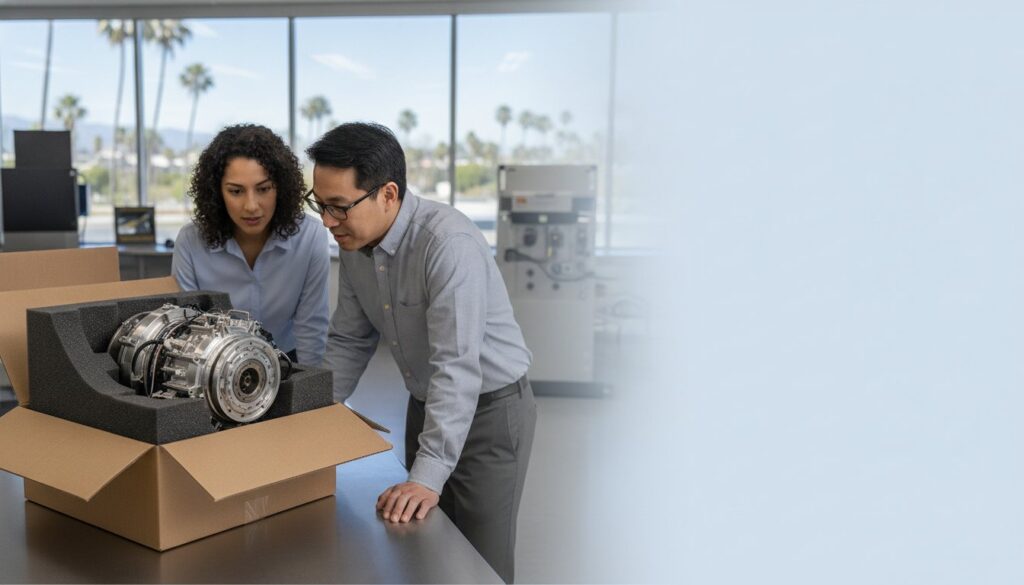
A damaged prototype is more than a logistical failure; it is a direct threat to your startup’s credibility and potential funding. When you have invested months into engineering a high-value medical device or aerospace component, the final few hundred miles of transit are often the most dangerous. Many founders discover too late that standard off-the-shelf boxes provide insufficient protection, yet finding suppliers willing to handle low-volume runs is a constant challenge for new ventures. This is why identifying the right prototype packaging solutions for startups early in the development cycle is essential for operational success.
We understand the pressure of balancing technical durability with the need for a scalable supply chain. You need a solution that fits your product perfectly today while providing a clear path toward mass production as your orders grow. This article explains how to select and design custom prototype packaging that protects your high-value assets and prepares your business for long-term growth. We will cover the technical aspects of material selection, the benefits of custom foam inserts, and how to establish a partnership with a supplier capable of scaling from a single sample to full distribution across Southern California and beyond.
Key Takeaways
- Understand how specialized prototype packaging solutions for startups prevent costly delays during the testing phase by using custom-engineered materials.
- Learn to select the correct structural foundation for your high-value assets, ranging from custom corrugated boxes to precision-cut foam inserts.
- Discover the technical workflow for developing packaging prototypes, starting with CAD modeling and moving into functional sampling.
- Identify strategies for transitioning from low-volume prototypes to high-volume production by moving from digital cutting to cost-effective hard tooling.
- Leverage local expertise in Southern California hubs like Orange County and San Diego to reduce turnaround times for critical packaging samples.
What is Prototype Packaging & Why Startups Need It?
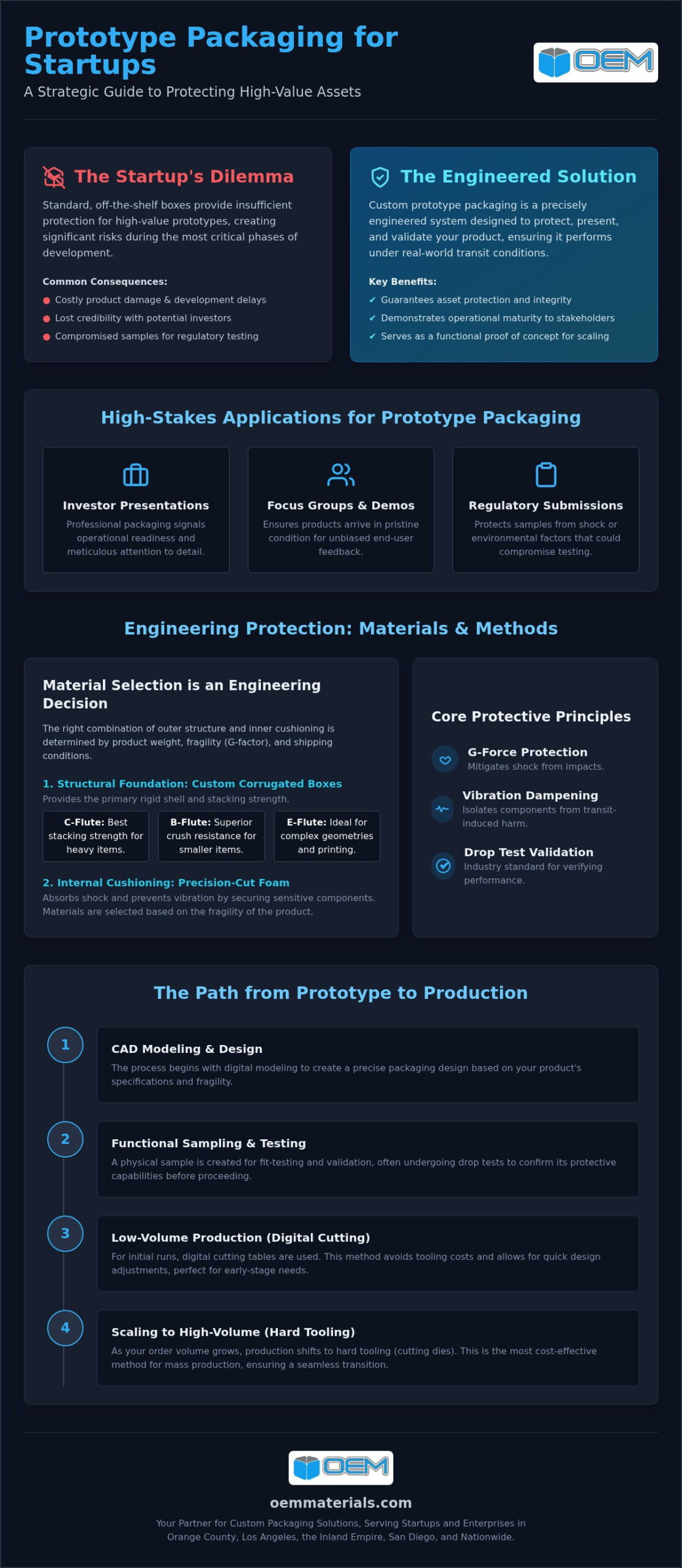
Prototype packaging is far more than a temporary container for a new product. It is a custom-engineered solution built to protect and present high-value assets during the critical development and testing phases. For early-stage companies, securing effective prototype packaging solutions for startups is a strategic necessity. A single incident of product damage during transit to a potential investor or a regulatory body can lead to lost funding opportunities or significant delays in testing cycles. This stage serves as a functional proof of concept, ensuring that the final production-level packaging will perform as expected under real-world conditions.
Startups utilize these specialized solutions for several high-stakes scenarios:
- Investor Presentations: First impressions matter when pitching to venture capitalists. Professional packaging demonstrates operational maturity and attention to detail.
- Focus Groups: Testing product-market fit requires the product to arrive in pristine condition to ensure unbiased feedback from end-users.
- Regulatory Submissions: Agencies require samples that have not been compromised by environmental factors or physical shock during shipping.
The Role of Protective Engineering
Protection must be the primary objective of any prototype design. While aesthetics are important for branding, the structural engineering must account for physical stresses like G-force protection and vibration dampening. Custom foam packaging inserts are often required to ensure that sensitive electronic or medical components remain stationary within custom corrugated boxes. These materials are selected based on the fragility of the product and the predicted shipping environment. A drop test serves as the industry standard for prototype validation; it measures the ability of the packaging to withstand impacts from specific heights and angles without damaging the internal contents.
Validation of Market Readiness
Utilizing professional-grade materials signals to stakeholders that a product is ready for industrial application. Beyond protection, implementing robust prototype packaging solutions for startups allows engineers to test assembly line efficiency and kitting processes before high-volume manufacturing begins. By identifying potential packaging flaws during the prototyping stage, startups can implement design changes that save significant costs during the scale-up phase. This proactive approach prevents the need for expensive structural redesigns once the product enters the mass distribution channel. Working with an experienced partner for custom packaging design ensures that the transition from a single unit to thousands is seamless and cost-efficient.
Selecting Materials for Industrial Prototype Packaging
Selecting the right substrate is an engineering decision rather than an aesthetic one. For hardware-focused ventures, effective prototype packaging solutions for startups must prioritize the interaction between a product’s mass and the material’s energy-absorption capabilities. The choice of material depends entirely on the product’s weight, its fragility rating (G-factor), and the specific shipping environment it will face. Industrial prototypes often require a multi-layered approach, combining a rigid outer shell with precision-engineered internal cushioning to mitigate the risks of shock and vibration.
Early in the design process, startups should evaluate the cost-to-protection ratio of various materials. Over-engineering leads to unnecessary material costs and increased shipping weights, while under-protecting can result in catastrophic product failure. Balancing these factors requires an understanding of how different corrugated grades and foam densities perform under stress.
Custom Corrugated Box Options
Custom corrugated boxes provide the necessary structural foundation for most industrial prototypes. The performance of the box is largely determined by its flute size. C-flute is the industry standard for stacking strength, making it ideal for shipping heavier industrial components. B-flute offers a flatter surface and superior crush resistance, which is preferable for smaller items. For prototypes with complex geometries, E-flute allows for intricate die-cut designs that can fold into unique shapes, ensuring a snug fit that prevents the product from shifting. Using the correct flute size ensures the outer container can withstand the rigors of the Southern California logistics network, from warehouse stacking in San Diego County to last-mile delivery in Los Angeles.
Engineered Foam Inserts for Sensitive Assets
For high-value electronics and medical devices, corrugated walls alone rarely provide sufficient protection. Engineered foam packaging inserts are essential for isolating the product from external impacts. Polyethylene (PE) foam is a closed-cell material that provides excellent vibration dampening for heavier items; it is durable and resistant to moisture. Conversely, polyurethane (PU) foam is an open-cell, softer material ideal for lightweight, highly sensitive components that require a gentle cushion. Startups in the electronics sector must also specify ESD (electrostatic discharge) foam to prevent latent damage to circuit boards during transit. If you are unsure which density or material combination is required for your specific application, you can consult with a packaging specialist to review your product’s fragility and dimensions.
The Step-by-Step Process of Developing Packaging Prototypes
Developing effective prototype packaging solutions for startups requires a methodical approach that balances engineering precision with fiscal responsibility. The process begins with a comprehensive technical consultation. During this phase, we collect specific data points, including exact product dimensions, total weight, and the estimated fragility rating. Understanding these variables allows us to determine the appropriate thickness for corrugated walls and the necessary density for foam cushioning. This initial data gathering ensures that the protective design is built on a foundation of factual requirements rather than guesswork. The process doesn’t stop at the drawing board; it’s a cycle of engineering and validation.
Once the technical parameters are established, the design moves into a Computer-Aided Design (CAD) environment. Engineers create a 3D model of the packaging system, including every internal divider and foam insert. This digital stage is where the structural integrity of the package is first validated. By simulating how the product sits within the cavity, we can identify potential stress points or clearance issues before a single piece of material is cut. This precision is vital for startups working with high-value electronics or aerospace components where tolerances are measured in millimeters.
From CAD Design to Physical Sample
The transition from a digital model to a physical sample is achieved through rapid prototyping techniques. We utilize digital die-cutting for corrugated materials and CNC foam cutting for internal protection. These methods eliminate the need for expensive permanent tooling during the testing phase, allowing for low-volume runs that fit startup budgets. Through custom packaging design services, startups can verify the fit and finish of their product in a real-world container. If the initial fit is too loose or the assembly is too cumbersome, the digital file can be adjusted and a new sample produced within hours.
Testing for Real-World Conditions
A physical sample must prove itself through rigorous transit testing. We simulate the harsh conditions of the Southern California supply chain, from the high temperatures of an Inland Empire warehouse to the vibrations of long-haul trucking. Testing identifies failure points such as corner crushing or foam compression set. For startups in the medical device or electronics sectors, this stage ensures compliance with industry-specific safety standards. After testing, the design is refined based on physical performance and feedback from your assembly team. This iterative loop guarantees that when you move to full-scale production, your packaging is already optimized for both protection and speed.
Scaling from Prototype to High-Volume Production
Transitioning from a single functional sample to a 10,000-unit production run is a significant hurdle for any manufacturing venture. Many companies fail to realize that the most effective prototype packaging solutions for startups are those designed with mass manufacturing in mind from day one. If a design is too complex for automated assembly or requires excessive manual labor, costs will spiral as volume increases. Engineering for scalability means choosing materials and structures that can be produced using high-speed equipment without compromising the protective standards established during the testing phase.
During the initial prototyping stage, we use digital cutting tables to avoid the cost of steel-rule dies. However, as your order volume moves from dozens to thousands, investing in hard tooling becomes the most effective way to lower per-unit costs. While this involves an upfront expense, the speed and precision of die-cutting significantly reduce the manufacturing time per container. This shift is essential for maintaining healthy margins as your product gains market traction. It is a logistical transition that requires careful planning to ensure your supply chain remains uninterrupted.
Inventory Management for Growing Startups
Startups often lack the warehouse space to store pallets of empty packaging materials. Transitioning to packaging VMI services allows you to focus on product development while we manage your inventory levels. We monitor your usage and replenish stock automatically, ensuring you never face a line-down situation due to a shortage of boxes or foam. For companies in high-rent industrial hubs like Orange County or Los Angeles, JIT packaging delivery is a functional remedy for warehouse clutter. It keeps your floor space dedicated to revenue-generating production rather than storage.
Cost Reduction Through Volume
High-volume production offers opportunities for significant spending optimization across your entire packaging spend. Beyond raw material discounts, startups should evaluate labor-saving services like kitting and assembly. Having your supplier deliver a pre-assembled kit, which includes the box, foam inserts, and labels, reduces the time your team spends on the packing line. These efficiencies are critical when calculating the total landed cost, as labor often represents a hidden but substantial portion of the expense. Results always depend on specific variables like product dimensions and annual usage, so a thorough review of your supply chain is necessary to find the most effective strategy.
If you are ready to move your design into full-scale production, you can request a quote for high-volume manufacturing to see how tooling and VMI can optimize your operations.
Why Southern California Startups Partner with OEM Materials & Supplies
Southern California remains one of the most concentrated manufacturing hubs in the world. Startups operating in Orange County, San Diego County, and Los Angeles County face unique logistical pressures that national online resellers are ill-equipped to handle. When you require prototype packaging solutions for startups, the ability to collaborate with a local partner provides a functional advantage that directly impacts your development timeline. We offer more than just a catalog of materials; we provide the technical expertise and hands-on support necessary to move a product from a concept to a market-ready asset.
Our proximity to the major distribution centers in Riverside and the Inland Empire ensures that we understand the specific rigors of the local supply chain. We don’t just ship boxes; we engineer systems that withstand the specific environmental and transit stresses of the region. This local presence allows us to act as a seasoned industry partner, offering a level of dependability that distant vendors cannot match. We prioritize precision and speed because we understand that for a startup, every day spent in the prototyping phase is a day of deferred revenue.
Local Prototyping for Faster Iteration
Proximity is the primary driver of speed in the design cycle. Being local allows for face-to-face consultations and immediate adjustments to packaging designs that a digital-only relationship cannot facilitate. If a physical sample requires a modification to a foam cavity or a corrugated fold, you can visit our facilities in Orange County or Los Angeles for a real-time design review. This direct collaboration eliminates the multi-day delays associated with shipping samples back and forth across the country. Reduced shipping times for prototypes mean a faster time-to-market for your product, giving you a competitive edge in fast-moving industries.
Industry-Specific Expertise
Southern California’s economy is driven by the medical, aerospace, and electronics sectors. Each of these industries demands rigorous standards for protection and cleanliness. We have proven experience navigating these requirements, providing specialized solutions that range from anti-static packaging for sensitive circuit boards to custom wood crates for heavy aerospace machinery prototypes. We understand the nuances of G-force protection and the necessity of moisture barriers for overseas shipping. By partnering with a supplier that already speaks the language of your industry, you avoid the common pitfalls of under-engineered packaging that lead to costly product damage and lost credibility with stakeholders.
Secure Your Product’s Path to Full-Scale Production
Selecting the right prototype packaging solutions for startups is a critical step in moving from a technical concept to a commercially viable product. By prioritizing structural engineering and material durability early in the process, you protect your high-value assets from the risks of transit damage and ensure a professional presentation to stakeholders. Establishing a scalable design allows your business to transition seamlessly from low-volume testing to high-volume manufacturing without incurring unnecessary redesign costs or labor inefficiencies. This proactive approach ensures your supply chain is built for growth from the very first shipment.
OEM Materials & Supplies has served manufacturers across Orange County, Los Angeles, and San Diego for decades. We specialize in the complex requirements of the aerospace, medical device, and electronics sectors, providing full-service support that spans from initial CAD design to long-term vendor-managed inventory. Our local expertise ensures that your prototypes are validated for real-world conditions and ready for the next stage of industrial application. When you’re ready to protect your investment and optimize your supply chain, request a custom prototype packaging quote from OEM Materials & Supplies. Please include your product’s dimensions, weight, and expected usage so we can provide a precise recommendation. We look forward to helping your startup scale with confidence.
Frequently Asked Questions
What is the minimum order quantity for prototype packaging?
We can produce as few as a single unit for functional testing or investor presentations. Our digital cutting equipment allows for low-volume runs without the need for expensive permanent tooling or long setup times. This flexibility is a core component of our prototype packaging solutions for startups, enabling you to validate designs and material performance before committing to high-volume production.
How long does it take to get a custom packaging sample?
Standard lead times for physical samples typically range from 48 to 72 hours after the CAD design is finalized and approved. Our proximity to major manufacturing hubs in Orange County and Los Angeles allows for rapid turnaround and local delivery options. If the project requires complex engineered foam inserts or unique corrugated structures, we will provide a specific timeline during your initial technical consultation.
Can you design packaging if I only have a 3D model of my product?
Yes, our engineering team can utilize your 3D CAD models to design a precise packaging system from scratch. We import your product’s geometry to create custom cavities in foam or structural dividers in corrugated board. This digital-first approach ensures a perfect fit and allows us to simulate protection levels and weight distribution before manufacturing the first physical prototype.
What materials are best for protecting fragile electronic prototypes?
A combination of high-density polyethylene (PE) foam and double-wall corrugated boxes usually provides the best protection for sensitive electronics. The PE foam absorbs high-frequency vibrations, while the corrugated walls provide the necessary compression strength for warehouse stacking. We often recommend custom foam inserts to isolate delicate components from external shock during the shipping cycle to prevent latent mechanical failures.
Do you offer anti-static packaging for sensitive components?
We provide a full range of ESD (electrostatic discharge) materials, including pink anti-static foam and conductive corrugated coatings. These materials are essential for preventing latent damage to circuit boards and other sensitive electronic components during transit. Protecting against static is a standard requirement for many aerospace and medical device startups we serve throughout Southern California and the Inland Empire.
How do I transition from a prototype run to full production?
The transition involves moving from digital cutting to permanent steel-rule dies to lower per-unit costs at higher volumes. Once your design is validated, we assist in the shift to high-volume manufacturing and can implement vendor-managed inventory (VMI) to streamline your supply chain. This path ensures that your prototype packaging solutions for startups remain cost-effective as your order volumes increase from dozens to thousands.
Can you help with the assembly and kitting of my startup’s product?
We offer comprehensive kitting and assembly services to reduce your internal labor costs and floor space requirements. Our team can pre-assemble boxes, insert custom foam, and include necessary components like labels or instruction manuals. This service is particularly beneficial for startups in San Diego or Orange County looking to optimize their packing line efficiency and focus resources on product development.
Is custom prototype packaging more expensive than stock boxes?
While the initial cost per unit is higher than a stock box, custom packaging often results in lower total landed costs. Tailored designs eliminate the need for excessive void fill and significantly reduce the risk of expensive product damage. Proper right-sizing also lowers shipping fees by minimizing dimensional weight, which is a critical factor in long-term cost optimization for any growing manufacturing business.