
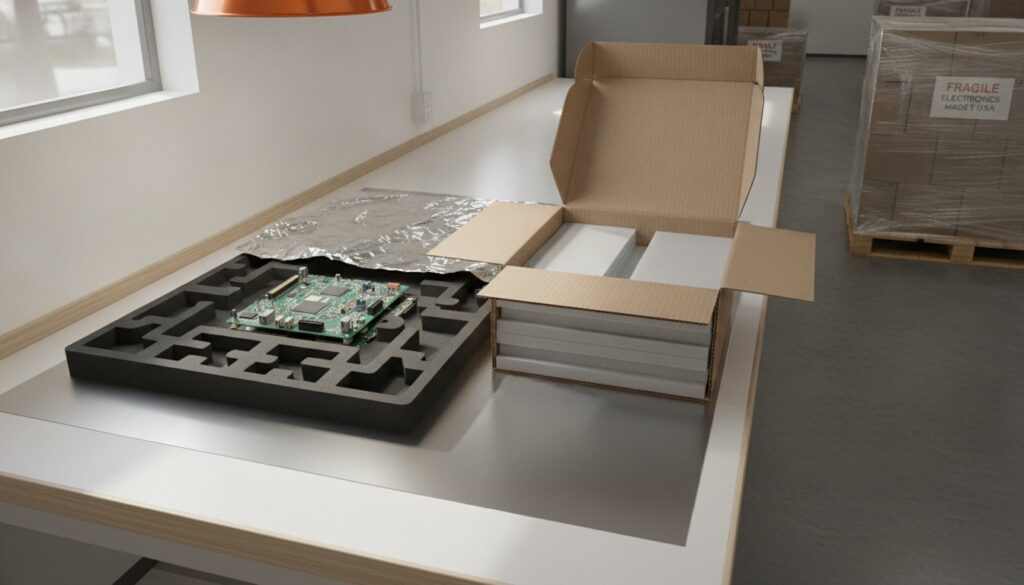
Why are your most sophisticated engineering designs still failing the six-foot drop test from a delivery truck? For many electronics manufacturers in Southern California, high RMA rates are not just a logistical nuisance; they are a direct drain on profit margins and brand reputation. You understand that protecting sensitive printed circuit boards and finished goods requires more than just a standard box and some generic cushioning. Understanding how to reduce shipping damage for electronics starts with treating your packaging as an extension of the product engineering itself.
This guide provides the technical strategies and material selections required to eliminate transit damage for sensitive components and finished goods. We will examine how to integrate custom foam inserts with specific densities, utilize electrostatic discharge (ESD) shielding, and optimize corrugated structural design for maximum protection. By focusing on a zero-defect delivery model, you can lower your total cost of ownership and streamline packing station efficiency across your entire supply chain. From the Inland Empire to San Diego, these engineering principles ensure your hardware arrives in the same condition it left the cleanroom.
Key Takeaways
- Identify the true financial impact of transit failures by calculating the hidden costs of technical inspections and RMA labor.
- Learn technical strategies on how to reduce shipping damage for electronics by mitigating mechanical shock and electrostatic discharge.
- Understand why engineered foam inserts outperform generic cushioning for high-value components with complex geometries.
- Establish a repeatable packaging protocol based on precise fragility assessments and targeted material selection.
- Reduce total cost of ownership through custom packaging designs that improve packing speed and lower dimensional weight.
The Hidden Costs of Shipping Damage in the Electronics Industry
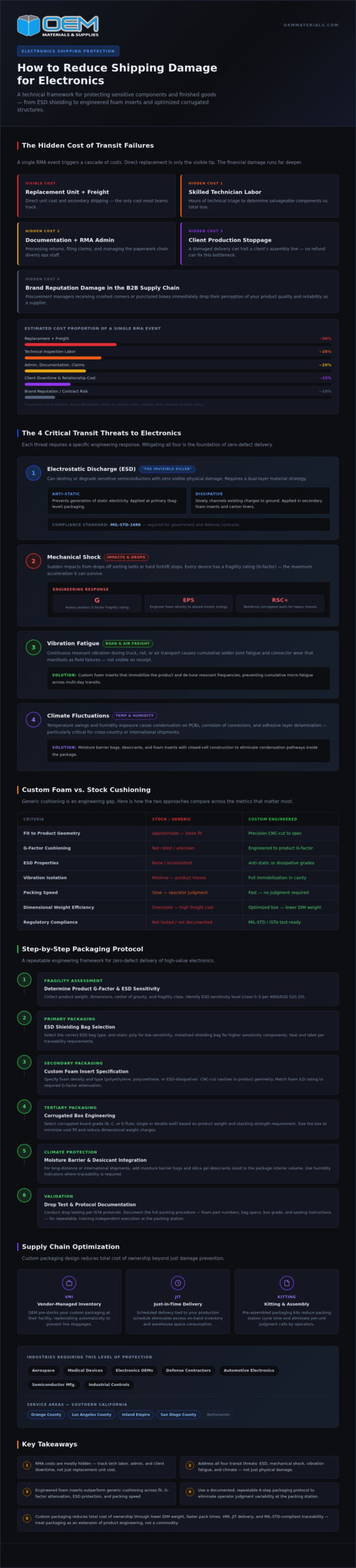
Shipping damage in the electronics sector is rarely a simple line item. While direct costs like replacement units and secondary freight are easy to track, they represent only a fraction of the total financial impact. For a manufacturer in Orange County or Los Angeles, a single transit failure triggers a cascade of expensive operational hurdles. Identifying how to reduce shipping damage for electronics starts with recognizing that the real drain on your bottom line occurs long before a replacement unit is shipped.
Stock packaging frequently fails to meet the rigorous standards required by electronics OEMs. Generic corrugated boxes and loose-fill materials lack the precision needed to protect sensitive circuitry from the vibrations and shocks of the modern supply chain. When these materials fail, the manufacturer absorbs the cost of technical triage, documentation, and the inevitable disruption of the customer’s production schedule. These failures are not just logistical errors; they are engineering gaps that compromise your operational efficiency.
RMA Metrics and Operational Efficiency
The true cost of a Return Merchandise Authorization (RMA) includes significant labor overhead. Highly skilled technicians must spend hours inspecting damaged hardware to determine if components can be salvaged or if the entire assembly is a total loss. This diverted labor stalls new production and inflates the total cost of ownership for every unit sold. Packaging failures at the destination facility can also halt a client’s assembly line; this creates a bottleneck that no simple refund can fix. Streamlining your protective strategy reduces these labor-intensive touchpoints and keeps your warehouse staff focused on outbound fulfillment rather than inbound returns.
Brand Reputation in the B2B Supply Chain
Reliability serves as a primary differentiator in the industrial electronics market. When a procurement manager receives a shipment with crushed corners or punctured boxes, their perception of your product quality drops immediately. Professional, high-performance packaging signals that your operation values precision and technical competence. Investing in custom packaging design ensures that your hardware arrives in “as-manufactured” condition, reinforcing your status as a dependable partner. In the competitive landscape of the Inland Empire and San Diego County, zero-defect delivery is not just a goal; it’s a requirement for long-term contract retention. Learning how to reduce shipping damage for electronics is ultimately an investment in your brand’s industrial authority.
The Four Critical Threats to Electronics During Transit
Protecting sophisticated hardware requires an understanding of physics, not just a sturdy box. Shipping environments subject your products to a variety of stressors that can compromise internal circuitry without showing a single mark on the outer container. Learning how to reduce shipping damage for electronics involves identifying and mitigating four primary environmental threats: electrostatic discharge, mechanical shock, vibration, and climate fluctuations. Each of these forces acts differently on electronic components, requiring a specific engineering response to ensure zero-defect delivery.
Managing Electrostatic Discharge (ESD)
Electrostatic discharge is often called the “invisible killer” because it can destroy or degrade sensitive semiconductors without any visible sign of damage. To prevent this, engineers must distinguish between anti-static and dissipative materials. Anti-static materials are designed to prevent the generation of static electricity, while dissipative materials allow existing charges to flow to ground at a controlled, slow rate. Effective protection requires integrating these properties into both primary packaging, such as shielding bags, and secondary packaging, like specialized foam inserts. For manufacturers handling government or defense contracts, packaging must often meet rigorous MIL-STD-1686 standards to ensure compliant electrostatic protection throughout the supply chain.
Shock and Vibration Mitigation
Mechanical shock occurs during sudden impacts, such as a package falling from a sorting belt or a forklift driver making a hard stop. Every electronic device has a fragility rating, known as a G-factor, which measures the maximum acceleration the unit can withstand before failure. Cushioning materials must be engineered to absorb this kinetic energy and redistribute it away from the product. For heavy electronic chassis, standard corrugated walls are insufficient; you must employ reinforced edge and corner protectors to prevent structural deformation during a drop.
Vibration is a more subtle but equally dangerous threat. Long-haul transit induces harmonic resonance, a phenomenon where the frequency of the truck or aircraft matches the natural frequency of the electronic components. This constant oscillation can loosen internal ribbon cables or cause micro-cracks in lead-free solder joints, leading to intermittent failures that are difficult to diagnose in the field. High-density foam packaging acts as a dampener, shifting the resonant frequency of the system to a safe range. If you are seeing high failure rates despite intact outer packaging, it may be time to request a technical consultation to evaluate your current cushioning density.
Finally, climate factors like humidity and temperature fluctuations can cause condensation to form on cold circuit boards as they move through different shipping zones. Utilizing desiccants and moisture barrier bags is essential for protecting sensitive hardware during transit through varying climates, ensuring that Orange County’s coastal humidity or the Inland Empire’s heat doesn’t compromise your product’s integrity.
Selecting Materials: Custom Foam vs. Stock Cushioning
Relying on commodity packaging materials for industrial electronics is a high-risk strategy. Loose-fill “peanuts” and standard bubble wrap are designed for lightweight consumer goods, not the precision-engineered components manufactured in Southern California’s aerospace and tech hubs. These stock materials often fail because they allow for product migration; as a package is handled, loose-fill shifts, eventually leaving the product in direct contact with the outer box wall. Understanding how to reduce shipping damage for electronics requires a shift toward engineered foam inserts that provide consistent, repeatable protection.
The synergy between internal cushioning and custom corrugated boxes creates a unified protective system. While stock boxes offer generic dimensions, custom-sized corrugated containers eliminate excess void space, reducing the amount of cushioning required and lowering dimensional (DIM) weight costs. This integrated approach ensures that the structural integrity of the outer shell complements the energy-absorbing properties of the internal foam.
Custom Foam Insert Density and Design
Selecting the correct foam density is a technical decision based on the weight and fragility of your hardware. Polyethylene (PE) and Polyurethane (PU) serve different engineering purposes:
- Polyethylene: A closed-cell foam that is highly durable and resistant to repeated impacts. It is the preferred choice for heavier electronic chassis and items with sharp edges that might puncture softer materials.
- Polyurethane: An open-cell foam that is softer and more flexible. It is ideal for lightweight, highly fragile components that require gentle deceleration during a drop.
Precision die-cut cavities are designed to match the specific geometry of your product. This prevents movement within the box and ensures that the item stays centered in the “protection zone.” For multi-component kits, engineers can combine different foam densities within a single insert to accommodate a heavy power supply alongside a delicate sensor array.
Corrugated Strength and Box Selection
The outer box must do more than just hold the product; it must resist puncture and stacking forces. For heavy industrial electronics, double-wall corrugated is often necessary to provide the required structural rigidity. When selecting a box, you must consider two primary metrics: the Mullen Test, which measures puncture resistance, and the Edge Crush Test (ECT), which evaluates stacking strength. In high-volume warehouse environments in the Inland Empire or San Diego, ECT ratings are particularly important for maintaining pallet integrity. To further secure palletized loads, the use of edge and corner protectors prevents the vertical compression that often leads to internal component damage during long-haul transit.
A Step-by-Step Protocol for Packaging High-Value Electronics
Implementing a technical material strategy is only effective if the assembly process is repeatable and standardized. A rigorous packaging protocol ensures that every unit leaving your Southern California facility maintains the same level of protection, regardless of the shift or the operator. When considering how to reduce shipping damage for electronics, you must treat the packing station as a final stage of the manufacturing process where precision is non-negotiable.
The first step in any industrial packaging protocol is a fragility assessment to determine the item’s G-force threshold. Once the engineering team identifies the maximum acceleration the internal components can withstand, the following sequence should be followed:
- Primary ESD Shielding: Apply a static shielding bag or dissipative film directly to the component. This creates a Faraday cage effect, protecting the circuitry from external electrical fields.
- Internal Cushioning: Secure the unit within its custom-engineered foam cavity. The fit must be snug enough to prevent migration but designed to allow the foam to compress and decelerate the item during an impact.
- Structural Housing: Place the cushioned unit into a corrugated outer container that meets the specific Edge Crush Test (ECT) requirements for the total shipment weight.
- Final Stabilization: For palletized shipments, seal the load using high-performance stretch film to prevent shifting during transit.
The Box-in-Box Method for Critical Components
For high-value aerospace or medical electronics, the box-in-box method provides an additional layer of shock isolation. This involves placing the primary product box inside a larger secondary container. To be effective, you must maintain the “two-inch rule,” ensuring at least two inches of cushioning material separate the inner and outer containers on all sides. This air gap, filled with engineered foam or high-grade cushioning, allows the inner box to move independently of the outer shell during a drop, significantly reducing the G-forces transferred to the electronic assembly. Clear labeling and orientation instructions are essential to ensure the package is handled according to its engineering design.
Palletization and Load Stabilization
Electronics often sustain damage not from individual drops, but from the shifting of an entire pallet during ocean or rail transit. Securing your goods to industrial pallets is a critical defensive measure. When applying stretch film, the tension must be calibrated to provide maximum containment without crushing the corrugated walls of the individual boxes. Utilizing impact indicators on the exterior of the pallet can also provide a data-driven trail of handling quality, allowing you to identify exactly where in the supply chain a failure occurred. If your current return rates are unacceptable, you can request a quote for a comprehensive packaging audit to identify weaknesses in your stabilization protocol.
Optimizing the Supply Chain with Custom Packaging Design
Engineering a protective environment for sensitive hardware is only half the battle. To achieve true operational excellence, your packaging strategy must integrate with your logistics and warehouse workflows. Custom packaging design does more than shield a product; it eliminates the inefficiencies inherent in stock materials. Integrating custom solutions is a strategic move for those researching how to reduce shipping damage for electronics while simultaneously improving operational margins through reduced waste and lower dimensional (DIM) weight costs.
For high-volume manufacturers in Southern California, leveraging a local partner for Vendor Managed Inventory (VMI) provides a significant competitive advantage. VMI programs ensure that your packaging stock is always aligned with your production schedule, preventing the inventory shortages that lead to rushed, substandard packing. By utilizing just-in-time (JIT) delivery from suppliers in Orange County or the Inland Empire, you can repurpose valuable warehouse space for production rather than storing bulky stacks of empty boxes.
Kitting and Assembly Services
Labor costs at the packing station often exceed the cost of the materials themselves. Kitting and assembly services streamline this process by providing ready-to-use sets that include the outer corrugated box, the custom foam insert, and any necessary ESD shielding. This integrated approach reduces the footprint of packaging inventory and ensures that every unit is packed with perfect consistency. When a packer doesn’t have to source multiple components from different aisles, the risk of human error is minimized. This repeatability is essential for maintaining the zero-defect standards required in the aerospace and medical device sectors.
Design for Logistics Efficiency
Logistics costs are heavily influenced by how effectively you utilize space on a pallet or inside a shipping container. Custom-designed packaging allows you to optimize box dimensions to perfectly match your product’s geometry and the standard dimensions of industrial pallets. This precision increases pallet density, meaning you can ship more units in a single truckload. The relationship between intelligent packaging design and overall cost savings is direct; better design leads to lower freight expenses and fewer damage claims. Actual results and financial improvements depend on specific variables such as product dimensions, material selection, and unique shipping requirements. Partnering with a local industrial packaging expert in Los Angeles or San Diego County allows for rapid prototyping and testing, ensuring your design is optimized for the specific rigors of your unique supply chain.
If you are ready to audit your current packaging for efficiency and protection, contact OEM Materials & Supplies today. Our engineering team can provide a technical consultation and prototypes based on your specific requirements. To receive a precise recommendation, please be prepared to provide your product dimensions, weight, annual usage, and any relevant fragility ratings or G-factor data.
Securing Your Supply Chain Against Transit Failures
Eliminating transit damage requires moving beyond generic supplies toward an integrated engineering strategy. We have explored how the combination of precision foam density, structural corrugated design, and rigorous ESD protocols creates a defensive barrier that stock packaging cannot match. By addressing the physics of shock and vibration, you protect both your product’s integrity and your brand’s reputation for reliability in the industrial sector.
Optimizing your logistics cycle further enhances these results. Utilizing local Southern California delivery and VMI programs ensures your production line never stalls due to packaging shortages. When you understand how to reduce shipping damage for electronics, you aren’t just buying boxes; you’re investing in a streamlined distribution model that lowers your total cost of ownership. OEM Materials & Supplies provides the technical expertise needed for rapid custom foam prototyping and JIT support across Orange County, San Diego, and the Inland Empire.
We are ready to help you transition from reactive damage control to a proactive, zero-defect shipping protocol. Request a custom packaging design consultation for your electronics today to begin your audit. Please include your product dimensions, weight, and annual usage to help our team provide an accurate technical recommendation for your specific application.
Frequently Asked Questions
What is the best way to protect electronics from static during shipping?
The most effective method is using a multi-layered approach that includes primary static shielding bags and dissipative foam inserts. Static shielding bags create a Faraday cage effect that protects circuitry from external electrical fields. Simply using anti-static pink bubble wrap is often insufficient for sensitive semiconductors; you must ensure the primary barrier provides a true metalized shield to prevent electrostatic discharge from reaching the components.
How do I determine the right foam density for my electronic device?
Determining foam density requires calculating your product’s weight relative to its fragility rating, or G-factor. This engineering step is fundamental when you are looking for how to reduce shipping damage for electronics because it dictates the deceleration rate during an impact. Heavier items usually require higher-density polyethylene foam to prevent bottoming out, while lighter, more delicate sensors benefit from softer polyurethane foams that absorb energy more gradually.
What is the difference between anti-static and static shielding bags?
Anti-static bags prevent the generation of static electricity caused by the contents rubbing against the bag, but they do not block external charges. Static shielding bags include a buried metal layer that acts as a shield against external electrical fields. For industrial electronics and aerospace components, shielding bags are the standard requirement. They provide a much higher level of protection than simple dissipative or anti-static films.
Why is vibration a problem for electronics even if the box isn’t dropped?
Vibration causes harmonic resonance that can fatigue solder joints and loosen internal connectors during long-haul transit. Even without a significant impact, the constant oscillation from truck or aircraft engines can lead to micro-cracks in printed circuit boards. High-performance foam packaging acts as a dampener to isolate the product from these frequencies. This prevents intermittent failures that might not be visible during a standard physical inspection.
Can I use standard corrugated boxes for heavy industrial electronics?
Standard boxes often lack the Edge Crush Test (ECT) ratings required to support the weight and stacking forces of heavy industrial electronics. For these applications, you should utilize double-wall or triple-wall corrugated containers with high puncture resistance. Using custom corrugated boxes ensures the structural integrity of the outer shell matches the internal cushioning, preventing the box from collapsing under the weight of other pallets in the supply chain.
How can custom packaging design reduce my total shipping costs?
Custom packaging design reduces total costs by optimizing box dimensions to lower dimensional (DIM) weight and reducing the volume of material waste. By eliminating excess void space, you spend less on secondary cushioning and shipping fees. This strategic approach is a key component of how to reduce shipping damage for electronics because it ensures a snug fit that prevents internal movement, which is a leading cause of transit failure.
What are the benefits of using a local packaging supplier in Southern California?
Local Southern California suppliers offer rapid prototyping and just-in-time (JIT) delivery, which reduces your warehouse footprint and lead times. For manufacturers in Orange County, San Diego, or the Inland Empire, this proximity allows for immediate design adjustments and faster response to production spikes. Working with a regional partner also lowers inbound freight costs for your packaging materials and enables more effective vendor-managed inventory (VMI) programs.
Is the box-in-box method necessary for all electronic shipments?
The box-in-box method is typically reserved for high-value or extremely fragile components that require an extra layer of shock isolation. It is not necessary for every shipment, but it serves as a critical safeguard for aerospace or medical devices. This technique provides a sacrificial outer layer that absorbs initial impact energy, while the inner container and its cushioning provide the final stage of deceleration.