

Packaging delays often begin before production starts. Reducing packaging supplier lead times starts with complete specifications, ready-to-approve artwork, clear service targets, and a packaging format suited to the job. Missing dimensions, material details, or approvals can create extra rounds of questions and rework, stretching the time from order to delivery.
That pressure is especially familiar with secondary packaging, labels, and shipper boxes, where a late detail can disrupt a production schedule or launch. A proof can catch color variance before printing and help avoid the 3 to 4 weeks required for a reprint.
This article explains why packaging timelines stretch and how buyers can reduce avoidable delays. You’ll learn what to include in a specification, how to speed up approvals, which supplier service targets to track, and how standard and custom packaging choices affect timing. It also covers forecasting and inventory practices that align supply with demand, helping procurement and operations teams make practical improvements without compromising fit or protection.
Key Takeaways
- Map the steps between order placement and delivery to identify where packaging delays actually occur.
- Make specifications and approval responsibilities clear before production begins to limit avoidable clarification and rework.
- Track supplier delivery, defect, and response performance against practical service targets.
- Match packaging format and sourcing approach to the schedule, balancing customization with production complexity.
- Use demand patterns and reorder points to plan replenishment before packaging shortages become urgent.
1. Supply chain lead-time reduction benefits
Reducing packaging supplier lead times gives operations teams more control over production and delivery schedules. Packaging lead time includes sourcing, manufacturing, decoration, quality control, and final delivery. A delay at any stage can leave a finished product waiting for packaging, stalling a launch, interrupting a production line, or tying up inventory before orders ship. Faster replenishment also gives buyers more flexibility when demand or product plans change.
Start by mapping each handoff from purchase order to receiving, then record where work waits. Separate supplier processing from approval delays, transit, and receiving time. This supply chain view helps purchasing and operations identify the longest delays instead of treating the timeline as one block. If artwork approval holds an order before production, for example, changing the shipping method won’t solve the main problem.
Disruptions can cause delays outside a buyer’s direct control. Port congestion, labor shortages, severe weather, and regulatory changes can affect material availability and delivery schedules. A domestic supplier can reduce manufacturing lead times by two weeks or more. Dual sourcing can protect continuity when one source faces a disruption, while local sourcing may shorten transit and response time. Total costs depend on the packaging, sourcing arrangement, shipping requirements, and inventory each source needs.
Shorter, more predictable timelines can help manufacturers protect launch dates and production flow. A 2019 Gartner survey found that 45% of product launches were delayed by at least one month. Lead-time reduction doesn’t mean rushing every order; it means removing unnecessary waiting and making handoffs clearer. Compare quoted dates with actual receipt dates, then investigate recurring gaps. That record can show whether the main constraint is supplier capacity, internal approvals, or transportation.
Speed can also create risks if teams remove safeguards instead of delays. Rushed specifications or reduced inspection can let packaging defects reach production or customers. Ordering too late, or cutting buffer inventory without reliable replenishment, can cause stockouts if a delivery slips. Keep quality control in the process and define acceptance requirements before orders begin. Review packaging fit, protection, labeling, and receiving quantities against the approved requirements.
For a product with fragile components, for example, a faster box supply matters only if the packaging still protects the item. Foam packaging can be part of a defined protection approach when the product and shipping conditions call for it. Compare lead-time gains against the work required to qualify another source, manage separate orders, and hold inventory. Track delivery performance and defects together, so faster supply does not come at the expense of quality or continuity.
2. Clear specifications, dielines, and artwork approvals
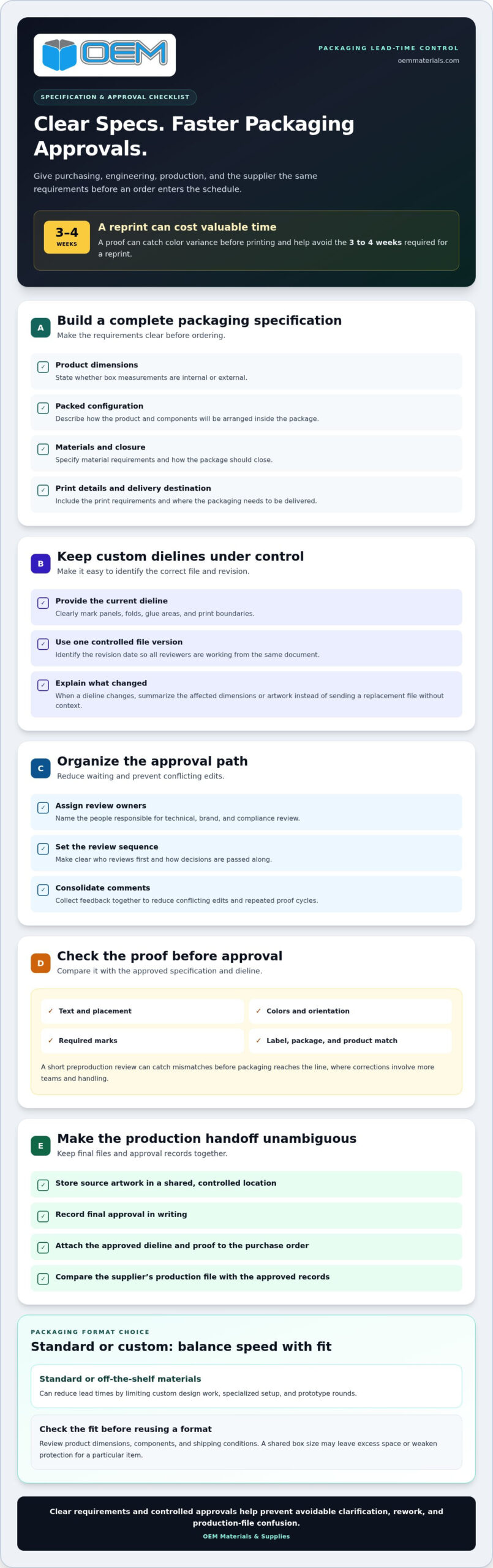
A complete packaging specification gives purchasing, engineering, and production the same requirements before an order enters the supplier’s schedule. Include product dimensions, packed configuration, material requirements, closure method, print details, and delivery destination. For example, a box specification should distinguish internal from external dimensions. That helps prevent poorly fitting samples and clarification requests that delay production.
Standardizing packaging specifications and using off-the-shelf materials can reduce lead times by limiting custom design work, specialized setup, and prototype rounds. Reusing an approved format across products also makes ordering and receiving more consistent. Still, review product fit: a shared box size may leave excess space or weaken protection for a particular item. Consider dimensions, components, and shipping conditions when deciding.
For custom packaging, provide the current dieline with panels, folds, glue areas, and print boundaries clearly marked. Use one controlled file version and identify its revision date so operations, design, and the supplier review the same document. If the dieline changes, summarize the affected dimensions or artwork instead of sending a replacement file without context. This makes the revision clear and helps prevent production from using an outdated layout.
Artwork introduces another approval path. Name the people responsible for technical, brand, and compliance review, then set a clear sequence for their decisions. Finalizing packaging artwork can delay timelines when several stakeholders must approve files. A proof can reveal color variance before a print run and help avoid the 3 to 4 weeks required for a reprint. Consolidated comments reduce conflicting edits and repeated proof cycles.
Before approval, compare the proof with the approved specification and dieline. Confirm text, placement, colors, orientation, and required marks. Check that labels match the intended package and product, since poorly applied labels can require rework and disrupt logistics. A short preproduction review is especially useful when components come from different sources. It catches mismatches before packaging reaches the line, where corrections involve more teams and handling.
Build approval readiness into order planning. Assign an owner for each file, keep source artwork in a shared, controlled location, and record final approval in writing. For example, a buyer can attach the approved dieline and proof to the purchase order, then compare the supplier’s production file with those records. This clear handoff reduces ambiguity and supports a predictable schedule without skipping quality review.
3. Information delays and service-level targets
Define owners and response expectations for information handoffs. For each packaging order, identify who can answer technical questions, approve changes, and communicate schedule updates. If an order is waiting on a dimension decision, purchasing and manufacturing should know who is responsible. Without clear ownership, messages can circulate between departments while production planning remains blocked.
Set a response target for information that holds up an order. Reducing an information delay from three days to one day is a practical target for shortening manufacturing lead time. Apply it to questions about order details, release status, and schedule changes. Record when a request arrives, when the answer is sent, and whether the next step can proceed. This shows where communication time accumulates.
Use a shared order record instead of scattered email threads. Include the purchase order, current status, pending decision, assigned owner, and latest committed date. An order marked “awaiting buyer response,” for example, identifies an action more clearly than “in process.” Keep the response or decision with the record, so a shift change or staff absence does not restart the information search.
Supplier scorecards can turn recurring service issues into specific improvement work. Review on-time delivery, defect rate, and responsiveness to change requests together for a fuller picture than delivery performance alone. A supplier may meet the promised date but still create avoidable work through defects or slow handling of a packaging change. Share the results and agree on a process adjustment for future orders.
Define escalation steps before a schedule becomes critical. Specify who receives an alert when a commitment changes, which internal planner needs the updated date, and how unresolved questions move to the next contact. A revised arrival date should reach the production scheduler before the packaging is needed on the line. This gives operations time to resequence work or adjust allocations.
Keep service targets practical and review them against order records. Each target should identify the event being measured, the person responsible, and how completion is recorded. Distinguish acknowledging a request from resolving the issue: a quick acknowledgement does not necessarily unblock production. Reviewing both helps teams separate communication responsiveness from actual order progress.
When a supplier repeatedly misses an agreed information target, examine the handoff instead of adding more status meetings. Clarify required purchase order fields, route questions to one accountable contact, and define which changes require a revised commitment. Share the process with the supplier and internal teams. Consistent records make service reviews useful for preventing repeat delays, not just documenting them.
Lead times for secondary packaging, labels, and shipper boxes
Standard, in-stock packaging typically ships in 1 to 4 weeks. Custom packaging timelines depend on design complexity, material availability, production capacity, order quantity, artwork readiness, and shipping arrangements. Labels, secondary packaging, and shipper boxes each have distinct production requirements, so buyers should plan by item rather than apply one estimate to every component.
For custom work, separate structural development from repeat production. A new box or insert design may need prototype review before production can proceed. A repeat order with an approved design avoids that step, though material supply and supplier workload still affect scheduling. For manufacturers in Orange County, Los Angeles, San Diego, and Riverside, local sourcing can reduce the distance between production and the receiving facility.
Expedited shipping and safety stock address different parts of the timeline. Compare the expedited freight charge with the carrying costs of extra inventory, including storage space, handling, and the risk that design changes make stock unusable. Make the comparison for the specific item and shipment, since package size, route, and required arrival date affect the decision.
Distinguish routine items from project-specific packaging to limit inventory carrying costs. Keep commonly used, approved formats on a replenishment plan, and purchase special artwork or one-time components closer to confirmed production needs. For example, a manufacturer can maintain its standard shipper while releasing a launch-specific printed component against a firm schedule. This avoids treating every packaging item as equally predictable.
Coordinate components that must arrive together. A shipper box that reaches the plant before its required insert or label may take up storage without being usable for the scheduled product. Align purchase orders and requested delivery dates with the packaging set’s first required use. For products with several packaging elements, identify which item controls readiness and plan its arrival accordingly.
Use current written delivery estimates for each order, especially when seasonal demand or capacity changes may affect schedules. For facilities across Southern California, compare the supplier’s production location and delivery route with the required receiving date. A local source may reduce transit distance, but the full schedule still depends on manufacturing, approvals, and receiving coordination. Plan around the complete order path, not freight time alone.
5. How can businesses reduce packaging lead times through better forecasting and demand planning?
Start with actual packaging consumption, not purchase order history alone. Orders may arrive irregularly even when production uses materials at a steady rate. Compare usage with finished-goods schedules, open orders, and inventory on hand. A packaging buyer, for example, can review recent withdrawals by item and identify whether demand rises with a recurring production cycle. That baseline creates a more practical forecast than simply repeating the last order quantity.
Set reorder points using average weekly usage and the supplier’s known lead time. The reorder point should account for the quantity likely to be consumed while replenishment is in transit. Review it when production plans or supplier timelines change. If a packaging format supports several products, combine their expected usage before calculating demand. This prevents teams from overlooking shared consumption and placing duplicate or late orders.
Share reorder expectations with suppliers using actual sales and production data. Distinguish firm orders from anticipated demand in the forecast, so projections are not mistaken for confirmed releases. Update the outlook when promotions, product launches, or schedule changes alter expected consumption. Clear updates help suppliers prepare routine orders earlier and give purchasing time to address shortfalls before they become urgent.
Shorten the planning cycle with daily scheduling and replenishment reviews. A daily check can catch production or inventory changes sooner than a weekly review. Keep it focused: compare available stock, scheduled production, open purchase orders, and the next expected delivery. If a shipment moves, planners can revise the production sequence or allocate remaining packaging to priority orders.
Use different replenishment rules for stable and variable items. A regularly consumed shipper may suit a predictable reorder point, while a seasonal package needs closer review against the launch calendar. Avoid applying the same buffer to every item. Consider usage consistency, supplier lead time, storage constraints, and the consequence of a stockout. This links inventory decisions to operational risk rather than a blanket target.
For a clear operating routine, assign one owner to maintain the forecast, record changes, and communicate releases. During each review, purchasing can compare forecast demand with actual usage and adjust future orders when patterns shift. Operations should flag schedule changes promptly, while receiving records quantities and delivery dates. These handoffs keep the forecast current and reveal gaps between expected and actual supply.
Better forecasting reduces avoidable rush orders, but it does not remove the need for sound packaging choices. If product dimensions, weight, or annual usage are changing, include those details when you request a packaging quote. A current demand picture helps align the packaging recommendation and replenishment plan with the production schedule.
OEM Materials & Supplies: Corrugated Boxes
OEM Materials & Supplies provides corrugated boxes for businesses aligning packaging supply with production schedules. Clear box dimensions, product weight, order quantities, and delivery requirements help define the packaging need and make the supply discussion more useful. For products that need added cushioning, foam packaging addresses a separate protection requirement, while packaging kits group components for a repeatable packing process.
Turn to OEM Materials & Supplies when packaging specifications or recurring demand need a practical review. Share product dimensions, weight, annual usage, and shipping requirements to focus the discussion on your application. Contact OEM Materials & Supplies or visit oemmaterials.com to discuss your packaging needs.
Put a More Predictable Packaging Plan in Motion
Reducing packaging supplier lead times is an ongoing operations practice, not a one-time purchasing adjustment. Choose a packaging family that regularly affects production, assign an owner to coordinate its requirements, and use actual consumption and delivery records to refine the next planning cycle. This creates a practical starting point for improving supply continuity without changing every packaging process at once.
OEM Materials & Supplies offers corrugated boxes, foam packaging, and packaging kits for industrial packaging needs. Share the application, product dimensions, weight, and expected usage to focus the discussion on your operation’s requirements.
Contact OEM Materials & Supplies to discuss your packaging requirements and identify a useful next step for your team. Clear priorities and sound specifications give your packaging plan a stronger foundation.
Frequently Asked Questions
Why do packaging lead times take so long?
Lead times can feel long because the date a buyer requests may differ from the date a supplier accepts an order for scheduling. Compare the requested date, order acceptance date, and confirmed delivery date for recent orders. A gap before acceptance, for example, points to a different planning issue than a gap after production begins. This comparison helps pinpoint where the timeline is expanding.
What is Lead Time Reduction?
Lead time reduction means completing a defined order or process in less elapsed time. To measure it usefully, choose one packaging category and consistent start and finish points, then compare the baseline with later orders. Track standard shipper boxes separately from custom packaging, for example. This prevents a change in product mix from making the improvement appear larger or smaller than it is.
What’s Slowing Down Your Packaging Timeline?
Find the latest completed milestone on the delayed order, then identify the next action needed to move it forward. Compare that record with an order that arrived on schedule. If both followed the same process until one required a revised quantity, that change may explain the difference. Reviewing a specific delayed order is more actionable than assuming every late shipment has the same cause.
Can I reduce lead time without switching suppliers?
Yes. A buyer can coordinate releases with the supplier’s production calendar and provide a forward view of expected orders. For recurring packaging, discuss whether scheduled releases against planned demand could replace separate last-minute orders. This can improve planning without changing suppliers. A disciplined approach to reducing packaging supplier lead times also preserves existing specifications and working relationships while teams address preventable internal delays.
How fast can secondary packaging be produced?
There isn’t one production speed that applies to every secondary packaging order. A repeat job using an approved design differs from a new printed package requiring setup and review. To plan a specific order, distinguish when materials are ready from when production can start, then include delivery to the receiving location. This gives the schedule a clear basis without treating an estimate as universal.
What about Process Time: isn’t this the same as Lead Time?
No. Process time counts active work; lead time also includes periods when the order is not being worked on. A package may require a short production run but spend additional elapsed time queued for a scheduled run. Separating work from waiting helps teams avoid investing in faster equipment when the constraint is scheduling or release timing.
What are the main causes of long packaging supplier lead times?
The cause depends on the order, so classify delays instead of relying on one general explanation. Review whether the variance came from order release, production scheduling, material readiness, or transit, and record the reason consistently. A late shipment caused by a carrier disruption, for instance, should not be grouped with a job held for buyer approval. Useful categories make corrective action more precise.
How can supplier scorecards, service-level agreements, and lead-time targets improve packaging delivery?
Service targets help both parties interpret performance consistently and decide what to change. Define what counts as an on-time order, how partial deliveries are recorded, and who reviews exceptions. Then assign an owner and due date to each corrective action. A recurring miss tied to order changes needs a process fix and follow-up review, not simply another scorecard entry.