

A low unit price can hide a high operational risk. A secondary packaging supplier risk assessment helps you look beyond the quote and identify issues that could affect product protection, supply continuity, or production flow. A packaging change can alter how products are protected, how much labor packing requires, and how smoothly materials move through your operation.
Price matters, but it does not show the full operational picture. You also need evidence about a supplier’s quality processes, capacity, inventory approach, and ability to meet your packaging requirements. Without that information, it is harder to plan for shortages, specification changes, or shifts in demand.
This checklist provides a repeatable way to compare suppliers against the same criteria. It covers packaging design and workflow fit, production capacity, continuity planning, and options such as vendor-managed inventory and just-in-time services. You’ll also learn how to document risk levels, identify evidence gaps, and assign follow-up actions. The goal is an evidence-based decision that supports reliable packaging operations, not a comparison based on price alone.
Key Takeaways
- Assess packaging risks across product protection, specifications, capacity, inventory, and communication, not price alone.
- Use a consistent secondary packaging supplier risk assessment process to define requirements, gather evidence, rank risks, and assign follow-up actions.
- Compare suppliers against the same product, shipping, and operational needs, including how packaging design and packing methods fit your workflow.
- Prioritize risks by potential product impact, operational disruption, detectability, and available alternatives.
- Choose a partner based on packaging fit, engineering support, production scale, delivery approach, and practical risk controls.
What Does a Secondary Packaging Supplier Risk Assessment Need to Cover?
A secondary packaging supplier risk assessment evaluates how packaging materials, supply, or related processes could disrupt product protection, production, or delivery. It focuses on risks tied to the packaging program, such as corrugated boxes, foam packaging, crates, cushioning, and how those materials are used on the packing line. A broader supply chain risk management approach can help teams frame how they identify and address these exposures.
Supplier qualification determines whether a supplier meets requirements at the time of approval. Ongoing supplier-risk management tracks whether changes in capability, supply, or process create new exposure. Both matter. A supplier may qualify initially, then face capacity constraints or make a material or production change that affects packaging performance.
Which secondary packaging risks can affect industrial operations?
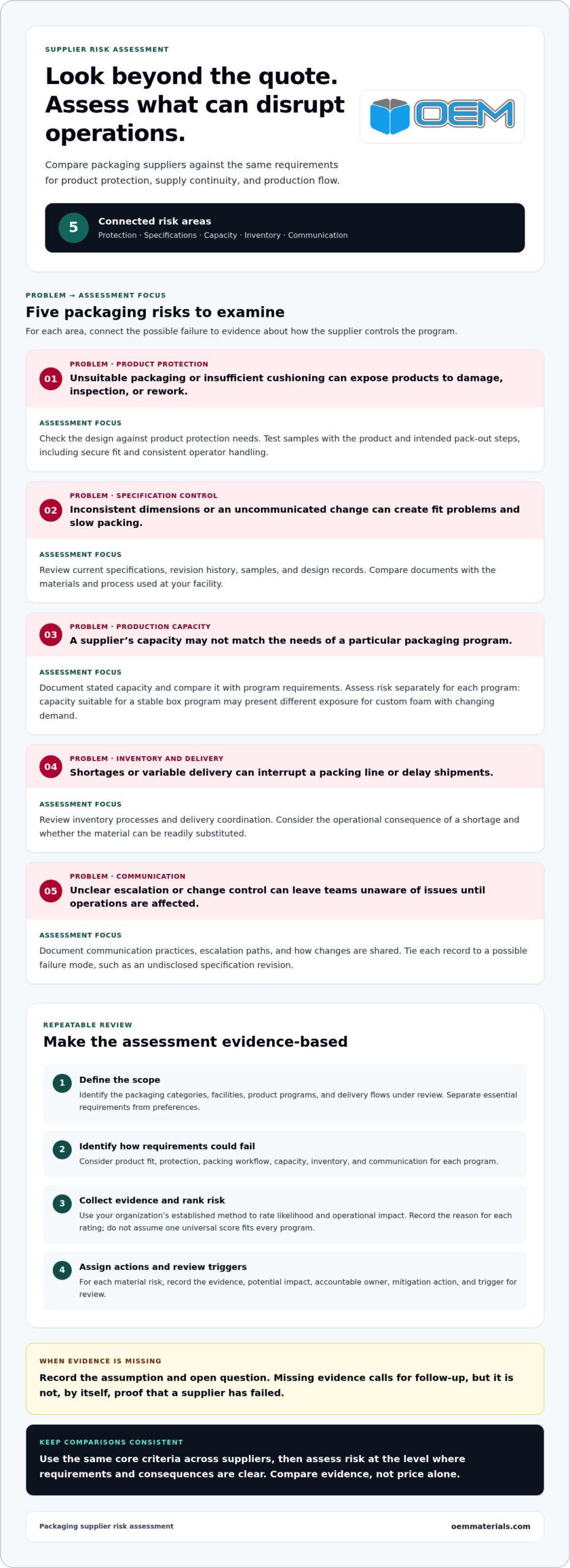
Assess risks across five connected areas: product protection, specification control, capacity, inventory, and communication. Each can create a different operational failure:
- Protection: Insufficient cushioning or an unsuitable package can expose products to damage, inspection, or rework.
- Specifications: Inconsistent dimensions can cause fit problems, slow packing, or prevent packaging from working with established processes.
- Capacity and inventory: Shortages or variable delivery can interrupt a packing line or delay shipments.
- Communication: Unclear escalation and change-control processes can leave teams unaware of a supply issue or packaging change until it affects operations.
Evaluate packaging design against both the product’s protection needs and the actual packing workflow. For example, foam packaging may need to hold a product securely while allowing operators to pack it consistently. Test fit and handling with the product and the intended pack-out steps, not just against a drawing.
How should teams set assessment boundaries?
Define the scope before collecting evidence. Identify the packaging categories, facilities, product programs, and delivery flows under review. A supplier’s risk for one packaging program may differ from its risk for another, so record assessments at the level where requirements and consequences are clear.
Separate essential requirements from preferences. Product fit, protection, and compatibility with the packing process may be essential; a convenience feature may be desirable but not critical. Include food or pharmaceutical criteria only when they apply to the product or customer requirements. Keep the assessment focused on secondary packaging supply and performance rather than expanding it into every upstream, product, or regulatory risk.
How to Build a Secondary Packaging Supplier Assessment Checklist
A useful checklist makes supplier reviews repeatable. For each packaging program, define the requirements, identify how they could fail, collect evidence, rank the risks, and assign actions. Procurement, engineering, and operations should use the same core criteria when comparing suppliers, while assessing risk separately for each program. A supplier’s capacity may suit a stable corrugated box program but pose a different level of risk for a custom foam insert with changing demand.
The Chartered Institute of Procurement & Supply outlines how to conduct a supplier risk assessment. Apply that structured approach to the packaging requirements and operating conditions that matter to your team.
What evidence should the assessment collect?
Review records that show how the supplier controls the packaging program, not just how it describes its capabilities. Evidence may include current specifications, revision history, samples, and packaging design records. Compare the documents with the materials and process used at your facility. A sample may fit the product but slow packing, revealing a workflow issue that a specification review alone would miss.
Also document the supplier’s stated capacity, delivery coordination, inventory processes, and communication practices. Include quality records or customer-specific requirements when they apply to the program. Tie each piece of evidence to a possible failure mode. For example, an uncommunicated specification change could create fit problems on the packing line.
How can procurement rank supplier risks consistently?
Use your organization’s established method to rate likelihood and operational impact. Don’t create a universal score or threshold for every packaging program. A delayed shipment of a readily substituted material may have a different consequence from a shortage that stops packing or leaves a product exposed. Record the reason for each rating so reviewers can see what drives the priority.
For each material risk, capture the evidence, potential impact, accountable owner, mitigation action, and review trigger. Triggers might include a specification revision, a change in demand, or a recurring delivery issue. If information is missing, record the assumption and open question. Missing evidence warrants follow-up, but it is not, by itself, proof that a supplier has failed.
Once the checklist is defined, teams can use it to review packaging programs, compare supplier evidence, and keep follow-up responsibilities visible. If you’re evaluating a packaging design or supply approach, share your packaging requirements as part of that review.
How to Compare Packaging Performance, Capacity, and Supply Continuity
Compare suppliers against the same product requirements, operating conditions, and evidence standards. A quote alone won’t show whether packaging protects the product during handling, fits the pack-out process, or can be supplied at the volume and cadence your program needs. In a secondary packaging supplier risk assessment, keep the comparison consistent, then record where risk differs by program.
Does the packaging solution fit the product and process?
Evaluate packaging with the actual product and pack-out steps in mind. Check how it fits, where protection is needed, how operators load and close it, and how it is handled before shipment. Corrugated boxes may suit one application, while foam, cushioning, or crates may be appropriate for others. Match the material to the product, shipping conditions, and workflow rather than treating one packaging format as a universal solution. For additional context, review this industrial corrugated box overview.
Include program scale in the comparison. A prototype or short run can reveal fit and handling issues. A high-volume program also tests whether production and replenishment processes can support ongoing demand. Record the evidence reviewed, such as samples, specifications, and observed pack-out steps, and note any differences between prototype performance and production requirements.
Can supply and inventory processes support production?
Review how each supplier coordinates deliveries, communicates replenishment needs, and provides inventory visibility for the specific program. Consider demand variability and how an interruption would affect production. Just-in-time packaging services may fit an operation with planned delivery flows. Vendor-managed inventory or an alternate packaging plan may also be considered as mitigation options, not as guaranteed protection from shortages.
Use a compact comparison table to keep findings actionable. Add evidence notes so each rating can be traced to a sample, document, process discussion, or unresolved question.
| Area | Compare | Evidence notes |
|---|---|---|
| Performance | Product fit, protection needs, and pack-out steps | Sample, specification, or packing observation |
| Capacity | Support for the program’s expected volume and production needs | Supplier capacity information and program assumptions |
| Continuity | Delivery coordination, replenishment, inventory visibility, and alternatives | Inventory process, delivery plan, and mitigation options |
| Communication | How changes, delays, and issues are escalated | Documented contacts, process, or open questions |
Use the same rows for each candidate, but assess them against the requirements of each packaging program. This preserves a fair comparison without masking differences in product risk, operating scale, or delivery flow.
How to Prioritize Risks and Create Practical Mitigation Actions
Not every supplier issue deserves the same response. Prioritize each material risk by its potential effect on product protection, production, and shipment. Then consider how easily the issue would be detected and whether a workable alternative exists. A packaging defect that could reach a customer or a shortage that could stop packing may require stronger controls than a readily detected issue with an established substitute.
In a secondary packaging supplier risk assessment, turn each high-priority finding into an action record. Name an accountable owner, define the mitigation, and specify what evidence will show the action is complete. For example, assign a risk tied to specification changes to an engineering owner. Approved revision records and documented change communication can serve as completion evidence.
Which controls can reduce packaging supply exposure?
Use approved specifications, sample validation, and revision control to keep packaging aligned with product and process requirements. Establish how proposed changes are communicated and reviewed before they affect production. For suitable programs, inventory planning or vendor-managed inventory support may clarify replenishment responsibility and inventory visibility. Treat these as controls to evaluate, not guarantees against disruption.
Consider alternate materials or packaging designs only after confirming they meet the required protection and packing needs. A substitute that is easier to source may still introduce product damage, packing delays, or other operational problems if it has not been evaluated for the application.
How can teams monitor risk after supplier selection?
Set review triggers around activity that could change the risk profile: a specification revision, delivery issue, demand shift, or new production program. Avoid imposing an arbitrary review schedule. Align review timing with your organization’s existing risk controls and the supplier’s activity for that packaging program.
Track indicators the team can act on, such as delivery performance, specification deviations, and issue-resolution status. Review trends with procurement, engineering, warehouse, and production stakeholders. A recurring delivery problem, for instance, should lead to a documented corrective action and a reassessment of continuity exposure, not just another entry in a tracking log.
Close the loop by recording the action owner, completion condition, and evidence. Then reassess the risk after the change or corrective action. For a program involving packaging design or supply continuity, review your packaging requirements as part of the planning process.
How to Select a Secondary Packaging Partner for Your Operation
The final decision should reflect how well each supplier supports your specific packaging program, not just whether it meets basic purchasing requirements. A qualified supplier can meet defined specifications. A suitable partner also fits the operation’s needs for product protection, engineering support, production scale, delivery coordination, and ongoing risk control.
Use the secondary packaging supplier risk assessment to compare each supplier’s evidence, unresolved risks, mitigation actions, and operational fit. Separate must-haves, such as packaging that protects the product and works with the pack-out process, from differentiators that may improve workflow or supply planning. A capability is valuable when it addresses a real need in the program.
What should a final supplier comparison show?
Bring the assessment into a concise decision record. Note where each supplier meets requirements, where evidence is incomplete, and what action would reduce any material risk. Consider engineering support alongside supply capability: packaging design should align protection requirements with packing steps, while delivery and inventory processes should suit the program’s demand and replenishment needs.
OEM Materials & Supplies supports manufacturers with packaging design, corrugated boxes, foam packaging, kitting, assembly, and inventory programs. Its work includes prototypes, short runs, and high-volume production programs. For manufacturers in Orange County, Los Angeles, Riverside, and San Diego, these capabilities can help shape packaging around product requirements and production workflows.
What information helps scope a packaging quote?
Clear project details help frame packaging requirements and operational constraints. Share the product’s dimensions and weight, annual usage, shipping conditions, current packaging concerns, and any known damage or inventory issues. Include the pack-out steps and delivery expectations so the proposed approach accounts for how materials are used and replenished.
You can start the discussion with the information already available. Samples, drawings, current specifications, or photos of the existing pack-out can help explain the application. Identify must-have protection and process requirements separately from preferred features. This gives the review a practical basis and focuses attention on the risks that matter most to the operation.
For a tailored quotation, send your packaging project details, including product dimensions, weight, annual usage, and shipping requirements. OEM Materials & Supplies can use that information to discuss packaging design, materials, and supply options suited to your program.
Make Supplier Risk Part of the Packaging Decision
A practical secondary packaging supplier risk assessment looks beyond price. It compares product protection, packaging specifications, production capacity, delivery and inventory processes, and communication using consistent criteria. It also turns identified risks into assigned actions with clear evidence and review triggers. This gives procurement, engineering, and operations a stronger basis for selecting a supplier that fits the program, not just the purchase order.
OEM Materials & Supplies supports manufacturers with custom packaging design, from prototypes through high-volume production programs. Capabilities include corrugated boxes, foam packaging, crates, kitting, assembly, vendor-managed inventory, and just-in-time services. The right approach depends on your product, packing workflow, and shipping requirements.
Ready to evaluate a packaging program or address a supply concern? Request a quote for your packaging program and include product dimensions, weight, annual usage, and shipping requirements. These details help frame a practical discussion about packaging fit and supply needs.
Frequently Asked Questions
What should a secondary packaging supplier risk assessment include?
A secondary packaging supplier risk assessment should cover packaging fit and protection, specification control, production capacity, delivery and inventory processes, communication, and issue response. For each finding, record the supporting evidence, potential operational impact, and action owner. Tailor the criteria to the product and production program. Include customer, facility, or sector-specific requirements only when they apply, rather than adding controls that have no bearing on the packaging application.
How do you assess the risk level of a packaging supplier?
Assess risk by defining requirements, identifying credible failure scenarios, and rating their likelihood and business impact using your organization’s established method. For example, consider a specification mismatch that affects product fit or a material shortage that could interrupt packing. Document available evidence, assumptions, and existing controls. Prioritize scenarios that could expose products or disrupt operations, then assign an owner and practical mitigation instead of relying on an unexplained score.
How often should packaging suppliers be reassessed?
Set reassessment timing according to your company’s risk process, supplier performance, and the packaging program’s operational importance. Review the supplier when new information changes the risk profile, such as a specification change, recurring delivery or quality issue, demand shift, or new production program. A planned calendar review can support oversight, but it should not replace an event-driven review when an issue requires timely action.
What documents help evaluate a secondary packaging supplier?
Useful records include current packaging specifications, drawings, sample approvals, revision history, delivery records, issue history, and relevant quality documentation. The right evidence depends on the product and customer requirements. Keep each record connected to the packaging program it supports. For manufacturers in Orange County, Los Angeles, San Diego, and Riverside, documenting facility-specific needs can also clarify whether packaging and delivery processes fit the operation.
How can a manufacturer reduce packaging supplier disruption risk?
Define packaging requirements clearly, control specification revisions, and establish communication expectations for changes and delivery issues. Review demand variability and replenishment processes so inventory needs are visible. Inventory planning or an alternate packaging approach may help address a specific exposure, but neither should be treated as automatic protection. Validate alternate materials or designs against product protection, shipping conditions, and packing steps before relying on them as a contingency.
Should packaging price be part of a supplier risk assessment?
Yes. Include price, but compare it alongside packaging performance, supply reliability, packing labor, and inventory impact. Use the same scope and assumptions for each supplier, including product dimensions, materials, and shipping requirements. A lower material quote may not mean a lower overall operational cost if a packaging change increases packing time, product damage exposure, or replenishment demands. Evaluate those factors for the specific program rather than assuming savings.