
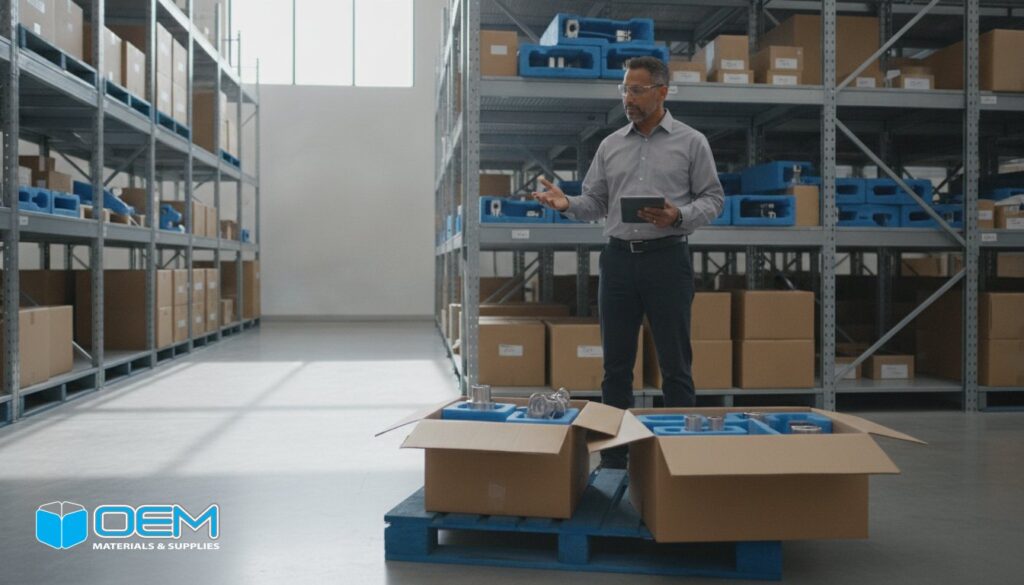
A packaging audit is not about finding cheaper boxes; it’s about eliminating the total cost of friction across your entire supply chain. While many procurement teams focus on the unit price of corrugated or foam, the real expenses often hide in high product damage rates, excessive material waste, and the rising labor costs associated with manual kitting and assembly. Implementing vendor managed inventory for packaging is one way to mitigate these issues, yet many OEMs overlook the broader systemic inefficiencies. You likely recognize that current market volatility, including a 10.4% increase in paper costs over the last year, makes operational efficiency more critical than ever.
This guide provides a professional framework to identify hidden inefficiencies and reduce your total cost of ownership through technical optimization. We will provide a comprehensive checklist to evaluate your current specifications and warehouse workflows. This article outlines a clear roadmap to achieve zero shipping damage and better supplier reliability through a structured, data-driven audit of your industrial packaging requirements. By focusing on durability and accuracy, you can transform your packaging from a commodity expense into a strategic operational advantage.
Key Takeaways
- Establish clear performance metrics to identify where packaging material waste and product damage are impacting your total cost of ownership.
- Optimize material specifications by right-sizing corrugated boxes and selecting appropriate foam densities to reduce freight expenses and improve protection.
- Learn how to eliminate inventory stockouts and reclaim valuable warehouse floor space through vendor managed inventory for packaging.
- Audit specialized requirements for high-stakes sectors like aerospace and medical devices to ensure compliance with shipping standards and ESD protection.
- Transition from audit data to functional results by prioritizing high-ROI improvements and validating new designs with rapid prototyping.
The Strategic Framework of a Packaging Supply Chain Audit
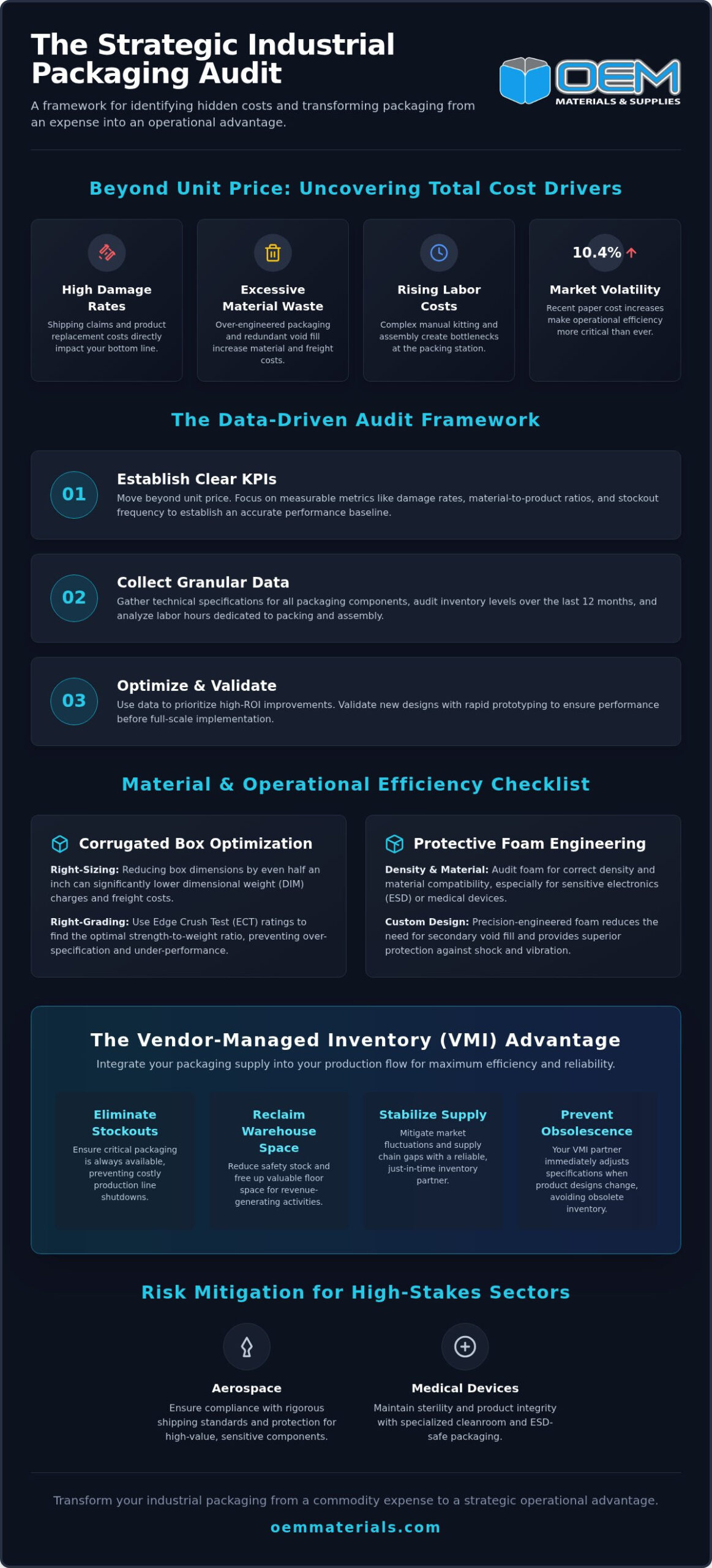
An industrial packaging audit is more than a cursory review of supplier invoices. It is a systematic evaluation of every material specification and operational workflow within your distribution cycle. To drive actual results, you must establish clear Key Performance Indicators (KPIs) that move beyond simple unit pricing. Focus on damage rates and material-to-product ratios to determine if your current corrugated boxes are over-engineered or insufficient for the application. High-volume manufacturing programs require this audit at least once per year to account for shifts in freight standards or the 10.4% increase in paper costs seen in 2026. This process requires a cross-functional team, including procurement, engineering, and warehouse operations, to ensure that cost-saving measures don’t compromise product integrity.
Setting Audit Objectives and Scope
Before collecting data, define whether the primary objective is total cost reduction or damage mitigation. While these goals often overlap, the technical remedy for each varies significantly. A thorough audit maps the entire journey of a component from the manufacturing floor to the end user. You must evaluate the primary container along with secondary and tertiary layers, such as custom foam packaging, edge protectors, and stretch film. This comprehensive scope prevents logistical friction where saving on material thickness leads to a spike in shipping claims. By identifying the specific hazards of your transit loop, you can refine your packaging to meet the exact demands of the environment.
Data Collection for Accurate Benchmarking
Accurate benchmarking relies on granular data rather than anecdotal evidence. Start by gathering current technical specifications for all corrugated and foam components. You should audit inventory levels and stockout frequency over the previous 12 months to identify supply chain gaps. This is where vendor-managed inventory (VMI) becomes a critical benchmark for operational health. If your facility in Orange County or Los Angeles frequently experiences shortages or carries excessive safety stock, implementing vendor managed inventory for packaging can stabilize these fluctuations and reclaim warehouse floor space. Finally, analyze the labor hours dedicated to manual kitting and assembly. Understanding the time spent at the packing station allows you to identify bottlenecks that are often more expensive than the packaging materials themselves.
Material Efficiency Checklist: Corrugated and Protective Inserts
Auditing physical materials is the most direct path to reducing operational costs. Many OEMs rely on legacy packaging designs that haven’t been updated to reflect current material pricing or modern shipping standards, such as the 2026 ISTA updates. This checklist focuses on right-sizing and material substitution to ensure your protection levels are accurate without being excessive. By evaluating the interaction between your outer container and internal cushioning, you can eliminate redundant layers that drive up both material and freight expenses.
Optimizing Corrugated Specifications
Start by reviewing your box dimensions. Even a half-inch reduction in a single dimension can significantly lower dimensional weight (DIM) charges, especially for high-volume air or ground freight moving through Southern California distribution hubs in Orange County or San Diego. You should also evaluate board grades. Over-specified containers add unnecessary weight and cost, while under-specified boxes fail during palletization. Compare corrugated boxes using Edge Crush Test (ECT) ratings to find the optimal strength-to-weight ratio for your specific load. Implementing vendor managed inventory for packaging allows for continuous monitoring of these specifications. If a product design changes, your VMI partner can immediately adjust the corrugated requirements to prevent obsolete inventory. Custom die-cut designs often provide a tighter fit than standard RSCs, which reduces the need for secondary void fill and lowers labor costs during assembly.
Engineering Protective Foam Solutions
Protective inserts must be audited for both density and material compatibility. For sensitive electronics or medical devices, the wrong foam can cause surface abrasion or static discharge. Compare polyethylene (PE) and polyurethane (PU) foam based on the fragility of your product. Polyethylene is a closed-cell material that provides excellent cushioning for heavier industrial parts; polyurethane is an open-cell foam ideal for delicate items needing a softer interface. Determining if engineered foam can replace bulkier cushioning materials like loose-fill or crumpled paper can streamline your packing station and reduce the total footprint of your shipping container. For a deeper dive into material properties, consult this guide on foam inserts. If you need to validate a new design for a specialized application, you can request a quote for a custom prototype to test performance before moving to high-volume production.
Evaluating Operational Inefficiencies in Assembly and Logistics
An industrial packaging audit must extend beyond the material specifications to evaluate how those components interact with your labor force and facility footprint. Bottlenecks often occur at the packing and kitting stations, where manual processes slow down the entire manufacturing line. You should analyze the footprint of your packaging inventory on the warehouse floor, as bulky corrugated and foam components often displace revenue-generating production equipment. Reviewing your palletization methods is also essential. Inefficient stretch wrapping or poor pallet configurations lead to instability and increased shipping costs. Finally, evaluate your supply chain logistics; frequent small-parcel deliveries of packaging supplies are significantly more expensive than consolidated LTL shipments.
Streamlining Kitting and Assembly Workflows
Calculating the internal labor costs for complex packaging kits is a critical audit step. Many OEMs find that their skilled manufacturing staff spends too much time on non-core activities like folding boxes or inserting foam. If your assembly process involves multiple components, evaluate whether pre-assembled packaging kits could reduce your manufacturing lead times. By receiving kits that are ready for immediate use, you eliminate several manual steps and ensure consistency across every shipment. This approach is particularly effective for high-precision sectors like aerospace and medical devices where assembly accuracy is paramount. Outsourcing these labor-intensive tasks to a specialized partner allows your team to focus on core manufacturing operations.
Inventory Management and VMI Programs
Managing multiple packaging vendors creates hidden administrative costs and increases the risk of inventory stockouts. A comprehensive audit often reveals that purchasing and warehouse teams spend excessive time tracking orders and managing safety stock levels. Transitioning to a Vendor Managed Inventory (VMI) program addresses these inefficiencies by shifting inventory oversight to a specialized partner. Implementing vendor managed inventory for packaging ensures that stock levels are automatically maintained based on your actual usage data. For manufacturers in Southern California, utilizing just-in-time delivery from a local partner in Orange County or the Inland Empire can free up critical warehouse space and improve cash flow by reducing on-hand inventory levels. This shift from reactive ordering to a proactive, managed system is a primary outcome of a successful supply chain audit.
Risk Mitigation for Aerospace and Medical Device Sectors
Aerospace and medical device manufacturers operate under rigorous regulatory frameworks that leave no margin for error. An audit in these sectors must prioritize compliance with sector-specific shipping standards to prevent costly rejections or safety failures. For electronics, evaluating Electrostatic Discharge (ESD) protection is mandatory. Sensitive components require specialized shielding to prevent latent damage during transit. In the medical field, maintaining sterile barrier integrity is the primary concern for container design. If the packaging fails, the product is compromised. Implementing vendor managed inventory for packaging ensures that these highly specialized materials are always in stock, preventing production halts due to the long lead times often associated with custom-engineered solutions.
Compliance for High-Stakes Industries
Regulatory compliance starts with the materials themselves. For aerospace exports, you must ensure all wood crates meet ISPM-15 heat treatment requirements. Non-compliant wood can lead to international shipment seizures and significant fines. Medical device packaging requires rigorous validation protocols to confirm that the materials can withstand sterilization processes and maintain a barrier over time. Additionally, verify that your thermal transfer ribbons and labels are compatible with the specific surface of your corrugated or plastic containers. Poor adhesion can lead to tracking failures in the supply chain, which is a major risk for industries requiring full lot traceability.
Southern California Logistical Considerations
Logistical risks in Southern California are unique due to the density of the Los Angeles and Long Beach port complexes. Port congestion and local traffic patterns across the Inland Empire and Orange County can fluctuate wildly, impacting Just-In-Time (JIT) delivery schedules. Proximity to your supplier is a critical factor in risk mitigation. Evaluating the location of your packaging partner relative to San Diego and Los Angeles hubs helps determine if they can respond quickly to sudden demand spikes. Utilizing local warehousing for high-volume items like plastic pallets and stretch film reduces freight costs and provides a buffer against regional transit delays. By integrating vendor managed inventory for packaging into your local supply chain, you shift the burden of logistical monitoring to a partner capable of navigating these regional challenges. If you need a partner that understands these technical requirements, you can request a quote for specialized packaging designed for high-stakes environments.
Executing Audit Findings: From Data to Distribution
Collecting data is only the first phase. The value of a packaging supply chain audit lies in your ability to convert findings into functional improvements. Start by prioritizing your findings based on potential ROI and the ease of implementation. High-impact changes, such as right-sizing corrugated boxes or consolidating vendors, often provide immediate cost relief. Establishing a baseline from this initial audit allows you to track progress during future annual reviews. This structured approach ensures that efficiency gains are permanent rather than temporary fixes. By focusing on the most critical inefficiencies first, you can fund more complex engineering changes through the savings realized in the initial stages of execution.
Prototyping and Validation Testing
Validating new material configurations is essential before a full-scale rollout. Use rapid prototyping to test new corrugated or foam designs. This phase allows you to identify potential failure points in a controlled environment without risking actual product shipments. For high-value industrial goods, conduct drop tests and vibration testing to ensure the new specifications meet or exceed your protection requirements. Consulting with a custom packaging design team provides the engineering support necessary to balance material reduction with structural integrity. Validation testing is particularly critical for OEMs in the aerospace and electronics sectors, where a single failure can lead to significant financial loss. Once a prototype is validated, it serves as the new standard for your production line, ensuring consistency across every unit shipped from your facility.
Supplier Consolidation and Partnership
Managing a fragmented supplier base often leads to communication breakdowns and inconsistent quality. Consolidation allows you to leverage your total spend for better service and technical support. Identify partners who act as consultants rather than commodity resellers. A partner that offers wholesale industrial packaging supplies can often manage everything from stretch film to custom wood crates. Integrating vendor managed inventory for packaging during this consolidation phase further streamlines your operations. By allowing a single, reliable partner to monitor stock levels and deliver JIT to your facility in Los Angeles, Riverside, or Orange County, you reduce administrative overhead and eliminate the risk of stockouts. This partnership approach transforms your packaging from a series of individual purchases into a cohesive, optimized system. Moving from a vendor-client relationship to a strategic partnership ensures that your packaging supply chain remains resilient against market fluctuations and logistical challenges in the Inland Empire and beyond.
Optimizing Your Packaging Supply Chain for Long-Term Efficiency
A thorough packaging supply chain audit is the most effective way to identify the hidden costs eroding your operational margins. By evaluating your material specifications and warehouse workflows, you can eliminate excessive waste and significantly reduce product damage rates. Transitioning toward strategic solutions like vendor managed inventory for packaging provides a sustainable remedy for inventory stockouts and reclaimed floor space; it allows your team to focus on core manufacturing objectives. These systematic improvements ensure that your packaging remains an asset rather than a logistical burden.
OEM Materials & Supplies serves manufacturers across Los Angeles, Orange County, and San Diego as a specialist in custom industrial packaging. We provide technical expertise in custom foam design, corrugated optimization, and value-added kitting services to streamline your distribution. To begin refining your process and lowering your total cost of ownership, Request a Packaging Audit Consultation today. Providing specific data such as product dimensions, weight, and annual usage will help us develop accurate recommendations tailored to your facility. We look forward to helping you build a more resilient and cost-effective supply chain.
Frequently Asked Questions
What is the primary goal of a packaging supply chain audit?
The primary goal of a packaging supply chain audit is to identify hidden systemic costs that exceed simple material pricing. By evaluating both physical packaging and labor-intensive workflows, you can eliminate waste and improve product protection. This process identifies where over-engineered corrugated or insufficient cushioning impacts your bottom line. It transforms packaging from a commodity expense into a strategic advantage for manufacturers operating throughout Los Angeles and Orange County.
How often should a manufacturer conduct a packaging audit?
Manufacturers should conduct a packaging audit at least once per year to remain competitive and efficient. High-volume production programs often require more frequent reviews to account for fluctuating material costs, such as the 10.4% increase in paper prices seen in 2026. Regular audits help you stay aligned with updated ISTA testing standards and ensure your specifications haven’t drifted from the original engineering requirements during demanding production cycles in San Diego or Riverside.
Can a packaging audit help reduce shipping damage?
A technical audit directly reduces shipping damage by aligning material specifications with real-world distribution hazards. By analyzing damage logs and conducting validation testing, you can determine if current custom foam inserts or corrugated grades provide adequate shock absorption. This data-driven approach allows for precise adjustments that protect sensitive components in the aerospace and electronics sectors. It ensures zero damage during transit through the complex logistical hubs of Southern California.
What data do I need to prepare for a successful audit?
Preparation requires granular data including product dimensions, weight, and annual usage for every SKU in your inventory. You should also gather current material specifications, damage reports from the previous 12 months, and an analysis of labor hours spent on manual kitting and assembly. Providing this information to an industrial partner in the Inland Empire allows for a more accurate assessment of where your current supply chain is losing efficiency.
How does right-sizing packaging materials save money?
Right-sizing saves money by eliminating unnecessary material use and lowering dimensional weight (DIM) charges during transit. When you reduce the footprint of a shipping container, you lower freight costs and increase the number of units that fit on a single plastic pallet. This optimization reduces the total volume of materials purchased and lessens the storage space required in your warehouse. It provides immediate relief to operational overhead for manufacturers in Los Angeles and San Diego.
What are the benefits of including VMI in an audit plan?
Integrating vendor managed inventory for packaging into your audit plan automates replenishment and stabilizes stock levels based on real usage data. This service eliminates the administrative burden of tracking multiple vendors and prevents costly inventory stockouts. For OEMs in Southern California, a VMI program reclaims valuable floor space by shifting inventory management to a local partner. This ensures that essential supplies like stretch film and edge protectors are delivered just-in-time for your production line.
Does a packaging audit address regulatory compliance?
Yes, a professional audit ensures your packaging meets rigorous industry and international standards. This includes verifying that wood crates meet ISPM-15 heat treatment requirements for export and that medical device packaging maintains sterile barrier integrity. For electronics, the audit evaluates ESD protection to prevent latent damage. These compliance checks are essential for mitigating legal risks and preventing shipment rejections at major ports in Los Angeles and Long Beach, protecting your brand’s reputation and bottom line.
How long does a typical industrial packaging audit take?
The duration of an industrial packaging audit typically ranges from two to four weeks depending on the complexity of your product line. This timeframe includes the initial data collection, on-site workflow observation, material testing, and the final presentation of findings. For manufacturers requiring rapid prototyping or custom foam configurations, the process allows for validation testing to ensure the new designs meet all engineering requirements before full-scale implementation across your distribution network.